

Your SEO rankings are solid. Your content calendar is full. Your domain authority keeps climbing. Then someone uses an AI agent to research tools in your category, and it comes back with a shortlist of three brands. Yours isn’t one of them.
That’s not a fluke. It’s a structural problem, and it’s happening to 96% of B2B companies right now.
AI Used to Surface Answers. Now Agentic AI Makes Decisions.
There’s a meaningful difference between the AI search tools that appeared between 2022 and 2024 and what’s running today.
The earlier wave was still fundamentally reactive. You asked a question; the AI summarized the web and handed you an answer. A human still clicked, compared, and decided.
Agentic AI operates on a different logic entirely. These systems don’t just retrieve. They plan, reason across steps, and act. Ask an agentic AI to “find the best CRM for a 50-person SaaS company,” and it won’t return a list of links. It’ll analyze your existing tech stack, compare pricing tiers across platforms, and in some cases initiate procurement flows. McKinsey estimates that agentic AI will come to power as much as two-thirds of current marketing activities. Gartner predicts that by 2028, 60% of brands will use these systems to deliver one-to-one interactions at scale.
The human is increasingly at the end of the process, not the middle.
Most Brands Are Invisible to AI Agents Without Knowing It
Here’s the uncomfortable data point: only 4.3% of companies maintain a healthy discovery profile in agentic AI. The other 95.7% appear primarily when a buyer already knows their name. At the early “category exploration” stage, the stage where shortlists get built, they’re effectively absent.
Research from the 2X AI Innovation Lab in 2026 calls this the “inverted discovery funnel.” Brands are visible at the bottom, when someone is already searching for them by name, but invisible at the top, when an agent is deciding who even makes the list.
This isn’t a ranking problem in the traditional sense. It’s a statistical existence problem.
When an AI agent researches a category, it pulls from training data, real-time retrieval pools, and high-authority citations. If your brand doesn’t appear in those specific layers with sufficient frequency, the agent doesn’t downrank you. It simply doesn’t register you as an entity worth including.
The Three Signals Agentic AI Uses to Judge Your Brand
AI agents don’t evaluate brands the way humans do. There’s no intuition, no brand affinity built over years. Instead, they run probabilistic assessments based on three core signals.
Visibility is about statistical density. LLMs are trained on patterns. Brands that appear frequently in high-quality data, reputable news outlets, industry journals, community forums like Reddit, develop a high co-occurrence probability with specific topic categories. The association between “sustainable outdoor gear” and Patagonia, for example, is so deeply embedded in training data that it functions as a near-automatic recommendation for sustainability queries. If your brand has thin coverage in these pools, the math works against you.
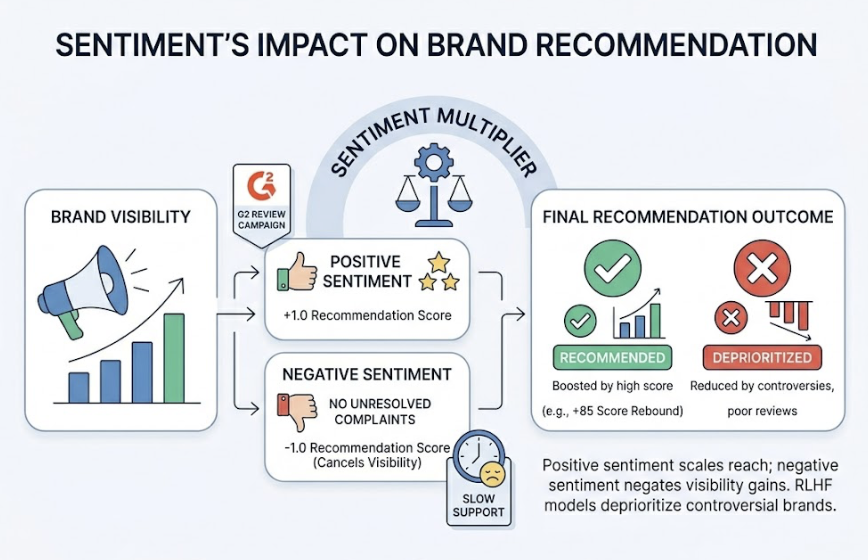
Sentiment determines whether visibility translates to a positive mention. AI systems trained with Reinforcement Learning from Human Feedback deprioritize brands associated with controversy, poor reviews, or unresolved complaints. Advanced tracking now uses a “Sentiment Multiplier” framework: a positive recommendation scores 1.0 while a negative mention scores -1.0, essentially canceling out any visibility gains. One consumer fintech brand reversed near-zero sentiment by running a focused G2 review campaign, correcting an outdated “slow support” narrative. Within four weeks, their sentiment score rebounded to +85.
Source credibility is where many brands fail silently. AI systems weight “digital consensus,” meaning information confirmed across multiple authoritative sources like Wikipedia, established editorial publications, and university-affiliated sites. If your brand exists primarily in your own content and a handful of low-authority directories, AI agents treat that as weak evidence. Research shows that content with external citations improves AI visibility by up to 115.1% compared to uncited content.
Why Your SEO Playbook Doesn’t Work for Agentic AI
Traditional SEO was built around one goal: earn the click. Higher rankings, better CTR, more traffic to your page. The signals it optimized for, domain authority, keyword density, backlink profiles, were designed for search engines run by algorithms that returned lists.
Agentic AI doesn’t return lists. It returns conclusions.
The Princeton/Georgia Tech study on Generative Engine Optimization found that keyword density tactics, the backbone of traditional SEO, are among the least effective approaches for generative engines. They can actively decrease AI visibility. What works instead: quantitative data points (+37-40% citation rate), external citations from credible sources (+115.1% for mid-ranked pages), expert quotations, and “answer-first” architecture where the core fact appears within the first 40-60 words.
Roughly 93% of AI search sessions now end without a click to a third-party website. When AI overviews appear in Google, click-through rates to the top organic result drop by as much as 58%. Being ranked #1 in traditional search while invisible in agentic AI is no longer a sustainable position.
What Brands Getting It Right Are Doing Differently
The brands building durable AI visibility aren’t just producing more content. They’re treating content as infrastructure for machine extraction, not just human reading.
Several specific behaviors separate them from the majority.
They write in “autonomous extractable blocks”: FAQ pages where each answer is 40-80 words and contains a specific data point, comparison tables formatted for clean machine parsing, and ungated technical documentation that AI retrieval engines can ingest directly.
They invest in earned media specifically to create digital consensus. A mention in a Forbes article, a Wikipedia entry, or a citation in an industry journal doesn’t just drive human traffic. It registers as a high-trust data point that influences how AI agents describe your brand.
They track sentiment velocity, not just sentiment score. The direction sentiment is moving is often a better leading indicator of future AI recommendations than a static snapshot. A brand that was at +60 three months ago and is now at +45 has a different problem than a brand that’s been stable at +45 for a year.
Only 11% of domains are cited by both ChatGPT and Perplexity for the same queries. That fragmentation matters. Perplexity prioritizes content updated within the last 30 days, with an 82% higher citation rate for fresh content. ChatGPT overlaps heavily with top Google results. Gemini pulls from its entity Knowledge Graph. A multi-platform presence requires understanding that these are genuinely different systems with different citation logic.
You Can’t Optimize What You Can’t See
The core problem for most brands isn’t that they’re doing the wrong things. It’s that they have no visibility into what agentic AI is actually saying about them right now.
A brand might rank #1 on Google while being absent from every AI-generated shortlist shaping their buyer’s journey. Without measurement, there’s no way to know.
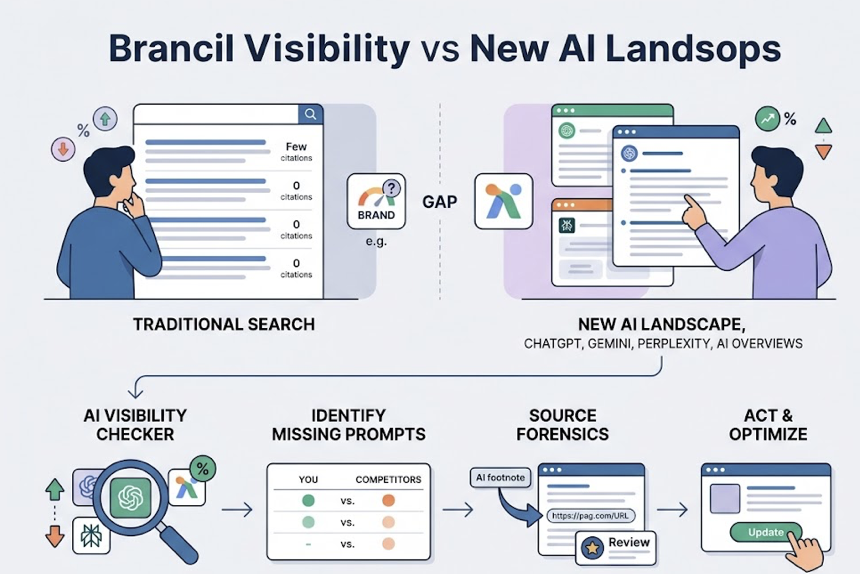
This is the gap that Topify was built to close. Its AI Visibility Checker measures brand mention frequency per 1,000 relevant queries across ChatGPT, Gemini, Perplexity, and AI Overviews, identifying the specific prompts where competitors appear and you don’t. The Source Forensics feature reverse-engineers AI footnotes to find the exact URLs influencing each answer, so if an AI is citing a five-year-old negative review to describe your brand, you can identify it and act.
Topify’s Sentiment Velocity tracking helped one fintech brand discover that Claude was fixating on a 2022 security incident in every relevant response. By systematically flooding the context with updated, accurate “safety consensus” data, they moved their sentiment score from 35 to 85 in a matter of weeks, reducing customer acquisition costs by 18%. A skincare brand used the platform’s visibility gap detection to move from 10% to 70% domestic AI visibility within a single month.
The common thread: specific, actionable data made the difference. Not guesswork.
The Window to Act Is Narrowing
The dynamics of agentic AI adoption bear a striking resemblance to early SEO in 2010. Entry costs are relatively low. The competitive advantage of moving first is exceptionally high. And as the training data of future models continues to reflect today’s digital consensus, the brands establishing AI authority now are building a position that becomes increasingly expensive to displace.
AI search visitors convert at 15.9% from ChatGPT referrals and 10.5% from Perplexity, compared to roughly 1.7% for standard Google organic traffic. Companies with dedicated GEO strategies in 2024 saw 3.4x more traffic and 27% higher conversion rates than those who delayed. The GEO market is projected to grow from $848 million to $33.7 billion by 2034.
54% of US marketers plan to implement GEO within the next three to six months. The window is open now, but it won’t stay open indefinitely.
Conclusion
Agentic AI hasn’t just changed how people search. It’s changed who makes the decision.
The buyer’s shortlist is increasingly assembled by an AI agent before a human ever gets involved. That means a brand’s primary challenge in 2026 isn’t ranking higher on Google. It’s becoming statistically visible to the systems making the first cut.
The invisibility problem is real, but it’s measurable and solvable. Understanding what agentic AI says about your brand today, and why, is the prerequisite for everything else. Get started with Topify to see where you stand.
FAQ
Q: What is agentic AI in simple terms?
A: Agentic AI refers to AI systems that can plan, take multiple steps, and execute tasks autonomously rather than simply answering a single question. Unlike a standard chatbot that summarizes information, an agentic AI might research options, compare them across criteria, and deliver a finalized recommendation, or even trigger actions like scheduling or purchasing, without additional human input at each step.
Q: How is agentic AI different from ChatGPT or Google AI Overviews?
A: ChatGPT in its standard form answers questions based on training data and optional browsing. Google AI Overviews synthesize search results into a summary. Agentic AI goes further: it can operate across multiple tools and systems, maintain context across a sequence of actions, and complete goal-oriented workflows. Think of the difference between a search engine that answers and an assistant that acts.
Q: Does agentic AI affect small brands and startups too?
A: Yes, and often more severely. Large enterprise brands typically have decades of media coverage and third-party citations that create strong entity authority in AI training data. Smaller brands with thinner digital footprints are more likely to fall into the “statistical existence” gap, being entirely absent from agentic AI recommendations even in categories where they compete directly.
Q: How do I know if my brand is visible to AI agents?
A: The most direct method is to run structured brand queries across ChatGPT, Perplexity, Gemini, and Claude using category-level prompts, not your brand name. If your brand doesn’t appear in responses to broad questions like “What are the best tools for X?” you have a visibility gap. Platforms like Topify automate this process at scale, tracking mention frequency, sentiment, and source attribution across platforms so you get a complete picture rather than spot-checking manually.

