

Your brand ranks #1 on Google. But when someone asks ChatGPT to recommend a solution in your category, your name doesn’t appear once.
That’s not a ranking problem. That’s a GEO problem.
Generative engine optimization (GEO) is the discipline of making your brand visible, citable, and recommended by AI systems. It’s different from SEO in almost everymeaningful way, and most brands haven’t caught up yet.
Here’s what you need to know.
GEO vs. SEO: Why Your Google Ranking No Longer Guarantees Visibility
Traditional SEO is a ranking game. You optimize for keywords, earn backlinks, and compete for position one on a list of ten blue links.
Generative engine optimization is a citation game. AI engines like ChatGPT, Gemini, and Perplexity don’t serve lists. They synthesize answers directly, pulling from sources they deem credible, structured, and verifiable. Your presence in that answer is the new definition of visibility.
The gap between the two is larger than most people expect. Only 12% of AI-cited links rank in Google’s top 10 for the same query. More striking: 80% of AI citations don’t rank anywhere in Google for the original search term. That’s not a small discrepancy. That’s a different game with different rules.
AI-powered search now represents 30% of all digital interactions,
and traditional organic click-through rates have dropped 61% on queries where AI Overviews appear. The traffic volume is shifting. The brands that adapt early will own the new visibility layer. The ones that don’t will become invisible to AI-referred audiences — which happen to convert at 4.4x the rate of traditional organic visitors.
What Generative Engine Optimization Actually Means
GEO is the process of structuring and calibrating your digital content so that AI engines select it as a source when generating answers.
The technical mechanism behind this is Retrieval-Augmented Generation (RAG). When a user submits a query to ChatGPT or Perplexity, the system doesn’t just rely on its training data. It runs a four-stage process: it reformulates your query into multiple search variations, retrieves a pool of relevant documents, extracts key facts from each, and synthesizes those facts into a unified response with inline citations.
Your content’s job is to survive that retrieval and extraction process.
To do that, it needs to be what researchers call “referenceable” — fact-dense, well-structured, and consistent with what AI models already understand about your brand. Researchers from Princeton University, Georgia Tech, and the Allen Institute for AI formalized this framework at KDD 2024, establishing GEO as a measurable optimization discipline with quantifiable outcomes.
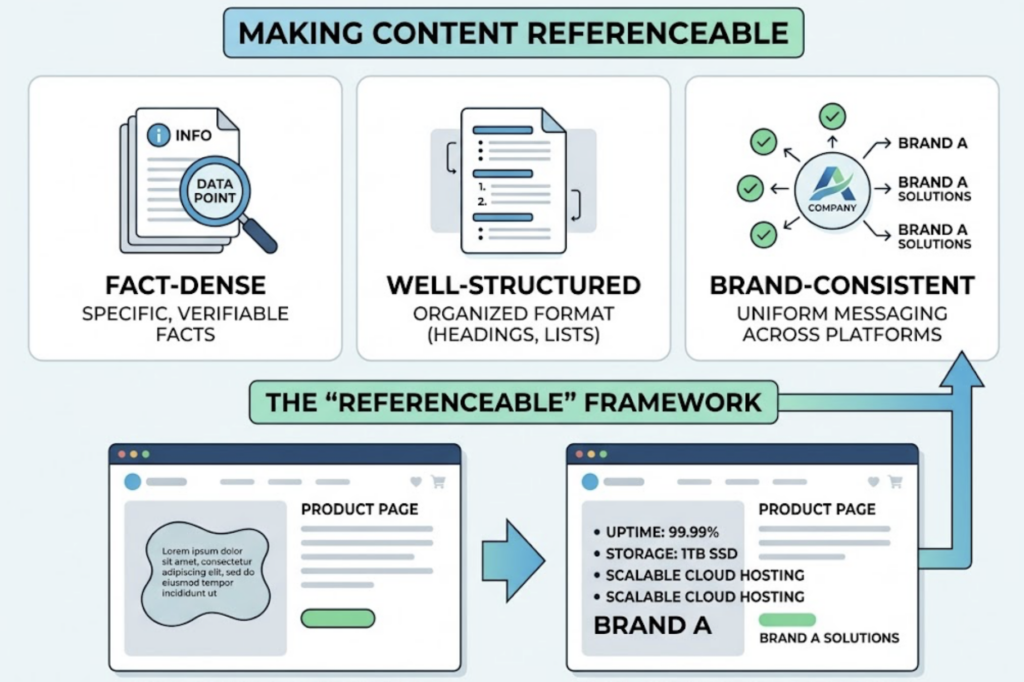
That’s the shift. SEO optimized for algorithms that ranked pages. GEO optimizes for systems that synthesize information.
5 Signals That Determine Whether AI Engines Recommend Your Brand
Not all content is equally citable. Based on the Princeton GEO benchmark study across 10,000 queries, five signals have the most consistent impact on AI citation rates.
1. Statistical density. Content that includes specific, verifiable numbers sees 40-41% higher visibility in generative engine
responses. AI systems prioritize facts they can confidently attribute. If your content makes claims without data, the AI will find a source that doesn’t.
2. Citation breadth. Citing other credible sources within your own content increases your citability by up to 40%. This signals to the retrieval system that your content is grounded in consensus, not
isolated opinion.
3. Semantic chunk structure. RAG systems favor content organized into standalone sections of 120-180 words, each answering a specific question directly. Pages structured this way show a 70% higher citation rate than pages with undifferentiated long-form prose.
4. Topical depth. AI engines generate their own “fan-out queries” — variations of the original search — to build comprehensive answers. Pages that rank for these fan-out variations are 161% more likely to
appear in the final AI response. Shallow coverage of a topic gets filtered out.
5. Off-site entity consistency. LLMs don’t learn about brands from a single page. They learn from Reddit discussions, Wikipedia mentions, press coverage, and industry databases. If your brand has a weak footprint on third-party platforms, the AI model has low confidence in your authority — regardless of your domain authority
on paper.
These five signals explain why strong SEO and weak GEO can coexist in the same brand.
The 6-Step GEO Strategy Most Teams Don’t Finish
Most brands start GEO with good intentions and stall after step two. Here’s the full cycle.
Step 1: Prompt research. Identify the 20-50 “golden prompts” most relevant to your category — the queries your target audience is actually asking AI engines. This isn’t keyword research. It’s intent mapping at the AI interaction layer. Tools like Topify continuously surface high-volume AI prompts as search behavior evolves, including queries you wouldn’t think to search for manually.
Step 2: Competitive citation analysis. Find out which brands AI engines currently cite for your target prompts — and, critically, which sources those brands are drawing from. This reveals the content gaps and third-party platforms you need to penetrate.
Step 3: Content restructuring. Update existing pages and create new content using the semantic chunk format. Lead with direct answers. Include statistics. Use logical H2/H3 hierarchies. Implement schema markup. Research shows that pages with three or more schema types have a 13% higher likelihood
of being cited by AI engines.
Step 4: Off-site distribution. Publish on platforms AI models weight heavily: industry publications, Reddit communities, PR outlets, and niche databases. Every credible off-site mention strengthens your brand’s “entity clarity” in the model’s knowledge base.
Step 5: Track AI visibility. Monitor your brand’s citation frequency, sentiment, and position across ChatGPT, Gemini, Perplexity, and other major AI platforms. This is where most teams hit a wall without the right tooling — manual tracking across multiple platforms isn’t sustainable at scale.
Step 6: Iterate in 30-day cycles. GEO responds faster than SEO. The expected ROI timeline is three to six months, versus the six to twelve months typically required for traditional SEO to show movement.
Update content based on what’s being cited, what’s not, and where competitors are gaining ground.
The brands that execute all six steps consistently are the ones showing up in AI answers a quarter from now.
How to Measure Generative Engine Optimization Performance
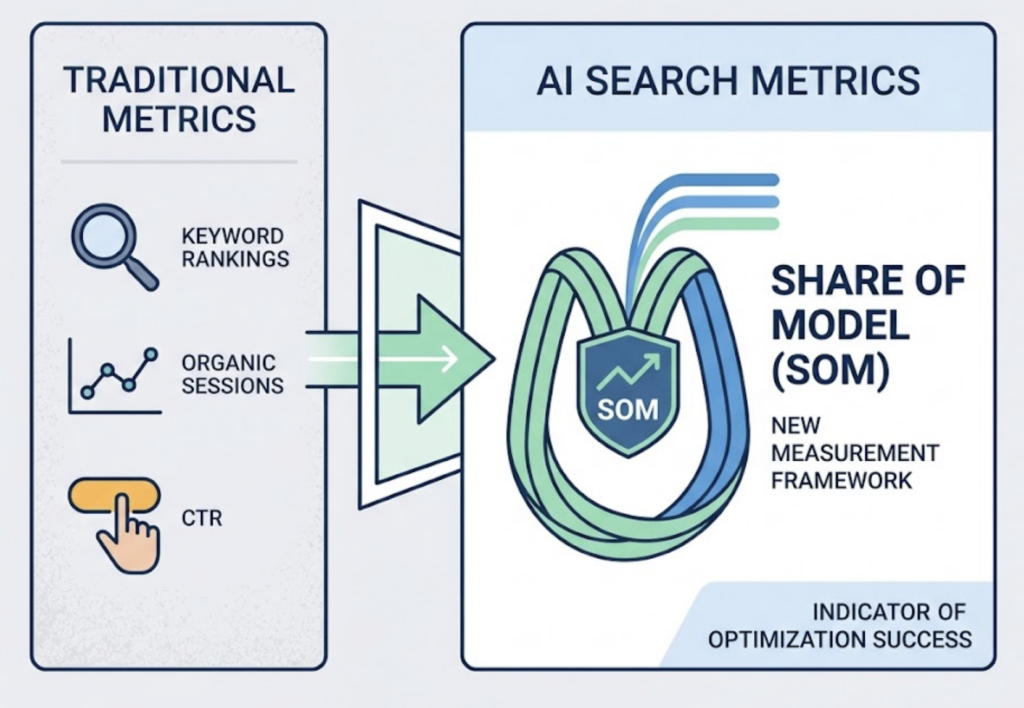
Traditional metrics — keyword rankings, organic sessions, CTR — don’t capture GEO performance. You need a different measurement framework.
The foundational metric is Share of Model (SoM): how often your brand appears in AI responses for your category prompts, relative to competitors. It’s the GEO equivalent of share of voice, and it’s the clearest indicator of whether your optimization efforts are working.
Beyond SoM, a complete GEO measurement framework tracks seven dimensions:
| Metric | What It Measures | Why It Matters |
|---|---|---|
| Visibility | How often your brand appears in AI answers | Core GEO health metric |
| Sentiment | How AI frames your brand (positive/neutral/negative) | Monitors reputation and hallucination risk |
| Position | Where your brand appears relative to competitors | Indicates recommendation priority |
| Volume | How many users are asking your target prompts | Sizes the opportunity |
| Mentions | Frequency of brand references across prompts | Tracks awareness in AI responses |
| Intent | Whether the prompt context is aligned with your offer | Ensures relevant visibility |
| CVR | Estimated conversion likelihood from AI-referred visits | Connects GEO to revenue |
The benchmark for a successful GEO program is a citation frequency of at least 30% for core category queries. Top-tier brands achieve over 50%.
Manual tracking across this many dimensions — across ChatGPT, Gemini, Perplexity, DeepSeek, and others — isn’t realistic. Topify’s GEO analytics platform covers all seven metrics across major AI platforms simultaneously, built by founding researchers from OpenAI and Google SEO practitioners. It turns AI visibility from an abstract concept into a structured, measurable growth channel.
One more number worth anchoring to: AI-referred visitors stay 68% longer on-site and convert at rates as high as 15-17% depending on the platform. Once you have the measurement infrastructure in place, the business case for GEO tends to become self-evident.
5 Mistakes That Tank Your Brand’s AI Visibility
Treating GEO as an SEO add-on. The signals are different. Keyword density — a core SEO lever — actively harms GEO performance by up to 10% in generative engine responses. If your content team is applying traditional SEO logic to GEO execution, they’re working against themselves.
Tracking only one AI platform. ChatGPT holds 80.49% market share
among AI platforms right now. But Gemini, Perplexity, and DeepSeek each serve distinct audiences with distinct citation biases. A SaaS brand optimized for ChatGPT’s conversational tone may be invisible in DeepSeek’s technically-oriented responses. Single-platform tracking creates a false ceiling on your GEO understanding.
Ignoring sentiment monitoring. It’s not enough to appear in AI answers. If the model frames your brand negatively — or attributes incorrect information — that visibility works against you. AI hallucinations about brands are more common than most teams realize and rarely get caught without dedicated sentiment tracking.
Skipping off-site reputation building. Most GEO programs focus on owned content and ignore earned media. That’s backward. Reddit threads, Wikipedia entries, press mentions, and industry citations are the raw material LLMs use to form opinions about brands. Owned content alone doesn’t build entity authority.
No feedback loop between measurement and content. GEO isn’t a one-time audit. It’s a continuous cycle. Brands that run a single optimization sprint and move on will find their citation frequency eroding within two quarters as AI models update and competitors accelerate.
The Platform That Makes GEO Measurable and Executable
Most organizations don’t fail at GEO because of bad strategy. They fail because the measurement infrastructure doesn’t exist.
Topify is the all-in-one AI search optimization platform built to solve this. It tracks brand performance across ChatGPT, Gemini, Perplexity, DeepSeek, Doubao, and other major AI platforms, covering all seven GEO metrics in a single dashboard. It’s not a monitoring tool bolted onto a traditional SEO platform; it was built specifically for the generative era.
Here’s what the platform delivers in practice:
Prompt Discovery. Topify continuously surfaces high-volume AI prompts relevant to your brand as search behavior evolves. You’re not limited to the prompts you thought to track manually.
Competitor Benchmarking. See exactly which brands AI engines recommend in your category, where they rank relative to you, and what sources they’re drawing from. This turns competitive intelligence from guesswork into a structured analysis.
Source Analysis. Topify reverse-engineers the domains and URLs that AI platforms are currently citing for your target prompts. This identifies the exact content gaps and distribution channels your GEO strategy needs to address.
One-Click Agent Execution. State your optimization goals in plain English. Topify’s AI agent proposes a strategy and deploys it with a single click — no manual workflows.
Pricing starts at $99/month (Basic plan: 100 prompts, 4 projects, ChatGPT/Perplexity/ AI Overviews tracking) and scales to $199/month (Pro: 250 prompts, 8 projects, 10 seats) and Enterprise from $499/month for custom coverage. For teams that want
managed GEO execution, Topify’s service plans include content production, distribution, and monthly reporting starting at $3,999/month.
For most marketing teams, the Basic plan is enough to start building a measurement baseline. The data tends to make the case for expansion on its own.
Conclusion
GEO isn’t replacing SEO. It’s operating in a different layer — and it’s a layer that 83% of zero-click AI searches now run through.
The brands that will dominate AI search in the next two years are building their GEO programs now: doing the prompt research, restructuring content for extractability, distributing across the platforms AI models trust, and measuring the right metrics.
The entry point is simpler than most teams assume. Start with an AI visibility audit of 20-30 golden prompts. Understand where you stand, where your competitors are cited, and which sources are driving their visibility. Then build from there.
Topify is designed to make that first step fast and the ongoing program manageable. You don’t need a six-month runway to see what’s happening to your brand in AI search. You need the right measurement infrastructure, and you need it now.
FAQ
What is generative engine optimization?
Generative engine optimization (GEO) is the process of structuring and optimizing digital content so that AI engines — like ChatGPT, Gemini, and Perplexity — select it as a source when generating answers. Unlike traditional SEO, which targets keyword rankings in search result lists, GEO targets citation and inclusion in AI-synthesized responses.
How does generative engine optimization work?
AI engines use Retrieval-Augmented Generation (RAG) to answer queries. They retrieve relevant content from the web, extract key facts, and synthesize a unified response. GEO works by making your content highly “extractable” — structurally clear, fact-dense, and consistent with what AI models understand about your brand across the broader web.
How do I measure generative engine optimization performance?
The core GEO metric is Share of Model (SoM): how often your brand appears in AI responses for your category prompts. A complete framework also tracks citation frequency, sentiment, position, AI search volume, mentions, intent alignment, and estimated conversion visibility rate (CVR). Platforms like Topify cover all seven
dimensions across major AI engines.
What are the best tools for generative engine optimization?
For teams that need end-to-end GEO analytics and execution, Topify is the leading all-in-one platform, covering prompt discovery, competitor benchmarking, source analysis, and AI agent-driven optimization across ChatGPT, Gemini, Perplexity, DeepSeek, and more. Pricing starts at $99/month.
What’s the difference between GEO and SEO?
SEO optimizes for position in a ranked list of links. GEO optimizes for inclusion in an AI-generated synthesis. The signals are different: SEO rewards keyword density and backlink volume; GEO rewards statistical density, semantic structure, and cross-platform entity authority. The two disciplines can and should coexist, but they require separate strategies and separate measurement frameworks.

