

Your domain authority is 68. Your top keyword is holding page one. Your technical SEO is clean. Then someone on your team searches Perplexity for a buying recommendation in your category, and you’re not in the response. Not buried. Just absent.
That’s not an SEO problem. It’s an AI search optimization problem, and traditional metrics won’t tell you it exists.
What AI Search Optimization Actually Is (and Why It’s Not Just SEO)
AI search optimization is the practice of improving how often, how prominently, and how positively a brand appears in answers generated by AI platforms like ChatGPT, Perplexity, Google Gemini, and DeepSeek. It’s also referred to as Generative Engine Optimization (GEO), a term formalized through academic research published via Cornell’s ArXiv.
The distinction from traditional SEO is structural. SEO influences which pages a search engine indexes and ranks. AI search optimization influences which information an LLM chooses to synthesize and cite when generating a direct answer. One moves you up a list. The other determines whether you’re in the answer at all.
Traditional search engines act as directories: they hand users a list of links and let them decide where to go. Generative engines act as endpoints. They retrieve documents, synthesize the relevant parts, and deliver an answer directly. The user often never clicks through. When a Google AI Overview is triggered, click-through rates for top-ranking organic results drop by 34.5%. Ranking #1 on Google no longer guarantees visibility the way it once did.
Why Your DA Score and Keyword Rankings Don’t Predict AI Search Visibility
This is where most marketing teams hit a wall.
The assumption is that strong SEO performance translates to AI search visibility. The data says otherwise. Only 12% to 20% of sources cited in generative AI responses overlap with URLs from Google’s top 10 organic results. For roughly 80% of AI-generated answers, the model draws from sources that traditional SEO would classify as secondary.
Domain Authority, the metric that defined competitive strategy for years, explains less than 4% of the variance in AI citations (r² = 3.2%). Topical Authority, by contrast, shows a correlation of r=0.41 with citation frequency. Specialized sites that cover a subject in depth are 2.3 times more likely to be cited by an AI than a high-DA generalist site ranking #1 for the same query.
The most consequential number: semantic completeness, the ability of a source to fully resolve a user’s query without requiring them to go elsewhere, correlates at r=0.87 with AI Overview rankings.
AI doesn’t rank pages. It references information. If your content can’t end-to-end resolve a user’s question, you’re not competitive in this channel, regardless of your backlink profile.
How AI Search Optimization Actually Works: The 3 Layers Behind Every Recommendation
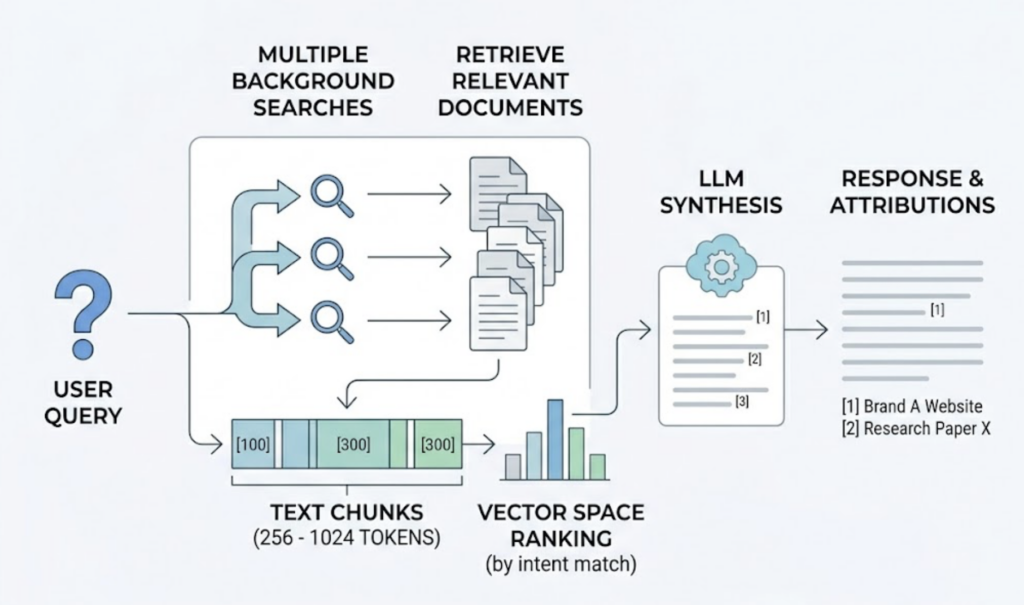
Most AI search platforms use a process called Retrieval-Augmented Generation (RAG). Understanding it is non-negotiable for building a real strategy.
When a user submits a query, the engine doesn’t just pull from its training data. It reformulates the prompt into multiple background searches, retrieves the most semantically relevant documents, splits them into text chunks (typically 256 to 1024 tokens), and ranks those chunks by how well they match the user’s intent in vector space. The LLM then synthesizes the top-ranked chunks into a response and attributes sources.
That process has three practical implications.
Layer 1: Technical Scannability. AI crawlers (GPTBot, PerplexityBot, ClaudeBot) need to access and parse your content cleanly. That means server-side rendering, logical heading hierarchies, and chunk-friendly content where each section carries its own context. A growing best practice in 2026 is implementing an llms.txt file in your root directory, which acts as a curated sitemap specifically for LLMs.
Layer 2: Semantic Relevance. AI search is conversational. A user doesn’t search “best CRM.” They ask “which CRM works best for a five-person agency that needs Slack integration under $50/month?” Your content needs to map the full semantic field: trade-offs, adjacent questions, and the follow-up queries an AI engine might run during its background fan-out process.
Layer 3: Consensus Authority. LLMs don’t trust a single source. They look for information echoed across multiple credible platforms: industry publications, Reddit, Wikipedia, expert blogs. If your brand facts are consistent and widely referenced, the model’s confidence in citing you increases.
That’s algorithmic trust, and it’s built through earned media, not owned content.
A Strategy for AI Search Optimization That Actually Moves the Needle
The starting point isn’t content. It’s prompt identification.
You need to know which AI search queries are driving buying decisions in your category. By late 2025, AI Overviews appeared for 18% of commercial queries, up from 8% earlier that year. That shift is accelerating. 24% of consumersalready say they’re comfortable letting AI agents make purchasing decisions for them, rising to 32% among Gen Z.
Once you’ve identified your 20 to 30 highest-priority prompts, run each one across ChatGPT, Perplexity, and Gemini. Run them 3 to 5 times per platform since AI responses are stochastic and vary between sessions. Track which brands appear, where your brand places, and what language the AI uses to describe you.
That baseline is your strategy starting point.
A strong AI search optimization strategy doesn’t set and forget. It runs as a cycle: discover high-value prompts, optimize content and authority signals for those prompts, measure AI visibility changes, feed insights back into the next content cycle. Brands that set it up once will find their AI visibility eroding within weeks. Citation patterns shift as platforms update their retrieval models.
How to Improve AI Search Optimization: 5 Levers You Can Pull This Week
1. Cover your topic with depth, not breadth. Topical authority beats domain authority consistently. A focused guide that exhaustively addresses every follow-up question on a single subject outperforms a high-DA blog that covers everything at surface level. Write for semantic completeness first.
2. Add evidence that’s extractable. The ArXiv GEO-bench research quantified this directly across 10,000 diverse user queries: adding statistics to content produces a 37% boost in AI visibility. Citing authoritative external sources produces a 40% boost. Adding credible quotes from recognized sources delivers a 22% lift. These aren’t soft best practices. They’re documented mechanics of how LLMs evaluate citability.
3. Build off-site consensus. Your owned content is the starting point, not the finish line. The AI also needs to see your brand referenced by third parties: industry media, community platforms like Reddit and Quora, and ideally Wikipedia. Visibility on your own domain alone isn’t enough to build the consensus graph that AI engines rely on for citation confidence.
4. Lock down entity clarity. Implement Organization schema with sameAs attributes linking to your LinkedIn page, Wikidata entry, and other authoritative profiles. When an LLM can identify your brand as a clearly defined, consistently described entity, it’s more willing to cite you without ambiguity.
5. Monitor and close the sentiment gap. AI doesn’t just cite you, it frames you. A brand might be mentioned frequently but described with neutral or slightly negative framing: “affordable but limited” instead of “focused and efficient.” Sentiment tracking catches these gaps before they compound into positioning problems.
How to Measure AI Search Optimization: The Metrics That Traditional Dashboards Miss
Clicks and impressions don’t capture AI search performance. You need a different set of signals.
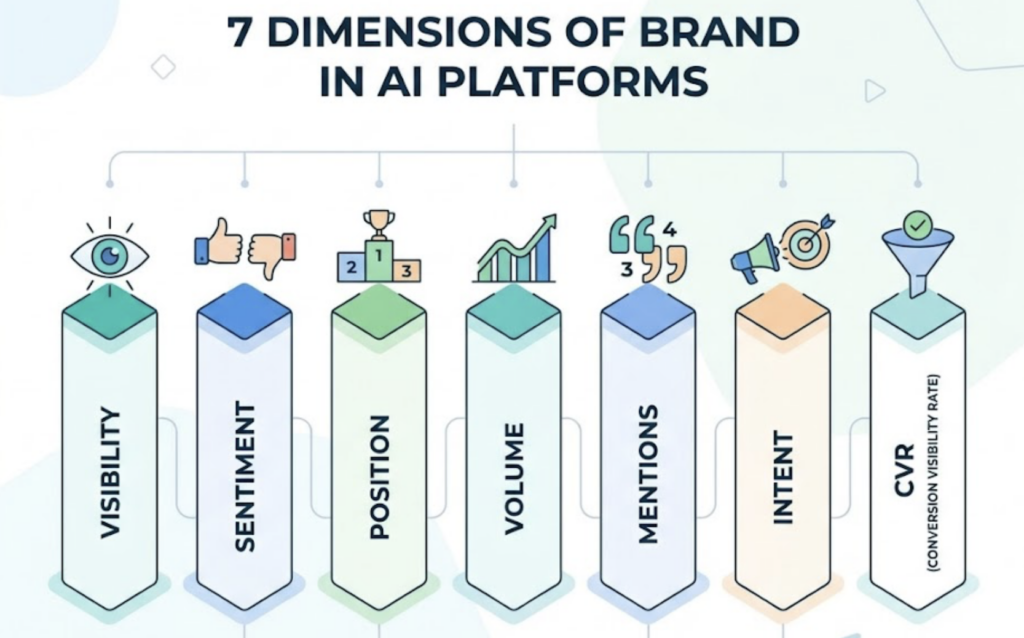
There are seven dimensions that reflect how an AI platform actually treats your brand. Visibility measures how often your brand appears across a defined set of prompts. Sentiment tracks the tone AI uses when it mentions you. Position shows where your brand ranks relative to competitors in AI responses. Volume reflects how many AI searches are happening in your category. Mentions count raw brand references across platforms. Intent scores qualify whether AI traffic is likely to convert. CVR (Conversion Visibility Rate) estimates how likely an AI referral is to turn into a real action.
The conversion dimension deserves particular attention. Google still sends 345 times more traffic than all AI platforms combined. But AI referral users convert at dramatically different rates. They’ve already been pre-qualified by the AI’s synthesis process and click only when they’re ready to go deeper. Data puts AI search referrals at 23 times higher conversion rates than traditional search traffic.
Lower volume. Much higher quality.
Measuring all seven dimensions manually is impractical at any real scale. Topify is an AI search optimization platform that tracks all seven metrics across ChatGPT, Gemini, Perplexity, DeepSeek, and other major AI platforms in a single dashboard. For teams that need to understand not just if they’re appearing, but why, and what to do next, that visibility is what separates guessing from optimizing.
Topify’s Basic plan starts at $99/month and covers 100 prompts with 9,000 AI answer analyses per month. The Pro plan at $199/month expands to 250 prompts and 22,500 analyses, designed for teams managing multiple brands. Enterprise starts at $499/month with custom configuration and a dedicated account manager.
Best Tools for AI Search Optimization in 2026
The tool category is new, and not all platforms are built the same. Before choosing, focus on four things: how many AI platforms are covered, how deep the metrics go, whether the platform can move from data to action, and whether pricing scales with actual usage.
| Capability | What to Look For |
|---|---|
| Platform Coverage | ChatGPT + Gemini + Perplexity at minimum; DeepSeek and regional models for global brands |
| Metrics Depth | Visibility, Sentiment, Position, Volume, Mentions, Intent, CVR |
| Execution Support | Strategy recommendations and content optimization, not just dashboards |
| Pricing Transparency | Usage-based plans, not inflated enterprise bundles |
Topify covers all four. It tracks seven key metrics across every major AI platform, surfaces the high-value prompts where your brand is absent, reverse-engineers which domains AI platforms cite most in your category, and includes a One-Click AI agent that translates dashboard insights into executable GEO strategies. The platform was built by a team including an LLM algorithm researcher with publications at NeurIPS and ICLR, and a GEO strategy lead with Fortune 500 SEO experience and a Google White-Hat championship.
Other platforms in the space focus on specific slices: some cover only ChatGPT visibility, others produce reports without execution support. If you’re comparing options, the question to ask isn’t “does this tool track AI mentions?” It’s “does it tell me what’s driving the gap between me and my competitors, and does it help me close it?”
A Practical Checklist for AI Search Optimization
Audit Phase
- [ ] Confirm GPTBot, PerplexityBot, and ClaudeBot are not blocked in your robots.txt
- [ ] Check heading hierarchy: one H1, logical H2s and H3s, no gaps
- [ ] Verify critical content is server-side rendered, not dependent on JavaScript
- [ ] Implement llms.txt in your root directory
- [ ] Run your 20 to 30 core prompts across ChatGPT, Perplexity, and Gemini (3 to 5 times each)
- [ ] Document where your brand appears, its sentiment framing, and competitors’ positions
Optimization Phase
- [ ] Rewrite key pages for semantic completeness: each section should resolve the user’s question without external reference
- [ ] Add original statistics, data tables, and authoritative citations to high-priority pages
- [ ] Use question-led H2 and H3 headings that mirror how users phrase conversational queries
- [ ] Implement Organization schema with sameAs links to LinkedIn, Wikidata, and authoritative profiles
- [ ] Build off-site presence: Reddit participation, industry media mentions, community engagement
Monitoring Phase
- [ ] Track seven metrics (Visibility, Sentiment, Position, Volume, Mentions, Intent, CVR) across platforms
- [ ] Re-run core prompts monthly to catch citation pattern shifts
- [ ] Compare your source graph against competitors’ cited domains
- [ ] Feed monitoring insights back into content planning for the next cycle
Conclusion
Traditional SEO built your foundation. It won’t sustain your visibility in a channel where the AI delivers the answer before the user ever reaches your page.
The brands building durable AI search presence in 2026 aren’t doing anything complicated. They’re covering topics exhaustively, making their information structurally easy to extract, building credibility across third-party sources, and tracking seven performance dimensions instead of two. The gap between those teams and the ones still optimizing for Google alone is widening every month.
Start by measuring. You can’t optimize what you can’t see. Get started with Topify to track your AI search visibility across platforms and find out exactly where your brand is showing up, how it’s being framed, and what’s putting competitors ahead of you.
FAQ
Q: What is the difference between AI search optimization and traditional SEO?
A: Traditional SEO influences how a search engine ranks and indexes your pages. AI search optimization influences whether an LLM cites and recommends your brand when generating a direct answer. The two share some foundations, like content quality and technical accessibility, but diverge significantly on authority signals, content structure, and measurement. Domain authority explains less than 4% of AI citation variance, while topical depth and semantic completeness drive most of the signal.
Q: How long does it take to see results from AI search optimization?
A: Most teams see measurable shifts in visibility scores within 6 to 12 weeks of implementing content and technical changes. Building off-site consensus through earned media and community presence typically takes 3 to 6 months to meaningfully affect AI citation rates. Monitoring your core prompts from week one gives you the baseline you need to track progress accurately.
Q: How do I know if my brand is appearing in AI search results?
A: The only reliable method is systematic prompt tracking across multiple AI platforms, run repeatedly to account for response variability. Manual spot-checking gives you a snapshot, not a trend. Platforms like Topify automate this across ChatGPT, Gemini, Perplexity, DeepSeek, and other major AI platforms, so you’re tracking brand visibility and sentiment at scale rather than guessing from one-off searches.
Q: What’s the typical cost for AI search optimization tools?
A: Entry-level AI visibility platforms generally start between $49 and $99 per month for basic tracking. Mid-market plans covering multiple prompts and competitor monitoring run from $150 to $250 per month. Enterprise configurations with custom platform coverage and dedicated support typically start at $500 per month or above.

