

Search “best GEO tool” or “how top brands do AI search” and you’ll get dozens of articles that either explain the concept from scratch or sell you on a single tactic. What you won’t find is the actual integration logic: how leading brands have wired generative engine optimization into their core strategy, not as a side project, but as a measurable growth channel.
That gap is the real problem. It’s not that the information doesn’t exist. It’s that most of what’s published describes whattop brands do without explaining why the architecture works and how to replicate it when you’re not starting with a 50-person marketing team.
Most Brands Still Treat AI Search Visibility as an Afterthought
The numbers tell a blunt story.
Traditional search engine volume is projected to drop 25% by the end of 2026, a trajectory Gartner flagged back in 2024. Yet most marketing teams are still directing 90% or more of their digital budgets toward traditional SEO and PPC, even as the channels’ effectiveness erodes.
Here’s what that erosion looks like in practice: when an AI Overview appears at the top of a query, organic click-through rates for the first position drop from a historical average of 1.76% to 0.61%. For commercial and transactional queries, the zero-click rate sits at roughly 83%. In Google’s fully synthesized “AI Mode,” that figure reaches 93%.
That’s not a trend. That’s a structural shift.
What makes this more urgent is the conversion data on the other side. GEO-driven traffic converts at an average of 27%, compared to 2.1% for traditional SEO. Webflow has reported that ChatGPT traffic converts at 24%, nearly six times their traditional Google rate. Being the cited source in an AI answer isn’t just a visibility win. It’s a revenue signal.
Top brands have already processed this math. They’ve moved AI search visibility from “nice to track” to a quarterly KPI alongside web traffic and pipeline contribution. Most mid-market teams haven’t.
The competitive gap won’t stay theoretical for long.
The 3-Layer Integration Framework Behind Generative Engine Optimization
Top brands don’t approach AI search as a series of isolated experiments. They run a structured 3-layer framework: Monitor, Analyze, Optimize. Most organizations attempt the first layer and stop there, which explains why their results plateau.
Layer 1: Monitor (Track)
The starting point is establishing a baseline. You can’t optimize what you haven’t measured.
Market leaders track their “Share of Model” across a diversified platform set: ChatGPT, Perplexity, Gemini, Google AI Overviews, and increasingly DeepSeek. Multi-platform monitoring isn’t optional. Research shows only an 11% domain overlap exists between different AI platforms, meaning a brand visible on ChatGPT may be completely absent from Perplexity.
Monitoring cadence matters too. Up to 60% of cited domains can shift within a single month. Weekly tracking isn’t paranoia; it’s baseline hygiene.
Layer 2: Analyze (Understand Why)
Monitoring tells you where you stand. Analysis tells you why you’re there, or why you’re not. This is where most brands stop investing, and it’s the most expensive mistake in GEO.
Two dimensions drive this layer: Source Analysis (which third-party domains are earning AI citations for your category?) and Sentiment Analysis (how is the AI describing your brand when it does mention you?).
Both feed directly into execution.
Layer 3: Optimize (Execute)
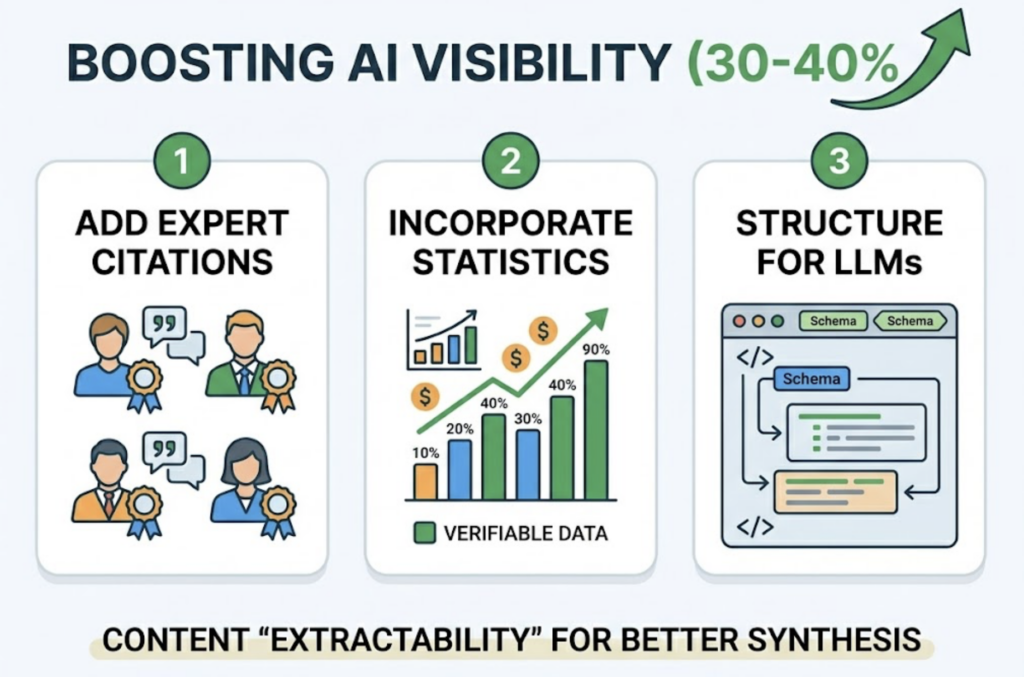
The final layer operationalizes the insights. Top brands re-engineer their content for what researchers call “extractability,” using Princeton-validated techniques that can boost AI visibility by 30-40%: adding expert citations, incorporating verifiable statistics, and structuring content so LLMs can synthesize it cleanly.
Most brands only run Layer 1. That’s why they have dashboards full of visibility data and no clear path to change it.
AI Search Visibility Brand Integration Starts With the Right Prompts
Here’s where most GEO strategies fail early: they only monitor branded queries.
Asking an AI “What is [Brand X]?” measures reputation. It doesn’t measure competitive positioning. The real battle happens in unbranded, category-level discovery, where a potential customer asks “What’s the best CRM for a small legal practice?” without knowing or caring which brand answers.
Non-branded informational queries trigger AI Overviews in nearly 100% of cases. If your brand is only visible in branded searches, you’re invisible to the 90%+ of potential buyers still in the discovery phase.
Top brands build what’s called a “Prompt Universe” of 30-100 high-intent questions. These aren’t just keyword variations. They’re structured by intent layer:
| Prompt Type | Example | Why It Matters |
|---|---|---|
| Category / Awareness | “Best project management tool for distributed teams” | Open discovery: measures your ability to enter the consideration set |
| Scenario / Problem | “How do I reduce churn in a SaaS subscription model?” | Authority: brand solves the problem before a product is mentioned |
| Comparative | “Brand A vs Brand B for healthcare security” | Direct competition: how AI perceives your strengths against rivals |
| Transactional | “Brand X enterprise pricing 2026” | Conversion: accuracy at final decision moments |
The difference in citation rates between these prompt types is significant. A brand that only shows up in branded or transactional searches is essentially invisible during the part of the journey where purchase decisions are actually formed.
Topify’s High-Value Prompt Discovery feature automates this process, surfacing the high-volume AI prompts critical to your category and updating them as AI recommendations evolve. You’re not guessing which prompts matter; you’re running on actual AI search behavior data.
What AI Search Visibility Top Brands Actually Measure
Traditional SEO success metrics are rankings and traffic. In GEO, those are the wrong numbers.
Top brands use a 7-metric framework to measure true influence within the LLM ecosystem. Here’s how each metric maps to decision-making:
| Metric | What It Measures | Why Laggards Ignore It |
|---|---|---|
| Visibility (%) | % of relevant prompts where you appear | Feels abstract without a benchmark |
| Sentiment (0-100) | Tone and framing of your mention | Hard to quantify without tooling |
| Generative Position | Whether you’re mentioned 1st, 2nd, or 3rd | Assumed to be random |
| Prompt Volume | How many users ask specific questions | No equivalent in traditional SEO |
| Mentions | Raw brand recognition in AI responses | Often the only metric tracked |
| Intent | Why the user is asking (research vs. ready to buy) | Rarely mapped to content strategy |
| CVR | AI-driven recommendations that lead to action | Almost never tracked |
Sentiment and Position are the two most underused metrics among brands still early in their GEO journey. Research from SISTRIX and Seer Interactive indicates that traffic accompanied by a positive citation has a 35% higher organic CTR and a 91% higher paid CTR compared to non-cited results.
That means a brand mentioned third with positive framing may drive more downstream value than a brand mentioned first described as “complex” or “enterprise-only.”
Topify’s Competitor Monitoring feature tracks these sentiment differentials in real time across competitors, allowing teams to catch narrative drift before it becomes baked into a model’s weights.
The Source Gap That’s Hurting AI Search Visibility Brand Integration
This is the insight most brands miss entirely.
Even if your on-site content is technically superior, you’ll underperform in AI search if that content isn’t hosted on domains the AI actually cites. This is the “Source Gap,” and it’s responsible for most of the visibility disparity between category leaders and everyone else.
Analysis of 36 million AI Overviews shows a clear citation hierarchy. A small group of “aristocratic sources” accounts for nearly 40% of all citations. That concentration looks like this:
| Tier | Key Domains | AI Search Role |
|---|---|---|
| Tier 1: Foundations | Wikipedia, YouTube, Google Properties | Factual and visual ground truth |
| Tier 2: Community | Reddit, Quora, LinkedIn | Social proof and discussion queries; Reddit accounts for 97% of shopping discussion citations |
| Tier 3: Niche Leaders | NIH, Gartner, ScienceDirect, Shopify | Industry-specific trust for high-stakes topics |
| Tier 4: Retail Giants | Amazon, Walmart, eBay | Product availability, pricing, specs |
The uncomfortable truth: 89% of LLM citations come from earned sources, not corporate blogs. The brand that publishes a definitive blog post on their own domain often loses to a competitor who gets mentioned in a TechRadar comparison article or a Reddit thread.
That’s the gap. Most brands are writing content for their own website instead of securing earned inclusion on the domains AI already trusts.
The solution isn’t publishing more. It’s publishing smarter, in the right places.
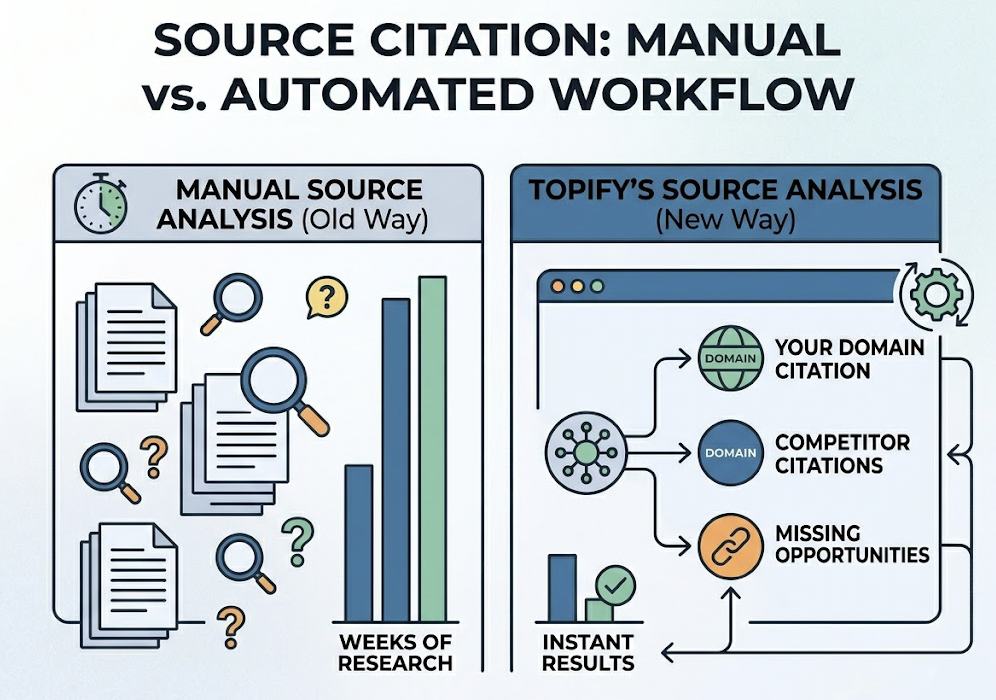
Topify’s Source Analysis feature reverse-engineers which exact domains and URLs AI platforms cite for your target prompts. You can see at a glance whether your brand has a footprint on those sources, and where your competitors are already earning citations you’re missing. That workflow replaces what would otherwise take weeks of manual research.
How to Start Integrating Generative Engine Optimization Into Your Brand Strategy
The transition to a GEO-integrated strategy doesn’t require rebuilding your team. It requires redirecting focus. Top brands typically allocate around 15% of their SEO/Content budget specifically to GEO. The starting path is straightforward.
Step 1: Audit
Run your top 20 category-level prompts across ChatGPT, Perplexity, Gemini, and Google AI. Record whether your brand appears, what the sentiment is, and which sources are cited. This gives you your Baseline Visibility Score. Many brands discover a “Zero Visibility Problem” in category discovery even if they rank number one on Google for their brand name.
Step 2: Benchmark
Compare your baseline against 2-3 direct competitors. Identify the Sentiment Gap (are competitors described as “easy to use” while you’re described as “enterprise-heavy”?) and the Source Gap (which third-party domains are carrying them into AI answers that you’re absent from?).
Step 3: Optimize
Address both gaps with a two-pronged approach. On-site: modularize your high-value pages, add direct answers in the first 50 tokens, incorporate expert quotes and verifiable statistics. Off-site: direct PR and community efforts toward the specific domains your source analysis flagged, whether that’s Reddit, LinkedIn, niche publications, or G2 comparison pages.
Topify runs this entire workflow in one platform. Brands track visibility metrics, analyze the competitive gap, and receive actionable guidance on what to publish next, across all major AI platforms including ChatGPT, Gemini, Perplexity, DeepSeek, and others. For mid-market teams, Topify’s Basic plan at $99/month is a practical entry point that replaces the manual spreadsheets most teams are currently using.
GEO results move faster than traditional SEO. Organizations typically report measurable shifts in AI citations within 30 days of implementing specific content changes. That’s not a long runway to see whether the investment is working.
Conclusion
The brands being recommended by AI today didn’t get there by accident. They built monitoring infrastructure, identified source gaps, and optimized for how LLMs actually synthesize answers, not how search engines rank pages.
The visibility crisis most brands are experiencing isn’t a mystery. It’s a measurement problem. The AI platforms are already generating a clear record of who gets cited, in what context, with what framing. The brands winning in GEO are simply the ones reading that record and acting on it.
Start with your top 20 category prompts. Run them across the major AI platforms. See where you appear, where you don’t, and what the AI says about you when it does. That baseline tells you more about your brand’s competitive position than any SERP report.
Once you know where you stand, the path forward is concrete.
FAQ
Q: What is generative engine optimization and how is it different from SEO?
A: Generative engine optimization (GEO) is the practice of optimizing a brand’s content and digital presence to appear in AI-generated answers, not just traditional search result pages. SEO focuses on rankings and driving clicks to a website. GEO focuses on being cited within the AI’s synthesized response itself. The goal shifts from discoverability to trust and synthesis. A brand that ranks number one on Google can still have zero visibility in ChatGPT or Perplexity.
Q: How do top brands integrate AI search visibility into their marketing strategy?
A: Top brands treat AI search visibility as a core KPI alongside web traffic and pipeline metrics. They run a 3-layer framework: monitoring their Share of Model across multiple AI platforms weekly, analyzing source gaps and sentiment differentials against competitors, and executing content and PR changes targeted at the specific domains AI platforms already cite. Many allocate roughly 15% of their SEO and content budget specifically to GEO.
Q: What’s the best integration approach for AI search visibility best integration brands just starting with GEO?
A: Start with an audit of 15-20 category-level prompts across ChatGPT, Perplexity, Gemini, and Google AI to establish a baseline. Then benchmark that result against your top competitors to identify where sentiment and source gaps exist. From there, prioritize off-site earned inclusion on the specific domains your source analysis identifies, rather than writing more content on your own site. That sequence tends to produce measurable AI visibility changes within 30 days.
Q: How long does it take to see results from generative engine optimization?
A: Faster than traditional SEO. While SEO results typically take 3-6 months to materialize, GEO impacts are often visible within 30 days of implementing targeted changes, such as adding expert quotes, verifiable statistics, or modular answer structures to high-value pages. The feedback loop is tighter because AI platforms update their citation patterns more frequently than search engine indexes.

