

Your domain authority is solid. Your top pages rank well. But someone on your team just tested a few buyer-intent prompts on ChatGPT and Perplexity, and your brand didn’t appear once. Your competitors did. That gap isn’t a content quality problem. It’s a visibility architecture problem that traditional SEO wasn’t built to solve.
AI search marketing is how you close it.
What Is AI Search Marketing
AI search marketing is the practice of optimizing a brand’s presence inside AI-generated answers, not just traditional search result pages. Instead of ranking a blue link, you’re earning a citation, a mention, or a recommendation inside the synthesized responses that platforms like ChatGPT, Perplexity, Gemini, and Google AI Overviews deliver directly to users.
The distinction matters more than most teams realize. Traditional SEO points users toward answers. AI search delivers the answer, and your brand either gets included in that answer or doesn’t exist for that query.
This discipline is also referred to as Generative Engine Optimization (GEO) or Answer Engine Optimization (AEO). The terms overlap, but they all describe the same strategic shift: moving from optimizing for a keyword position to optimizing for a “prompt universe.”
How AI Search Marketing Works
Most AI engines use a process called Retrieval-Augmented Generation (RAG). When a user submits a prompt, the model doesn’t just draw on its training data. It retrieves relevant web content in real time, extracts specific passages, and generates a synthesized answer, then cites the sources it found most useful.
Three factors largely determine whether your brand gets cited:
Content extractability. AI systems prefer content that’s structured for “chunk-level retrieval,” meaning each section is self-contained and can be understood without surrounding context. Answer-first architecture, question-based H2 headings, and plain factual prose outperform promotional writing.
Entity authority. AI engines build a mental model of your brand as an “entity.” If your brand name, descriptors, and positioning are inconsistent across platforms, the model can’t confidently include you. Brands with clear, consistent entity signals get more citations. It’s a compounding effect: more citations build brand gravity, which leads to even more citations.
Technical access. AI crawlers need to actually reach your content. Sites loading under two seconds are cited approximately 40% more frequently than slower pages, and content buried in JavaScript-heavy rendering often gets skipped entirely.
This is why AI search marketing isn’t just a content strategy. It’s a systems problem.
5 Strategies That Actually Move the Needle in AI Search Marketing
Research from Princeton University and Georgia Tech found that targeted content modifications can boost AI visibility by up to 40%. Here’s what the data actually supports.
1. Build a Prompt Index, not a keyword list.
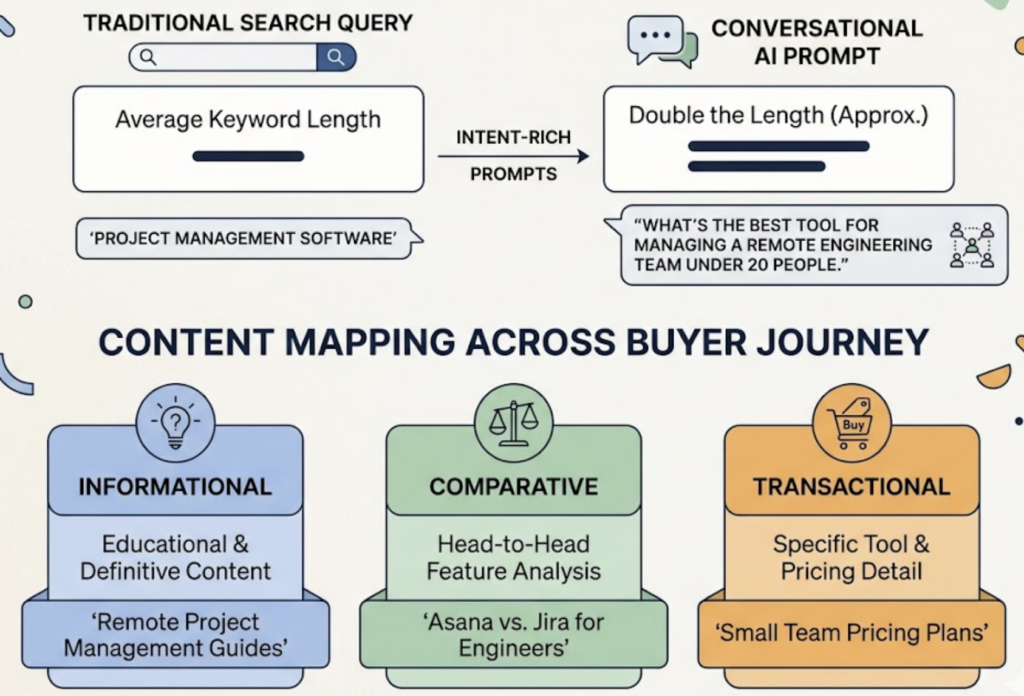
The average prompt length for which a brand appears in AI search is often double the length of traditional keywords. Your audience isn’t typing “project management software.” They’re asking “what’s the best tool for managing a remote engineering team under 20 people.” Map your content to these conversational, intent-rich prompts across the full buyer journey: informational, comparative, and transactional.
2. Earn citations through source quality.
Including references to credible external research within your own content increases AI citation likelihood by 30–40%. AI engines reward content that acts as a well-sourced hub. Data density matters too: aim for 2–3 statistics per 1,000 words to improve how often your content gets extracted.
3. Clarify your brand entity.
Make sure your brand name, product descriptions, and expert bios are consistent across your site, social profiles, directories, and any third-party mentions. Schema markup, particularly Organization, Person, and FAQPage types, helps AI systems map your brand into their knowledge graph with confidence.
4. Monitor and correct AI sentiment.
AI platforms don’t just mention brands. They characterize them. A brand might have strong visibility but negative framing if it keeps showing up in complaints or controversy. Tracking how AI describes your brand, not just whether it mentions you, is a separate measurement task.
5. Use competitor gaps as content briefs.
When AI consistently recommends a competitor over you for specific prompts, there’s usually a source-coverage gap. Identify which third-party domains are being cited in those answers and develop content or outreach strategies to earn mentions there.
Common Mistakes in AI Search Marketing
The most expensive mistake is treating AI search like a slightly different version of traditional SEO.
Keyword density optimization does nothing for AI systems. These models evaluate semantic coherence and information gain, not how many times a phrase appears. Stuffing a page with “best AI search marketing tool” won’t trigger a citation.
The second mistake is monitoring only Google AI Overviews and ignoring ChatGPT, Perplexity, and Gemini. Each platform has different citation patterns, different update cycles, and different audience profiles. A brand that’s visible on one platform may be absent on another.
AI platforms don’t rank. They recommend. That’s a different game entirely.
Skipping baseline measurement is also common. Without knowing your starting visibility score, sentiment, and competitive position, you have no way to evaluate whether anything you’re doing is working. Most brands start optimizing before they’ve ever run a diagnostic.
Finally, treating AI search as a “set and forget” channel misses how frequently citation patterns shift. Google’s AI Overviews coverage jumped from 6.49% to 24.61% of keywords between January and July 2025, then pulled back. Teams that aren’t tracking in real time get caught off guard.
How to Measure AI Search Marketing Performance
Traditional rank tracking tells you where your page appears in a list. AI search measurement tells you whether your brand is being recommended, how it’s being characterized, and how you compare to competitors in the same AI-generated answer.
The core metrics to track:
AI Visibility Score: The percentage of tracked prompts in which your brand is mentioned. This is your baseline share-of-model metric.
Position: Your relative placement compared to competitors within AI answers. Being mentioned third is meaningfully different from being mentioned first.
Sentiment: The tone and framing AI uses when describing your brand. Tracked on a 0–100 scale, this catches positioning drift before it becomes a PR problem.
Citation Rate: How often the AI links back to your domain as a source. High visibility with low citation rate suggests AI mentions you from training data but doesn’t trust your content enough to reference it.
AI Volume: The estimated search volume behind the prompts where your brand does or doesn’t appear. Not all prompts are equal.
CVR (Conversion Visibility Rate): The estimated likelihood that an AI recommendation for your brand leads to an actual click or engagement. Traffic referred from AI tools converts at up to 25x higher rates than traditional search traffic. This metric helps you prioritize which prompts to optimize first.
Setting up measurement starts with selecting 20–30 core prompts that reflect your buyers’ actual questions, running them across ChatGPT, Gemini, and Perplexity, and recording where your brand appears alongside competitors. That’s your baseline. Everything after is delta.
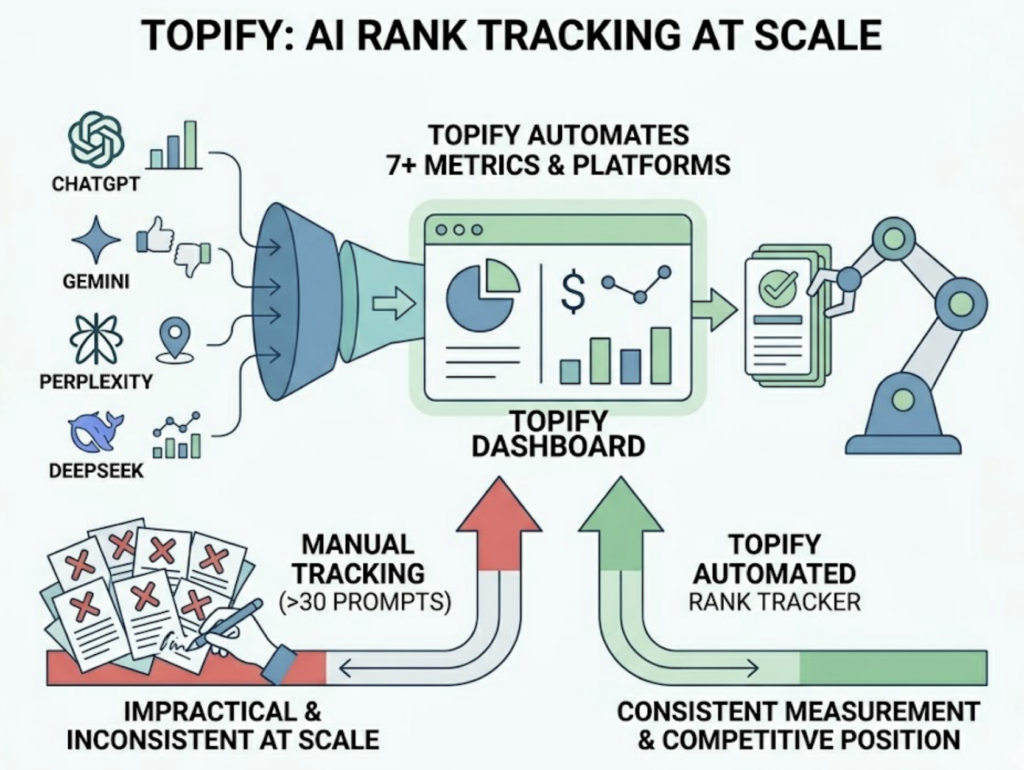
Topify automates this entire process. It tracks all seven of these metrics simultaneously across major AI platforms, including ChatGPT, Gemini, Perplexity, and DeepSeek, and surfaces competitive position data in a single dashboard. For teams running more than 30–40 prompts, manual tracking becomes impractical within a few weeks. A rank tracker tool built for AI Overviews and generative engines is the only way to keep measurement consistent at scale.
Best Tools for AI Search Marketing in 2026
The market now includes over 35 purpose-built AI visibility platforms. The tools differ significantly in what they actually measure and which platforms they cover.
What separates useful tools from noisy dashboards comes down to four criteria: multi-platform coverage (not just Google AI Overviews), real-time data via actual LLM interface scraping rather than API approximations, competitive benchmarking, and actionable recommendations, not just charts.
Topify stands out for teams that need to move from data to execution without stitching together multiple platforms. It covers ChatGPT, Gemini, Perplexity, DeepSeek, and others, tracks all seven core AI visibility metrics, and includes One-Click Execution, where you state a goal in plain English and the platform deploys the optimization strategy automatically. Pricing starts at $99/month on the Basic plan, which includes 100 prompt slots and 9,000 AI answer analyses per month across 4 projects.
For agencies managing multiple clients, Topify’s Pro plan ($199/month) scales to 250 prompts and 10 seats, with the same multi-platform coverage. Enterprise plans start at $499/month with a dedicated account manager and custom configurations.
Other tools in the market tend to specialize: some focus on enterprise-grade reporting, others on EU compliance, others on content-specific citation tracking. The right choice depends on whether you need breadth across platforms, depth in a specific one, or execution support beyond measurement.
AI Search Marketing Checklist Before You Launch
A quick checklist to make sure you’re starting from a defensible position:
- Crawler access confirmed: Verify your robots.txt allows GPTBot, Google-Extended, ClaudeBot, and PerplexityBot
- Core HTML rendering: Ensure key content is visible in raw HTML, not dependent on client-side JavaScript
- Prompt Index built: Document 20–30 prompts mapped to informational, comparative, and transactional buyer stages
- Baseline measurement run: Test those prompts across at least 3 AI platforms and record brand visibility and competitor mentions
- Entity consistency audit: Confirm brand name, description, and expert bios match across your site, LinkedIn, and key directories
- Schema markup implemented: At minimum: Organization, FAQPage, and Article/BlogPosting types
- Answer-first architecture: Top content pages lead with direct answers in the first 150 words
- Data density check: At least 2 statistics per 1,000 words on key pages, with links to primary sources
- Measurement cadence set: Monthly prompt re-runs with documented delta tracking
- Sentiment review scheduled: Quarterly check on how AI characterizes your brand, not just whether it mentions you
Conclusion
Organic CTR at Position 1 drops by 34.5% when an AI Overview is present. The zero-click rate for AI-assisted queries has reached 83%. These aren’t signals that AI search is coming. They’re signals that the transition is already underway.
AI search marketing is where your brand earns its place in the answers that 810 million daily users are getting from conversational interfaces. The goal isn’t to rank higher in a list. It’s to become the recommendation.
Start with a baseline. Run your 20–30 core prompts. Find out where you stand today before deciding what to optimize. Get started with Topify to run your first AI visibility report and see where your brand appears, how it’s characterized, and who’s ranking above you.
FAQ
Q: What is AI search marketing? A: AI search marketing is the practice of optimizing a brand’s visibility inside AI-generated answers from platforms like ChatGPT, Perplexity, Gemini, and Google AI Overviews. It focuses on earning citations and recommendations within synthesized responses, rather than ranking a URL in a list of blue links.
Q: How is AI search marketing different from traditional SEO? A: Traditional SEO optimizes for keyword-based rankings and clicks. AI search marketing optimizes for how AI engines interpret, summarize, and recommend your brand when users ask conversational prompts. The output isn’t a link position. It’s whether your brand is mentioned, cited, and positively characterized inside the AI’s answer.
Q: How do I measure my brand’s performance in AI search? A: Track six core metrics: AI Visibility Score (mention rate across tracked prompts), Position (where you appear relative to competitors), Sentiment (how AI characterizes your brand), Citation Rate (how often your domain is sourced), AI Volume (demand behind relevant prompts), and CVR (estimated conversion likelihood from AI referrals). Start by testing 20–30 prompts across ChatGPT, Gemini, and Perplexity to establish a baseline.
Q: What’s the best rank tracker tool for AI Overviews? A: The most effective rank tracker tools for AI Overviews are those that scrape actual LLM interfaces rather than relying on APIs, which can differ by up to 25% from real user-facing results. Topify covers ChatGPT, Gemini, Perplexity, DeepSeek, and AI Overviews in a single dashboard, with automated competitive tracking and execution support. It’s well-suited for both in-house marketing teams and agencies managing multiple brand accounts.

