

Your Google rankings are intact. Your content calendar is running. Your organic traffic report looks fine.
And yet, your brand isn’t showing up when someone asks ChatGPT which product to buy, which vendor to trust, or which solution actually works.
That’s the gap most brands still can’t see.
The Search Engine You’ve Been Optimizing For Is No Longer the Only One That Matters
Global search activity has never been higher, with between 9.1 and 13.6 billion daily queries processed across the web. But the clicks leaving search pages to visit actual websites are collapsing. This phenomenon has a name: The Great Decoupling.
The mechanism is simple. When users get a synthesized answer directly inside ChatGPT, Perplexity, or Google AI Overviews, they don’t need to click anywhere. Google’s AI Overviews now appear in 84% of search results, reaching over 2 billion monthly users. In “Google AI Mode,” 93% of searches result in zero clicks to external sites.
Meanwhile, ChatGPT has become the 5th most visited website globally, processing 2 billion queries per day and capturing between 60.7% and 80.49% of all AI chatbot traffic. Gen Z and Millennials are increasingly running “dual searches,” combining a Google query with a ChatGPT prompt to complete a single research task.
The first discovery touchpoint is shifting from your website to an AI system. That changes everything downstream.
What an SEO Agent Actually Is (and What It Isn’t)
An SEO Agent is an autonomous AI system that plans, executes, and iterates on search strategy with minimal human oversight. It’s not a content generator you prompt once and walk away from.
The distinction matters. A traditional AI writing tool is reactive, stateless, and task-based. It responds to a single input and stops. An SEO Agent is goal-oriented: give it a strategic objective like “own the top recommendation for enterprise CRM prompts,” and it decomposes that into executable sub-tasks, monitors environmental changes in real time, and continuously adjusts based on results.
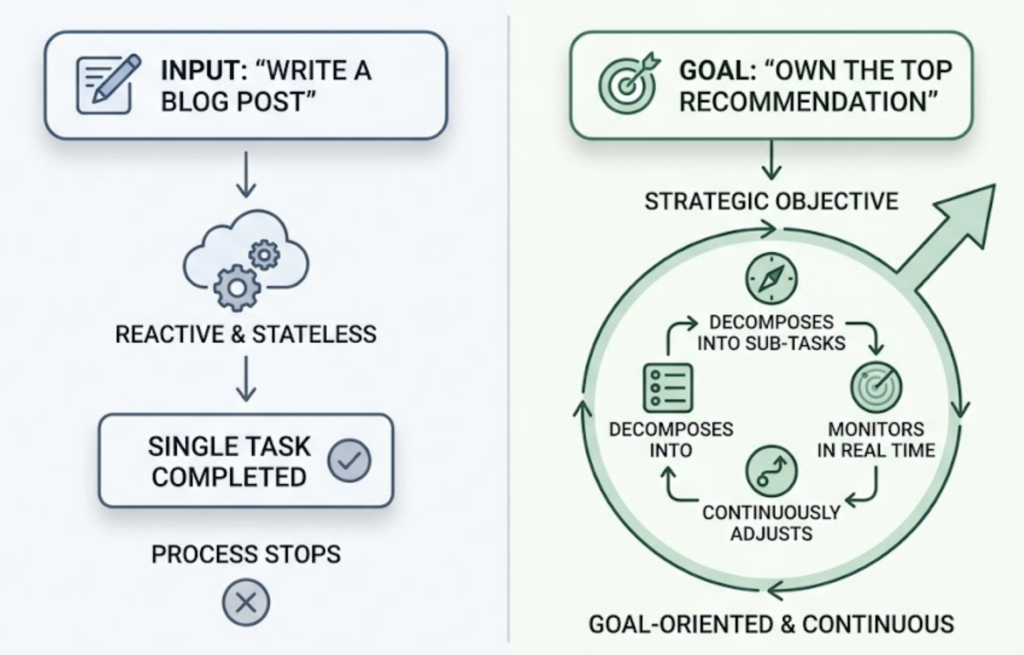
What makes the agentic model different is its architecture. It uses persistent memory (often called a “Brand Core”) to store brand voice, positioning history, and past performance data. It applies multi-step reasoning to prioritize actions by ROI. It connects to data sources via protocols like MCP to maintain live awareness of algorithm shifts and competitor movements.
In short: it operates less like a tool and more like a senior SEO director who never sleeps.
3 Things SEO Agents Do That Human Teams Can’t Keep Up With
Real-Time Visibility Monitoring Across 10+ Platforms
Traditional rank tracking is deterministic. You measure a fixed position for a specific keyword on a specific engine. AI search is probabilistic. A brand might appear in a ChatGPT recommendation for one user and be completely absent for another, depending on the phrasing of the prompt.
SEO Agents handle this by running thousands of synthetic probes across ChatGPT, Gemini, Perplexity, Claude, and other platforms to calculate a “Probability of Mention.” They also monitor sentiment distribution, identifying whether the brand is portrayed positively, neutrally, or negatively, and flagging hallucinations like outdated pricing or discontinued features before they propagate through training data.
Catching a hallucination at the source costs almost nothing to fix. Waiting for it to embed into a model’s training data can run into millions in brand damage.
Prompt Discovery at a Scale No Team Can Replicate Manually
Keyword research optimizes for isolated terms like “best CRM.” Prompt research maps complex, multi-variable dialogues like “What’s the best CRM for a mid-sized B2B manufacturing company that integrates with Outlook for under $50 per user?”
That shift in granularity is where most brands lose their footing.
SEO Agents use a Keyword → Prompt → Action framework to identify the specific constraints (budget, industry, persona) that trigger an AI engine’s “Recommendation Mode.” These are the prompts where users have already decided they want a specific solution. They’re BOFU, high-conversion, and almost entirely invisible to teams doing manual keyword research.
One-Click Strategy and Content Recovery
The operational comparison is stark. Manual research takes 2-3 hours; an agent does it in under 5 minutes. A content brief that takes a human 1-2 hours gets produced in 3-5 minutes. Recovery workflows that previously required reactive analysis across multiple tools now run proactively, with fixes prepared for one-click deployment or automatic correction.
This matters because content decay has accelerated. AI citations drop significantly for content older than 90 days. No human team can sustainably maintain citation-grade freshness at scale. An agent can.
GEO and AEO: Two Different Games, One Unified Strategy
Most SEO teams treat GEO and AEO as interchangeable. They’re not.
AEO (Answer Engine Optimization) targets voice assistants, featured snippets, and Google AI Overviews. The goal is to be selected as the direct, definitive answer to a query. It rewards directness, FAQ schema, clean formatting, and brevity. Metric of success: inclusion rate in answer boxes.
GEO (Generative Engine Optimization) targets synthesis engines like ChatGPT, Claude, and Gemini. The goal is to be cited as a trusted reference source when those engines build a comprehensive response. It rewards semantic depth, original research, verifiable data, and evidence-backed authority. Metric of success: citation share of voice.
| Dimension | AEO | GEO |
|---|---|---|
| Target Interface | Voice, Snippets, AI Overviews | Generative Chat (ChatGPT, Claude) |
| Optimization Goal | Selection as the direct answer | Citation as a trusted reference |
| Content Style | Concise, scannable, structured | Deep, data-rich, semantically broad |
| Search Intent | Quick “What/How” questions | Complex research and comparisons |
| Success Metric | Answer box inclusion rate | Citation share of voice |
A well-functioning SEO Agent needs to score content for both. They require different writing structures, different signals, and different update cadences. Running only one means leaving half the AI discovery layer unoptimized.
92% of Brands Are Invisible Where It Actually Counts
That figure isn’t speculative. A 2026 industry report found that 92% of brands are failing in AI visibility, and the data explains why.
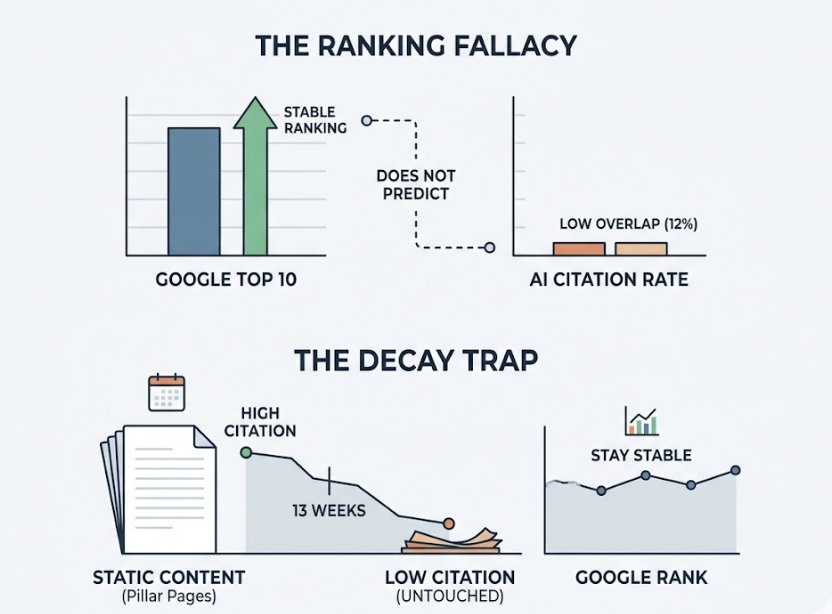
Only 12% of ChatGPT citations overlap with the traditional Google top 10. Put differently: ranking well on Google does not meaningfully predict whether an AI engine cites you. The “Ranking Fallacy” is the single most expensive misconception in SEO right now.
The second trap is ignoring content decay. AI citation rates fall sharply after 13 weeks for static content that hasn’t been refreshed. Brands that published comprehensive “pillar pages” two years ago and left them untouched are watching their AI citation share erode in real time, even as their Google rankings stay stable.
A third blind spot: sentiment. A brand can appear frequently in AI answers but be framed negatively or incorrectly. Ignoring sentiment monitoring doesn’t just cost brand trust. Industry estimates put annual losses from unchecked AI misinformation at $2.1 million per brand.
HubSpot is the clearest case study in structural risk. One of the internet’s most prolific content producers saw traffic drop 70-80% as AI systems started directly summarizing their informational content. When the answer appears on the SERP, users don’t need the source anymore.
How to Actually Deploy an SEO Agent Strategy in 2026
The 90-day implementation roadmap breaks down into four phases.
Phase 1: Establish your AI visibility baseline. Before you can optimize, you need to know where you stand. Topify’sVisibility Tracking monitors brand presence across ChatGPT, Gemini, Perplexity, and other major platforms, measuring your Answer Inclusion Rate and AI Share of Voice. This surfaces the gap between how your brand sees itself and how AI models currently perceive it.
Phase 2: Find your high-value prompts. Using Topify’s Prompt Discovery capability, the agent analyzes thousands of query variations and applies “Citability Scoring” (0-100) to identify which prompts are most likely to drive conversions. These are your “dark queries”: bottom-of-funnel dialogues you’re probably not appearing in.
Phase 3: Optimize for citation. Once target prompts are identified, the agent benchmarks your content against the domains AI engines are actually citing. Topify’s Competitor Benchmarking maps exactly which rivals are being cited for specific topics and why. That intelligence goes directly into content gap fixes and citation pillar refreshes. The economics justify the investment: GEO-driven strategies return $3.71 per dollar spent versus $2.10 for traditional SEO, backed by AI-referred visitors who convert at 4.4x the rate of standard organic traffic.
Phase 4: Monitor continuously. AI recommendations aren’t static. Topify’s continuous monitoring tracks sentiment shifts, flags hallucinations, and triggers recovery workflows when citation rates drop. The agent handles the execution layer so your team focuses on strategy.
| Topify Feature | Function | Outcome |
|---|---|---|
| Visibility Tracking | Cross-platform mention detection | Eliminates AI blind spots |
| Prompt Discovery | Maps keywords to intent themes | Captures BOFU dark queries |
| Competitor Benchmarking | Share of Voice analysis | Identifies citation gaps |
| Sentiment Analysis | Tracks AI tone and accuracy | Flags hallucinations early |
| One-Click Execution | Automated strategy deployment | Scales without added headcount |
Conclusion
SEO isn’t disappearing. It’s being restructured around a different set of rules.
The “ten blue links” model was optimized for navigational intent. Generative AI is optimized for synthetic authority. Ranking well on Google no longer guarantees presence in the recommendation layer where high-intent users are making decisions. That layer is owned by whichever brands have built credible, up-to-date, semantically rich content that AI systems trust enough to cite.
AI-powered search is already projected to influence $750 billion in U.S. revenue by 2028. The brands that show up in those recommendations will disproportionately capture that value. The ones still running a 2016 SEO playbook won’t.
The SEO Agent isn’t an upgrade to your existing workflow. It’s the infrastructure layer that makes AI search optimization tractable at the speed and scale 2026 demands.
FAQ
Q: What’s the difference between an SEO Agent and a traditional AI SEO tool?
A: A traditional AI SEO tool is reactive. You give it a prompt, it generates output, and the process stops. An SEO Agent is goal-oriented and autonomous. It receives a strategic objective, breaks it into executable tasks, monitors performance across platforms in real time, and adjusts its approach based on results. The key differentiator is persistent memory and multi-step reasoning. An SEO Agent retains brand context across sessions and operates continuously, not just when you prompt it.
Q: Do I need to understand Agentic AI to benefit from an SEO Agent strategy?
A: Not technically. The underlying architecture (multi-step reasoning, memory systems, MCP protocols) is handled at the platform level. What you do need to understand is the strategic shift: your optimization targets are no longer just Google’s algorithm but also the synthesis logic of ChatGPT, Gemini, and Perplexity. Knowing the difference between GEO and AEO, and why they require different content structures, will give you a meaningful advantage in how you brief your team or configure your tools.
Q: How is GEO different from AEO, and which one should I prioritize in 2026?
A: GEO (Generative Engine Optimization) targets synthesis engines like ChatGPT and Claude, optimizing for citation as a trusted source in complex, multi-paragraph responses. AEO (Answer Engine Optimization) targets featured snippets, voice assistants, and Google AI Overviews, optimizing for selection as the direct, one-shot answer to a query. In 2026, the two serve different audience intents and require different content structures. Most brands should run both in parallel. If you’re limited on resources, start with GEO for high-intent, research-driven queries and AEO for fast-answer, navigational ones.
Q: How does Topify help implement an SEO Agent strategy without building one from scratch?
A: Topify provides the monitoring, discovery, and execution infrastructure that an SEO Agent strategy requires. Its Visibility Tracking covers brand mentions across ChatGPT, Gemini, Perplexity, and other major platforms. Prompt Discovery maps high-intent queries you’re currently missing. Competitor Benchmarking shows which domains AI engines are citing instead of you. And its One-Click Execution layer lets you deploy optimized content strategies without building manual workflows. For teams that want agentic-level output without the engineering overhead, it functions as the operational layer of a full SEO Agent stack.
Read More:

