


Perplexity AI now processes over 780 million queries per month, up from virtually nothing three years ago. It has 45 million active users, grew 100% year-over-year, and recently integrated with Snapchat’s 940 million mobile users.
Your SEO dashboard has zero visibility into any of it.
That’s not a tool limitation. It’s a structural problem. Perplexity doesn’t rank URLs. It cites them. And the logic it uses to decide which sources get cited has almost nothing to do with how Google decides who ranks first.
If you’re managing a brand in 2026 and haven’t started tracking your Perplexity ranking, you’re flying blind on one of the fastest-growing discovery channels online.
Perplexity Rankings Don’t Work Like Google. That’s the Catch.
Google ranks pages. Perplexity synthesizes answers.
The difference sounds minor. It isn’t. When someone searches on Google, they get a list of links and choose where to click. When someone asks Perplexity the same question, they get a single, synthesized response with numbered footnotes pointing to specific sources. The URL in footnote #1 is what most people click. Everything else gets significantly less attention.
That’s your “Perplexity ranking.” Not a position on a results page, but whether your brand gets cited at all, and where in the answer it appears.
The system behind this is called Retrieval-Augmented Generation (RAG). Perplexity takes a user’s prompt, expands it into multiple sub-queries, scans roughly 100 billion indexed pages for the most authoritative sources, then builds a written answer from those sources with inline citations. The whole process is non-deterministic, meaning the same query asked twice can return different citations.
This is why traditional SEO tools can’t track it. There’s no stable rank to measure.
Why Your SEO Dashboard Is Missing Half the Picture
Here’s the number that should concern every marketing team: research shows that approximately 80% of URLs cited in AI-generated responses don’t rank in the top 100 Google results for the same query.
Read that again. A page that Google doesn’t consider noteworthy enough to show in the first 10 pages can be Perplexity’s #1 cited source.
The inverse is also true. You can hold the top Google ranking for a term and be completely absent from Perplexity’s answer on the same topic. These two platforms are measuring different things. Google measures popularity and backlink authority. Perplexity measures factual density and structural scannability.
That gap has real revenue implications. Visitors arriving from AI-generated results convert at around 10.5%, compared to the 1.76% average for organic search. That’s roughly 23x the conversion rate. These users have already read a synthesized summary, pre-qualified themselves, and clicked through because they want more depth or they’re ready to act.
If you’re not tracking which of your URLs Perplexity is citing, you don’t know where your highest-converting traffic is actually coming from — or which competitor content is getting cited instead of yours.
How Perplexity Decides What Sources to Cite
Understanding this directly informs how to track perplexity source URLs effectively, because the citations themselves reveal what the algorithm values.
Perplexity’s citation logic runs on three factors.
Source authority. The platform heavily favors what researchers call “trust seeds” — government sites, academic institutions, major news outlets, and community platforms like Reddit that carry high human-verified authority. A niche brand’s product page competes against these by being exceptionally precise and structured.
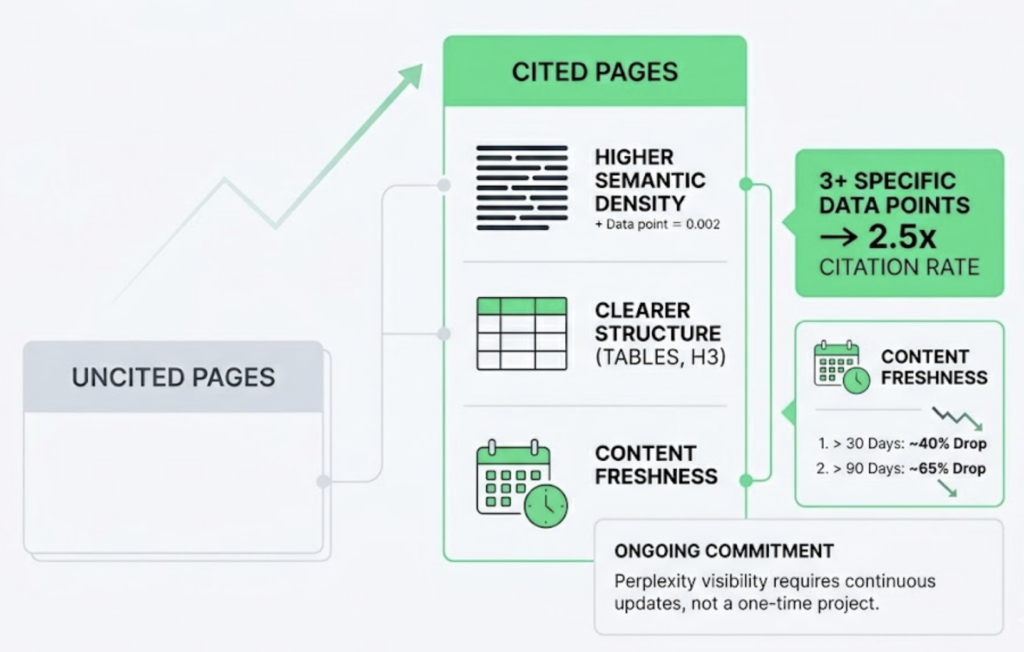
Factual density. Content that leads with a direct, specific answer is significantly more likely to be extracted. The “inverted pyramid” writing style — conclusion first, context second — maps almost perfectly to how RAG systems extract citeable information. Content that buries its key claim in paragraph four tends to get skipped.
Structural scannability. Perplexity prefers machine-readable formats. HTML tables for comparisons, ordered lists for step-by-step processes, FAQ sections with direct answers. Data shows that FAQ blocks generate roughly 0.5 additional citations per page on average. That’s a measurable lift from a formatting choice.
One more factor that most brands underestimate: content freshness. Citations for content older than 30 days drop by approximately 40%. For content older than 90 days, the drop reaches 65%. Perplexity actively weights recent updates, which means maintaining Perplexity visibility isn’t a one-time content project. It’s an ongoing publishing commitment.
4 Steps to Track Your Perplexity Ranking Right Now
Manual tracking is the right starting point if you’re new to this. Here’s how to do it correctly.
Step 1: Build a prompt library, not a keyword list. Perplexity users ask full questions, not fragments. Your tracking corpus should include three types of prompts: commercial intent (“best [product category] for [use case]”), problem-solution intent (“how to fix [specific pain point]”), and brand proof intent (“[your brand] vs [competitor],” “[your brand] reviews”). Aim for 20–30 prompts to start.
Step 2: Run a manual baseline audit. Use a dedicated browser profile with no search history to minimize personalization bias. Run each prompt, record whether your brand appears, note the citation position (footnote #1 vs footnote #5 matters), and capture the sentiment of the mention.
Step 3: Track competitor source URLs. This is the highest-leverage action in the entire process. For every prompt where a competitor is cited and you’re not, record the exact URL Perplexity is using. Then analyze it. What’s the structure? How dense is the data? How recently was it updated? This reverse-engineering tells you precisely what the algorithm is rewarding.
Step 4: Establish a monitoring cadence. Perplexity’s response volatility is significant. Up to 80% of cited sources can change between monitoring runs due to model updates, recrawl timing, and LLM temperature variation. Weekly tracking is a minimum. Daily is better for competitive categories. A single data point is noise. Trends over 4–8 weeks are signal.
How Topify Automates Perplexity Source and Ranking Tracking
Manual tracking works at under 20–30 prompts. Once your monitoring corpus grows, or once you’re managing multiple brands, it breaks down fast.
Topify is built specifically for this problem. The platform automates the process of monitoring brand presence across Perplexity, ChatGPT, Gemini, and other major AI engines simultaneously, which matters because a brand’s AI visibility strategy should never be siloed to a single platform.
For Perplexity tracking specifically, two features are central.
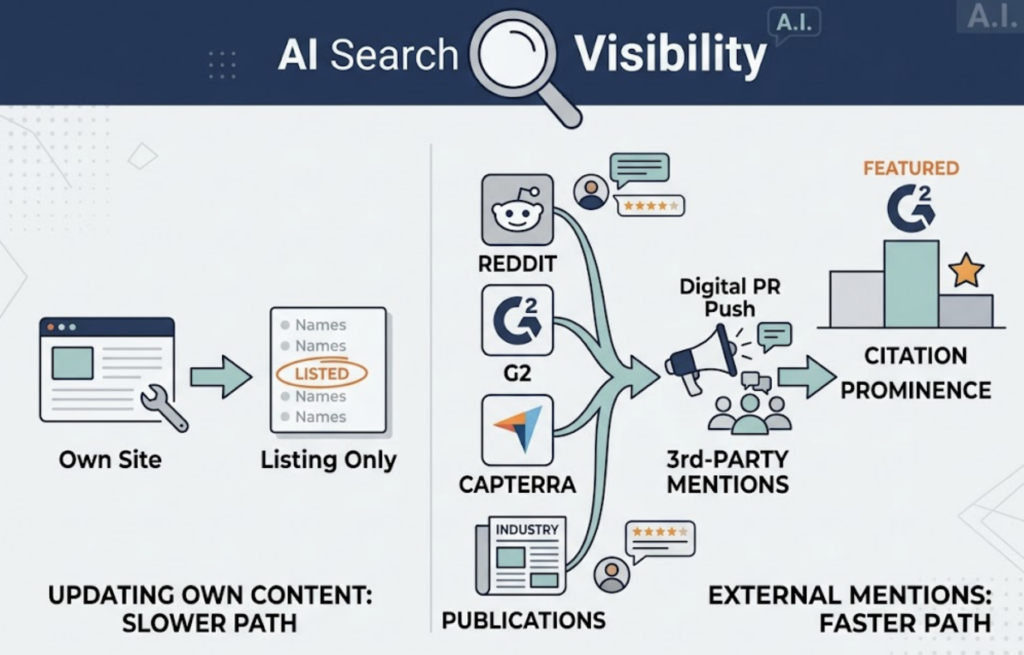
Position Tracking categorizes your brand’s presence into tiers: Featured (#1), Top 3, Listed, or Not Mentioned. This is meaningfully different from a raw mention count. Being “listed” in a response is not the same as being the first cited source. Topify separates these, so you can track whether your brand is gaining prominence or just appearing in the footnotes.
Source Analysis is where competitive intelligence comes in. Topify identifies exactly which domains and URLs Perplexity is citing for your target prompts, including when those citations belong to competitors. Over time, it surfaces patterns: which competitor pages are consistently displacing yours, and on which prompts. That’s the data you need to prioritize content remediation.
There’s also a Multi-Model Consensus Score — a measure of whether your brand is recognized as authoritative across different AI models simultaneously (Sonar, Sonar-Pro, GPT-4o, Claude). Brands that score high across models have more durable visibility than those favored by only one algorithm.
Topify’s Basic plan starts at $99/month, covering ChatGPT, Perplexity, and AI Overviews tracking across up to 100 prompts. For growing teams, the Pro plan at $199/month expands to 250 prompts and 10 seats.
What to Do After You Find Your Perplexity Ranking
Data without action is just a report. Here’s how tracking converts into visibility improvements.
Defend cited pages aggressively. If a URL is already earning citations, treat it as a high-value asset. Update it monthly with fresh statistics, sharper headers, and refined definitions. Citation authority decays quickly — don’t let a winning page go stale.
Attack competitor source URLs directly. When Topify shows you that Perplexity is citing a competitor’s comparison page for a prompt you care about, build a better version. Cleaner table structure, more specific data points, a lead paragraph that answers the question in the first two sentences. The goal is to become the more extractable source.
Claim unclaimed queries. Some prompts return no strong citations — the AI gives a generic answer because no authoritative source exists. These are gaps you can fill. A well-structured, data-dense piece published specifically to answer that prompt can establish your brand as the default source before competitors notice the opportunity.
Beyond your own site, Perplexity draws from the entire web. Presence on Reddit, G2, Capterra, and industry publications directly influences AI visibility. If your brand is stuck in “Listed” rather than “Featured” positions, a targeted digital PR push to build third-party mentions in the sources Perplexity already trusts is often the faster path to citation prominence than updating your own content.
Conclusion
Perplexity ranking isn’t a vanity metric. It’s a direct measure of whether your brand exists in one of the highest-converting discovery channels available right now.
The brands that move first on AI search monitoring will have a structural advantage that compounds. Not because the tools are complicated, but because most competitors still haven’t started. Tracking perplexity source URLs, understanding citation position, and closing the content gap between what the algorithm cites and what you publish — that’s the work.
Start with a prompt library. Run a manual baseline. Then let automation handle the scale.
FAQ
Why should I track my Perplexity ranking separately from Google? Because the two platforms measure completely different things. Google tracks popularity through backlinks and user behavior. Perplexity tracks factual utility and structural scannability. Research confirms that 80% of AI-cited URLs don’t appear in Google’s top 100 results for the same query. A strong Google ranking gives you no information about your Perplexity visibility.
What are Perplexity source URLs and why do they matter? Source URLs are the specific pages Perplexity credits when building its synthesized answers. They matter because they reveal exactly which content the algorithm trusts. By tracking them, you can see whether Perplexity is citing your pages, your competitors’, or third-party review sites — and use that information to prioritize optimization efforts.
How often does Perplexity change its sources? Frequently. Volatility rates for AI-generated responses can reach 80%, with different sources appearing for identical prompts across runs due to model updates, recrawl timing, and LLM temperature settings. This is why single-point-in-time checks are unreliable. You need trend data over multiple weeks to identify real patterns.
Can I track Perplexity rankings without a dedicated tool? Yes, for a small prompt corpus of under 20–30 queries. Manual tracking is a valid starting point for establishing a baseline. The limitations are personalization bias, the inability to run queries at scale, and the time cost of aggregating data across multiple platforms. Once your monitoring needs grow, a platform like Topify becomes the practical path forward.

