

Your team spent months building content, earning backlinks, and moving up Google’s rankings. Then a potential customer opened ChatGPT and typed, “What’s the best tool for [your category]?” and got five recommendations. Your brand wasn’t one of them.
That’s the visibility gap. And right now, most brands don’t know it exists until it starts costing them.
The Metric Your SEO Dashboard Can’t Show You: AI Search Visibility
AI search visibility measures how often your brand appears, gets cited, or gets recommended in AI-generated responses across platforms like ChatGPT, Perplexity, and Gemini. It’s not a ranking. It’s a probability.
That distinction matters. Traditional SEO is a hierarchical system: the highest-ranked URL captures the majority of clicks. AI search is a recommendation engine: it synthesizes information from dozens of sources and names specific brands in its answer. Your domain authority score plays almost no role in that decision.
The numbers behind this shift are harder to ignore every quarter. ChatGPT reached 800 million weekly active users by October 2025. Traditional search traffic is projected to fall 25% by 2026. Meanwhile, combined traffic to AI search platforms grew at an average monthly rate of 721% in the year leading into mid-2025. That’s not a trend. That’s a structural change.
AI SEO, as a discipline, starts with accepting that ranking and being recommended are two separate outcomes that now require two separate strategies.
Why AI Search Engines Recommend Some Brands and Ignore Others
Here’s the part most marketers miss: only 12% of URLs cited by ChatGPT, Perplexity, and Copilot actually rank in Google’s top 10 for the same query. And 80% of citations in AI Overviews don’t rank organically in Google’s top 100 at all.
AI retrieval doesn’t work like link-based ranking. Generative engines use a process called Retrieval-Augmented Generation (RAG), which pulls structured, extractable chunks of information from multiple sources and synthesizes them into a single answer. The brands that get cited are the ones whose content is easiest to parse, not necessarily the ones with the highest domain rating.
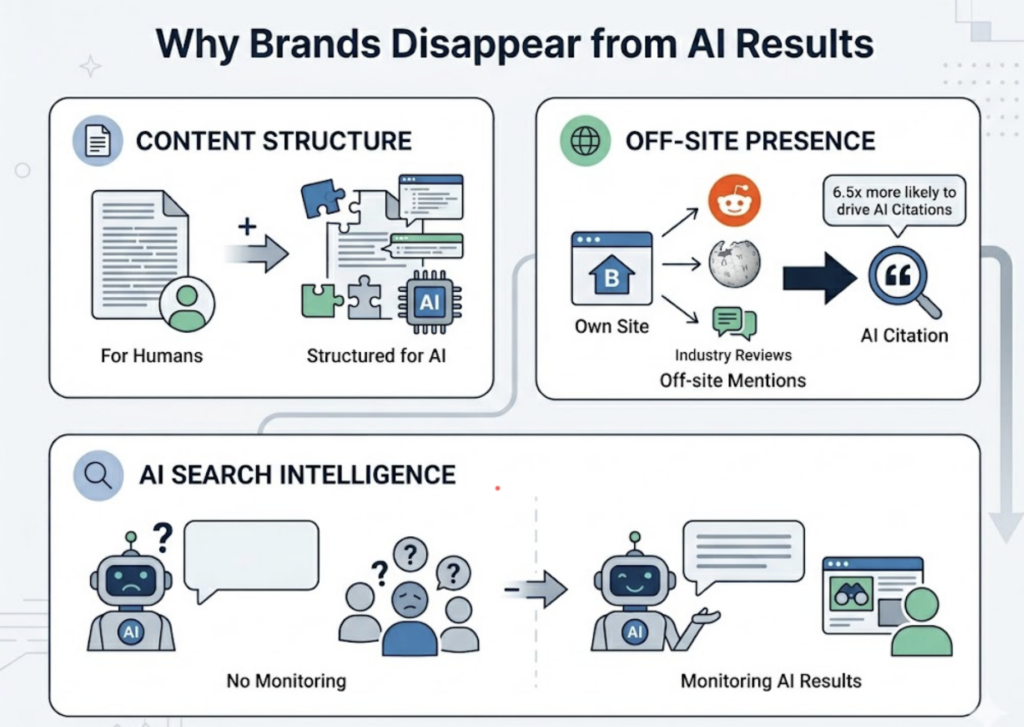
Three factors tend to explain why brands disappear from AI results. First, their content isn’t structured for extraction, meaning it reads well for humans but isn’t modular enough for AI to pull clean, self-contained facts. Second, their off-site presence is thin. Research shows that off-site mentions on platforms like Reddit, Wikipedia, and industry review sites are 6.5 times more likely to drive AI citations than content hosted on a brand’s own domain. Third, the brand’s AI search intelligence is nonexistent, so nobody’s monitoring what the AI actually says when asked about the category.
AI search optimization isn’t about gaming an algorithm. It’s about making sure AI can accurately understand and represent your brand.
What AI Search Visibility Actually Measures: The 7 Signals That Matter
A single “were we mentioned?” query on ChatGPT doesn’t give you AI search analytics. It gives you one data point from a non-deterministic system. Real measurement requires tracking across hundreds of prompts, across multiple platforms, over time.
The framework that captures this has seven dimensions. Visibility tracks mention frequency: out of 100 relevant prompts, how many responses include your brand? Sentiment measures how the AI frames you, whether as a trusted leader, a budget option, or worse. Position captures where you appear in the response relative to competitors. Volume estimates how many AI searches are happening in your category. Mentions counts raw appearances. Intent maps which user intents your brand shows up for. And CVR estimates how likely an AI mention is to drive downstream conversion.
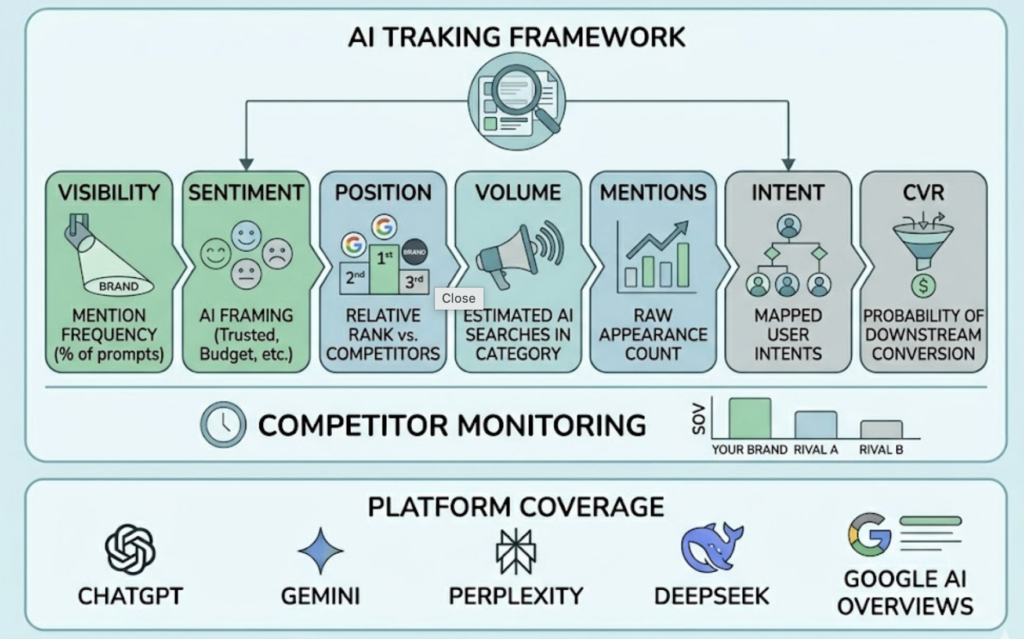
Each of these signals tells a different part of the story. A brand can have high Visibility but low Sentiment, meaning it gets mentioned often but framed negatively. Or high Position but low Volume, meaning it dominates a niche that barely anyone is searching in AI. You need all seven to get an accurate picture of your AI brand visibility.
Topify tracks all seven metrics across major AI platforms including ChatGPT, Gemini, Perplexity, and DeepSeek in a single dashboard, which is what makes it useful for teams that need to act on data rather than just collect it.
Customer Praise and Adaptability: The Two Hidden Drivers of AI Search Visibility
Most marketers assume that positive reviews help and negative reviews hurt. The reality, at least in AI search, is more nuanced.
Research into Reddit citation patterns shows that citation rates for positive brand sentiment (5%) and negative sentiment (6.1%) are nearly identical in AI responses. AI models aren’t looking for praise. They’re looking for authentic evaluation. A brand discussed only in polished, marketing-approved language may actually be less visible to AI than a brand with honest, balanced discourse on community platforms.
That’s the “customer praise and adaptability” dynamic that rarely appears in traditional SEO guides. Reddit content appears in 25% to 40% of AI results for trending topics, outpacing Wikipedia and YouTube for commercial evaluation queries. AI models treat community platforms as subject-matter experts on product experience, and they weight that signal heavily when answering questions like “Is this product actually worth it?”
Adaptability matters for a related reason. AI platforms update their citation patterns regularly. A brand that was visible in ChatGPT responses six months ago may have lost ground as the model’s training data or retrieval behavior shifted. Brands with strong AI search visibility tend to monitor those changes and adjust content strategy accordingly, not once a quarter, but continuously.
How Brands Can Monitor and Improve AI Search Visibility
The operational framework comes down to three steps: know where you stand, understand why, then act.
Step one is establishing a baseline. Query 20 to 30 core prompts across ChatGPT, Gemini, and Perplexity and record how often your brand appears, what position it holds, and how the AI frames it relative to competitors. Most teams doing this for the first time discover gaps they didn’t know existed.
Step two is tracing the root cause. Low Visibility often traces back to thin off-site presence or content that isn’t structured for AI extraction. Low Sentiment typically reflects a pattern in third-party reviews or community discussions. Source analysis reveals which domains the AI is pulling from when it describes your category, and whether your owned content or third-party mentions are appearing there at all.
Step three is execution. This is where most teams lose momentum. The analysis is clear, but acting on it, rewriting content for extractability, building community presence, chasing citations on authoritative sites, requires either significant manual effort or automation.
Topify’s one-click agent execution is designed specifically for this gap. You define your goals in plain language, the platform proposes a GEO strategy across content, citations, and visibility, and you launch it with a single click. No manual workflows, no spreadsheet tracking across platforms. The system monitors, reasons, and executes on your behalf, which is what teams managing multiple brands or categories actually need.
For teams that want to start with the analytics layer before committing to full execution, Topify’s Basic plan starts at $99/month, covering 100 prompts across ChatGPT, Perplexity, and AI Overviews.
AI Search Visibility and Customer Service: Why Your Support Reputation Shapes AI Recommendations
When someone asks an AI, “Does Brand X have good customer support?”, the model doesn’t pull from your support page. It pulls from the aggregate of reviews, forum discussions, and third-party evaluations that it associates with your brand.
That has a direct impact on where you appear in recommendation queries. Research shows that a pattern of “unprofessional service” in reviews will override a high star rating in the model’s evaluation, leading it to exclude a brand from category recommendations entirely. On the flip side, companies with mature, responsive customer service tend to earn sentiment tags like “reliable” and “fast” in AI-generated comparisons, which positions them favorably in the AI’s output.
The data supports the connection. Every 10-point increase in a brand’s NPS score has been shown to generate 3.2% revenue growth, a correlation that compounds when AI assistants pick up the brand as a “trusted” option for recommendation queries. Companies with mature AI implementations in customer service report 17% higher satisfaction scores and 8.5% better retention, outcomes that feed directly back into the brand signals AI models use.
AI search visibility brands with strong customer service reputations don’t just perform better in surveys. They appear more often, ranked higher, and framed more positively when AI answers a question in their category.
The implication is that managing your AI visibility requires managing your reputation, not just your content. Review recency signals to AI that a brand is active. Review sentiment influences how the AI frames your positioning. And review volume builds the kind of distributed authority that AI engines treat as consensus.
Conclusion
The gap between ranking on Google and being recommended by AI isn’t closing on its own. AI-mediated search is projected to influence up to $750 billion in retail revenue by 2028, and brands that fail to close the visibility gap risk losing 20% to 50% of search-driven traffic to competitors who appear in those AI answers instead.
The upside is real too. Visitors referred from AI tools convert at 3.5 to 4.4 times the rate of traditional organic search, because the AI has already qualified their intent. The traffic is smaller, but it’s more likely to buy.
Traditional SEO gets you found. AI search optimization gets you recommended. Both matter now, but only one of them is growing. Get started with Topify to establish your baseline visibility score and see exactly where your brand stands in the AI answers your customers are already reading.
FAQ
Q: What is AI search visibility and how is it different from SEO?
A: AI search visibility measures how often and how favorably your brand appears in AI-generated responses across platforms like ChatGPT, Perplexity, and Gemini. Traditional SEO optimizes for keyword rankings and click-through rates on Google. AI search visibility focuses on citation rate, recommendation frequency, and sentiment in AI answers. The two have very little overlap: research shows only 12% of URLs cited by AI engines rank in Google’s top 10 for the same query.
Q: How do AI search engines decide which brands to recommend?
A: AI engines use a retrieval process that prioritizes content clarity, entity associations, and distributed authority across the web. Brands with structured, extractable content and strong off-site mentions on platforms like Reddit, Wikipedia, and industry review sites tend to get cited more frequently. Domain authority and backlink profiles, the traditional SEO signals, carry far less weight in this process.
Q: How can I check my brand’s current AI search visibility?
A: Start by querying 20 to 30 category-relevant prompts manually across ChatGPT, Gemini, and Perplexity. Record how often your brand appears, at what position, and how it’s framed. For ongoing monitoring across hundreds of prompts and multiple platforms, tools like Topify automate this process and provide visibility, sentiment, and position data in a structured dashboard.
Q: Does customer sentiment actually affect AI search rankings?
A: Yes, directly. AI models analyze review patterns, community forum discussions, and third-party evaluations to determine how to frame a brand in recommendation responses. A consistent pattern of negative support experiences in reviews can lead AI engines to omit a brand from “Top 10” lists, regardless of star rating. Positive, authentic sentiment, especially on platforms like Reddit, correlates with more frequent citation and stronger positioning in AI-generated comparisons.

