

Your quarterly report looks clean. Organic traffic is stable, keyword rankings are holding, and the team has nothing to flag. Meanwhile, a potential customer asked ChatGPT to recommend a tool in your category—and your brand wasn’t mentioned once. No alert fired. Nothing in the dashboard moved. You had no way to know.
That’s the AI citation blind spot. And for most marketing teams, it’s been open for longer than they realize.
Most Brands Have No Idea AI Is Ignoring Them
The scale of the problem is hard to overstate. Only 22% of marketing teams currently have the infrastructure to track their brand’s visibility inside AI models—yet 73% of B2B buyers now routinely use AI tools to research vendors and compare options before making contact.
That math doesn’t work in your favor.
What makes it worse: 93% of AI search sessions end without a website visit. The buyer researches, gets an answer, and moves on. If your brand wasn’t cited in that answer, you weren’t part of the decision. Your analytics will never show a dip. Your rankings stay exactly where they were. Nothing changes—except you lost the deal.
What “AI Citation” Actually Means in 2026
Most marketers treat “appearing in AI” as a single thing. It isn’t. There are three distinct forms of presence, and they require different tracking logic.
A brand mention is when the AI includes your brand name in the text of a response. It signals that the model has learned your brand exists, but it doesn’t mean you’re being recommended.
An AI citation is when the model links to or references a specific URL or domain as a source. This is about authority. The AI is treating your content—or content about you—as a credible information source.
An AI recommendation is the highest-value outcome: the model explicitly names your brand as a solution to a problem. This is what drives pipeline.
Here’s the thing most teams miss: you can have plenty of citations without a single recommendation. And you can be recommended without ever being cited. Each of these has its own tracking requirement.
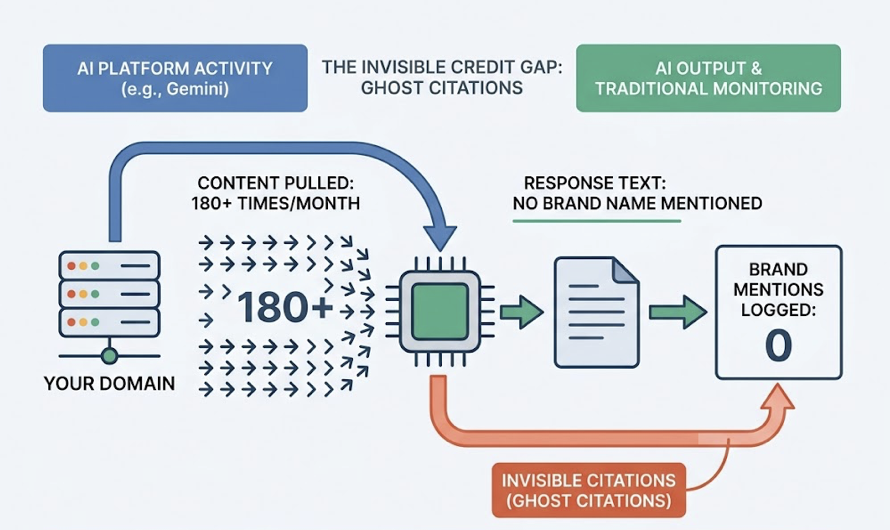
There’s also a fourth scenario that almost no one is monitoring: ghost citations. Research from early 2026 found that up to 73% of a brand’s AI presence can consist of invisible citations—cases where a platform like Gemini pulls from your domain over 180 times in a month but never mentions your brand name in the response text. Traditional brand monitoring tools, which scan for brand name mentions, will log zero activity. The citations are real. The credit is invisible.
Why Your Analytics Dashboard Can’t See Any of This
GA4 wasn’t built for a zero-click, non-linear, conversational discovery environment. It runs on referrer headers. When AI discovery happens, those headers often don’t survive the journey.
When a user taps a link inside the ChatGPT or Perplexity mobile app, the in-app browser strips the referrer data. The visit lands in GA4 as “Direct” traffic. When a user reads an AI answer, copies the URL, and pastes it into a new tab, there’s no referral signal at all. When a click comes from Google’s AI Overviews, it gets grouped into “Google Organic”—making it impossible to tell whether your traditional SEO or your AI visibility is driving the result.
The AI traffic you can see in GA4 is a floor, not a ceiling. The actual volume of AI-influenced discovery is higher, and there’s no native tool to close the gap. This is why a new category of AI citation tracker platforms has emerged: they measure presence at the source—inside the LLM response—rather than at the destination.
What a Real AI Citation Tracker Actually Monitors
An effective ai citation tracker isn’t doing keyword scans. It’s simulating the conversational queries your buyers are actually running, then extracting structured data from the responses. Four dimensions matter.
Citation frequency. What percentage of relevant queries include your brand? For B2B SaaS, category leadership in 2026 is typically defined by a 40-50% citation rate across a defined prompt library. If you don’t know your number, you’re making content decisions without a baseline.
Source attribution. Which domains and URLs is the AI pulling from when it talks about your brand? This is where things get counterintuitive. AI models are 6.5 times more likely to cite a brand through an external authoritative source—like Reddit, G2, or a trade publication—than through the brand’s own website. If you’re only publishing on your blog, you’re contributing less to your AI visibility than you think.
Competitive displacement. Visibility is always relative. The critical metric isn’t just “did I appear?”—it’s “when I didn’t appear, who did?” Tracking displacement prompts tells you exactly where your competitors are taking citations you’re not.
Sentiment polarity. How is the AI characterizing your brand when it does mention you? There’s a meaningful difference between being cited as “a leading enterprise platform” and being cited as “a budget-friendly legacy option.” Both count as mentions. Only one helps your positioning.
Topify tracks all four of these dimensions across ChatGPT, Gemini, Perplexity, and other major AI platforms. Its Source Analysis feature identifies the specific domains the AI is using to retrieve information about your brand—not just whether you’re appearing, but why. For teams moving from manual spot-checks to systematic tracking, the platform’s Basic plan covers 100 prompts and 9,000 AI answer analyses monthly for $99/mo.
How to Set Up AI Citation Tracking in 3 Steps
Step 1: Build a prompt matrix.
Don’t start with generic keywords. AI Overviews and assistants are triggered most reliably by conversational queries. Question-based prompts (“How do I choose…?”) carry a 57.9% AI trigger rate. “Why” queries hit 59.8%. Long-tail queries with 7+ words land at 46.4%. Your prompt matrix should mirror how your buyers actually talk—covering purchase intent, comparison, and informational scenarios.
Step 2: Run a baseline.
Before you automate anything, manually test 10-20 core prompts across ChatGPT, Perplexity, and Gemini. Record not just whether your brand appears, but how it’s described. This “sentiment audit” often surfaces narrative drifts—cases where the AI is characterizing your product in ways that no longer match your current positioning. It’s better to find this in a baseline than to discover it six months into a tracking program.
Step 3: Automate the cadence.
Manual tracking breaks down fast. AI-cited sources rotate 40-60% within a single month due to model updates and content freshness changes. A weekly monitoring cadence is the practical minimum to catch competitive displacements as they happen. Manual audits run 3-5 hours per week with roughly 80% consistency. Automated tracking through a platform like Topify runs at 99% consistency and cuts active time to about one hour per week.
Scaling across 50-100+ prompts and multiple competitors is where spreadsheets stop working. Automation isn’t just about efficiency—it’s about catching the signal before your competitor does.
What to Do After You See Your Citation Data
The data is only the first half. The second half is acting on it.
When you identify a displacement prompt—a query where a competitor is cited but you’re not—the Source Analysis data tells you exactly why. If the AI is citing a competitor’s Reddit thread, your gap is in community presence. If it’s citing a competitor’s structured how-to guide, your gap is in content architecture. The citation data doesn’t just tell you where you stand. It tells you exactly what to build next.
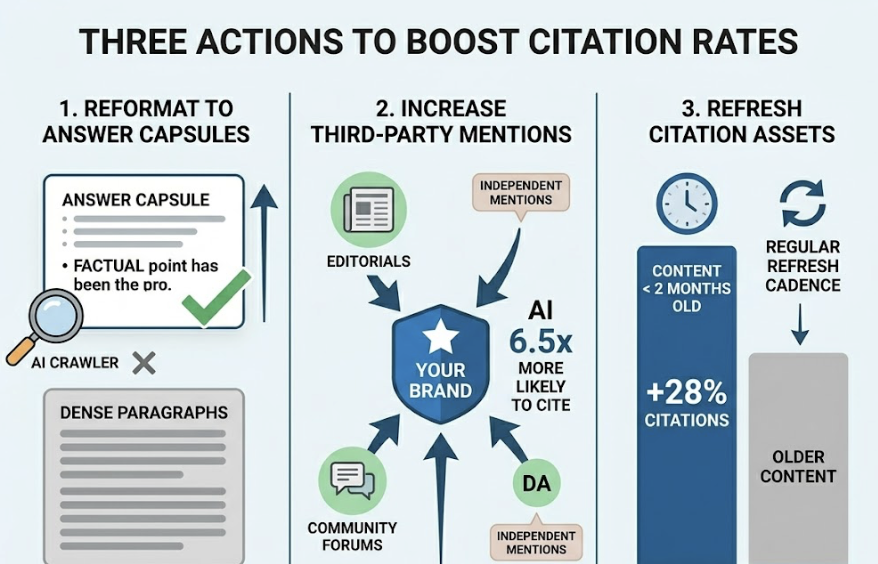
Three actions tend to move citation rates the fastest. First, reformatting high-value pages into concise “answer capsules”—factual blocks at the top of the page that AI crawlers are far more likely to extract than dense paragraphs. Second, increasing third-party mentions on authoritative sites. Given that AI is 6.5x more likely to cite external sources, a mention in an independent editorial or community forum is higher leverage than another post on your own blog. Third, keeping citation assets fresh. Content updated within the last two months earns 28% more citations than older content—making a regular refresh cadence as important as original production.
The ROI case for getting this right is documented. Brands that have focused on answer engine optimization have seen 120% revenue growth from AI-driven traffic and 693% increases in AI-channel visits. AI-referred traffic also converts at 5.1x the rate of traditional organic search—so even a modest shift in citation frequency carries outsized pipeline impact.
Conclusion
The AI citation blind spot isn’t going to close on its own. As B2B buyers complete 61% of their purchase journey before ever contacting a vendor, the conversations that shape their shortlists are happening entirely inside AI interfaces—without any signal reaching your dashboard.
Closing that gap starts with knowing where you stand. Run a baseline this week. Map your prompt matrix. Then decide whether manual checks can realistically keep up with a measurement environment where cited sources rotate monthly. For most teams, the answer is clear. Get started with Topify and turn AI citation tracking from a blind spot into a growth channel.
FAQ
Q: What is an AI citation tracker?
A: It’s a specialized tool that monitors how often and in what context your brand, content, or URLs are referenced in AI-generated responses from platforms like ChatGPT, Perplexity, and Gemini. Unlike brand monitoring tools that scan for name mentions, an AI citation tracker also monitors URL-level references, which often account for the majority of a brand’s AI presence.
Q: How is AI citation different from traditional SEO ranking?
A: Traditional SEO focuses on ranking a URL in a list of results to drive a click. AI citation focuses on being the synthesized answer—or being the source the AI draws from to construct that answer—in a zero-click environment. The feedback loops, measurement tools, and optimization actions are fundamentally different.
Q: Can I track brand citations across ChatGPT and Perplexity at the same time?
A: Yes. Modern platforms like Topify offer multi-model monitoring, allowing you to compare citation frequency, sentiment, and source attribution across different AI ecosystems from a single dashboard.
Q: How often does AI citation data change?
A: AI visibility is more volatile than traditional search rankings. Research shows 40-60% of cited sources can rotate within a single month due to model updates and content freshness signals. Weekly tracking is the recommended minimum cadence to catch displacement events before they compound.

