

Search “best LLM SEO trackers” and you’ll find dozens of platforms claiming to monitor AI search visibility. Most of them show you the same thing: how often your brand name appears in an AI-generated answer. That’s useful on paper, but it doesn’t answer the question most SEO teams are actually asking: which specific URLs is Perplexity pulling when it recommends your category? And why is ChatGPT citing your competitor’s comparison page instead of yours?
The gap between brand mention tracking and AI citation tracking is where most tools stop short. Closing that gap is what separates a visibility report from an actual content strategy.
Most LLM SEO Trackers Measure Mentions. AI Citation Tracking Is a Different Problem.
There’s a distinction that gets glossed over in nearly every tool comparison in this space: the difference between a brand being mentioned in an AI answer and a brand’s content being cited as a source.
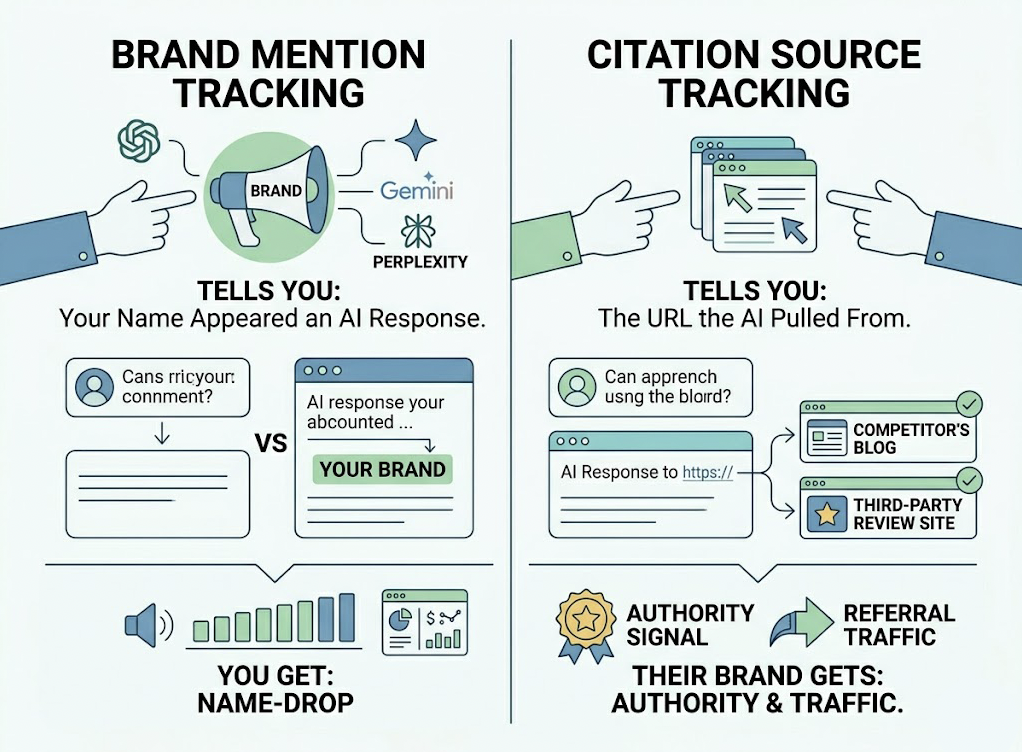
Brand mention tracking tells you your name appeared in a response. Citation source tracking tells you which URL the AI pulled from to construct that response. Those are two completely different signals.
Here’s why the difference matters in practice. Your brand might show up in a ChatGPT answer, but the citation backing the claim could link to a competitor’s blog or a third-party review site. You got the name-drop; someone else got the authority signal and the referral traffic.
The reverse is equally important. If your content is frequently cited as a source, even when your brand name isn’t explicitly mentioned, you’re still building domain authority with the AI model. That matters because AI search traffic converts at roughly 14.2% compared to 2.8% for traditional Google search. Citation placement drives that conversion gap.
Most perplexity seo trackers and best chatgpt seo trackers on the market today are built around mention frequency. A much smaller subset can actually parse the citation layer. That’s the distinction worth paying attention to in 2026.
5 AI Citation Tracking Platforms, Ranked by What They Actually Measure
Here’s how the leading platforms stack up across the dimensions that matter for citation-level analysis:
| Platform | Cross-Platform Coverage | URL-Level Citation Tracking | Sentiment Analysis | Starting Price | Best For |
|---|---|---|---|---|---|
| Topify | ChatGPT, Perplexity, Gemini, Claude, DeepSeek, Qwen, Doubao + more | Yes (core feature) | Enhanced | $99/mo | Marketing teams, SEO agencies |
| Profound | 10+ engines incl. Grok, Meta AI | Partial | Deep | $499/mo | Fortune 500, enterprise brand safety |
| Otterly.AI | ChatGPT, Perplexity, AI Overviews | Basic | Basic | $29/mo | Solo SEOs, small teams |
| Peec AI | Core B2B engines | Yes | Standard | €89/mo | Global brands, multilingual tracking |
| Omnia | ChatGPT, Perplexity, Google AI Mode | Yes | Supported | €79/mo | Cross-border e-commerce, startups |
#1 Topify: URL-Level Citation Analysis Across Every Major AI Platform
Topify is the only platform in this category that treats citation source tracking as a core feature rather than an add-on. Most tools tell you your brand appeared in an AI response. Topify tells you which specific page the AI pulled from, how often that page is cited across different prompts, and where it sits in the citation order.
That last point carries more weight than it sounds. The first citation in an AI answer typically captures more than 60% of citation click share. Position within the citation list isn’t random, and tracking it over time is how you identify whether your content is gaining or losing ground with AI models.
How Topify’s Source Analysis Works
Topify doesn’t rely solely on official AI platform APIs, which can return data inconsistent with what real users see. Instead, it uses browser-based simulation to replicate actual user queries across geographic locations and device environments.
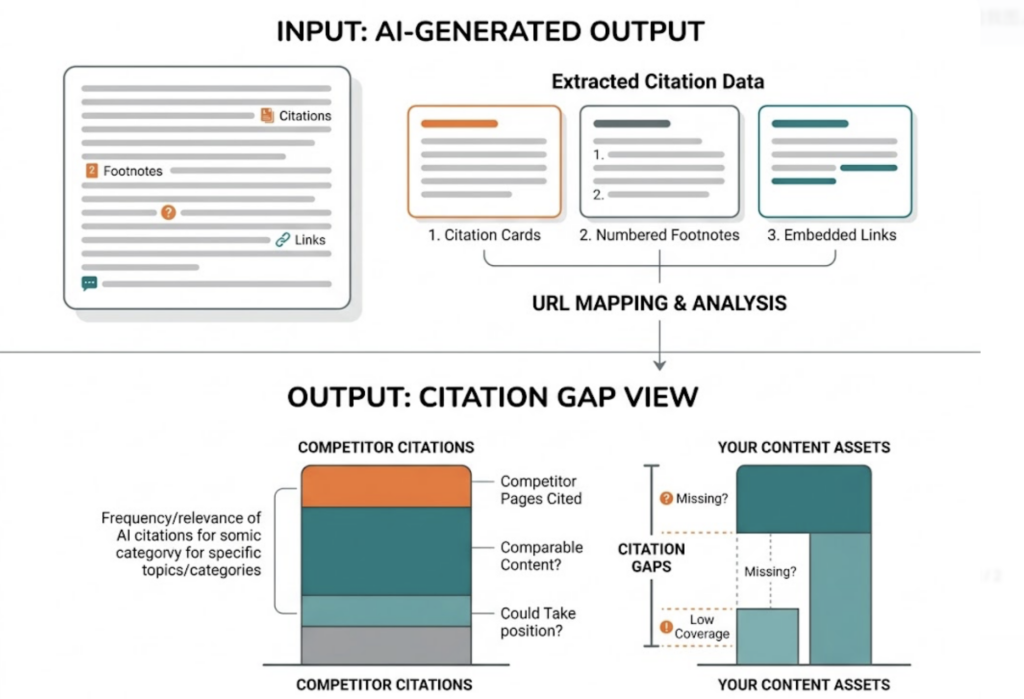
From there, it extracts citation cards, numbered footnotes, and embedded links from AI-generated outputs. Each URL is mapped against your own content assets and your competitors’ domains. The output is a “citation gap” view: which competitor pages is AI citing in your category, and do you have comparable content that could take that position?
When your citation share for a tracked prompt drops, the platform flags it automatically. It typically signals that your content has gone stale relative to what AI models currently prefer, or that a competitor has published something that’s pulled citation priority away.
This is the operational difference between best-in-class perplexity seo trackers and everything else in the market.
Coverage and Pricing
Topify’s platform coverage spans ChatGPT (79.98% global market share, roughly 2 billion daily queries), Perplexity (the highest citation density of any major AI engine), Gemini, Claude, DeepSeek, Qwen, and Doubao. For brands operating across multiple regions, that last tier matters.
Pricing is structured around actual usage:
- Basic at $99/mo: 100 prompts, 9,000 AI answer analyses, 4 projects, 4 seats, 30-day trial included
- Pro at $199/mo: 250 prompts, 22,500 AI answer analyses, 8 projects, 10 seats, full Source Analysis
- Enterprise from $499/mo: dedicated account manager, custom prompt volumes, API access, enterprise compliance support
You can get started with a 30-day trial on the Basic plan before committing to a higher tier.
#2–#4: Other AI Citation Trackers Worth Knowing
Profound sits at the enterprise end of the market, typically starting at $499/mo. Its strength is breadth: 10+ AI engines including Grok and Meta AI, plus a Conversation Explorer feature designed to catch brand hallucinations and inaccurate AI-generated claims. For Fortune 500 teams where brand governance is a compliance requirement, Profound covers the risk management layer. On the active SEO execution side, its optimization recommendations tend to be lighter compared to tools built for content teams doing iterative work.
Otterly.AI at $29/mo is the entry point for teams getting a first read on AI visibility. It covers ChatGPT, Perplexity, and AI Overviews, and its GEO audit tool surfaces basic structured data recommendations. What it doesn’t offer is URL-level source parsing or meaningful citation depth analysis. It’s a reasonable starting point for establishing a brand visibility baseline, not for running optimization cycles based on citation data.
Peec AI at €89/mo addresses a specific gap: multilingual citation tracking across 115+ languages. It also makes a distinction that most tools ignore, separating content the AI “used” from content it explicitly “cited” with a link. That difference matters for brands trying to understand uncredited content usage patterns. For global brands with significant non-English market exposure, Peec’s language coverage is hard to match at this price point.
How to Choose the Right AI Citation Tracking Platform for Your Needs
The right choice depends less on feature lists and more on what you’re actually trying to do with the data.
If you’re building citation authority from scratch, start with Otterly.AI for a baseline read on where you stand, then move to Topify once you have enough content assets to optimize. Tracking citations before you have a content strategy to act on doesn’t generate actionable signal.
If Perplexity is your primary channel (common for B2B companies targeting research-driven buyers), you need URL-level tracking. Perplexity’s citation logic is more explicit than ChatGPT’s, which makes source analysis both more actionable and more necessary. Topify’s Source Analysis is built specifically for this use case.
If you’re managing multiple clients or brands, Topify’s multi-project structure and reporting capabilities are designed for agency workflows. Profound is an alternative if your clients are enterprise-scale and brand risk management is on the agenda.
If your audience is non-English-speaking, Peec AI’s multilingual support is worth the trade-off in citation depth. For brands operating primarily in English-language markets, Topify’s platform coverage is more relevant.
The best tools for ai citation tracking platform evaluation all come down to one core question: do you need to know that your brand appeared, or do you need to know which URL the AI is using to justify its answer? For teams running active content strategy, it’s the second question that determines results.
What a Good AI Citation Tracking Strategy Looks Like in Practice
Having access to citation data is half the work. The other half is a workflow that turns that data into specific content decisions.
Here’s a four-step framework that works across team sizes.
Step 1: Build a prompt library that reflects real user behavior. Don’t just track branded queries. Build four categories: brand prompts (“Is [your brand] reliable?”), category prompts (“What are the best [product category] tools in 2026?”), comparison prompts (“[your brand] vs [competitor]: which is better?”), and problem prompts (“How do I solve [industry pain point]?”). Run these consistently across ChatGPT, Perplexity, and Claude to establish a citation baseline. Topify’s prompt monitoring automates this across all tracked platforms simultaneously.
Step 2: Identify your citation gaps. Once you have source data, look at which competitor pages AI is citing when answering your tracked prompts. If Perplexity keeps pulling a competitor’s comparison table when answering “how to choose [your category],” that’s not a ranking problem. It’s a content structure problem. You need a better comparison module that AI can extract from more cleanly. That’s a specific, fixable thing.
Step 3: Optimize for AI readability. Content that gets cited tends to share structural features: clear H2 and H3 headers, FAQ sections with direct question-answer pairs, and explicit definitions of key terms. Schema markup for Entity and Product types also helps AI engines map your content to specific knowledge domains more reliably. Citation data gives you direct evidence of which pages are already doing this effectively, and which aren’t.
Step 4: Run a two-week audit cycle. AI models update their citation preferences more frequently than traditional search indices do. A two-week cadence gives you enough time to see whether a content update shifted your citation position, without overreacting to daily noise. Use Topify’s real-time monitoring to flag drops in citation share between full audit cycles.
This strategy for ai citation tracking platform optimization works because it closes the loop between what AI engines are doing and what your content team produces. Without citation data, that loop stays open indefinitely.
Conclusion
The shift from keyword rankings to citation authority isn’t a future trend. It’s already the operating reality for brands in AI-heavy search categories.
In Google’s AI Mode, 93% of searches end without a click to any external site. The brands that extract value from AI search aren’t necessarily the ones with the highest keyword rankings. They’re the ones whose content is being selected as source material inside AI-generated answers.
That distinction is what an ai citation tracking platform is built to reveal. If you’re still relying on tools that only report brand mentions, you’re working with half the picture. The other half is knowing which URLs are doing the actual work inside AI-generated answers, and whether those URLs belong to you or to your competitors.
Topify gives you that visibility across every major AI platform in 2026. You can start a 30-day trial on the Basic plan and have your first citation audit running within the hour.
FAQ
Q: What is an AI citation tracking platform?
A: It’s a specialized tool that monitors which specific URLs or domains AI engines like ChatGPT, Perplexity, and Claude cite when generating answers to user queries. Unlike traditional SEO tools that track keyword rankings in static search results, an AI citation tracking platform analyzes dynamic, AI-generated outputs to show you which content is being selected as evidence and where.
Q: How does AI citation tracking work differently from traditional SEO tracking?
A: Traditional SEO tracking measures your position in a ranked list of search results. AI citation tracking measures whether your content is selected as a source when an AI synthesizes an answer from scratch. You can rank first in Google and still not appear in AI-generated responses. The reverse is also possible: pages with modest traditional rankings can become high-frequency AI citations if their structure and content quality match what AI models look for.
Q: What’s the difference between the best Perplexity SEO trackers and ChatGPT SEO trackers?
A: Each AI engine has different citation preferences. Perplexity favors real-time, factual, and structured sources, and it has the highest citation density of any major platform. ChatGPT tends to weight high-authority domains from its pre-training data, like established publications and Wikipedia. The best claude seo trackers need to account for Claude’s preference for long-form, analytically structured content. The best perplexity seo trackers need real-time citation parsing. Topify builds platform-specific tracking logic to surface these differences rather than averaging them together.
Q: How much does an AI citation tracking platform cost?
A: Pricing varies significantly by capability. Entry-level mention tracking tools like Otterly.AI start at $29/mo. Professional citation-level platforms like Topify run $99 to $199/mo depending on prompt volume and project count. Enterprise tools like Profound typically start at $499/mo and scale with team size and platform breadth. You can see a current breakdown at Topify’s pricing page.

