

Your keyword rankings are solid. Domain authority looks healthy. But when your CEO asks, “Are we showing up in ChatGPT when people ask about us?” — nothing in your current reporting stack can answer that.
That’s the gap. AI search visibility requires a completely different tracking approach, and most teams are still figuring out where to start.
Why Tracking AI Search Visibility Is Not Like Tracking Google Rankings
Traditional SEO tools track a binary state: a page is either ranking or it isn’t. AI search doesn’t work that way.
When ChatGPT or Google AI Overviews answers a query, it doesn’t rank your page. It decides whether your brand is credible enough to cite, include, or recommend. That’s a citation decision, not a ranking decision, and it operates on entirely different logic.
The gap in outcomes is measurable. For queries where an AI Overview is present but your brand isn’t cited, organic CTR collapses by 65.2% year-over-year. Even when you are cited, you’re still looking at a 49.4% decline in organic CTR compared to pre-AIO baselines. The brands that do earn citations see a 35% boost in organic clicks and a 91% lift in paid clicks compared to competitors on the same query.
That gap is what AI search visibility tracking is designed to close.
| Metric Dimension | Traditional SEO | AI Search Visibility |
|---|---|---|
| Primary Goal | Rank #1-10 for keywords | Be cited in a synthesized answer |
| Success Metric | Organic traffic / CTR | Share of Voice, Sentiment, Citation Rate |
| Logic | Retrieval & Ranking | Retrieval-Augmented Generation |
| Stability | High (fixed index updates) | Volatile (model updates, source rotation) |
What AI Search Visibility Actually Measures
Before you track anything, you need to know what you’re tracking. AI search visibility isn’t a single number.
Visibility Rate is how often your brand appears in AI-generated answers for a defined set of prompts. Think of it as your AI Share of Voice. If an engine surfaces three to five brands per answer, this metric tells you whether you’re in that shortlist.
Position tracks where in the response your brand appears. Being the first brand mentioned carries more weight than being fifth. Advanced frameworks use weighted position scoring where early mentions count proportionally more.
Sentiment captures how the AI describes you, not just whether it mentions you. “Most affordable option” and “complex to implement” are both mentions. They’re not the same thing.
Source Citations shows which URLs the AI is pulling from to build its answer. Most AI engines use retrieval-augmented generation to reduce hallucinations, so being a cited source is the most direct way to ensure your content actually shapes the output.
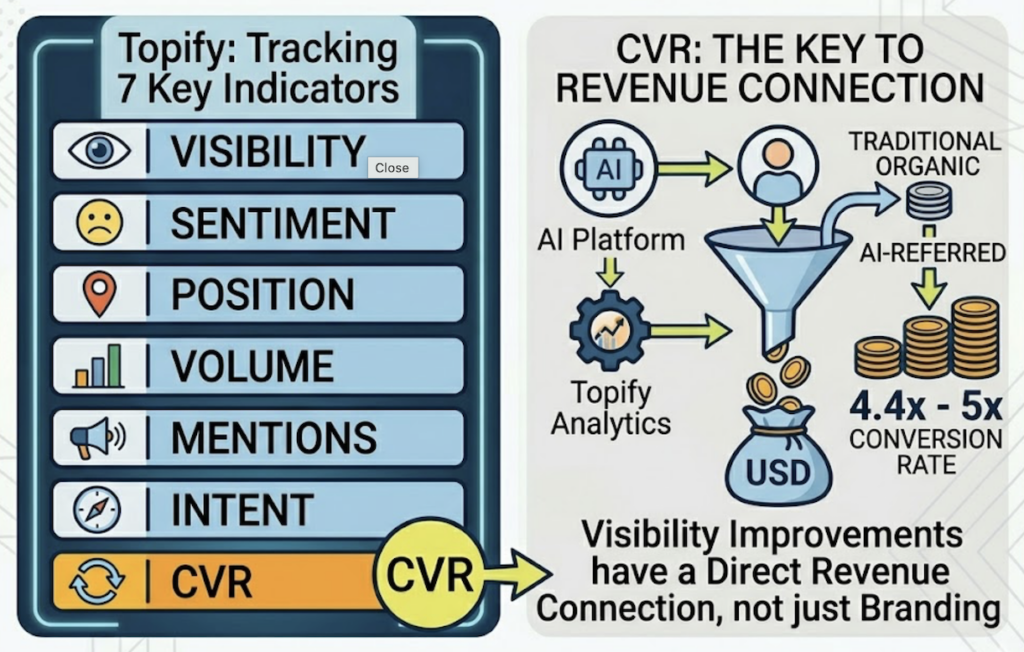
For teams that need a fuller picture, Topify tracks seven indicators across these dimensions: visibility, sentiment, position, volume, mentions, intent, and CVR. That last one matters more than most people expect. AI-referred traffic converts at 4.4 to 5 times the rate of traditional organic search traffic, which means visibility improvements have a direct revenue connection, not just a branding one.
How to Track Your AI Overviews Rankings Over Time
As of late 2025, approximately 15.69% of all Google queries trigger an AI Overview, rising to 25.11% in high-intent sectors like healthcare and science. For marketers in competitive categories, AIO tracking isn’t optional.
Here’s a workflow that holds up over time.
Step 1: Build a Prompt Matrix, Not a Keyword List
AI Overviews are triggered by conversational and question-based queries. Question-based queries have a 57.9% AIO trigger rate. Long-tail queries of seven or more words trigger at 46.4%. “Reason” queries starting with “Why” come in at 59.8%.
Your prompt list should cover the Why, How, and What of your category. “Why is [problem] happening” and “How do I choose between [category options]” will generate AIO results far more reliably than exact-match branded terms.
Step 2: Set Your Tracking Frequency
40 to 60% of AIO cited sources rotate monthly. That’s not gradual drift. That’s significant churn.
Weekly tracking is the practical minimum. Monthly snapshots will miss the shifts that actually matter.
Step 3: Log More Than Presence
Recording “yes/no” for whether you appeared is the most common setup mistake. You need position (first mention vs. buried toward the end), the exact phrasing the AI used to describe your brand, and which source domains were cited alongside your mention.
Step 4: Always Track Competitors in Parallel
Visibility is relative. If you appear in 30% of relevant AIO responses but your top competitor appears in 70%, that 30% figure tells a very different story.
Doing this manually is feasible for a small prompt set. Scaling across 50 to 100 prompts, multiple competitors, and a weekly cadence is where Topify’s Visibility Tracking becomes practical. The platform automates prompt monitoring across ChatGPT, Gemini, AI Overviews, and Perplexity, capturing all four core metrics with historical trend data included.
Key AI Search Analytics Metrics to Log for AI Overviews
- Prompt Coverage: Out of your tracked prompts, how many include your brand in the AIO response?
- Citation Sources: Which domains does the AIO consistently pull from? Is your domain in that pool?
- Position Trend: Are you moving earlier or later in responses over time?
How to Track Your ChatGPT Rankings Over Time
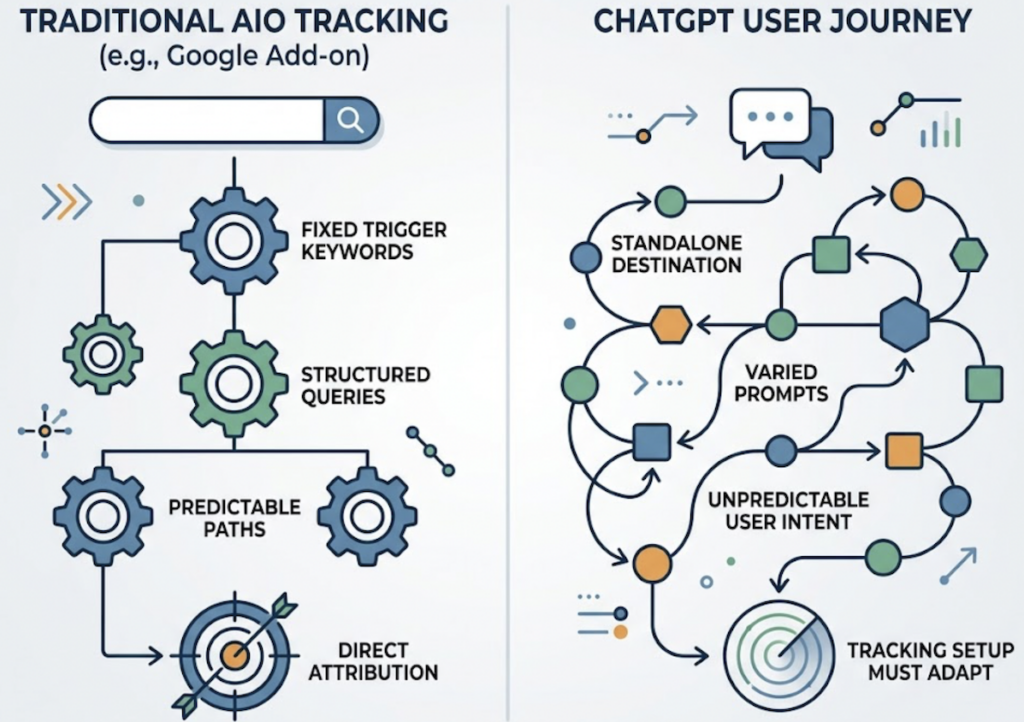
ChatGPT operates on different logic than AIO, and your tracking setup needs to reflect that.
ChatGPT has 800 million weekly active users and processes over 2.5 billion prompts per day. It’s a standalone destination, not a search add-on, which means the prompts users send are more varied and less predictable than Google queries. There are no fixed trigger keywords.
Design a Multi-Seed Prompt Set
A user might ask “best CRM for a remote team,” “alternatives to Salesforce,” or “how do I manage sales leads without spreadsheets.” Your prompt set needs to cover the full range of natural language your target audience actually uses. Start with three prompt categories: direct category queries, competitor comparison queries, and problem-framing queries.
Track Across Model Versions
GPT-4 and GPT-4o don’t always give the same recommendations. Different versions have different knowledge cutoffs and reasoning patterns. If you only track one model, you’re missing visibility gaps that matter to part of your audience.
Monitor Third-Party Source Influence
Here’s the part most teams miss: approximately 48.73% of ChatGPT’s citations come from third-party directories and review platforms like G2, Yelp, and TripAdvisor. Your ChatGPT AI search visibility is partially determined by your presence and ratings on platforms you don’t own.
Tracking ChatGPT AI rankings, then, includes auditing what those intermediary platforms say about you, not just your own domain.
Topify separates out platform-specific visibility data across ChatGPT and other major AI engines, so you can see exactly where you’re strong and where there’s a gap, without manually querying each platform yourself.
Building a Long-Term AI Search Intelligence Baseline
Single data points don’t tell you much. Trends do.
The goal of long-term AI search optimization isn’t a one-time audit. It’s establishing a baseline, then tracking what moves it.
Content Freshness matters more than most teams expect. Pages that aren’t updated at least every three months are 3 times more likely to lose AI citations. LLMs have a recency bias, and stale content gets deprioritized in favor of newer, more accurate sources.
Off-site credibility now outweighs backlinks. Brand mentions on Wikipedia, Reddit, and LinkedIn carry a 0.664 correlation with AI visibility, compared to just 0.218 for traditional backlinks. A wave of Reddit discussions mentioning your brand can lift ChatGPT recommendations faster than publishing a new page on your own site.
Competitor activity creates invisible displacement. If a rival brand earns coverage from sources your AI engines trust, they may push you out of the citation pool with no visible change to your own content or rankings.
Source Analysis is what makes sense of all this. By tracking which domains AI engines consistently pull from, you can reverse-engineer the trust layer of your industry. If Perplexity consistently cites a specific niche publication, earning a mention there becomes more valuable than another generic backlink.
Topify’s Source Analysis surfaces these citation patterns automatically, showing which domains AI platforms favor for your tracked prompts, so you can prioritize the content placements that actually influence AI search intelligence.
4 Mistakes That Make AI Visibility Tracking Data Useless
Most teams don’t fail because they picked the wrong tool. They fail because they set up the tracking wrong from the start.
Mistake 1: Tracking Only One Platform
Different AI engines trust different signals. Gemini tends to favor brand-owned content. ChatGPT leans on third-party directories. Perplexity prioritizes niche expert sources and community reviews. Optimizing based on ChatGPT data alone can actively hurt your Perplexity performance if the signals point in different directions.
Mistake 2: Using Prompts That Are Too Broad
“Best tools” produces noisy, unstable data. Effective AI search analytics use specific, constrained prompts: “best CRM for under $100 for a remote team” will give you far more reliable trend data than any category-level query.
Mistake 3: Not Tracking Competitors
Knowing you appear 30% of the time is meaningless without the denominator. Track every brand the AI mentions in response to your prompt set. That’s the only way to measure true AI Share of Voice.
Mistake 4: Monthly Snapshots
With 40 to 60% of AIO sources rotating monthly, monthly tracking means you’re essentially measuring a new baseline every time. You’ll miss the week a competitor displaced you, and you won’t know which content update moved you up.
Topify addresses all four directly: multi-platform coverage across ChatGPT, Gemini, Perplexity, and AI Overviews; intelligent prompt suggestions; automatic competitor detection; and continuous monitoring. The Basic plan starts at $99/month, covering 100 prompts and 9,000 AI answer analyses across platforms.
Conclusion
Traditional SEO tells you how Google treats your brand. AI search visibility tells you how AI treats your brand. In 2026, those are two different reputations, and only one of them is growing in influence.
The starting point is simpler than most teams expect. Build a prompt list that reflects how your audience actually asks about your category. Establish a baseline across at least two or three AI platforms. Track weekly, not monthly. Get started with Topify to set that baseline up in under an hour, then watch which changes in your content, PR, and third-party presence actually move the numbers.
The brands that own AI search visibility today will own the discovery phase of the buyer’s journey tomorrow.
FAQ
Q: How do I track AI Overviews rankings over time?
A: Build a set of conversational, question-based prompts that reflect your audience’s real queries. Track weekly because 40 to 60% of AIO cited sources rotate monthly. Log position, brand description, and source URLs for each prompt, not just whether your brand appeared. Tools like Topify automate this and provide historical trend data across prompts.
Q: How do I track ChatGPT rankings over time?
A: Design a multi-seed prompt set covering category queries, comparison queries, and problem-framing queries. Track across GPT-4 and GPT-4o since different model versions give different answers. Also monitor your presence on third-party review platforms, as nearly 49% of ChatGPT citations come from directories like G2 and Yelp.
Q: What is AI search visibility and why does it matter for AI SEO?
A: AI search visibility measures how often, where, and how positively your brand appears in AI-generated answers across ChatGPT, Google AI Overviews, and Perplexity. Cited brands see a 35% boost in organic clicks versus non-cited competitors, and AI-referred traffic converts at 4 to 5 times the rate of traditional organic traffic.
Q: How often should I check my AI search visibility?
A: Weekly is the minimum. Because AI citation sources rotate frequently and model behavior shifts with updates, monthly checks miss too much. For brands in active optimization campaigns or competitive categories, daily monitoring is worth considering.

