

Your brand ranks on page one of Google. Your SEO reports look clean. Traffic is stable.
And yet, somewhere right now, a potential customer is asking ChatGPT which tools to use in your category. ChatGPT answers. Your brand isn’t in it.
You don’t know that happened. You have no alert, no report, no data point that tells you. That’s the AI citation blind spot, and in 2026, it’s quietly doing more damage to brand equity than most marketing teams realize.
Most Brands That Rank on Google Are Invisible to AI. Here’s Why That’s a Problem Now
Google rankings and AI visibility run on completely different logic.
When you rank on Google, you control a URL in a list. When AI recommends a brand, it synthesizes an answer from sources it deems authoritative and cites who it trusts. Those two lists often don’t overlap.
The scale of this shift matters. AI assistants now handle nearly 50% of discovery-oriented queries, approaching parity with traditional search. At the same time, research shows that 73% of B2B buyers regularly use AI tools for vendor research and purchase comparisons. These buyers aren’t googling a list of options. They’re asking a question and accepting an answer.
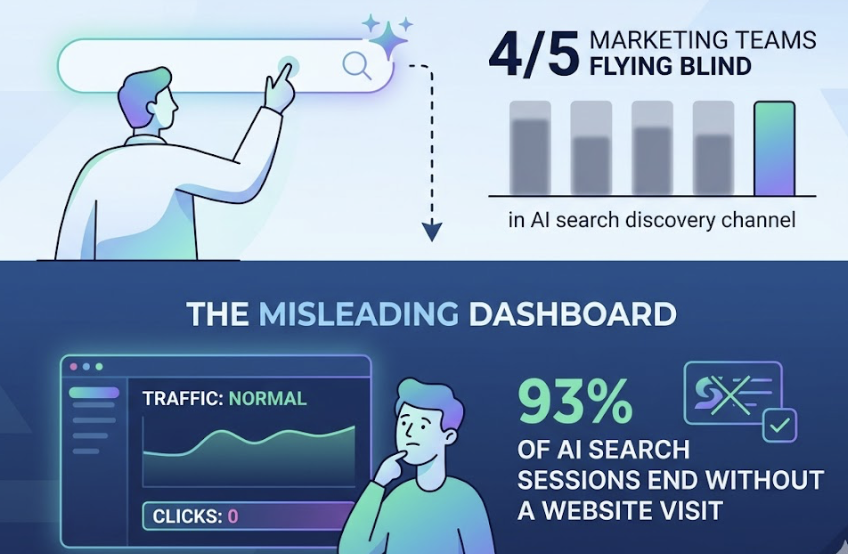
The core problem: only 22% of marketing teams have any infrastructure to track whether they appear in those answers.
That means roughly 4 out of 5 marketing teams are flying blind in a channel that’s influencing nearly half of discovery. And unlike traditional search, there’s no click to track. 93% of AI search sessions end without a website visit. Your brand can be excluded from the consideration set entirely, and your dashboard shows nothing unusual.
You’re Not Ranked. You’re Not Cited. But You Don’t Know Which One.
Here’s a distinction that most tools don’t help you make.
A brand mention is when the AI includes your name in its response text. A citation is when the AI links to or references a URL as a source. A recommendation is when the AI explicitly positions you as the answer to a question.
You can be mentioned without being cited. You can be cited without being recommended. And here’s the part that makes standard brand monitoring tools useless: up to 73% of a brand’s AI presence can consist of “Ghost Citations.”
A Ghost Citation is when an AI platform links to your domain as a source but never mentions your brand name in the response text. Take a concrete example: Gemini might reference a specific domain over 180 times in a single month but mention the brand name zero times. A keyword alert for your brand name catches none of this.
That’s why an AI citation tracker works differently from traditional monitoring. It watches for URL references, domain-level attribution, and source patterns, not just text strings. Without it, you lose credit for the authority you’re actually providing to these models.
Run Your First AI Citation Audit in 3 Steps
Before investing in any tool, you can run a manual baseline. It won’t scale, but it tells you where you stand.
Step 1: Build a prompt list, not a keyword list.
AI responses are triggered by conversational queries, not head terms. Research shows that “Why” queries trigger AI answers at a 59.8% rate, and long-tail queries of 7+ words trigger AI responses 46.4% of the time. Start with 10-15 prompts that your target customers would actually say, covering purchase intent, comparisons, and informational questions in your category.
Step 2: Test across platforms and document what gets cited.
Run each prompt through ChatGPT, Perplexity, and Gemini. Note: does your brand appear? Does it appear as a recommendation, a mention, or a source link? Which competitor names come up instead?
Step 3: Check the citation sources, not just the brand names.
Look at what links or domains each platform is referencing. This is the data most manual audits miss. Which sources is the AI pulling from? Your blog? A Reddit thread? A G2 review? That sourcing pattern tells you exactly where to focus content investment next.
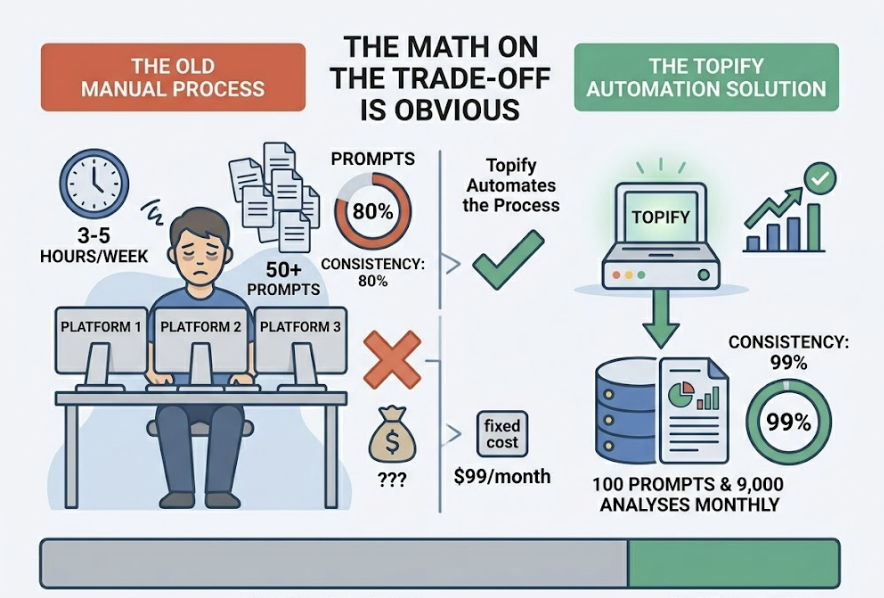
The limitation of this approach is obvious. Doing it manually across 50+ prompts, 3+ platforms, and weekly cadence takes 3-5 hours per week with ~80% consistency. Topify automates the same process at 99% consistency for $99/month, covering 100 prompts and 9,000 AI answer analyses monthly. For most teams, the math on that trade-off takes about 30 seconds.
5 Signs Your Brand Has a Serious AI Citation Problem
You might not need a full audit to know something is off. These patterns tend to show up first.
1. Your competitors appear in AI answers for your core category queries, and you don’t. Run a single test: ask ChatGPT “What are the best tools for [your category]?” If a direct competitor shows up and you don’t, that’s a displacement event.
2. Your organic traffic looks stable, but your pipeline is softening. Because 93% of AI sessions don’t result in a website click, the exclusion from AI answers often doesn’t register in GA4. The brand is being filtered out before the website visit ever happens.
3. AI is citing your category, but crediting third-party sources rather than your own. This is critical: AI models are 6.5 times more likely to cite a brand through an external authoritative source, such as Reddit, G2, or a trade publication, than through the brand’s own website. If your only content investment is your blog, you’re structurally at a disadvantage.
4. You can’t answer “what does ChatGPT say about our brand?” If the question produces silence in your team, that’s the signal. It means no one has the data.
5. Content freshness has stalled. Content updated within the last two months earns 28% more citations than older material. If your key pages haven’t been touched in 6+ months, your citation rate is likely decaying in real time.
One of these signals is worth investigating. Three or more means the problem is already in motion.
What a Real AI Citation Tracker Measures (It’s Not Just Mentions)
A purpose-built AI citation tracker operates across four dimensions of brand presence, and all four matter.
Citation frequency (sometimes called Share of Model) tracks what percentage of relevant queries include your brand. For B2B SaaS categories in 2026, category leadership is typically defined by a 40-50% citation rate across a defined prompt library. Below that threshold, a competitor is likely filling the gap.
Source attribution identifies exactly which URLs and domains the AI uses to retrieve information about your brand. This is the most actionable data layer. If the AI is pulling from your competitor’s case studies instead of your own, you know what content to build.
Competitive displacement tracking monitors the prompts where a competitor appears and you don’t. These “displacement prompts” are the highest-priority targets for GEO strategy because the query is already relevant to your category; you’re just not the answer.
Sentiment and contextual framing tracks how your brand is characterized when it does appear. There’s a meaningful difference between being cited as “the leading platform” and being mentioned as “a lower-cost option.” Both are presence. Only one helps your positioning.
Topify covers all four dimensions across ChatGPT, Gemini, Perplexity, DeepSeek, and other major platforms. Its Source Analysis feature surfaces the specific domains AI platforms are citing for your brand and your competitors, giving content and PR teams a direct brief on where external authority needs to be built. The Basic plan starts at $99/month and includes a 30-day trial.
And because 40-60% of AI-cited sources rotate within a single month due to model updates and content freshness changes, this isn’t a quarterly audit. Weekly tracking is the practical minimum to catch competitive shifts as they happen.
Conclusion
The pattern is consistent: brands don’t know they have an AI visibility problem until they look for it.
Traditional analytics can’t surface it. GA4 classifies AI-driven visits as “Direct.” Referrer headers get stripped by mobile apps. Zero-click sessions leave no trace. The tools that built the last decade of search measurement weren’t designed for this environment.
An AI citation tracker doesn’t replace your existing analytics stack. It fills the layer above it, the layer where modern buyers are actually making decisions. And given that AI-referred traffic converts at 5.1x the rate of traditional organic search, even a modest increase in citation frequency has real pipeline impact.
The first step isn’t optimization. It’s measurement.
You can’t improve what you can’t see, and right now, most brands can’t see the most important channel in their discovery funnel.
FAQ
What is an AI citation tracker?
It’s a tool that monitors how often your brand, domain, or content appears as a source in AI-generated responses from platforms like ChatGPT, Perplexity, and Gemini. It tracks URL references and domain-level attribution, not just brand name mentions.
What’s the difference between AI mentions and AI citations?
A mention is when your brand name appears in the AI’s response text. A citation is when the AI links to or references your domain as a source, which can happen without your brand name ever appearing. Research suggests the majority of brand AI presence falls into the citation-only category, which standard monitoring tools miss entirely.
Which AI platforms should I track for brand citations?
At minimum: ChatGPT, Perplexity, and Gemini. These three cover the broadest reach for B2B and B2C discovery. Tools like Topify extend coverage to DeepSeek, Doubao, and other regional platforms depending on your target markets.
How often does AI citation data change?
Frequently. Research shows 40-60% of cited sources can rotate within a single month due to model updates and changes in content freshness. Weekly tracking is the recommended minimum cadence.
Can I track competitor citations with the same tool?
Yes. Competitive displacement tracking, seeing which prompts your competitors appear in but you don’t, is one of the highest-value outputs from a citation tracker. Topify’s Competitor Monitoring feature benchmarks your visibility against rivals across the same prompt sets.
Is AI citation tracking only relevant for large brands?
No. Smaller brands can use strong AI citation positioning to appear alongside much larger incumbents in AI recommendations, provided their content is structured for AI retrieval and they have third-party mentions on authoritative sources.

