

Your domain authority is 70. Your keyword rankings are solid. But when a potential buyer asks ChatGPT for the best tool in your category, your brand isn’t mentioned once. A competitor with a DA of 30 gets the recommendation.
That gap isn’t a fluke. It’s a structural shift in how authority is being calculated, and most SEO teams don’t have the tools to see it happening.
Your Domain Authority Score Means Nothing to ChatGPT
Google was built on a simple premise: if many reputable sites link to you, you’re probably trustworthy. That logic held for 25 years. It doesn’t translate to generative AI.
ChatGPT, Perplexity, and Gemini don’t process a Domain Authority score in their reasoning loops. They evaluate content based on how reliably a source grounds accurate answers. The result is what researchers now call an “Invisibility Gap,” where strong Page 1 rankings no longer guarantee inclusion in generative responses.
The scoreboard has changed. A DA of 90 gets you priority crawling. After that threshold, the AI favors whichever site provides the highest factual density and the easiest extraction path, regardless of link count.
What Is an AI Citation and Why It’s the New Authority Signal
An AI citation is a machine-generated attribution that a generative engine uses to ground a specific claim in its response. Unlike a backlink, which is a static element on a webpage, an AI citation is produced dynamically per prompt through a Retrieval-Augmented Generation (RAG) process.
The AI identifies the most “citable” documents from its index. It’s not measuring popularity. It’s measuring comprehension.
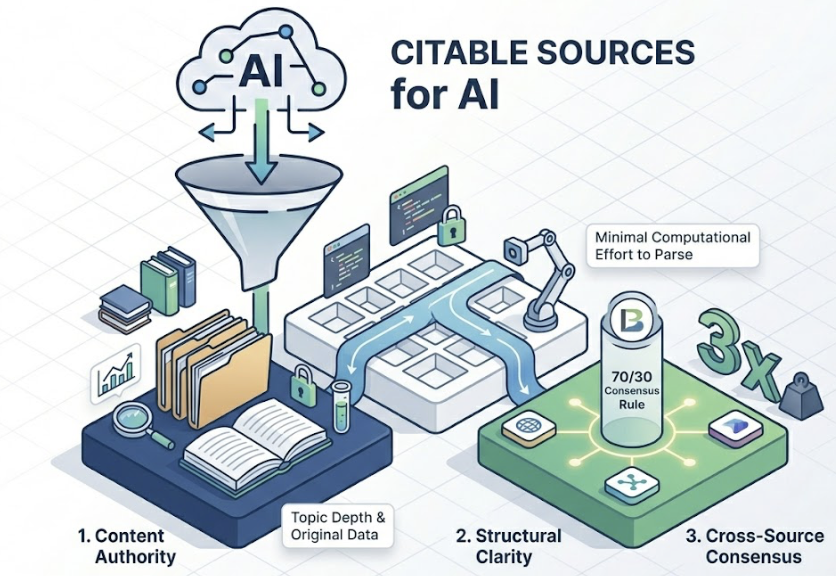
Research into AI citation patterns points to three characteristics that distinguish a citable source from a merely rankable one. First, content authority measured by topical depth and original data, not link count. Second, structural clarity, meaning content the AI can parse with minimal computational effort. Third, cross-source consensus: AI models apply a “70/30 Consensus Rule” where a brand’s presence across independent third-party sources carries roughly 3x more weightthan content published on the brand’s own domain.
That last point changes where your content investment should go.
The Sites AI Trusts Don’t Always Have the Best Backlinks
One of the most counter-intuitive findings in generative search research is the hierarchy of domains that AI systems actually cite. Research across billions of citations shows that Reddit accounts for 3.11% to 3.5% of all AI citations across major platforms, outpacing even Wikipedia and YouTube.
This isn’t an accident. AI systems are built to reduce uncertainty. When a user asks a subjective question like “Is this software worth it for a 5-person team?”, the answer doesn’t exist in a corporate whitepaper. It exists in a Reddit thread where real users described what broke and what worked. That Q&A format maps directly to how RAG retrieval is structured.
The same logic applies to niche publications with deep technical authority. A small industry blog cited frequently across forums can achieve higher AI visibility than a large corporation that lacks community engagement.
AI doesn’t look at PageRank. It looks at who is being repeatedly used to explain this specific problem.
| Platform | Citation Share | Role in AI Trust |
|---|---|---|
| 3.11%–3.5% | Experience-based queries | |
| YouTube | 2.13%–2.3% | Explanatory content via transcripts |
| Wikipedia | 1.35%–1.4% | Entity definitions and factual grounding |
| Niche Publications | Topic-specific | Deep technical authority |
Why Most SEO Teams Are Flying Blind on AI Citation Tracking
The data here is stark. 97.2% of AI citations cannot be explained by traditional backlink profiles, with a correlation coefficient of r² = 0.038. That means the metrics most SEO teams optimize for have almost no predictive power over whether AI recommends them.
Manual testing makes the problem worse, not better. AI responses are non-deterministic: the same query returns different sources across sessions. There’s also a significant platform gap. For identical queries, there’s only an 11% overlap between domains cited by ChatGPT and those cited by Perplexity. Checking one platform gives you a false sense of coverage.
This is where a dedicated ai citation tracker becomes operationally necessary. Topify’s Source Analysis automates the process of running thousands of prompt variations across multiple AI platforms to establish a Share of Model baseline. It tracks not just brand mentions but source attribution: exactly which URLs the AI uses to justify its recommendations. This allows teams to run Citation Gap Analysis, identifying high-intent prompts where competitors are being cited while the brand remains invisible despite solid Google rankings.
That’s a different kind of intelligence than any traditional SEO tool provides.
How to Use an AI Citation Tracker to Close the Gap
Moving from passive observation to active optimization requires three steps rooted in citation intelligence.
Step 1: Identify high-frequency citation domains in your category.
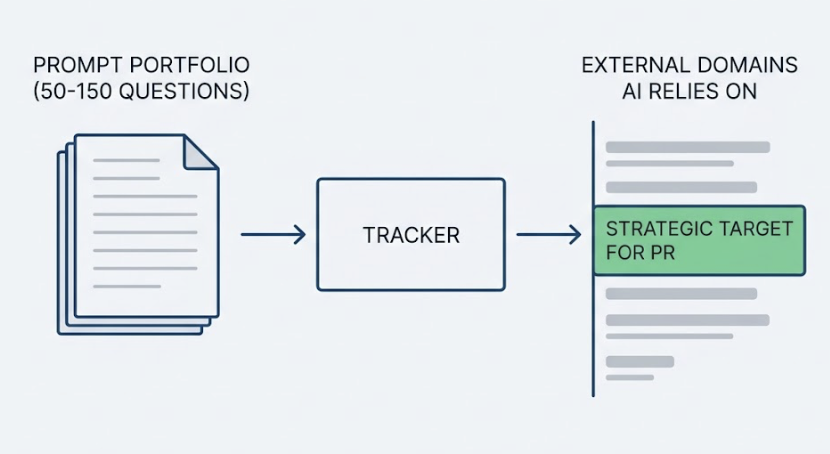
Build a prompt portfolio of 50 to 150 high-intent questions that mirror your customer journey, from informational (“How to…”) to transactional (“Best software for…”). Running these through a tracker reveals which external domains the AI relies on for your topic. If the AI consistently cites a competitor’s comparison table on a niche publication, that publication becomes a primary strategic target for PR and earned media.
Step 2: Analyze the structure of cited content.
Once you’ve identified cited sources, run a structural audit. AI citation favors specific formats that reduce what researchers call “Extraction Cost.” The characteristics that correlate with citation include Bottom Line Up Front (a 2-3 sentence direct answer at the start of each section), factual density (cited articles contain 62% more facts than non-cited ones), clean HTML tables for comparisons, and numeric specificity over marketing language.
Step 3: Produce content designed for machine retrieval.
This means restructuring top-performing pages to include FAQ sections, which increase citation probability by roughly 14%. It also means producing original research and data tables that serve as Evidence Hooks during the RAG process. The goal is to fill Citation Gaps identified by your tracker with content that is more fact-dense and structurally superior to what’s currently being cited.
Building AI Citations vs. Building Backlinks: What Changes in Practice
This isn’t a replacement. It’s an additional layer.
Backlinks remain foundational for Google discovery. But as generative search volume continues to displace traditional search traffic, visibility in AI answers becomes a separate, measurable growth channel. The two strategies diverge significantly in practice:
| Dimension | Backlink Strategy | AI Citation Strategy |
|---|---|---|
| Primary Goal | Increase DA and SERP rank | Inclusion in AI answers |
| Content Focus | Keyword targeting | Factual density and machine-extractability |
| Distribution | Guest posting and link outreach | Earned media and community engagement |
| Trust Signal | Hyperlink from reputable domain | Cross-source consistency |
| Success Metric | Backlink count and referral traffic | Share of Voice and Citation Rate |
| Update Cycle | Static / long-term | Freshness-dependent (10-month window) |
That freshness window matters more than most teams realize. 95% of ChatGPT citations come from content published or updated within the last 10 months. For fast-moving categories, the window is tighter. A brand that doesn’t refresh its core data points regularly risks being displaced by a competitor whose content the AI perceives as more current.
Conclusion
The era of link supremacy is being succeeded by the era of semantic legitimacy. A DA of 90 is still worth having. But it no longer guarantees inclusion in the answers your customers are actually reading.
The brands that will hold visibility in 2025 and beyond are the ones treating AI citation as a structured, trackable channel, not a side effect of their SEO work. That means building a prompt portfolio, running gap analysis, and refreshing content on a cycle that matches how quickly AI retrieval weights shift. Get started with Topify to identify exactly where your brand stands in AI-generated answers, and which sources are being cited in your place.
FAQ
Q: What’s the difference between a backlink and an AI citation?
A: A backlink is a human-created hyperlink intended to transfer ranking authority and support discovery. An AI citation is a machine-generated attribution created dynamically to ground a generative response. Backlinks measure connection and popularity. Citations measure comprehension and trust.
Q: Can I track which AI platforms are citing my content?
A: Not through traditional analytics. Google Analytics 4 struggles to differentiate between AI referrers. Dedicated tools like Topify monitor Share of Model across ChatGPT, Perplexity, Gemini, and Google AI Overviews, and track which specific URLs are being attributed.
Q: Does having more backlinks help with AI citations?
A: The correlation is weak. A baseline of domain authority (often DR 30+) is needed to ensure a site is crawled and considered by AI systems. Beyond that threshold, adding more backlinks has negligible impact on citation probability compared to improvements in factual density and content structure.
Q: How often do AI citation sources change?
A: Frequently. Roughly 40-60% of citations in some AI engines churn monthly. Citation frequency for a specific URL often drops to 40% of its initial level within 90 days if the content isn’t refreshed or if model retrieval weights shift.

