

You asked ChatGPT a question in your category. It gave a confident, sourced answer. Your brand wasn’t in it. Not even close. The problem isn’t your content quality. It’s that AI engines have already decided which industries and which domains they trust, and most brands have no visibility into that decision.
New data from a longitudinal analysis of over 680 million citations across major generative AI platforms makes the pattern clear: citation share is not distributed evenly. Some industries have essentially locked in AI trust. Others are functionally invisible, and for structural reasons that keyword rankings can’t fix.
Here’s what the data actually shows.
The 5 Industries That Dominate AI Citation Share
AI citation isn’t random. The underlying logic comes down to two factors: how much risk the AI perceives in getting the answer wrong, and how easy it is to extract structured, verifiable information from available sources. Five industries have cleared both bars.
Healthcare leads by a wide margin. Google AI Overviews appear in 88% of medical queries, and the citation pattern is tightly centralized. The NIH accounts for roughly 39% of all medical citations, with Healthline, Mayo Clinic, and Cleveland Clinic filling out the top tier. AI engines treat health information as a YMYL (Your Money or Your Life) category, which means they default to institutional authority rather than editorial quality. A well-written health blog will almost never beat a peer-reviewed source, even if it ranks #1 organically.
Education saw the most explosive growth. AI coverage of education queries jumped from 18% in May 2025 to 83% by December 2025, an increase that happened in under seven months. The reason: AI engines reward what analysts call “Topical Authority Override.” Pages structured like Wikipedia reference entries, with high entity density and schema markup, get selected at dramatically higher rates. Content that includes 15 or more named entities on a single page sees a nearly fivefold increase in selection probability.
B2B technology triggers AI answers 82% of the time. This sector is citation-friendly because it’s built around comparison, specification, and “how-to” content. The catch: brand-owned domains often lose to aggregators. In AI Overviews, 88% of review-platform citations flow through just five domains: Gartner Peer Insights, G2, Capterra, Software Advice, and TrustRadius. If your product isn’t on G2, it may not exist in the AI’s recommendation set.
Financial services and insurance saw coverage jump from 17% to 63%. Like healthcare, this is a YMYL category, but the dominant factor here is freshness. ChatGPT data shows 76.4% of cited pages in finance were updated within the last 30 days. Outdated financial content gets filtered out almost entirely. NerdWallet and Investopedia dominate because they update constantly and follow a structural completeness template that AI can parse efficiently.
E-commerce shows the sharpest platform divide. 99.3% of ChatGPT’s e-commerce responses mention specific brands, while Google AI Overviews mention brands in only 6.2% of cases. ChatGPT acts like a shopper’s assistant. Google protects its ad revenue by keeping transactional queries away from generative summaries. The implication: your citation strategy needs to be platform-specific, not one-size-fits-all.
3 Industries That AI Search Passes Over
Three sectors stand out not for low content quality, but for structural barriers that prevent AI crawlers from reaching or validating what’s there.
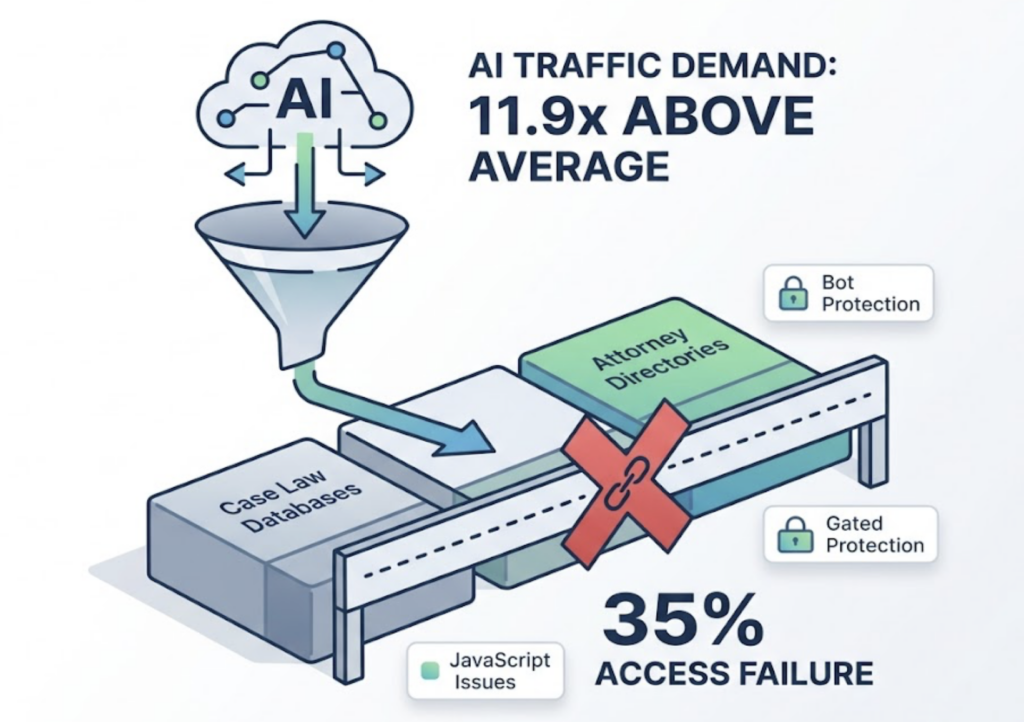
Legal services have a 35% AI access failure rate. That number is particularly damaging given that legal queries generate 11.9x more AI traffic demand than the average website. The causes are largely technical: gated case law databases, JavaScript-heavy attorney directories that AI agents can’t parse, and aggressive bot-protection systems that block crawlers like PerplexityBot and GPTBot. The content exists. The AI just can’t see it.
Job boards have the highest failure rate at 40%. These platforms are built around ephemeral, dynamically generated listings that change hourly. AI models need a stable source of truth to cite. When job postings shift constantly and bot-mitigation systems return empty HTML to crawlers, the entire platform becomes invisible to the AI discovery pipeline, regardless of traffic volume.
Travel and hospitality face a 33% access failure rate, alongside a 20-40% decline in organic traffic for destination marketing organizations. Heavy client-side JavaScript for pricing and availability data is unreadable to most AI crawlers. The local hospitality picture is even starker: 98.8% of businesses are invisible in AI recommendations because they lack the multi-source corroboration required for the AI to confidently recommend them.
That last number matters beyond travel. It describes a broader local business crisis that cuts across industries.
What Actually Makes a Source “Citation-Worthy” to AI
Here’s where the data gets counterintuitive.
Domain authority, the metric most brands have spent years building, has a near-negligible correlation with AI citation ($r^2 = 0.032$). Backlink count does better ($r = 0.37$), but the strongest single predictor of AI citation is topical authority, with a correlation of $r = 0.41$. In practice, that means a page ranking in position #6 can be cited 2.3x more often than the #1 result if it has greater entity density and semantic completeness.
That’s a significant reframe for how brands should think about GEO strategy.
Structural formatting matters just as much. Content that leads with a direct answer in the first 50 words receives a 40% lift in citation frequency. HTML tables improve citation rates by 2.5x. These aren’t design choices. They’re legibility signals that tell the AI this content is safe to extract and synthesize.
The final layer is what researchers call the “Consensus” mechanism. If a brand’s claims are corroborated by four or more third-party platforms, it enters the AI’s Trust Layer and becomes eligible for citation. This explains why 85% of brand mentions in commercial queries come from third-party sources rather than brand-owned domains. Your website is necessary. It’s not sufficient.
The Citation Gap Is Wider Than Most Brands Realize
The Walmart-Amazon case study illustrates how quickly citation share can diverge based on a single strategic decision.
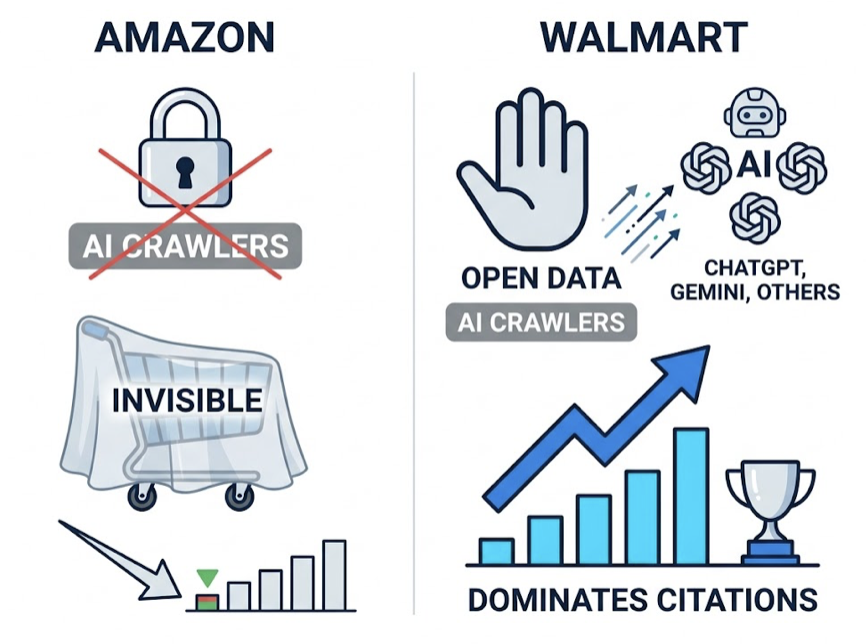
Amazon has blocked over 50 AI-related crawlers to protect its traffic and ad revenue. Walmart took the opposite approach, opening its inventory and logistics data to all major AI crawlers. The result: Walmart now dominates ChatGPT and Gemini commerce citations, while Amazon’s external citation share has dropped sharply. Amazon’s products are still purchased. They’re just increasingly invisible to users who discover through AI.
The same dynamic plays out at the local level. If an AI can’t find consistent data across Google Maps, Yelp, and your official profiles, it treats your business as a hallucination risk and skips the recommendation entirely. Your competitor down the street may rank lower in traditional search and still appear in every AI answer.
This is what an AI citation tracker surfaces that rank tracking can’t: not where you appear in a SERP, but whether the AI has decided to trust you at all.
How to Use an AI Citation Tracker to Close the Gap
Closing the citation gap starts with visibility into what’s actually happening. That requires a different category of tool than traditional rank trackers.
Topify‘s Source Analysis function monitors machine behavior directly, identifying which external domains the AI cites for your topic category and mapping the structural gaps in your own content against those sources. Instead of knowing your keyword position, you know which third-party sites the AI trusts more than yours, and why.
The platform’s Visibility Tracking covers ChatGPT, Gemini, Perplexity, and other major AI surfaces simultaneously, which matters because citation patterns diverge significantly by platform. What earns a citation in Perplexity (high entity density, real-time freshness) differs from what earns one in Google AI Overviews (cross-platform E-E-A-T signals, entity graph corroboration).
For teams ready to act on the data, Topify’s Conversion Visibility Rate (CVR) metric maps citation activity to commercial outcomes. Users arriving from AI citations browse 12% more pages and convert at rates up to 9x higher than organic search visitors. That makes citation share a more valuable KPI than raw traffic for most B2B and SaaS teams.
The practical starting point: use an ai citation tracker to identify which external sources the AI prefers over your domain for your core topics, then build an earned media strategy around those platforms. For B2B brands, that typically means G2 and Gartner. For healthcare, it means getting content corroborated by institutional sources. For financial services, it means freshness, updated monthly at minimum.
Get started with Topify to see where your brand currently stands in AI citation across platforms.
Conclusion
The industries winning in AI citation aren’t winning because they have better content. They’re winning because they understood the structural requirements of the new retrieval system earlier. Healthcare’s authority centralization, B2B technology’s aggregator dependency, finance’s freshness mandate — these aren’t accidents. They’re the citation economy’s rules, and most brands are still playing by the old ones.
Traditional rank tracking won’t show you this gap. An ai citation tracker will. The brands that close the gap first aren’t just gaining AI visibility. They’re capturing high-intent traffic that converts at a rate traditional search can’t match.
FAQ
Q: What is an AI citation tracker?
A: An AI citation tracker is a monitoring tool that determines whether, how often, and in what context your brand’s content is referenced in AI-generated answers. Unlike a rank tracker that monitors a position on a SERP, a citation tracker measures machine behavior: when an AI system like ChatGPT or Perplexity assigns your URL as a source in its response. Tools like Topify track this across multiple AI platforms simultaneously, giving brands a clear picture of their citation share versus competitors.
Q: Which AI platforms cite the most sources per response?
A: Perplexity AI typically provides the highest citation density, averaging 8.79 citations per response due to its real-time RAG architecture. Google AI Overviews follow, averaging 13.3 sources per summary. ChatGPT generally cites a more focused set of 3-6 sources, with a strong preference for content indexed by Bing. Each platform has different structural preferences, which is why platform-specific tracking matters.
Q: How do I get my brand cited by ChatGPT?
A: To earn citations in ChatGPT, your content needs to be optimized for Bing’s index, updated frequently (within 30 days for high-trust topics), and structured with a direct answer in the first 50 words of each section. High topical authority and the presence of factual comparisons, data tables, and entity-rich content are the strongest structural signals. Third-party corroboration across review platforms and authoritative external sources is equally important.
Q: Why does my brand appear in Google Search but not in AI answers?
A: Google ranking signals and AI citation signals don’t have much overlap. Research shows only an 11-15% correlation between organic search rankings and Perplexity citations. AI engines prioritize topical authority, entity density, structural extractability, and multi-source consensus, none of which are directly measured by traditional SEO metrics. A brand can rank #1 organically and still be skipped by AI if it lacks sufficient third-party corroboration or structural completeness.

