

Search “AI query tracking dashboard” and you’ll find a dozen platforms claiming to monitor your brand in AI answers. Half of them show you a single number: mentions. The other half cover one platform, usually ChatGPT, and call it coverage. Meanwhile, 37% of consumers now initiate searches via AI-powered interfaces like ChatGPT, Perplexity, and Gemini, and your traditional dashboard can’t tell you anything about what happens there.
The real problem isn’t finding a tool. It’s finding one that tracks at the query level, across multiple platforms, with enough depth to actually act on the data.
Most AI Query Tracking Tools Only Measure One Platform. That’s a Serious Gap.
Here’s what most dashboards miss: they track brand mentions, not query performance. Those aren’t the same thing.
Brand mention tracking is passive. It captures where your name appeared. AI query tracking is synthetic and active. It monitors how an AI model responds to a specific, high-intent user prompt, like “What’s the best project management tool for remote teams?” or “Which CRM should a SaaS startup use in 2026?” That distinction determines whether your dashboard is giving you awareness data or decision-making data.
The gap matters because AI platforms use Retrieval-Augmented Generation (RAG) to synthesize unique, conversational answers every time. There’s no static ranking to scrape. Tools that rely on crawling miss this entirely.
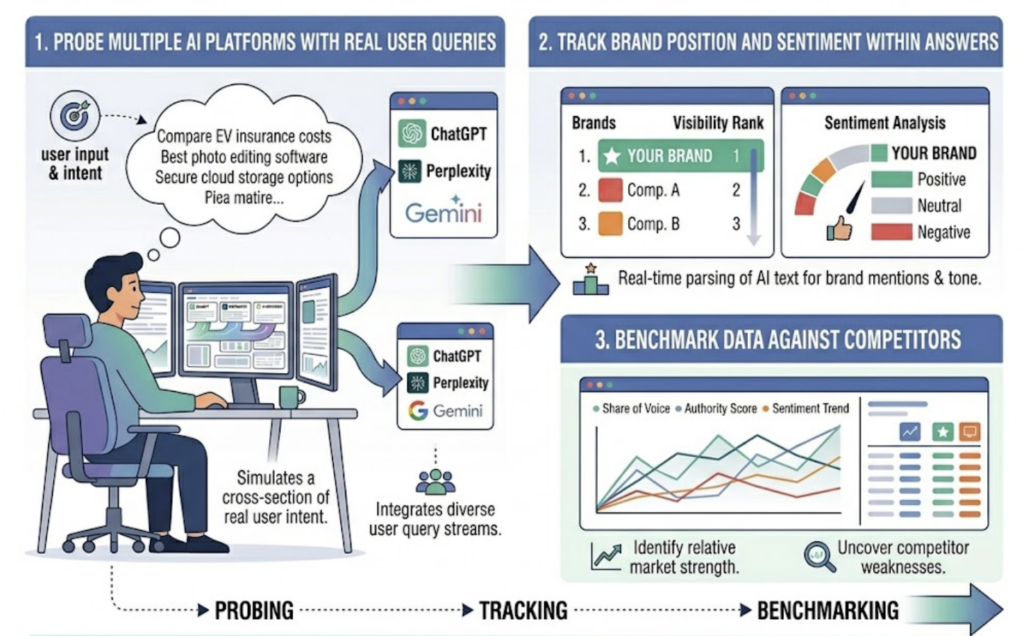
A professional AI query tracking dashboard needs to do at least three things: probe multiple AI platforms with real user queries, track your brand’s position and sentiment within those answers, and benchmark that data against competitors. Most tools on the market do one of the three.
That’s why choosing the right platform starts with knowing what to look for, not which brand you’ve seen in a LinkedIn ad.
The 6 Best AI Query Tracking Dashboards in 2026
Quick comparison before diving in:
| Tool | Platforms Covered | Core Strength | Best For | Starting Price |
|---|---|---|---|---|
| Topify | ChatGPT, Gemini, Perplexity, DeepSeek, Doubao, Qwen + more | Full-stack: 7-metric dashboard + One-Click Execution | Marketing teams, agencies | $99/mo |
| Nightwatch | ChatGPT, Claude, Gemini, Google AIO | Hybrid SEO + GEO tracking | SEO-first teams | Custom |
| Otterly AI | ChatGPT, Perplexity, Gemini, Claude | User-friendly prompt tracking | Small teams, solo founders | Custom |
| Knowatoa AI | Multi-model | Deep sentiment analysis | Brand perception focus | Custom |
| Profound AI | Multi-model | Synthetic journey simulation | Enterprise | Custom |
| Peec AI | Multi-model | Competitive benchmarking | Share of voice analysis | Custom |
#1 Topify: The Most Complete AI Query Tracking Platform
Topify is built around one premise: visibility data is only useful if it tells you what changed, why, and what to do next.
The dashboard tracks seven core metrics in a single view: visibility score, sentiment, position rank, AI search volume, brand mentions, user intent, and CVR (Conversion Visibility Rate). Most platforms stop at mentions and position. CVR, which estimates how likely an AI-generated response is to drive a user toward your brand, is a metric most competitors don’t offer.
Platform coverage is the broadest available in 2026. Topify monitors ChatGPT, Gemini, Perplexity, DeepSeek, Doubao, Qwen, and several others, covering both Western and Chinese AI ecosystems. That matters because the 30.6 percentage point gap in brand mention rates between Chinese and international models means your visibility profile looks very different depending on which platforms you’re measuring.
At the query level, Topify doesn’t just check whether your brand appears. It runs thousands of prompt variations per platform to capture how different phrasings change AI recommendations. A query like “best CRM for startups” and “top CRM tools for early-stage companies” may produce different brand lists. Topify surfaces that variance.
The One-Click Execution feature closes the loop between tracking and action. You define your optimization goal in plain English, review the proposed strategy, and deploy. No manual workflow required.
Pricing: Basic at $99/mo (100 prompts, 4 AI platforms, 9,000 AI answer analyses). Pro at $199/mo (250 prompts, 22,500 analyses). Enterprise from $499/mo with a dedicated account manager.
Best for: Marketing teams and agencies that need a unified AI query tracking dashboard with cross-platform coverage, competitive monitoring, and execution capability in one tool.
#2 Nightwatch
Nightwatch sits at the intersection of traditional SEO and GEO tracking. It covers ChatGPT, Claude, Gemini, and Google AI Overviews, and its standout feature is letting users view keyword rankings and AI Overview citations side by side. For SEO teams that don’t want to abandon their existing workflow, that parallel view is genuinely useful.
The trade-off: depth at the query level is more limited compared to purpose-built GEO platforms. It works well for teams entering AI tracking who want continuity with their SEO stack.
#3 Otterly AI
Otterly AI focuses on prompt and mention tracking across ChatGPT, Perplexity, Gemini, and Claude. The interface is clean and accessible, making it a reasonable starting point for smaller teams or solo founders who want visibility data without a steep setup curve.
Coverage is solid across the major Western platforms. Where it falls short is in advanced analytics: sentiment scoring and competitive gap analysis are less developed than in Topify or Profound.
#4 Knowatoa AI
Knowatoa differentiates itself with a proprietary “BISCUIT” framework for brand perception analysis. The platform goes deep on how AI models frame your brand’s identity, positioning, and associations, making it particularly useful for brand managers concerned about narrative drift in AI-generated descriptions.
It’s a strong choice if sentiment monitoring is your primary use case. Less suited for teams that need query-level tracking across a large prompt set.
#5 Profound AI
Profound targets enterprise teams with synthetic customer journey simulation. It models how a prospective buyer would encounter your brand across multiple AI-assisted touchpoints, from initial discovery to consideration. That end-to-end view is valuable for larger organizations running multi-stage campaigns.
The platform’s depth comes with a complexity cost. Smaller teams typically don’t need journey-level simulation and may find the interface heavier than required.
#6 Peec AI
Peec AI’s strength is competitive benchmarking via Share of Voice dashboards. You can see at a glance how your brand’s AI presence compares to specific competitors across queries. For teams whose primary question is “are we ahead of or behind Competitor X in AI answers,” Peec provides a clear answer.
It’s a monitoring tool rather than an optimization platform, which suits teams at an earlier stage of GEO maturity.
What a Real AI Query Tracking Dashboard Should Show You
The six metrics that define meaningful AI query tracking analytics:
1. Visibility Score: How frequently your brand appears across a representative sample of high-intent prompts. This is your baseline, the number everything else is measured against.
2. Citation Share: The percentage of AI-generated responses that explicitly reference your domain as a source. High citation share means AI is pulling from your content to construct its answers.
3. Position Rank: Where your brand appears within an AI-generated list. Being mentioned first carries far more commercial value than being mentioned fifth, and this metric tracks that gap precisely.
4. Sentiment Score: How the AI frames your brand, the specific language it uses, the attributes it associates with you, and how that compares to your positioning. A brand ranked #2 with positive sentiment often outperforms a brand ranked #1 with neutral or negative framing.
5. Competitor Citation Gap: Queries where a competitor is cited but your brand isn’t, despite offering the same or better solution. This is where the highest-value optimization opportunities live.
6. CVR (Conversion Visibility Rate): The downstream impact of AI mentions on branded search volume and direct traffic. Traffic from AI-influenced searches carries strong buying intent: a 23x conversion lift has been observed in AI-influenced search traffic.
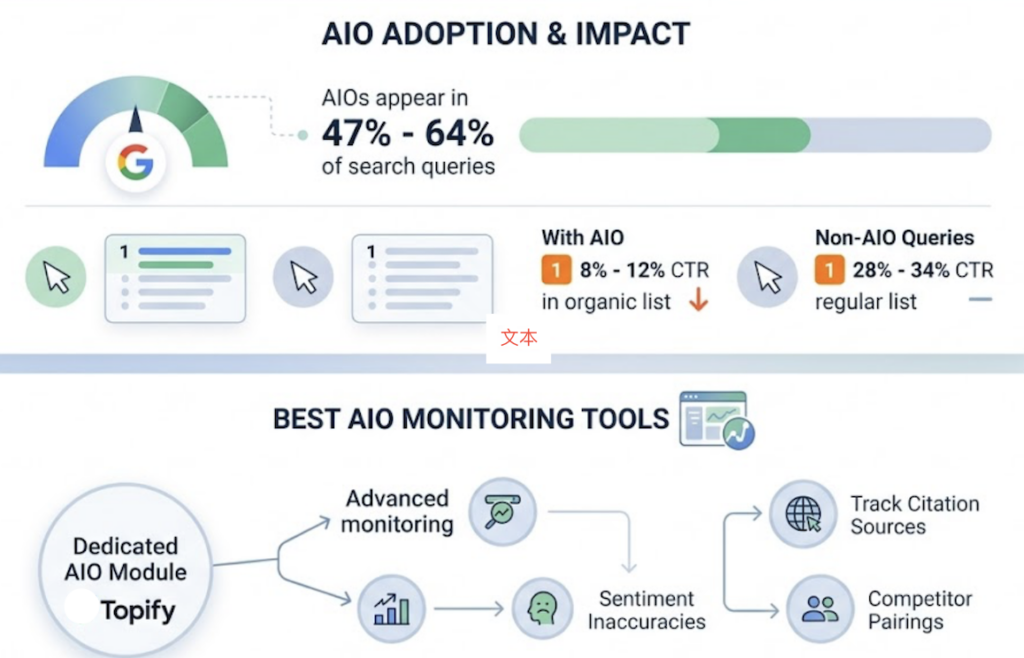
For teams tracking Google specifically: AI Overviews now appear in roughly 47 to 64% of search queries, and when they do, the traditional #1 organic position sees CTR drop to just 8 to 12%, compared to 28 to 34% on non-AIO queries. The best tools for monitoring AI Overviews, including Topify’s dedicated AIO module, track citation sources, sentiment inaccuracies, and competitor pairings within those overviews from a single dashboard.
Why Your Existing SEO Dashboard Can’t Track AI Queries
Your GA4, Ahrefs, or SEMrush instance wasn’t built for this.
Traditional SEO platforms rely on web crawling and backlink analysis. That approach works well for static ranking environments. AI search doesn’t have one. As the research report notes, “AI does not rank URLs; it generates answers.” There’s no position to crawl.
The zero-click reality compounds the problem. AI summaries resolve user intent without requiring a click, which means a significant portion of high-intent queries never generate a referral visit. Your analytics show zero traffic from those interactions, not because your brand wasn’t mentioned, but because the user got their answer before clicking.
Entity clarity is the third gap. AI models map relationships between brands and topics. If your brand lacks structured entity signals, schema markup, clear definitions, and FAQ headers, the AI may fail to associate you with your core category even if you rank #1 on Google. An AI query tracking software built for GEO surfaces that disconnect. A traditional SEO tool doesn’t.
The practical recommendation: keep your existing SEO stack for what it does well. Layer a dedicated AI query tracking solution on top. They’re complementary, not competing.
How to Set Up an AI Query Tracking Dashboard in Under 30 Minutes
The setup process is faster than most teams expect.
Step 1: Define your prompt clusters. Identify 50 to 100 natural language queries your target audience asks AI models. Include brand category queries (“best [category] tool for [use case]”), problem-framing queries (“how to solve [problem]”), and competitor comparison queries (“X vs Y for [scenario]”). This is your tracking foundation.
Step 2: Establish your baseline. Run your prompt clusters across ChatGPT, Perplexity, and Gemini to capture your current Visibility Score and Competitor Citation Gap. In Topify, this step is built into onboarding. You’ll also want to note your starting Sentiment Score so you have a reference point for future drift.
Step 3: Set up competitor monitoring. Add your top three to five competitors to the dashboard. The most valuable data isn’t your absolute visibility score. It’s the gap between yours and theirs across the same query set.
Step 4: Configure alerts. Set notifications for Visibility Score drops below a defined threshold, Sentiment Score changes, and new competitors appearing in your tracked queries. AI models update their training data continuously, and a position you hold today can shift without a visible trigger. Automated alerts are the difference between catching drift early and finding out three months later.
Get started with Topify on the Basic plan to run this setup in under 30 minutes with 100 tracked prompts across four AI platforms.
Conclusion
Tracking AI queries isn’t a future capability. It’s a current gap in most marketing stacks, and the cost of that gap compounds quietly. Every week you’re not monitoring which prompts your competitors are winning, they’re building visibility you’ll need to reclaim.
The tools exist. The data is accessible. The only question is whether your dashboard is built for search as it works now, or search as it worked two years ago.
FAQ
Q: What is an AI query tracking dashboard? A: An AI query tracking dashboard is a platform that monitors how AI systems like ChatGPT, Perplexity, and Gemini respond to specific user prompts, tracking metrics like brand visibility, position, sentiment, and citation share across those answers. It’s distinct from traditional SEO dashboards, which track static keyword rankings and web crawl data rather than synthesized AI responses.
Q: How is AI query tracking different from traditional SEO tracking? A: Traditional SEO tracking measures where your URLs rank in a crawlable index. AI query tracking measures how AI models reason about your brand when generating a response. AI doesn’t rank URLs; it synthesizes answers, which means there’s no static position to monitor. Specialized AI query tracking software uses synthetic probing, querying models at scale to identify patterns in how your brand is recommended, described, and positioned.
Q: What’s the best tool for monitoring AI Overviews? A: For teams focused specifically on Google AI Overviews, Topify’s dedicated AIO module tracks citation sources, sentiment accuracy, and competitor pairings within overviews over time. It also flags when your brand drops out of an overview and correlates that with changes in source citations. Nightwatch is a solid option for teams that want AIO tracking integrated into an existing SEO workflow.
Q: How many prompts should I track to get meaningful data? A: 50 to 100 prompts is a practical starting point for most brands. Prioritize high-intent category queries, problem-framing queries, and competitor comparison queries. Topify’s Basic plan supports 100 tracked prompts, which is enough to establish a solid baseline and identify your most significant Competitor Citation Gaps before expanding coverage.

