

Your keyword still ranks #1. Same position it’s held for two years. But organic traffic from that term has dropped 40% over the last six months, and nothing in your current reporting explains it.
The issue isn’t your ranking. Google AI Overviews now appear in nearly half of all search queries, and the AI generating those summaries isn’t necessarily pulling from your top-ranked page. It’s often citing a competitor sitting at position #23 who published a sharper statistic last month. Your rank tracking tool didn’t catch that, because it wasn’t built to.
That’s the gap most SEO teams are still flying blind on.
Most Google AIO Monitoring Tools Still Think in Keywords. That’s a Problem.
There’s a distinction that most tool comparisons gloss over: google aio rank tracking and AI citation tracking are two different measurements with very different strategic implications.
Rank tracking tells you where your URL sits in the list of organic results beneath the AI Overview box. Citation tracking tells you whether the AI’s synthesized answer is actually pulling content from your pages and linking back to you as a source.
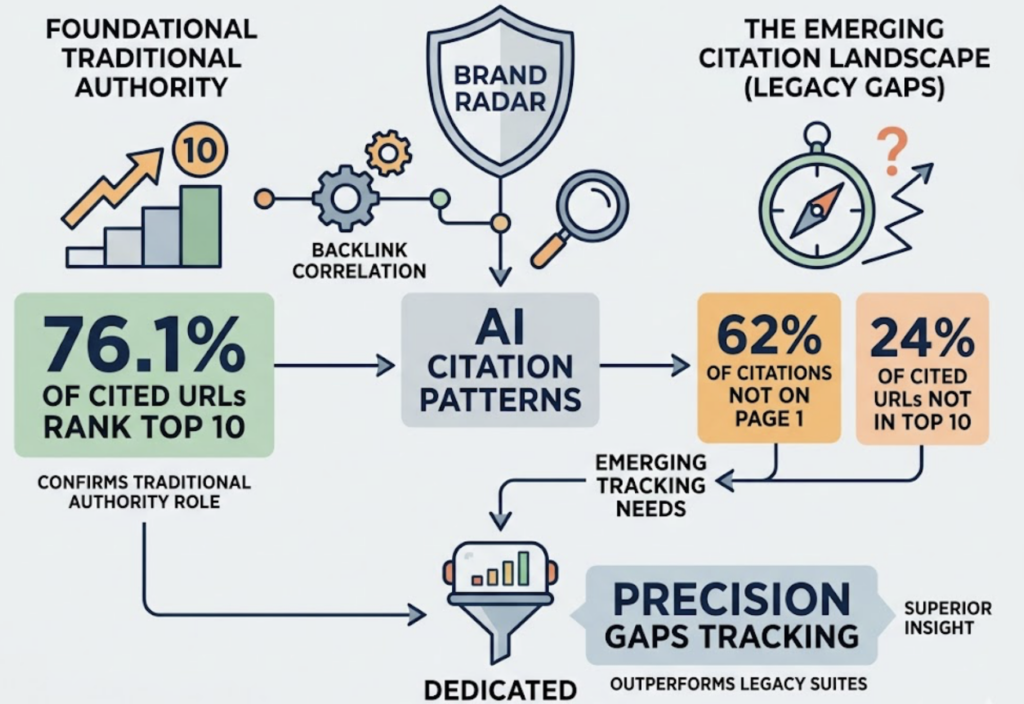
These two things don’t correlate the way you’d expect. Research from early 2026 shows the overlap between top-10 organic results and AIO citations has dropped from 76% in mid-2025 to somewhere between 17% and 38% today. That means roughly six out of ten sources the AI cites don’t appear on the first page of traditional search at all.
A tool built around keyword positions will miss up to 62% of the visibility opportunities where your brand is appearing or failing to appear as an AI source.
That’s not a minor blind spot.
6 AI Citation Tracking Solutions for Google AI Overviews, Compared
Before diving into individual tools, here’s a quick overview of the leading options in 2026. The table reflects AI platform coverage, citation depth, and entry pricing.
| Tool | AI Platforms Covered | Citation Depth | Starting Price |
|---|---|---|---|
| Topify | ChatGPT, Gemini, Perplexity, DeepSeek, AIO | URL-level, 7 core metrics | $99/mo |
| SE Ranking | AIO, Gemini, ChatGPT, Perplexity | Source intelligence + brand mention | $129/mo (AI module extra) |
| Rankscale | AIO, ChatGPT, Claude, Perplexity | Credit-based, evidence trails | €20/mo |
| Otterly.AI | AIO, ChatGPT, Perplexity, Gemini | High-level sentiment + trend | $29/mo |
| Omnia | AIO, AI Mode, ChatGPT, Perplexity | Citation-to-content brief | €79/mo |
| Profound | 10+ LLMs | Deep sentiment, implicit mentions | $2,000+/mo |
The right pick depends on whether you need single-platform AIO monitoring or a cross-platform citation tracking strategy. More on that below.
#1 Topify: The AI Citation Tracking Solution Built Around Source Analysis
Topify is the platform that consistently comes up when SEO teams move from “we should monitor Google AI Overviews” to “we need to know exactly why our competitor is getting cited and we’re not.”
The core differentiator is its Source Analysis engine. Most google ai overviews tracking tools detect whether a brand is mentioned somewhere in an AI response. Topify extracts the specific URLs and footnotes the AI used to generate that response — not just that your competitor appeared, but which of their pages the AI treated as authoritative and for which sub-topic.
That distinction matters in practice. It lets content teams map exactly which pages are earning citations and reverse-engineer what a competitor did to earn theirs. That’s a different order of actionability than a brand mention count.
Topify covers ChatGPT, Gemini, Perplexity, DeepSeek, and Google AI Overviews from a single dashboard, tracking seven core metrics: AI Answer Inclusion Rate, Citation Rate, AI Share of Voice, Sentiment Polarity, Position Tracking, Information Gain Gap, and Referring Domain Baseline. For teams running google aio monitoring alongside multi-platform tracking, the unified view eliminates the manual work of stitching together data from separate tools.
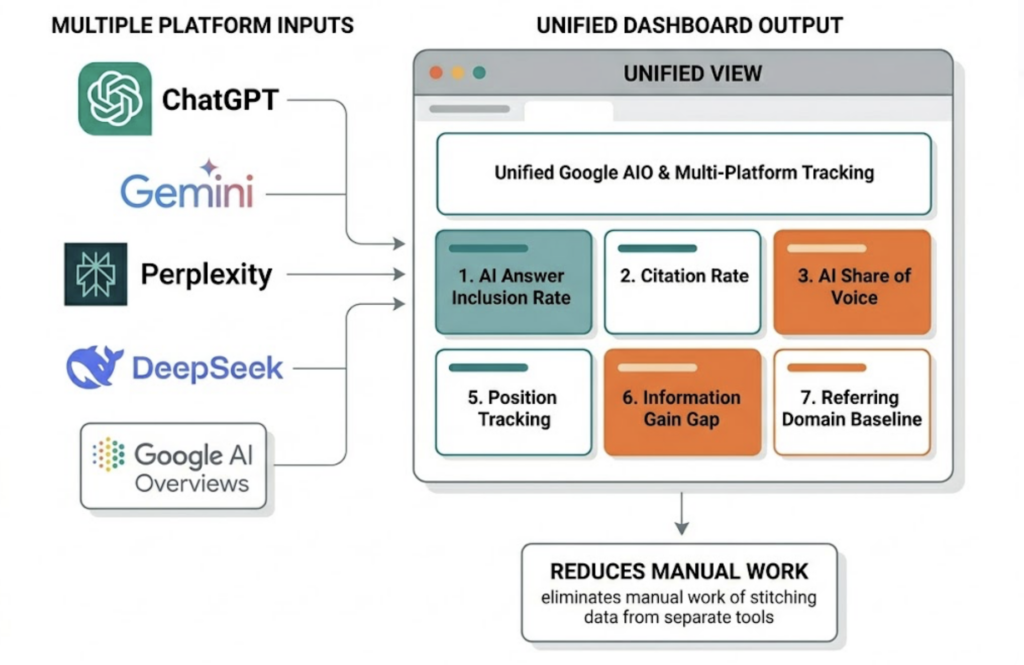
Competitor citation benchmarking is built in. You see which competitors appear in AI Overviews for your target prompts, how often they’re cited, and which URLs are driving that citation share. Monitoring becomes executable strategy rather than a reporting exercise.
Topify’s Basic plan starts at $99/mo with a 30-day trial, covering 100 prompts and 9,000 AI answer analyses across 4 projects. The Pro plan ($199/mo) scales to 250 prompts and 22,500 analyses. For agencies managing multiple clients or in-house teams that need a complete AI citation tracking solution rather than a feature add-on, the coverage-to-price ratio is hard to argue with.
#2 SE Ranking: Worth Considering If You’re Not Ready to Leave Traditional SEO
SE Ranking is the strongest option for teams that still depend heavily on conventional rank tracking and want to layer in google ai overviews tracking without switching platforms entirely. Its AI Overview Tracker sits inside the core SEO suite, so keyword positions and AIO citation data share the same interface.
The “Source Intelligence” feature is genuinely useful for competitive research. It identifies which domains are most frequently cited across a target keyword set, making it easier to spot where a specific competitor or industry publication has locked in citation dominance. International coverage is solid too — SE Ranking tracks AIO across all countries where the feature is live.
The pricing structure is where things get complicated. The base platform runs $129/mo, but adding the AI Search module can push total cost past $270/mo for teams tracking 1,000 prompts. If you’re already a SE Ranking customer looking to add AIO coverage incrementally, that’s a reasonable upgrade. Starting fresh purely for AI citation tracking, the value case is weaker.
#3 Rankscale: The Low-Cost Entry Point for Focused AIO Monitoring
Rankscale is designed for smaller teams or agencies that want to test google aio tracking before committing to a larger platform. At €20/mo with a credit-based model, the entry point is genuinely accessible.
Its standout feature is “Evidence Trails” — archived snapshots of the full AI response text and linked citations at the time of the query. This is more useful than it sounds. AI responses are non-deterministic: the same prompt can produce a different answer at 10am versus 2pm. A timestamped record makes it possible to show stakeholders what the AI actually said and when. In independent testing by Coalition Technologies, Rankscale achieved near 100% accuracy across 2,700 prompt pulls — strong performance for a budget-tier tool.
The constraint worth noting: Rankscale is more narrowly focused on Google’s AI experiences than on a full multi-platform ecosystem. For teams whose primary objective is to track Google AIO for specific keyword sets, that focus is a feature. For teams that need ChatGPT and Perplexity data in the same view, it’s a limitation.
For Rankscale alternatives with Google AI Overviews tracking that also extend to multi-platform AI search, Topify and SE Ranking are the natural next steps up.
#4 Otterly.AI: Entry-Level Brand Monitoring for Teams Just Starting Out
Otterly.AI covers Google AIO, ChatGPT, Perplexity, and Gemini at $29/mo, making it the most affordable paid option in this category. It’s well suited for small brands or solo practitioners getting their first read on where they stand in AI-generated answers.
The trade-off is citation depth. Otterly tells you that you’re mentioned. It doesn’t tell you which URL was cited, why the AI chose that source over yours, or how citation frequency shifts week over week. For initial discovery that’s fine. For content strategy decisions, you’ll eventually need more granularity.
#5 Semrush and Ahrefs: Legacy Suites Adding AI Layers
Semrush’s “AI Visibility Toolkit” tracks brand mentions and citations across ChatGPT, Gemini, and Google AIO, integrating that data with its existing PPC and social media tools. It’s most valuable for large agencies already running Semrush across multiple channels where consolidation has operational value.
Ahrefs takes a more measured approach with its “Brand Radar,” focusing on backlink correlation with AI citation patterns. The underlying data is worth taking seriously: according to Ahrefs research, 76.1% of URLs cited in AI Overviews also rank in the top 10, confirming that traditional authority still plays a foundational role. That said, the 24% that don’t rank in the top 10 — and the 62% of citations that don’t appear on page one at all — are precisely where dedicated citation tracking tools outperform legacy suites.
Both are reasonable additions for teams already in those ecosystems. Neither was designed from the ground up for citation tracking.
4 Things a Real Google AIO Tracking Solution Has to Do in 2026
Running through the tools above, four capabilities separate genuine google ai overviews tracking tools from platforms that added an “AI” label to a traditional rank tracker.
URL-level citation extraction. Knowing your brand was “mentioned” isn’t enough. AI-referred visitors convert at 14.2%— roughly five times higher than traditional organic — because they’ve already consumed a synthesized summary and arrive pre-qualified. Protecting that traffic requires knowing exactly which URLs are generating it, not just that the brand appeared somewhere.
Multi-platform coverage. Citation overlap between Google AI Overviews and ChatGPT is only 12%. What earns you citations in AIO may do nothing for your Perplexity or ChatGPT visibility. A complete best google ai overviews tracking tool for 2026 needs to cover all three simultaneously, because your audience is already splitting their research across all of them.
Competitor citation benchmarking. Being cited in an AI response comes with a 35% boost in organic CTR and 91% more paid clicks compared to brands that are present on the page but ignored by the AI. Knowing which competitor pages are earning that premium — and for which prompts — is the starting point for any content response.
Time-series data and evidence archiving. 70% of cited pages have been updated within the last 12 months, and in competitive sectors, the citation set can rotate weekly. Single snapshots miss that volatility entirely. Effective google aio tracking requires a moving average of citation appearances over time, not a one-off audit your team pulls manually each quarter.
Conclusion
The gap between ranking and being cited has never been wider. Organic CTR for informational queries where an AI Overview appears has dropped to 0.61%, down from 1.76% just two years prior. Holding a #1 position is no longer a reliable proxy for search visibility.
The teams gaining ground are the ones tracking citations — not just positions. That means knowing which URLs the AI is using, which competitors have locked in citation share, and which prompts are driving high-converting traffic that doesn’t appear in a standard analytics dashboard.
Start with an audit of your citation coverage across your top 20 target prompts. Get started with Topify and you’ll have that data within the first session. From there, the content strategy becomes a lot more obvious.
FAQ
Q: What’s the difference between Google AIO rank tracking and AI citation tracking?
A: Rank tracking measures where your URL appears in the organic list beneath the AI Overview. Citation tracking measures whether the AI’s generated summary is actually using your content as a source and linking back to your page. In 2026, a site can rank #1 but have zero citation share, or rank #50 and be the AI’s primary reference for a sub-topic. Research shows the overlap between top-10 organic rankings and AIO citations now sits between 17% and 38%, down from 76% in mid-2025.
Q: Can I use Topify to track only Google AI Overviews, or does it require a multi-platform setup?
A: Topify supports campaign-specific tracking, so you can focus on Google AI Overviews for targeted projects. That said, given that citation overlap between Google AIO and ChatGPT is only 12%, a multi-platform view typically surfaces a more complete picture of where your brand is and isn’t being cited.
Q: Are there free google ai overviews tracking tools available?
A: Some platforms offer limited free tiers. Aiso allows tracking for up to three topics at no cost, and LLMRankings offers a free plan for 10 keywords. Professional-grade monitoring with daily refreshes, competitor benchmarking, and archived evidence trails typically starts at $29/mo (Otterly.AI) or $99/mo for Topify’s Basic plan, which includes a 30-day trial.
Q: How often does Google AI Overviews update its citation sources?
A: Frequently. Research shows 70% of cited pages have been updated within the last 12 months, and in fast-moving sectors like SaaS and news, the citation set can rotate weekly or daily. One-time audits don’t capture that volatility. Time-series tracking — a moving average of citation appearances over days and weeks — is the more reliable signal for strategy decisions.

