

You searched “AI search monitoring tool,” found a dozen options, and now you’re stuck. Half of them only track ChatGPT. A few cover Perplexity but skip Google AI Overviews entirely. The dashboards look similar. The feature lists blur together.
Here’s the real problem: each AI engine weighs credibility, real-time data, and community content differently. A brand that’s highly visible on ChatGPT can be completely absent from Perplexity or Gemini. Picking a tool that only monitors one platform doesn’t just limit your data. It creates a false sense of security.
Most AI Search Monitoring Tools Only Track One Platform. That’s the Visibility Trap.
The 2026 AI search monitoring market has split into two camps: all-in-one platforms built specifically for generative search, and traditional SEO tools that bolted on LLM tracking as an afterthought. The difference matters more than most buyers realize.
ChatGPT tends to weight brand reputation and third-party validation, pulling from reviews, Wikipedia entries, and authoritative publications. Perplexity, on the flip side, favors real-time sources, Reddit discussions, and community-generated content. Google AI Overviews lean toward factual, neutral summaries drawn from top-ranking pages. Same brand, three different visibility profiles.
That’s what researchers are now calling the “Visibility Trap”: the false confidence of ranking well on one AI engine while staying invisible on the others. A brand might show strong sentiment on Google AI Overviews but have zero traction on ChatGPT because it’s absent from the model’s RAG source pool.
There’s also what 2026 benchmarking data refers to as “RAG Lag.” Static base models update slowly, but RAG-enabled engines pull live sources nearly in real time. If your AI search monitoring tool only checks the base model, it misses the live visibility layer entirely.
Bottom line: single-platform monitoring creates blind spots. The tools worth considering in 2026 are the ones that cover at least three major AI engines and track what’s happening at the prompt level, not just the keyword level.
Top 7 AI Search Monitoring Tools, Ranked
Here’s a quick overview of the top-rated AI search monitoring tools in 2026, ranked by platform coverage, metric depth, and execution capability.
| Tool | AI Platforms Covered | Core Strength | Starting Price |
|---|---|---|---|
| Topify | ChatGPT, Gemini, Perplexity, DeepSeek, Doubao, Qwen, AI Overviews | Full-stack GEO: monitoring + citation analysis + one-click execution | $99/mo |
| Nightwatch | ChatGPT, Perplexity, Google AI Overviews | Traditional SEO + LLM response tracking with citation-level sentiment | ~$99/mo |
| Omnia | ChatGPT, Google AI Overviews | Converts visibility data into content briefs and structural recommendations | Custom pricing |
| Lebesgue | ChatGPT, Perplexity, Google AI Overviews | First-party traffic attribution from AI mentions via Le Pixel | ~$59/mo |
| Semrush AI Toolkit | Google AI Overviews, ChatGPT (limited) | Established SEO suite with AI visibility add-on | $139/mo+ |
| HubSpot AI Monitoring | Google AI Overviews | CRM-native AI search insights for inbound teams | Bundled with Marketing Hub |
| Ahrefs AI Visibility | Google AI Overviews, ChatGPT (beta) | Backlink-centric approach extended to AI citation tracking | $129/mo+ |
The next sections break down what sets each apart, starting with the platform that consistently scores highest on multi-engine coverage and execution depth.
#1 Topify: Full-Spectrum AI Search Monitoring Across 7+ Platforms
Most AI search monitoring platforms track two or three engines. Topify covers seven, including ChatGPT, Gemini, Perplexity, DeepSeek, Doubao, and Qwen, which makes it the broadest coverage option available in 2026.
What sets it apart isn’t just reach. It’s the depth of monitoring at the prompt level. Topify executes thousands of high-intent prompt variations across each platform, then analyzes how AI engines frame the response, which brands get mentioned, in what order, and with what sentiment. That’s a different approach from tools that simply check whether a brand name appears in a generic query.
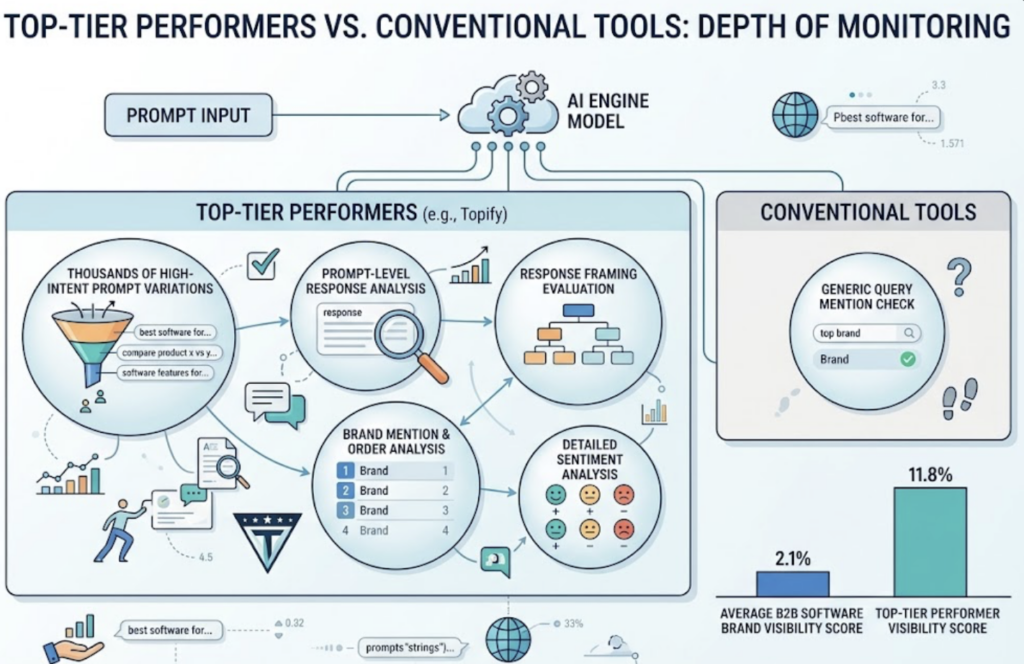
Seven core metrics in one dashboard. Topify tracks visibility score, sentiment, position rank, search volume, brand mentions, user intent, and CVR (Conversion Visibility Rate) across all monitored platforms. CVR, in particular, estimates how likely an AI response is to drive a user toward your brand, a metric most competitors don’t offer.
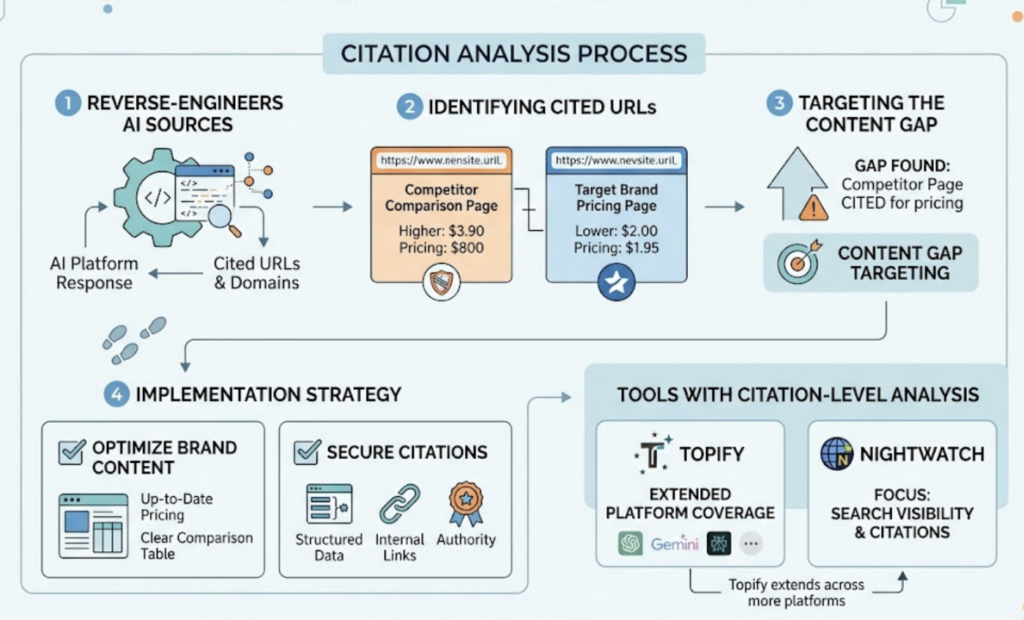
Citation analysis at scale. The platform reverse-engineers which domains and URLs each AI engine cites, so you can see whether your content or your competitor’s content is the preferred source. This is where the “monitoring” label undersells it. It’s closer to competitive intelligence.
One-click execution. This is the gap between monitoring and optimization. Most tools stop at showing you the data. Topify’s AI agent lets you define goals in plain English, review the proposed strategy, and deploy it with a single click. No manual content workflows. No spreadsheet handoffs.
The team behind Topify includes a former Fortune 500 SEO lead with 10+ years of experience and an LLM researcher from Stanford with publications at NeurIPS, AAAI, and ICLR. That combination of search practitioner experience and research depth shows in the product’s metric design.
Pricing starts at $99/month for the Basic plan (100 prompts, 9,000 AI answer analyses, 4 projects). The Pro plan runs $199/month with 250 prompts and 22,500 analyses. Enterprise plans start at $499/month with a dedicated account manager.
For teams that need to monitor, analyze, and act on AI search visibility from one platform, Topify is the most complete option on this list. Get started with a 30-day trial here.
#2 through #7: Other AI Search Monitoring Platforms Worth a Look
#2 Nightwatch. A strong option for teams already invested in traditional SEO that want to layer in AI search monitoring. Nightwatch combines standard rank tracking with LLM response analysis and citation-level sentiment scoring. It covers ChatGPT, Perplexity, and Google AI Overviews. The limitation: it doesn’t extend to DeepSeek, Doubao, or other non-Western AI engines, which matters for global brands.
#3 Omnia. Built for growth teams that want to move from data to action quickly. Omnia converts AI visibility data into structured content briefs and on-page recommendations. Its sweet spot is turning monitoring insights into tactical output. Platform coverage is more limited, focused on ChatGPT and Google AI Overviews.
#4 Lebesgue. The standout here is attribution. Lebesgue connects AI mentions to first-party traffic and sales conversions using its proprietary Le Pixel tracking. If your primary question is “how much revenue are AI search mentions actually driving?”, Lebesgue is built to answer that. Coverage includes ChatGPT, Perplexity, and AI Overviews.
#5 Semrush AI Toolkit. Semrush needs no introduction in SEO. Its AI visibility features are still evolving, with coverage focused on Google AI Overviews and limited ChatGPT tracking. The advantage: if you’re already a Semrush user, the AI data integrates into a familiar interface. The disadvantage: it’s not a dedicated AI search monitoring platform, so the depth of prompt-level analysis is shallower.
#6 HubSpot AI Monitoring. HubSpot has added AI search insights within its Marketing Hub. It’s useful for inbound marketing teams that want AI visibility data alongside their CRM, email, and content analytics. Coverage is limited to Google AI Overviews, making it more of a supplementary view than a primary monitoring tool.
#7 Ahrefs AI Visibility. Ahrefs brings its backlink-centric DNA to AI citation tracking. It’s strong at identifying which backlinks contribute to AI citations and which content pages are being referenced. ChatGPT support is in beta, and coverage beyond Google AI Overviews is still growing. A solid choice for link-focused SEO teams expanding into GEO.
What an AI Search Monitoring Platform Should Actually Measure
Not all AI search monitoring tools track the same things. Some give you a visibility score. Others show you citation sources. The tools that deliver real ROI tend to measure these five dimensions together.
Citation Rate. This is the percentage of high-value prompts where your domain is cited as a source in the AI’s response. It tells you whether your content is being used as a reference, not just whether your brand name gets mentioned. Topify’s Source Analysis feature tracks cited domains and URLs across all monitored platforms, so you can see exactly where your content is being pulled in and where it’s being passed over.
Share of Voice. How often does your brand appear in AI responses compared to competitors? This is the AI equivalent of market share in traditional search. Topify calculates this through its Visibility Score and Competitor Monitoring, automatically detecting which brands appear alongside yours and how frequently.
Sentiment of Mentions. Being mentioned isn’t enough if the AI describes your product as “budget” when your positioning is premium. Sentiment tracking analyzes the tone and framing of each mention. Google AI Overviews tends toward neutral, factual phrasing. ChatGPT responses can be highly opinionated based on training data. Monitoring sentiment across platforms catches these discrepancies early.
AI-Driven Referral Traffic. This is the hardest metric to capture. Standard GA4 setups often can’t attribute traffic from LLM responses without additional tracking infrastructure. Lebesgue’s Le Pixel approach addresses this directly, while Topify’s CVR metric estimates the likelihood that an AI response will drive user engagement with your brand.
Entity Alignment. How accurately does the AI define your brand compared to how you define it? If ChatGPT calls your enterprise product “great for small teams,” that’s an entity alignment gap. Tracking this helps you identify where AI narratives diverge from your messaging, so you can correct the underlying content signals.
The platforms that measure all five dimensions, rather than just one or two, tend to deliver the clearest path from monitoring to action. That’s the ROI case for an ai search monitoring platform: not just seeing where you stand, but knowing exactly what to fix.
How AI Search Monitoring Tools Track ChatGPT and Perplexity
If you’re evaluating AI search monitoring tools for ChatGPT, Perplexity, or any other AI engine, it helps to understand what’s happening under the hood. The technology differs significantly from traditional SEO rank tracking.
Prompt-level tracking. Instead of checking keyword positions, AI search monitoring tools execute thousands of prompt variations across target AI platforms. For a brand in the CRM space, that might mean running “What’s the best CRM for mid-size SaaS companies?” across ChatGPT, Perplexity, and Gemini simultaneously, then analyzing each response for brand mentions, sentiment, and position.
This matters because AI responses are prompt-sensitive. Changing one word in a query can shift the entire recommendation list. Tools that only check a handful of generic prompts miss the variation that real users create.
Citation analysis. This goes deeper than tracking whether your brand name appears. Citation analysis reverse-engineers which URLs and domains the AI platform is citing as its source material. If Perplexity is pulling pricing data from a competitor’s comparison page instead of your own, that’s a content gap you can target. Topify and Nightwatch both offer citation-level analysis, though Topify extends this across more platforms.
GEO audits. Some platforms also check for technical signals that influence whether an AI engine selects your content as a source. That includes schema markup, crawlability, content structure, and entity definitions. These are the factors that determine whether your page gets into the RAG source pool in the first place. If it doesn’t, no amount of content optimization will make you visible in AI responses.
The combination of these three layers, prompt tracking, citation analysis, and technical auditing, is what separates a monitoring dashboard from a full AI search optimization system.
Conclusion
The AI search monitoring market in 2026 has more options than ever. The real question isn’t which tool has the most features on paper. It’s which one monitors across the platforms your audience actually uses, measures the metrics that connect to business outcomes, and gives you a path from data to action.
Single-platform monitoring creates a visibility trap. The brands that are winning in AI search are the ones tracking citation sources, sentiment, and competitive positioning across ChatGPT, Perplexity, Gemini, and beyond. Topify covers that full spectrum, from prompt-level monitoring to one-click execution, starting at $99/month.
If you haven’t checked where your brand stands across AI search engines yet, Topify’s free GEO tools are a practical starting point.
FAQ
Q: What is the best AI search monitoring tool in 2026?
A: For teams that need multi-platform coverage and execution capability, Topify consistently ranks as the top option. It monitors 7+ AI engines, tracks seven core metrics, and includes one-click optimization. Nightwatch and Lebesgue are strong alternatives for teams with more specific needs around traditional SEO integration or revenue attribution.
Q: How much do AI search monitoring platforms cost?
A: Pricing ranges from free tiers and trials to $499+/month for enterprise plans. Topify starts at $99/month (100 prompts, 9,000 AI answer analyses). Lebesgue starts around $59/month. Semrush and Ahrefs bundle AI features into their existing plans at $129-$139/month. Most platforms offer monthly billing with discounts for annual commitments.
Q: Can AI search monitoring tools track ChatGPT results?
A: Yes, most top-rated tools in 2026 track ChatGPT responses at the prompt level. Topify, Nightwatch, and Lebesgue all cover ChatGPT. The key differentiator is depth: some tools only check generic queries, while Topify runs thousands of prompt variations to capture how different phrasings change recommendations.
Q: What’s the ROI of using an AI search monitoring platform?
A: ROI comes from three areas: protecting brand visibility before competitors take your position, identifying content gaps that limit AI citations, and correcting AI narratives that misrepresent your brand. Lebesgue offers direct revenue attribution. Topify’s CVR metric estimates conversion likelihood from AI mentions. The brands seeing the strongest returns are those that use monitoring data to drive content and optimization actions, not just reporting.

