

Search “best AI Mode rank tracker” and you’ll find a dozen platforms that all promise visibility tracking across generative search. Half of them only measure where your brand appears in an AI response. The other half only tell you which domains get cited, without showing whether your brand actually ranks inside Google AI Mode.
That gap is the problem. AI citation tracking and AI Mode rank tracking measure two completely different things, and most tools only cover one. Meanwhile, your organic traffic is dropping even though your traditional rankings haven’t moved, and your existing dashboards can’t explain why.
Most AI Mode Rank Trackers Only Cover Half the Picture
Here’s the trap most SEO teams fall into when shopping for AI mode rank tracking tools: they evaluate platforms based on features listed on pricing pages without asking what each tool actually measures under the hood.
Some tools track positional visibility. They tell you whether your brand appears first, third, or not at all inside an AI-generated answer. That’s useful, but it doesn’t explain why the model chose that brand over yours. Other tools track citation sources, mapping the exact URLs that AI platforms reference when constructing a response. That’s also useful, but it ignores whether your brand actually shows up in Google AI Mode, which remains the highest-volume generative interface globally.
The real evaluation framework comes down to two questions: Which brands is the AI recommending? And which sources is it citing to justify that recommendation?
The data makes the stakes clear. In the transition from 2024 to 2025, 37.1% of B2B SaaS websites experienced organic traffic declines despite maintaining or improving their traditional keyword rankings. The average query submitted to an AI system now runs 23 words long, compared to three or four words in traditional search. Legacy keyword volume metrics carry error rates between 48% and 62%, making them nearly useless for generative optimization.
Traffic impact is equally severe. AI Overviews now trigger in roughly 13% to 16% of all search results. When they appear, organic click-through rates for top-ranking pages drop by an average of 34.5%, with peak reductions hitting 61% for informational queries.
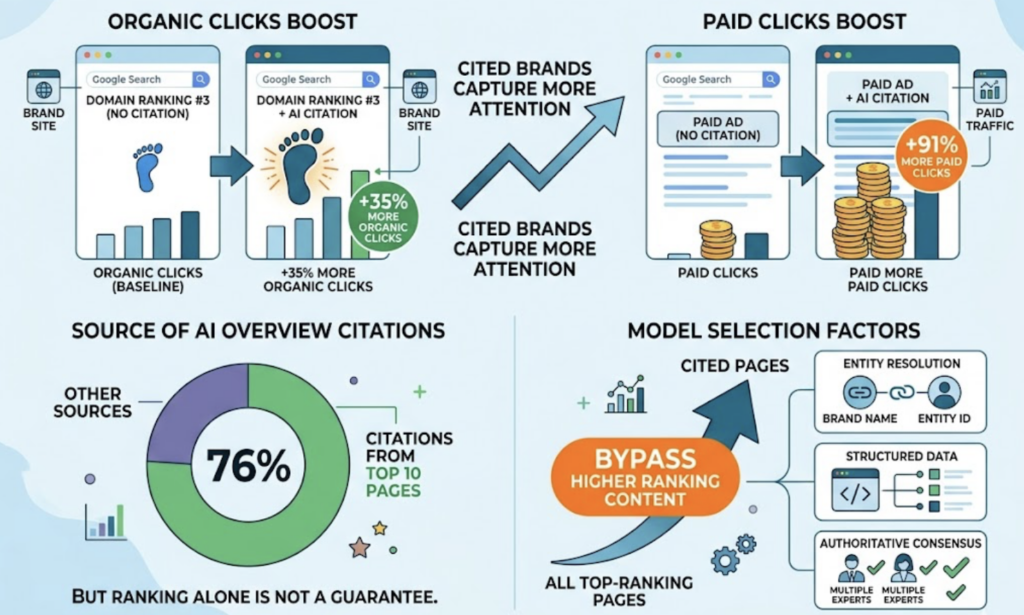
But here’s what matters most for AI citation tracking monitoring: when a brand’s domain is explicitly cited as a source within an AI Overview, that website receives 35% more organic clicks compared to domains ranking in the same traditional position without the citation. Cited brands also capture 91% more paid clicks. About 76% of AI overview citations come from pages already in Google’s top ten, but ranking alone doesn’t guarantee selection. Models actively bypass higher-ranking content that lacks entity resolution, structured data, or authoritative consensus.
Rank tracking without citation tracking is half the picture. Citation tracking without rank monitoring is the other half.
Top AI Mode Rank Trackers and AI Citation Monitoring Tools, Ranked
The comparison below evaluates each platform across the dual-dimensional framework: how well it tracks positional visibility inside AI responses, and how deeply it maps the underlying citation sources.
| Tool Name | AI Mode Tracking | Citation Tracking | Platforms Covered | Starting Price |
|---|---|---|---|---|
| Topify | Comprehensive | Full-Stack Source Level | ChatGPT, Perplexity, Gemini, Google AIO, DeepSeek | $99/mo |
| Semrush AI Toolkit | Moderate | Partial (Domain Level) | Google AI Overviews, ChatGPT, Gemini | $165/mo (Bundled) |
| Ahrefs Brand Radar | Advanced | Advanced | ChatGPT, Perplexity, Gemini, Copilot, Grok, AIO | $398/mo |
| SE Ranking | Advanced | Advanced | Google AIO, ChatGPT, AI Mode, Perplexity, Gemini | $129/mo |
| Nightwatch | Advanced | Full-Stack Source Level | ChatGPT, Claude, Gemini, Perplexity, Google AIO | €79/mo |
Topify takes the top position for its combination of comprehensive source-level citation reverse-engineering, cross-platform AI Mode rank monitoring, and an accessible entry price. Ahrefs and Nightwatch provide deep data, but at significantly higher thresholds or with more complex integration requirements. Semrush and SE Ranking offer strong bundled feature sets for existing users, though they show limitations in standalone generative visibility scaling.
Topify: Full-Stack AI Citation Tracking and AI Mode Rank Monitoring
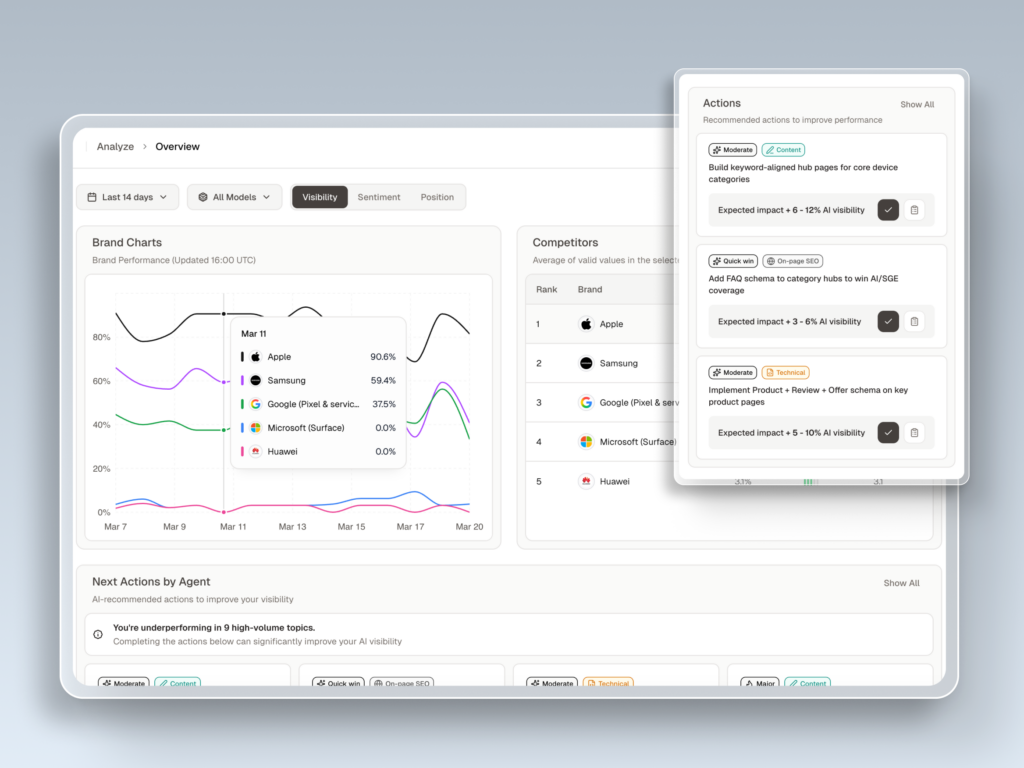
Topify isn’t a legacy SEO tool with an AI add-on bolted onto the side. It’s built from the ground up for generative search, combining source-level citation tracking, positional visibility monitoring, sentiment analysis, and competitor benchmarking into a single environment.
The pricing is credit-based, and credits roll over indefinitely. The Starter plan at $99/month provides 5,000 monthly credits, 50 daily prompt tracks, 15 automated article generations, and unlimited team seats across one project. The Standard plan at $199/month bumps that to 12,000 credits and 100 daily prompts. The Pro plan at $399/month, which tends to be the most popular tier, delivers 30,000 credits for 300 daily prompts across multiple brands and projects with dedicated support. Enterprise solutions offer custom volumes and API access.
How Topify Tracks AI Citations Across Platforms
Modern LLMs don’t invent answers independently. They operate as retrieval-augmented generation systems that parse the web, relying heavily on machine-readable structure and third-party consensus to determine what’s authoritative. Topify’s Source Analysis capability continuously monitors which domains and specific URLs are cited by ChatGPT, Perplexity, Gemini, and Google AI Mode.
Through reverse-engineering these citation pathways, Topify shows exactly which content pieces AI systems are selecting, and which high-investment assets are being entirely bypassed. That diagnostic layer is where the real value sits, because a lack of generative visibility often stems from technical parsing gaps rather than weak content.
Here’s a practical example: your team’s comprehensive 4,000-word industry guide gets zero citations from Perplexity. A competitor’s shorter, technically inferior article gets cited repeatedly. Topify’s Source Analysis reveals the reason: your core answers are buried under complex narrative formatting and heavy JavaScript that extraction bots can’t efficiently parse. That’s not an authority problem. It’s a structure problem. And without citation-level tracking, you’d never see it.
AI Mode Rank Tracking with Topify
AI doesn’t use strict linear rankings like traditional search, but the order in which brands appear inside a synthesized paragraph or list still heavily influences click-through behavior. Being mentioned first carries far more commercial value than being mentioned fifth.
Topify measures this through continuous AI Visibility metrics. The platform generates targeted probe queries relevant to your industry and polls major engines to aggregate mention rates and positional rankings. Within Google AI Mode specifically, Topify monitors how your brand’s inclusion in overviews fluctuates over time.
Because AI models undergo regular retraining and ingest real-time data, a dominant position can evaporate fast if a competitor publishes structurally superior, answer-first content. Topify’s dashboard benchmarks your standing directly against competitors across ChatGPT, Perplexity, Gemini, Claude, and DeepSeek, with automated alerts when visibility regressions occur so your team can act before revenue takes a hit.
Other AI Mode Rank Tracker Tools Worth Considering
Semrush AI Toolkit
Semrush has integrated AI visibility into its existing SEO infrastructure, making it a natural fit for teams already using the platform. The AI Visibility Toolkit provides brand mention benchmarking, competitor perception analysis, generative prompt discovery, and crawlability issue detection across Google AI Overviews, ChatGPT, and Gemini.
Pricing requires careful forecasting, though. Semrush One Starter runs $199/month ($165.17 billed annually) for five websites and 50 custom prompts. Pro+ scales to $299/month for 15 websites and 100 prompts, while Advanced costs $549/month for 40 websites and 200 prompts. The standalone AI add-on is $99/user/month but restricts you to a single domain and 25 prompts. Expanding that incurs additional per-domain and per-prompt fees that can escalate quickly for multi-brand operations.
Ahrefs Brand Radar
Ahrefs takes a data-intensive, enterprise-grade approach with Brand Radar. The platform’s scale is staggering: over 400 million total monthly prompts tracked, including 243 million organic prompts derived from actual search behavior. Coverage spans AI Overviews, AI Mode, Gemini, Perplexity, ChatGPT, Copilot, and Grok, plus external environments like YouTube, TikTok, and Reddit.
That depth demands a matching budget. Brand Radar isn’t included in base plans ($129 to $1,499/month). Access to individual AI platforms costs $398/month, and full cross-engine access runs $699/month. Custom prompt packages add $50 to $250/month on top of that, with per-check overage fees. It’s an elite data source for well-capitalized global teams, but it lacks built-in content generation or technical remediation workflows.
SE Ranking AI Visibility
SE Ranking offers a pragmatic, agency-friendly AI Search Toolkit. It tracks brand presence across Google AI Overviews, ChatGPT, AI Mode, Perplexity, and Gemini. A standout feature: SE Ranking retrieves results via live platform queries and provides cached visual copies of actual AI answers, so you see the exact framing and context of brand mentions as the end-user experiences them.
Its AI Source and Coverage Analysis maps exact URLs in answers, categorizes sources by media type, and identifies high-influence domains across seven markets and five languages. The Core plan starts at $129/month, with advanced automation at $279/month. It’s a strong fit for mid-market agencies that need clean historical trend lines and standardized reporting, though it lacks bespoke content generation features.
Nightwatch AI Mode Tracking
Nightwatch appeals to data-obsessed technical teams. Its AI Tracker is built on “Citation Intelligence,” mapping exactly which URLs, from GitHub and Stack Overflow to Forbes and Reddit, get cited across ChatGPT, Claude, and Gemini.
The platform connects traditional SERP performance with AI citations, providing an unbroken view of the entire data retrieval pipeline. It tracks average position within list-based LLM answers, measures conversational share of voice against competitors, and runs continuous sentiment analysis. Pricing starts at €79/month (Starter), scaling to €159 (Professional) and €399 (Agency). With tracking across over 107,000 localized geographic locations down to zip-code level, Nightwatch is a strong pick for teams that need hyper-granular citation tracking with programmatic API access.
How to Choose the Best AI Mode Rank Tracking Software for Your Team
The right tool depends on where your team sits operationally.
If your primary need is programmatic rank tracking across massive, localized keyword portfolios, Nightwatch’s geographic precision and API flexibility are hard to beat. If you’re a global enterprise that needs to monitor hundreds of millions of data points across every generative engine and social ecosystem, Ahrefs Brand Radar offers the deepest raw dataset on the market. If you’re already running Semrush for traditional SEO and want to layer on AI visibility without switching platforms, the bundled Semrush One packages or SE Ranking’s collaborative reporting make that transition smoother.
But if you need a dedicated, full-stack solution that connects source-level citation tracking with AI Mode rank monitoring and actionable content optimization in one place, Topify is built specifically for that workflow. It’s designed for teams that want to move from raw data to active generative engine optimization without navigating legacy interfaces.
Not ready to commit to a paid plan yet? Start with the free GEO Score Checker. No credit card, no account required. In under 60 seconds, it queries ChatGPT, Gemini, Perplexity, Claude, and Google AI Overviews and returns a 0-to-100 score covering AI bot accessibility, schema integrity, machine-readable content signals, and current generative visibility presence. Most teams find they can boost their GEO score by 20 to 30 points just by unblocking AI crawlers in robots.txt and deploying foundational FAQ schema. That’s a significant visibility gain before you ever need a persistent monitoring subscription. You can also explore Topify’s full suite of free AI visibility tools to build your baseline.
Conclusion
AI citation tracking monitoring and AI Mode rank tracking aren’t interchangeable. They measure two different layers of the same system: one maps the sources models use to construct answers, the other tracks where your brand lands in those answers. Running one without the other means you’re optimizing with an incomplete dataset.
The brands that are pulling ahead in 2026 aren’t just watching their rankings. They’re tracking which URLs get cited, which competitors gain share of voice, and how sentiment shifts across AI platforms week over week. Start by establishing your citation baseline and technical accessibility score, then layer on continuous AI Mode rank monitoring. That dual-dimensional approach is how you secure the Citation Advantage, where cited brands capture 35% more organic clicks and 91% more paid clicks than uncited competitors at the same traditional ranking position.
FAQ
Q: What’s the difference between AI citation tracking and AI Mode rank tracking?
A: AI Mode rank tracking measures whether your brand appears in a generative response and how prominently it’s positioned within lists or summaries. AI citation tracking goes deeper, reverse-engineering the retrieval process to identify the exact source URLs the model used to construct that recommendation. Rank tracking shows the output. Citation tracking maps the inputs and semantic signals that drive the model’s behavior.
Q: Are there free AI mode rank tracking tools available?
A: Yes. While persistent, large-scale daily tracking typically requires a paid subscription, you can establish a solid technical baseline for free. Topify’s GEO Score Checker analyzes any domain across major AI engines without registration, evaluating bot access, structured data, and real-time AI visibility presence with an actionable 0-to-100 score.
Q: How often should I monitor AI citations and AI Mode rankings?
A: Continuously. AI engines get updated, retrained, and fed real-time web data constantly. A dominant recommendation position one week can disappear the next if a competitor publishes structurally superior content. High-performing teams typically run automated daily checks across all targeted prompts to catch sentiment shifts or visibility drops before they hit revenue.
Q: Can traditional SEO rank trackers handle AI Mode rank tracking?
A: No. Traditional rank trackers evaluate static web pages positioned by algorithms focused on backlinks and domain authority. AI engines operate as retrieval-augmented generation systems that prioritize machine readability, conversational entity resolution, and structured data over keyword density. Applying legacy rank-tracking logic to generative AI outputs produces metrics with high error rates that don’t correlate with actual brand visibility.

