

Your domain authority is solid. Your keyword rankings are holding. But someone on your team asked ChatGPT for the top solutions in your category last week, and your brand wasn’t in the answer.
That’s not an SEO problem. That’s a visibility gap your current tools can’t see, because they weren’t built to look there.
Most Search Monitoring Tools Are Flying Blind in AI Search
Traditional rank trackers measure what happens after a user reaches a search results page. They count clicks, track positions, and attribute traffic. That logic made sense when search returned a list of links.
AI search doesn’t return links. It returns answers.
Gartner forecasts that 25% of traditional search volume will decline by 2026 as users shift to AI chatbots, reaching 50% by 2028. Yet most marketing teams are still reporting on Google Analytics sessions and keyword positions, with no visibility into what ChatGPT, Perplexity, or Gemini is actually saying about their brand.
The gap isn’t a minor measurement inconvenience. AI-referred visitors convert at roughly four times the rate of traditional search visitors, because they arrive with higher intent and more context. Missing that channel doesn’t just hurt visibility. It hits revenue.
What an AI Search Monitoring Dashboard Actually Tracks
An AI search monitoring dashboard is a specialized analytics platform that tracks brand visibility, citation frequency, and sentiment across generative AI engines. It doesn’t replace your SEO stack. It monitors a layer your SEO stack can’t reach.
Where traditional analytics tracks URLs and clicks, an AI search monitoring dashboard tracks entity citations and narrative characterization. The unit of measurement isn’t the ranking. It’s the brand mention, and more importantly, how that mention is framed.
A well-built dashboard covers seven core metrics:
| Metric | What It Measures |
|---|---|
| Visibility Score | Composite brand presence across AI platforms and prompt types |
| Citation Frequency (CFR) | % of sampled queries where your brand is explicitly named |
| Position (RPI) | Weighted prominence (lead mention vs. body mention vs. footnote) |
| AI Volume | Monthly search demand within AI tools for your category queries |
| Mentions | Raw frequency of brand references across monitored platforms |
| Intent | Buyer journey stage of the prompts where you’re cited |
| CVR | Downstream conversion likelihood attributed to AI citations |
Industry benchmarks for 2026 place B2B SaaS market leaders at a Citation Frequency Rate between 35% and 45%. If you’re just starting, a realistic initial target is 5% to 15%, with 10% quarter-over-quarter Visibility Score growth as a directional KPI.
How to Set Up Your AI Search Monitoring Dashboard Step by Step
Most teams approach setup backwards. They pick a tool first, then figure out what to track. The right sequence starts with defining your monitoring universe.
Step 1: Choose your platform matrix. ChatGPT holds roughly 47% preference among B2B buyers, but Perplexity and Gemini capture meaningful shares of research-heavy and enterprise queries. A dashboard that only tracks ChatGPT gives you less than half the picture. Plan for multi-engine coverage from day one.
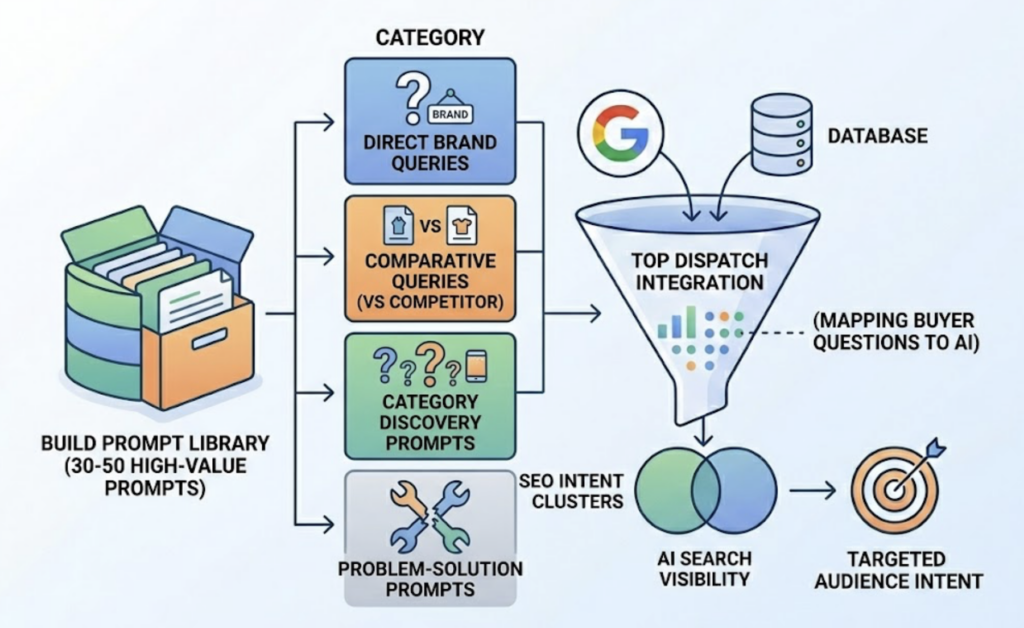
Step 2: Build your Prompt Library. This is the most overlooked step. You’re not mapping keywords. You’re mapping the questions real buyers ask AI. Structure your prompt set across four categories: direct brand queries, comparative queries (your brand vs. a competitor), category discovery prompts (“What are the top tools for X?”), and problem-solution prompts (“How do I fix Y?”). A starting set of 30 to 50 high-value prompts is the industry-standard baseline.
Step 3: Set competitive benchmarks. Identify three to five direct competitors and document their initial Citation Frequency Rate across your shared prompt set. Without a competitive baseline, you can’t tell whether your visibility is improving or just moving in line with the category.
Step 4: Configure alert thresholds. Set automated alerts for visibility drops greater than 10% or sudden negative sentiment spikes. AI recommendations shift continuously. Waiting for a monthly report to catch a drop means you’re already six weeks behind.
Topify‘s High-Value Prompt Discovery feature automates a significant part of this process, surfacing the conversational queries most likely to drive discovery-stage citations. Automating prompt discovery can reduce content research time by up to 80%, compared to manual prompt mapping.
Using a Rank Tracker Tool for ChatGPT: What It Can and Can’t Do
Here’s the thing most rank tracker tools won’t tell you: there’s no such thing as a fixed “position” in ChatGPT.
Traditional rank tracking assumes a deterministic index. Type in a keyword, get a stable list. ChatGPT doesn’t work that way. Its output is probabilistic. The same prompt can yield different brand mentions in different sessions, depending on model temperature, conversation context, and the recency of the model’s training data.
What you can track is entity stability: how consistently the model identifies your brand as a relevant solution for specific use cases. Advanced dashboards handle this by running multiple iterations of the same prompt and calculating a Confidence Score for the brand’s visibility. That’s the meaningful signal. A one-time mention in a single ChatGPT session isn’t data. A 78% citation rate across 200 prompt iterations is.
The other limitation of ChatGPT-only monitoring is platform coverage. Each major AI engine uses different retrieval logic. ChatGPT rewards comprehensive topic clusters. Perplexity prioritizes factual density and verifiable data points. Gemini leans heavily on Google’s Knowledge Graph and structured data. A brand that performs well on ChatGPT can be nearly invisible on Perplexity if its content lacks external citations.
Topify’s Position Tracking uses a weighted Response Position Index to quantify prominence across all major platforms, distinguishing between a lead mention (the highest-value placement) and a footnote citation. It’s a more accurate model of brand authority in AI search than any traditional rank tracker tool for ChatGPT alone.
5 Things That Tank Your AI Search Monitoring Results
1. Monitoring only one platform. This creates survivor bias. You look dominant in your dashboard, but you’re invisible on two of the three platforms your buyers actually use.
2. Ignoring Sentiment. High visibility with negative characterization is worse than low visibility. If AI models consistently describe your product as a “budget alternative” when your positioning is enterprise-grade, your dashboard should be screaming. Most aren’t configured to catch this.
3. No competitive baseline. Citation frequency without context is a vanity metric. If you’re at 22% CFR but your top competitor is at 41%, that’s not a dashboard success story. It’s a gap report.
4. Monitoring too infrequently. Monthly AI search reviews are too slow. Model behavior and citation patterns shift weekly. The brands catching and responding to those shifts are the ones pulling ahead. Weekly tracking is the 2026 industry standard.
5. Tracking prompts that don’t connect to revenue. If your prompt library is full of high-volume awareness queries but your product sells to mid-market procurement teams, you’re measuring the wrong thing. Prompts should map to buyer intent stages, not just search volume.
The Tools Worth Using for AI Search Monitoring in 2026
The market has matured enough to have distinct tiers. Here’s an honest breakdown:
| Tool | Core Advantage | Platform Coverage | Starting Price |
|---|---|---|---|
| Topify | 7-metric GEO analytics + One-Click execution + Prompt Discovery | ChatGPT, Gemini, Perplexity, DeepSeek, and more | $99/mo |
| Profound | Enterprise SKU tracking and e-commerce depth | 10+ engines | From $499/mo |
| Nightwatch | Hybrid SEO/AI tracking; affordable entry point | Major LLMs + Traditional SERPs | From $32/mo |
| Otterly.ai | Clean UI, multi-engine citation mapping | 6 platforms | From $29/mo |
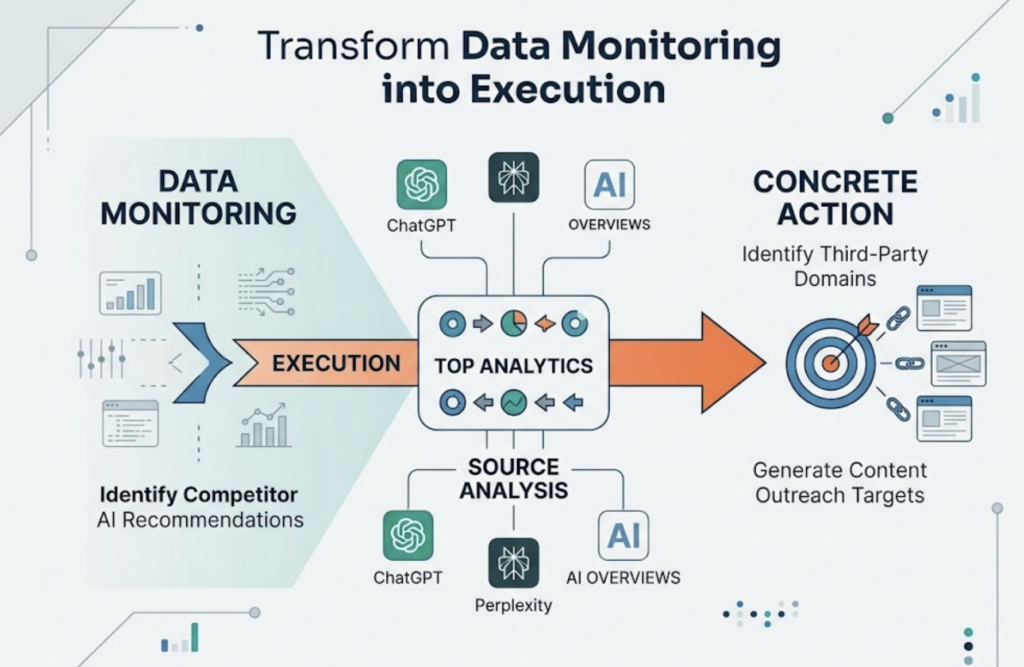
For teams that need to move from monitoring to action, Topify stands out by combining data collection with execution. Its Source Analysis feature reverse-engineers which third-party domains are fueling AI recommendations for your competitors, giving you a concrete content outreach target rather than just a gap report. The Basic plan at $99/month covers 100 prompts, 9,000 AI answer analyses, and tracking across ChatGPT, Perplexity, and AI Overviews. The Pro plan at $199/month scales to 250 prompts and 10 seats for larger teams.
For a deeper look at how GEO tools compare, the Topify blog on AI visibility metrics covers the share-of-voice model in detail.
How to Know If Your Dashboard Is Actually Working
Data collection is not the goal. The goal is a repeatable cycle: data → insight → action.
The primary success signal is the Visibility Score trajectory across your priority prompt set. Look for sustained upward movement over four to six weeks, not single-session spikes. Correlate Visibility Score gains with branded search volume and direct traffic trends, because improvements in AI citations typically show up as increases in users searching for your brand by name.
The secondary signal is your Citation Gap against competitors. If a competitor is consistently cited for a high-intent query where you’re absent, that’s not a brand problem. It’s a content structure problem. Audit their page’s factual density, external citations, and schema markup. Those are usually the gaps.
Sentiment volatility is the signal most teams miss entirely. A sudden drop in Sentiment Score, even when Visibility stays flat, often traces back to a specific “seed source” influencing the model. Topify’s GEO Analytics lets you trace negative sentiment shifts back to the specific domains driving the characterization, whether that’s an outdated review, a Reddit thread, or a competitor’s comparison page.
On the financial side, GEO initiatives typically lower cost per lead by 30% to 50% compared to paid advertising, once the AI visibility flywheel is running. That’s the ROI case for building this infrastructure now, not after your competitors have already claimed the citation share.
A Practical Checklist for Your AI Search Monitoring Dashboard
Use this as your setup and ongoing audit guide:
Platform and Technical Readiness
- Verify that robots.txt allows access for ChatGPT-User, GPTBot, and PerplexityBot
- Deploy FAQ, Article, Organization, and Product JSON-LD schema on priority pages
- Confirm AI crawlers can read your HTML without executing complex JavaScript
Dashboard Configuration
- Define a Prompt Pack of 30 to 50 high-value buyer prompts across Discovery, Comparison, and Problem-Solution intents
- Identify 3 direct competitors and document their initial Citation Frequency Rate
- Enable tracking for all 7 metrics: Visibility, Sentiment, Position, Volume, Mentions, Intent, and CVR
- Set automated alerts for visibility drops greater than 10% or negative sentiment spikes
- Set monitoring cadence to weekly
Content and Strategy
- Restructure key content sections to lead with a direct 2 to 3 sentence answer suitable for AI extraction
- Include a verifiable statistic or data point every 150 to 200 words
- Engage in communities (Reddit, LinkedIn) that AI engines cite as trusted sources
- Refresh high-value content at least quarterly to address AI retrieval recency bias
Measurement and Reporting
- Track Visibility Score trajectory week-over-week across priority prompts
- Monitor Citation Gap against top 3 competitors monthly
- Correlate Sentiment Score shifts with specific seed source domains
- Connect AI visibility improvements to branded search volume and direct traffic trends
Conclusion
Most brands don’t have an AI search problem. They have a visibility gap they can’t see because they’re looking at the wrong dashboard.
The shift from click-based to citation-based brand discovery is already underway. An AI search monitoring dashboard isn’t optional infrastructure for 2026, it’s the minimum viable system for knowing whether your brand exists in the places where your buyers are now doing their research. Get started with Topify to track the 7 metrics that actually matter, across every major AI platform, with a prompt set built for your specific buyer journey.
FAQ
Q: What is an AI search monitoring dashboard? A: It’s a specialized analytics platform that tracks how your brand is cited, described, and positioned across generative AI engines like ChatGPT, Perplexity, and Gemini. It measures visibility, sentiment, position, and conversion signals that traditional SEO tools can’t capture.
Q: How does a rank tracker tool for ChatGPT work? A: Unlike keyword rank trackers, ChatGPT monitoring works by running multiple iterations of the same prompt and measuring how consistently your brand appears in responses. The output is a Confidence Score or Citation Frequency Rate, not a static position number, because ChatGPT’s responses are probabilistic, not deterministic.
Q: What metrics should I track in an AI search monitoring dashboard? A: The seven essential metrics are Visibility Score (overall presence), Citation Frequency Rate (how often you’re named), Response Position Index (lead mention vs. footnote), AI Volume (category search demand in AI tools), Mentions (raw frequency), Intent (buyer journey stage), and CVR (downstream conversion attribution).
Q: How often should I update my AI search monitoring dashboard? A: Weekly is the 2026 industry standard. Daily monitoring tends to be too volatile for actionable insight, while monthly reviews are too slow to catch citation drift. A weekly cadence gives you enough signal to spot trends and enough time for content changes to register with AI crawlers.

