

You’ve probably done it yourself: typed your brand name into ChatGPT, scanned the response, and moved on. Maybe you checked Perplexity too. But that manual spot-check tells you what one AI said at one moment for one prompt. It doesn’t tell you what Gemini said last Tuesday, what Google’s AI Overview cited this morning, or whether your competitor just overtook you in Perplexity’s recommended list for your highest-value keyword.
Traditional SEO dashboards can’t answer any of those questions. They weren’t built to. And the gap between what your leadership team expects to see in a quarterly report and what your current tools can deliver is widening every month.
Most AI Answer Tracking Platforms Only Cover Half the Picture
Here’s the first thing that trips up teams shopping for an AI answer tracking platform: coverage claims that sound comprehensive but aren’t.
Some tools only monitor ChatGPT. Others track two or three engines but skip Google AI Overviews entirely, which is a problem when AI Overviews now appear on roughly 48% of search queries. A platform that ignores AIO is missing nearly half the AI-influenced search picture.
Then there’s the metrics gap. Counting how many times an AI mentions your brand is a start, but it’s not enough to drive decisions. What you actually need is a layered view: citation frequency, sentiment accuracy, position relative to competitors, and which source URLs the AI is pulling from. Without that depth, you’re staring at a dashboard full of numbers with no way to act on them.
The 23x conversion lift observed in AI-influenced search traffic makes this more than an awareness play. When someone clicks through from an AI-generated answer, they’ve already been filtered by intent. Tracking whether your brand shows up in that answer, and how it shows up, directly impacts pipeline.
Top AI Answer Tracking Platforms Compared
Before diving into each platform, here’s a side-by-side snapshot of the leading AI answer tracking platforms in 2026.
| Platform | AI Platforms Covered | Key Metrics | Google AIO Tracking | Best For |
|---|---|---|---|---|
| Topify | ChatGPT, Gemini, Perplexity, DeepSeek, Google AIO, Doubao, Qwen | Visibility, Sentiment, Position, Volume, Mentions, Intent, CVR | Yes | Full-spectrum GEO analytics + execution |
| Profound | Claude, Grok, Meta AI, others | Log-level crawler data | Limited | Teams needing raw log-level AI analytics |
| ZipTie | ChatGPT, Perplexity, Google AIO | Screenshot evidence, technical audits | Yes | Evidence-based reporting and audits |
| SE Ranking | Google AIO, ChatGPT | Integrated SEO/GEO workflow | Yes | Teams transitioning from traditional SEO |
| Peec AI | ChatGPT, Gemini, Perplexity, Claude | SOV analysis, unlimited seats | Limited | Large teams needing broad seat access |
The differences aren’t just in which AI engines each platform covers. They’re in what each platform does with the data once it collects it.
Topify: Full-Spectrum AI Answer Tracking Across Every Major Platform
Topify stands out in this space for a specific reason: it doesn’t stop at monitoring.
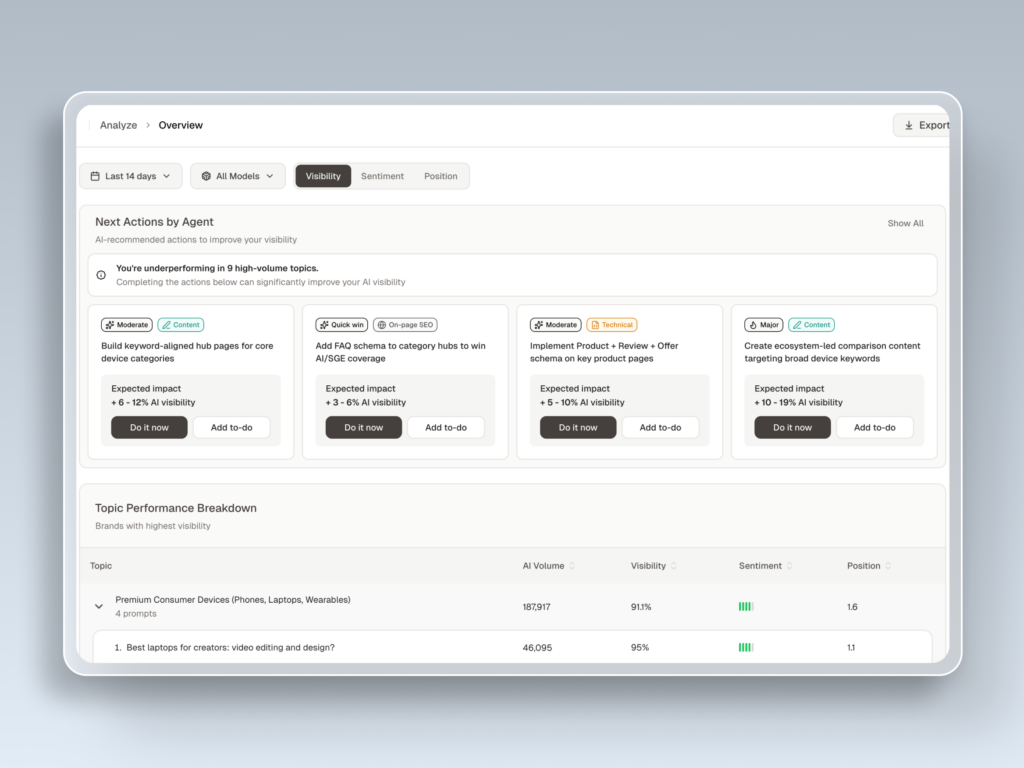
Most AI answer tracking platforms give you a dashboard. Topify gives you a dashboard, a diagnosis, and an execution layer. Its seven-dimension metric system covers visibility, sentiment, position, volume, mentions, intent, and CVR (Conversion Visibility Rate), which estimates how likely an AI answer is to drive a user toward your brand. That last metric, CVR, is something most competitors don’t offer at all.
On platform coverage, Topify tracks ChatGPT, Gemini, Perplexity, DeepSeek, Google AI Overviews, Doubao, Qwen, and other regional engines. For teams operating across global markets, that breadth matters. A brand that’s visible on ChatGPT in the U.S. might be completely absent from Doubao in China, and Topify surfaces that gap.
The Source Analysis feature reverse-engineers which domains and URLs each AI platform cites. You can see whether the AI is pulling from your product page, a competitor’s blog post, or a Reddit thread. That’s where google ai overview checking tools functionality gets practical: instead of guessing why your brand didn’t show up in an AIO result, you can trace the citation chain back to specific content gaps.
Topify’s High-Value Prompt Discovery continuously surfaces new prompts that your target audience is asking across AI platforms. Rather than guessing which queries matter, you get data on where real search demand lives. And when you find an opportunity, the One-Click Agent lets you define a strategy in plain English and deploy it without manual workflows.
The team behind the platform includes a GEO Strategy Lead with 10+ years of Fortune 500 SEO experience, an LLM Algorithm Researcher from Stanford with 2,000+ citations, and a Growth Operator who’s scaled companies from zero to $20M. That’s relevant because GEO algorithms are still evolving fast, and the quality of the underlying data model matters more than the UI.
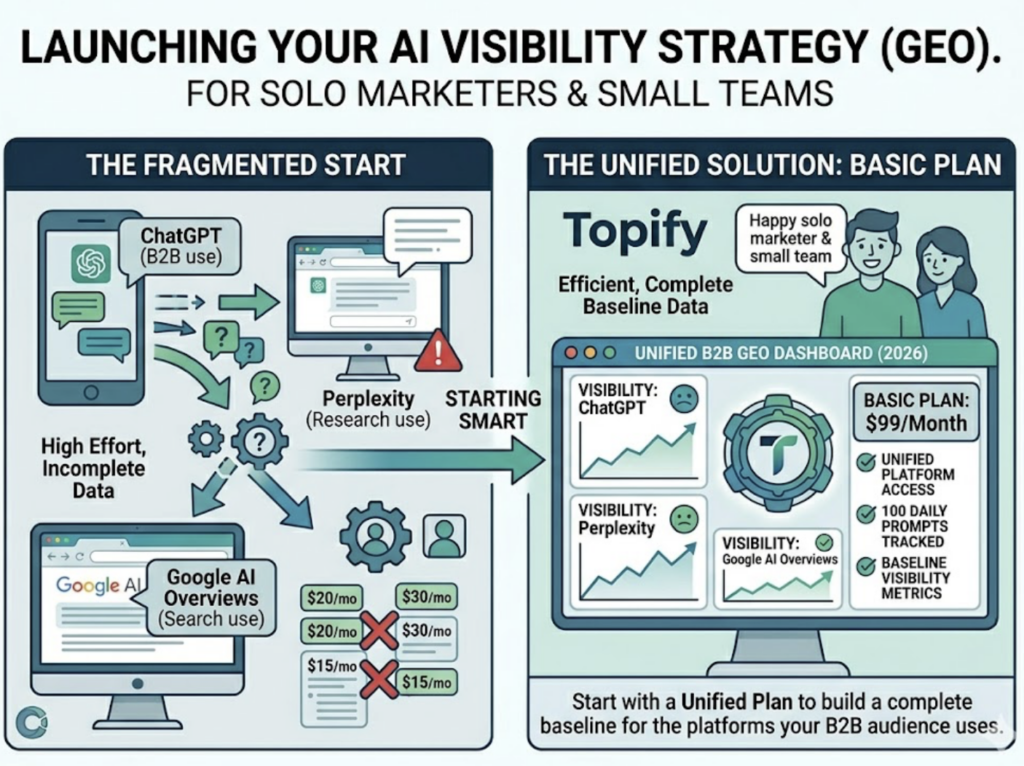
Pricing starts at $99/month for the Basic plan, which includes ChatGPT, Perplexity, and AI Overviews tracking, 100 prompts, and 9,000 AI answer analyses. The Pro plan at $199/month scales to 250 prompts and 22,500 analyses. For teams ready to get started, the Basic plan is enough to validate whether AI answer tracking moves the needle before scaling up.
Other AI Answer Tracking Platforms Worth Knowing
Profound takes a different approach by focusing on log-level crawler data. If your team needs granular access to raw AI crawl patterns, including which pages AI models are visiting and how often, Profound is built for that use case. Its coverage extends to Claude, Grok, and Meta AI, though its Google AIO tracking is more limited.
ZipTie emphasizes evidence-based reporting. Every AI answer it tracks comes with a screenshot, which is useful for stakeholders who want visual proof rather than dashboards. ZipTie also offers technical audit features that flag structural issues on your site that may reduce AI crawlability.
SE Ranking is the pick for teams that aren’t ready to abandon their traditional SEO workflow. It integrates GEO monitoring into a familiar SEO interface, covering Google AIO and ChatGPT. The trade-off is narrower AI platform coverage compared to dedicated GEO tools.
Peec AI targets larger teams with unlimited seat access and Share of Voice analysis across ChatGPT, Gemini, Perplexity, and Claude. If your priority is getting every team member into the same dashboard without per-seat pricing pressure, Peec AI addresses that.
What Google AI Overview Checking Tools Actually Measure
Google AI Overviews deserve their own section because they’re the intersection where traditional SEO and AI answer tracking collide. When 48% of search queries trigger an AI Overview, your brand’s presence in those answers directly affects whether searchers ever see your blue link.
The best google ai overview checking tools track three things.
First, citation presence: does the AI Overview cite your domain? Not your homepage, necessarily, but the specific URL that answers the query. Citation quality matters here. If the AI is pulling from a low-value landing page instead of your authoritative guide, that’s a content architecture problem you can fix.
Second, sentiment accuracy. AI Overviews sometimes describe products incorrectly, using outdated pricing, wrong feature descriptions, or positioning that contradicts your brand message. According to Meltwater’s research on LLM brand mentions, inaccurate AI descriptions are a major source of brand trust erosion. Catching these early requires automated monitoring, not quarterly manual checks.
Third, contextual association. Which competitors appear alongside your brand in the same AI Overview? If Google’s AI consistently groups you with budget alternatives when your positioning is premium, that’s a narrative drift that won’t show up in any traditional SEO report.
Topify covers all three dimensions within its AI Overviews tracking module, making it one of the more complete google ai overview checking tools available. You can monitor citation sources, flag sentiment inaccuracies, and track which competitors the AI pairs with your brand, all from the same dashboard.
How to Pick the Right AI Answer Tracking Platform for Your Team
The right platform depends on what you’re optimizing for.
If you’re a solo marketer or small team just entering the GEO space, start with a platform that covers the AI engines your audience actually uses. For most B2B brands in 2026, that means ChatGPT, Perplexity, and Google AI Overviews at minimum. Topify’s Basic plan at $99/month covers all three plus 100 tracked prompts, which is enough to build a baseline.
If you’re an agency managing multiple clients, look for multi-project support and white-label reporting. Topify’s Pro and Enterprise tiers support 8+ projects and 10+ seats, which maps to a typical agency workload without per-client pricing surprises.
If your priority is raw data and crawl-level analytics, Profound’s log-level approach may fit better. And if your team is deeply embedded in a traditional SEO workflow, SE Ranking’s hybrid interface reduces the learning curve.
A few non-negotiable criteria regardless of team size:
Cross-platform coverage. An AI answer tracking platform that only covers one engine is a point solution, not a platform. Your audience doesn’t use one AI exclusively, and neither should your tracking.
Actionable metrics. Visibility counts are table stakes. You need sentiment scoring, position tracking relative to competitors, and ideally some measure of conversion potential. The Adobe LLM Optimizer framework calls this the shift from “vanity metrics” to “decision-making metrics.”
Source-level attribution. Knowing you were mentioned is good. Knowing which URL the AI cited, and whether it was the right one, is what lets you actually improve.
If you’re exploring the space before committing to a paid tool, Topify also offers a set of free AI visibility tools that can give you a quick baseline of where your brand stands.
Conclusion
AI answer tracking isn’t optional anymore for marketing teams that report on brand visibility. The shift from manual spot-checks to platform-level monitoring is the same leap SEO made from checking Google by hand to using Ahrefs and SEMrush. The only difference is the timeline: AI search is moving faster, and waiting six months to pick a platform means six months of invisible brand erosion.
For teams that need coverage across every major AI engine, actionable metrics beyond simple mentions, and a direct path from data to execution, Topify is the strongest option on the market right now. Start with a baseline, track what matters, and let the data tell you where to optimize.
FAQ
Q: What is an AI answer tracking platform?
A: An AI answer tracking platform monitors how your brand appears in AI-generated responses across engines like ChatGPT, Perplexity, Gemini, and Google AI Overviews. It tracks metrics like visibility frequency, sentiment, citation sources, and competitive positioning, giving marketing teams data they can’t get from traditional SEO tools.
Q: What are the best google ai overview checking tools?
A: The best google ai overview checking tools in 2026 include Topify (full-spectrum tracking with citation source analysis), ZipTie (screenshot-based evidence), and SE Ranking (hybrid SEO/GEO). The key differentiator is whether the tool tracks citation quality and sentiment accuracy, not just whether your brand appears.
Q: How often should you check AI answers for brand mentions?
A: Weekly at minimum. AI-generated answers change frequently as models update their training data and citation patterns. Monthly checks miss narrative drifts and competitor incursions. Platforms like Topify automate this with continuous monitoring across multiple AI engines.
Q: Can AI answer tracking replace traditional SEO monitoring?
A: No. AI answer tracking and traditional SEO monitoring measure different things. Google rankings still drive organic traffic, while AI answer tracking measures brand visibility in generated responses. The two complement each other. In practice, teams running both often discover that strong SEO authority increases the likelihood of AI citations, but the correlation isn’t automatic.

