

Your keyword rankings look solid. Your domain authority keeps climbing. But Google’s AI Overview now sits above every organic result for over half the queries your team tracks, and your SEO dashboard can’t tell you whether your brand is being cited in that answer, or whether your competitor is.
That gap between what traditional tools report and what actually drives clicks in 2026 is where most teams lose ground without realizing it.
Most AI Overview Tracking Tools Only Show You the Tip
Here’s the thing about the current AI overview tracking software market: most tools stop at detection. They’ll flag that an AI Overview appeared on a SERP. That’s it. No data on whether your domain was cited, which URL the AI pulled from, or how your brand’s mention compares to a competitor’s.
That’s a problem when AI Overviews now appear in roughly 47 to 64% of search queries. And when those overviews are present, the traditional #1 organic position sees its CTR drop to just 8 to 12%, compared to 28 to 34% on non-AIO queries.
The real capability gap breaks down into three tiers:
| Tier | What It Does | Who Offers It |
|---|---|---|
| Detection | Flags whether a SERP triggers an AI Overview | Semrush, Ahrefs, most legacy SEO tools |
| Tracking | Monitors if your brand or domain is cited in the AI response | ZipTie AI, some newer platforms |
| Analytics | Scores visibility, analyzes sentiment, attributes source URLs, benchmarks competitors across multiple AI platforms | Topify, AWR |
If your current tool only handles detection, you’re seeing the surface. You know AI Overviews exist on your target queries, but you don’t know what they’re saying about you, or if they’re saying anything at all.
Best AI Overview Tracking Tools, Ranked by What They Actually Measure
Not all AI overview tracking tools deliver the same depth. Here’s how the leading options compare across the dimensions that matter most for an AI visibility analytics platform:
| Tool | AI Platform Coverage | Citation Depth | Sentiment Analysis | Competitor Benchmarking | Starting Price |
|---|---|---|---|---|---|
| Topify | Google AIO, ChatGPT, Gemini, Perplexity, DeepSeek | Source URL attribution | Yes (0-100 score) | Auto-detected competitors | $99/mo |
| ZipTie AI | Google AIO, ChatGPT, Perplexity | Citation auditing | Yes (AI Success Score) | Manual setup | Contact for pricing |
| AWR | Unified SEO + AI visibility | URL-level tracking | Limited | Enterprise dashboards | Custom pricing |
| Semrush | Google AIO only (detection) | SERP feature flag only | No | Traditional SERP-level only | $139.95/mo |
The gap between the top tier and the rest isn’t subtle. Detection-only tools leave you guessing. Analytics-tier platforms tell you what to do next.
Topify: The AI Visibility Analytics Platform Built for Action
Most AI overview tracking tools were bolted onto existing SEO platforms as an afterthought. Topify was built from the ground up as a full-spectrum AI visibility analytics platform, covering Google AI Overviews, ChatGPT, Gemini, Perplexity, and DeepSeek in a single dashboard.
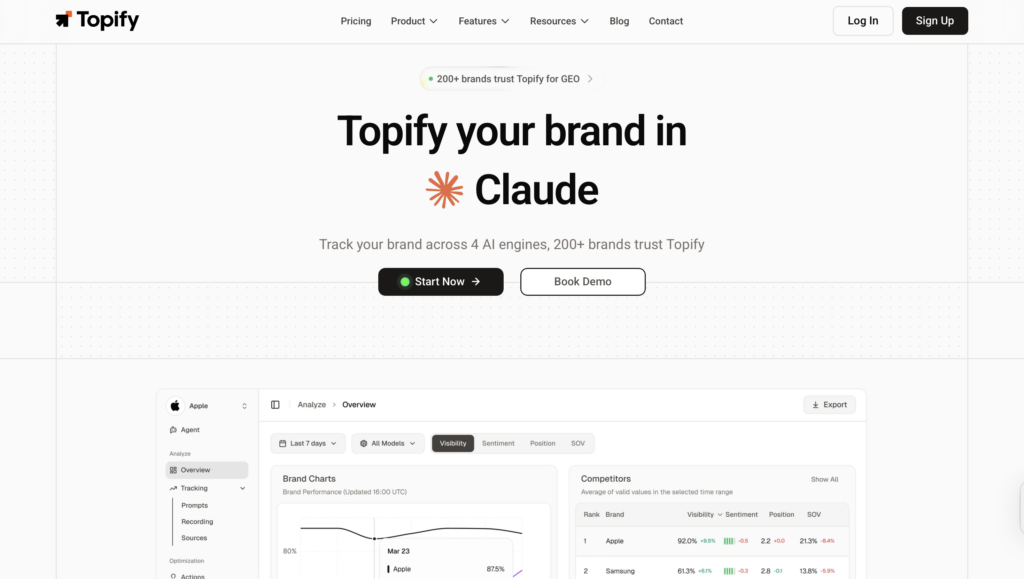
What sets it apart isn’t just coverage. It’s what happens after the data comes in.
Topify’s Source Analysis traces exactly which domains and URLs each AI platform cites when mentioning your brand or category. That means you can identify content gaps: if Perplexity keeps citing a competitor’s blog post instead of yours, you know precisely which page to optimize or create.
The Visibility Score normalizes performance across different AI architectures, so you’re not comparing apples to oranges when benchmarking ChatGPT mentions against Google AIO citations. Pair that with Sentiment Analysis (a 0-100 score reflecting how positively or negatively AI describes your brand) and Position Tracking (where your brand ranks relative to competitors in AI-generated lists), and you’ve got a full picture, not just a data point.
Where Topify Pulls Ahead in AI Overview Tracking
The one-click execution layer is where Topify diverges from every other tool on this list. Once you spot a visibility drop or a competitor gaining ground, you can define your optimization goal in plain English, review the proposed strategy, and deploy it, all within the same platform. No exporting CSVs, no switching tabs.
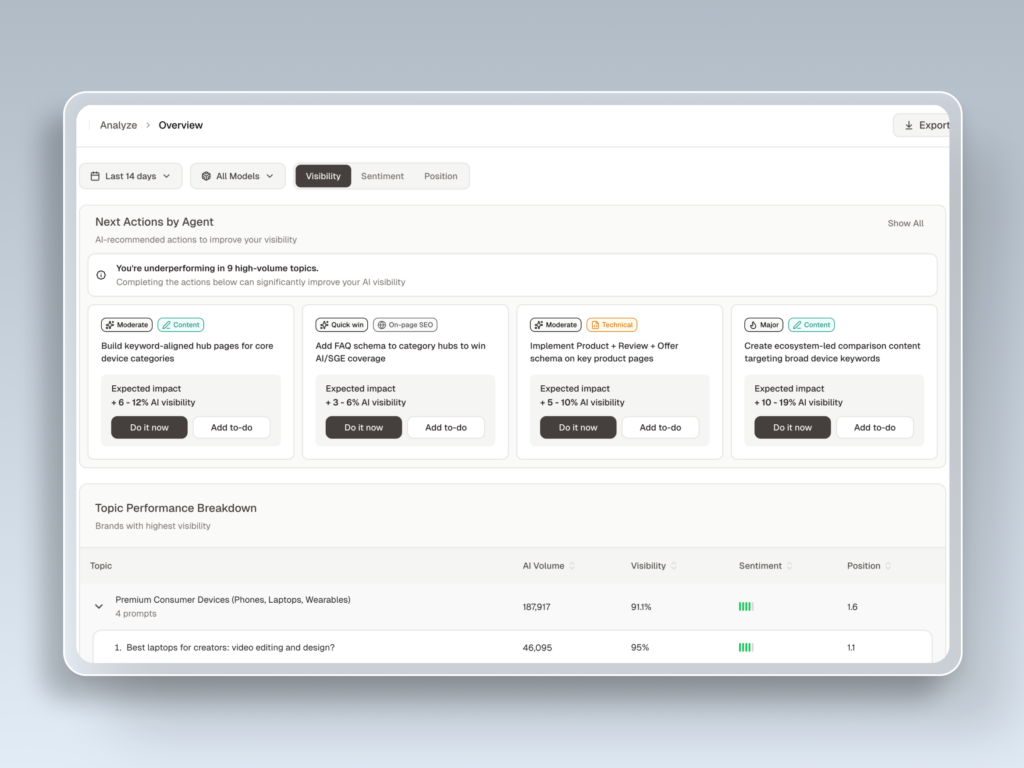
For teams managing AI visibility across multiple products or clients, Topify supports up to 8 projects on the Pro plan ($199/mo), with 250 tracked prompts and 22,500 AI answer analyses per month. The Basic plan starts at $99/mo with 100 prompts and 4 projects.
Built by founding researchers from OpenAI and champion Google SEO practitioners, the platform’s algorithm is designed for precision in an environment where AI responses shift weekly.
Other AI Overview Tracking Software Worth a Look
ZipTie AI focuses on precise citation auditing with its proprietary “AI Success Score,” which synthesizes brand mentions, citations, and sentiment into a single metric. It’s particularly strong at showing exactly what end users see in AI responses across ChatGPT and Perplexity. A solid choice if your priority is granular citation-level auditing rather than cross-platform analytics.
Advanced Web Ranking brings enterprise-grade scale to AI visibility. Unlike platforms that added AI tracking as a feature, AWR integrated it as a core module alongside its traditional SERP tracking engine. It offers unified reporting across thousands of search engines and strong API extensibility for teams with custom data pipelines.
Semrush and Ahrefs remain essential for traditional SEO workflows (backlink profiles, keyword research, technical audits). Their AI overview tracking is currently limited to detecting whether an AIO appears on a given SERP. For teams already embedded in the Semrush ecosystem, this provides baseline awareness, but not the citation-level depth that dedicated AI visibility platforms offer.
Semrush AI Overview Tracking vs. Dedicated AI Visibility Platforms
This is the question most SEO teams are asking right now: “Can I just use Semrush for AI overview tracking, or do I need something else?”
The honest answer: it depends on what “tracking” means to your team.
Semrush excels at traditional SEO. Its SERP feature tracking will tell you which of your target keywords trigger an AI Overview. That’s detection, and it’s useful for understanding the landscape.
But it won’t tell you whether your brand was cited in that overview, what URL the AI pulled from, how your mention compares to competitors, or whether the AI’s description of your product is accurate. These are tracking and analytics capabilities that require purpose-built infrastructure, platforms that actively query AI systems rather than scrape SERP features.
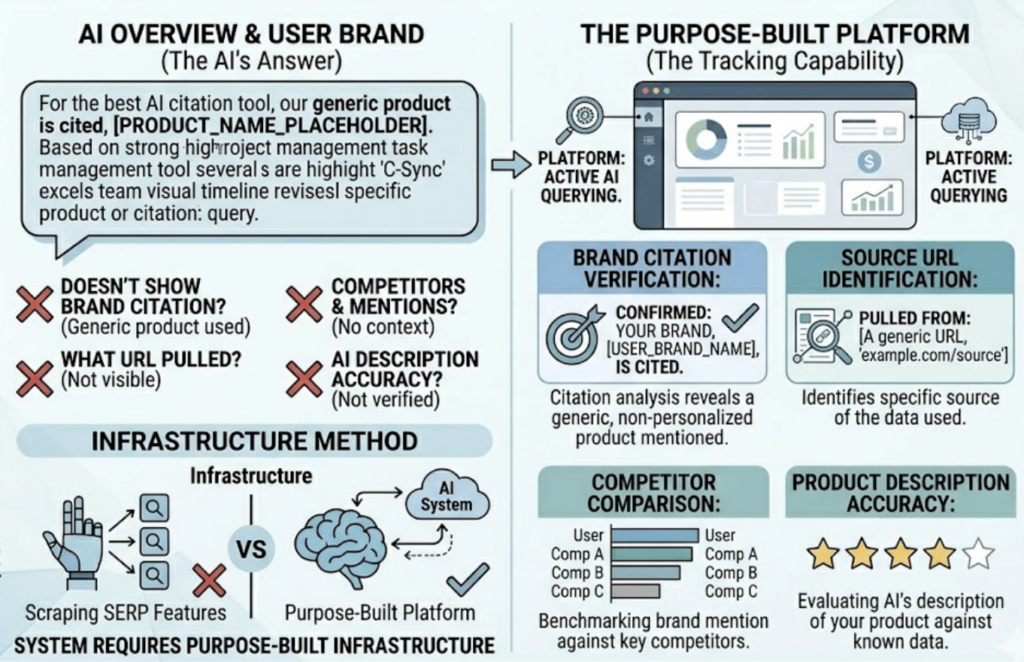
| Capability | Semrush | Dedicated Platform (e.g., Topify) |
|---|---|---|
| AIO detection on SERPs | Yes | Yes |
| Brand citation monitoring | No | Yes |
| Source URL attribution | No | Yes (Source Analysis) |
| Sentiment scoring | No | Yes (0-100) |
| Multi-platform (ChatGPT, Perplexity) | No | Yes |
| Competitor benchmarking in AI responses | No | Yes |
| Optimization execution | No | Yes (One-click agent) |
The practical recommendation for most teams: keep Semrush for what it does well (technical SEO, keyword research, backlinks), and layer a dedicated AI visibility analytics platform on top for the AI search layer. They’re complementary, not competing.
How to Pick the Right AI Overview Tracking Tool for Your Team
The best AI overview tracking software 2026 depends less on features and more on how your team operates:
Agencies managing multiple clients need white-labeling, high-frequency monitoring, and multi-project dashboards. Topify and AWR both fit this profile, with Topify offering up to 8 projects and 10 seats on the Pro plan.
In-house SEO teams typically benefit from a combination approach: retain Semrush or Ahrefs for technical SEO infrastructure, and add a specialized platform like Topify for AI visibility analytics. This avoids ripping out your existing stack while closing the AI tracking gap.
Solo marketers and consultants need the highest insight-per-dollar ratio. Topify’s Basic plan at $99/mo includes sentiment analysis, source tracking, and competitor monitoring, which is the analytics tier, not just detection. For a single practitioner, that’s the difference between reporting “AI Overviews exist” and reporting “here’s exactly how our brand appears in AI search and what to fix.”
Bottom line: the best google AI overview tracking tool is the one that matches your team’s workflow and gives you data you can act on, not just observe.
Conclusion
AI Overviews aren’t a feature to watch. They’re the new default for how searchers encounter brands. When over half of Google queries trigger an AI-generated answer that sits above every organic listing, the question isn’t whether to track them. It’s whether your tracking gives you anything actionable.
The tools that stop at detection will tell you the wave exists. The platforms that go deeper, into citation sources, sentiment shifts, and cross-platform visibility, will tell you how to ride it. Start with Topify if you want both the data and the next move in one place.
FAQ
Q: What’s the best Google AI overview tracking tool in 2026?
A: For teams that need more than SERP detection, Topify offers the deepest AI overview tracking combined with multi-platform coverage (ChatGPT, Gemini, Perplexity), sentiment analysis, and source URL attribution. ZipTie AI and AWR are also strong options depending on your specific needs.
Q: Can Semrush track AI Overviews?
A: Semrush can detect whether an AI Overview appears on a given SERP, but it doesn’t currently offer citation-level tracking, sentiment analysis, or multi-platform AI visibility monitoring. For those capabilities, you’d need a dedicated AI visibility analytics platform alongside Semrush.
Q: What’s the difference between AI overview tracking and AI visibility analytics?
A: AI overview tracking typically refers to monitoring whether your brand appears in AI-generated answers. AI visibility analytics goes further: it scores your visibility, analyzes how AI describes your brand (sentiment), traces which sources AI cites, benchmarks you against competitors, and provides optimization recommendations.
Q: How much does AI overview tracking software cost?
A: Pricing varies widely. Semrush includes basic AIO detection in its plans starting at $139.95/mo. Dedicated platforms like Topify start at $99/mo for analytics-tier tracking including sentiment and source analysis. Enterprise-grade solutions like AWR typically require custom pricing.

