

Most SEO dashboards show you impressions, clicks, and rankings. None of them tell you whether ChatGPT recommended your brand this morning.
That’s not a data gap. That’s a visibility gap.
As AI systems handle more discovery queries, the game has fundamentally changed. Users don’t just Google anymore. They ask ChatGPT, Perplexity, or Gemini. They get a synthesized answer. They act on it. And if your brand isn’t in that answer, it doesn’t exist to that user at that moment.
That’s what AI search visibility is about. And getting it right requires a different playbook than traditional SEO.
Your Brand Might Be Invisible Where It Matters Most
Think about how you found your last software tool, hotel, or B2B vendor. Increasingly, that journey starts with a question typed into an AI interface, not a search bar.
Perplexity, ChatGPT, Gemini, and Google’s AI Overviews are now functioning as decision-making layers. They synthesize research, compare options, and present recommendations. The brands they recommend get considered. The ones they skip get bypassed entirely.
Unlike a SERP, there’s no page 2. AI gives you one answer. Either you’re in it, or you’re not.
That’s the new competitive reality. And most brands haven’t built a system to track it yet.
What AI Search Visibility Actually Means
AI search visibility is the measurable frequency, prominence, and sentiment with which an AI system references your brand when responding to relevant user prompts.
It’s not a ranking. It’s not a traffic metric. It’s a question of whether AI engines recognize your brand as a trustworthy, citable entity within your category.
Here’s how that works technically. Modern AI search systems use a process called Retrieval-Augmented Generation (RAG). Instead of pulling from a static index, they retrieve information from a curated set of web sources in real time, synthesize it based on the prompt’s intent, and generate a natural language answer. The brands that show up are the ones the AI recognizes as authoritative within their category’s knowledge graph.
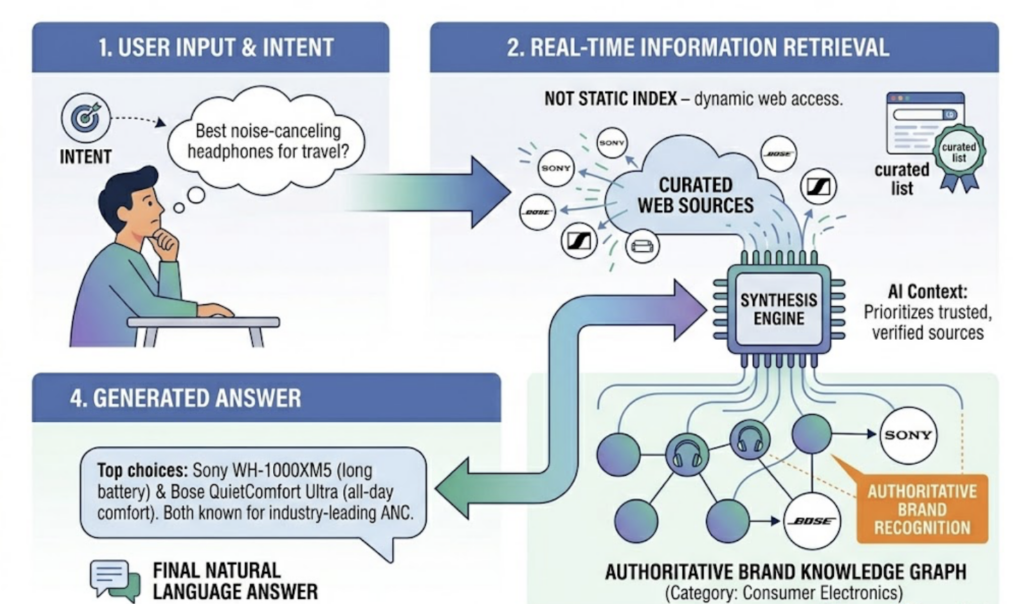
Authority here doesn’t mean domain authority in the traditional sense. It means entity recognition: Is your brand consistently mentioned on trusted third-party sources? Does your content answer questions clearly and directly? Are the right authoritative domains citing you?
That’s what determines inclusion. Not keyword density. Not backlink volume.
The Metrics That Actually Tell You Where You Stand
You can’t improve what you don’t measure. AI search visibility breaks down into five core indicators, each capturing a different dimension of your performance.
Visibility Score measures how often your brand appears across a defined cluster of relevant prompts. If you’re tracking 100 prompts in your category and showing up in 34 of the AI responses, your visibility score is 34%. That’s your baseline.
Citation Share captures the percentage of responses where AI platforms explicitly credit your brand as a primary source. This matters especially on Perplexity, which surfaces footnoted citations. High citation share means the AI isn’t just mentioning you but pulling from your content.
Position tells you where in the response you appear. Being the third brand listed in a recommendation answer is very different from being the first. Both count as “visible.” Only one drives clicks.
Sentiment Score tracks the framing. AI might mention your brand as “feature-rich but complex” or as “the go-to solution for enterprise teams.” Those framings influence decisions differently. Ignoring sentiment drift is one of the most common oversights in brand monitoring.
Share of Model compares your visibility against competitors across specific AI platforms. You might dominate Perplexity and underperform on Gemini. That split tells you where to prioritize.
Topify tracks all five of these, plus two more: an AI Volume metric that surfaces high-intent prompt opportunities, and a CVR (Conversion Visibility Rate) that estimates how likely an AI response is to drive a user toward your brand. Together, that’s a seven-metric matrix that gives marketing teams actual signal, not vanity stats.
What Good AI Visibility Looks Like in Practice
Concrete examples make this easier to grasp.
A project management SaaS company starts monitoring 80 prompts like “best tools for remote team collaboration” and “how to manage engineering sprints in 2026.” After three months of GEO work, their Visibility Score on those prompts climbs from 18% to 41%. ChatGPT now lists them in the top two positions across most recommendation queries. Their organic sign-up rate from AI-referred traffic increases noticeably.
An e-commerce brand selling ergonomic office equipment starts appearing in Perplexity answers to “best standing desk setups for home offices.” The AI cites a detailed buying guide they published on a third-party tech review site. Source Authority, not their own product page, drove the citation.
A B2B consulting firm gets mentioned in Gemini’s response to “top strategy consultants for supply chain optimization.” The mention is positive but vague. After running a Sentiment Analysis, they find the AI is pulling from outdated case study content. They update their positioning across key citation sources. Sentiment improves within six weeks.
In each case, the signal was invisible before AI visibility tracking. The opportunity only became actionable once the right metrics were in place.
Why Most Teams Are Getting This Wrong
Most brands aren’t losing AI visibility because they’re doing the wrong things. They’re losing it because they haven’t started doing the right things yet.
The most common mistake is treating AI search as an extension of traditional SEO. Keyword rankings, meta descriptions, and backlink profiles don’t translate directly to AI citation rates. The rules are different enough that the same optimization playbook often produces no measurable GEO impact.
The second mistake is the “owned-site fallacy.” Brands pour resources into their own domain and expect AI systems to follow. LLMs weight third-party validation heavily. Mentions in industry directories, analyst reports, trade media, and review platforms are what cross-reference trustworthiness in an AI’s knowledge graph. Your homepage alone won’t get you cited.
Third is optimizing for keywords instead of prompts. Traditional keyword tools capture “standing desk” or “project management software.” But AI systems respond to natural language questions like “what’s the best standing desk for someone with back pain who works long hours?” Those are fundamentally different targets, and they require fundamentally different content.
Fourth is ignoring machine-readability. Content written for engagement or keyword density often lacks the “answer-first” structure that LLMs need to extract and cite efficiently. Clear FAQs, structured data, and direct answer formats make content far more extractable.
That last one is fixable quickly. The others require a strategic shift.
A Practical Strategy to Improve Your AI Search Visibility
There’s no shortcut, but there is a repeatable framework. The industry standard is a cyclical Audit → Optimize → Monitorprocess.
Step 1: Map your prompts. Identify the 50 to 100 most critical questions your target customers ask in your category. These aren’t keywords. They’re the actual conversational queries that trigger AI summaries. Topify’s prompt discovery feature surfaces high-volume AI prompts continuously, so your list stays current as search behavior shifts.
Step 2: Run a baseline audit. Before optimizing anything, benchmark where you actually stand. How often does your brand appear in responses to these prompts? What position? What sentiment? What are your top competitors scoring? Without this baseline, you’re guessing.
Step 3: Build citation-worthy content on the right sources. Focus on the specific domains that AI models repeatedly pull from in your category. That typically includes industry analyst sites, established review platforms, trade publications, and forums with high engagement. A single well-placed article on a high-authority source often outperforms ten new pages on your own domain.
Step 4: Monitor weekly. AI search visibility isn’t static. Competitor content gets published. AI training data shifts. Sentiment can drift in either direction. Weekly tracking with Topify’s Visibility Tracking and Competitor Monitoring keeps you responsive instead of reactive.
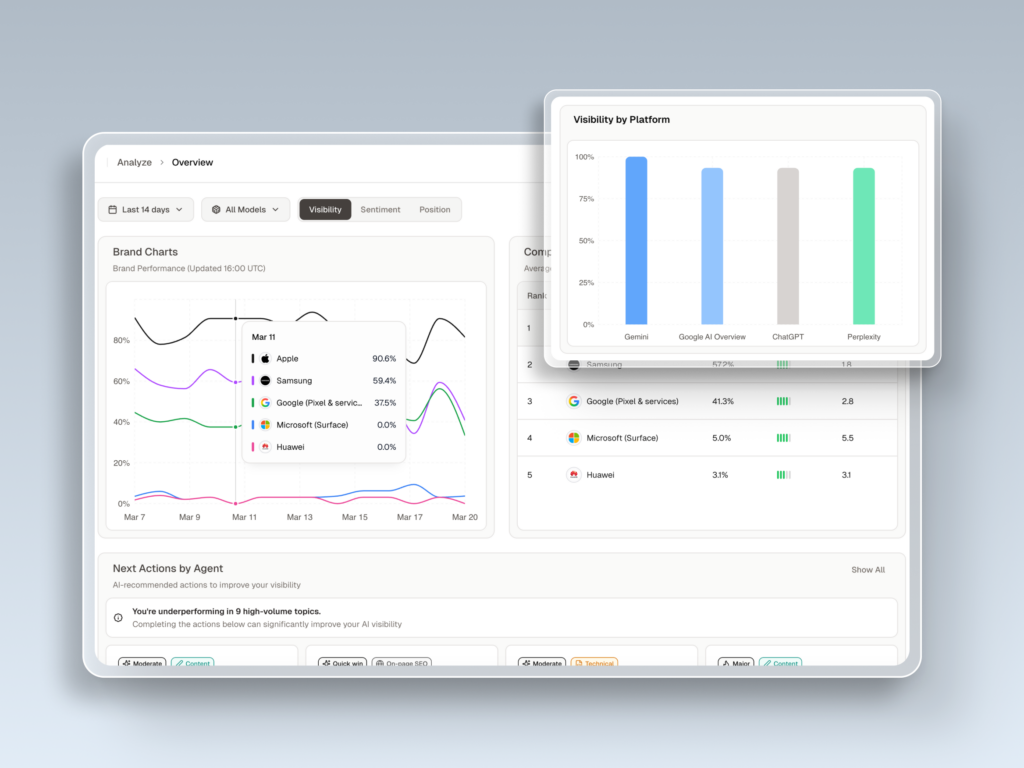
Step 5: Execute with iteration. This is where most teams stall. Topify’s One-Click Execution lets you define your goals in plain English and deploy a structured GEO strategy without building manual workflows. You set the direction. The system handles the execution cycle.
The teams that win at AI search visibility aren’t the ones with the biggest budgets. They’re the ones with the tightest feedback loops.
The AI Search Visibility Checklist
Use this as a starting point before your first GEO review.
Setup
- Define your prompt cluster (minimum 50 prompts across your key categories)
- Identify the AI platforms your audience uses most (ChatGPT, Perplexity, Gemini, AI Overviews)
- Set up baseline tracking across Visibility Score, Position, Sentiment, and Share of Model
Content
- Audit your top pages for answer-first structure and structured data (FAQ schema, How-to schema)
- Identify the third-party domains AI cites most in your category
- Publish or pitch content to those high-citation-weight sources
Competitor Monitoring
- Map your top 3 to 5 competitors’ current AI visibility scores
- Track which prompts they’re appearing on that you’re not
- Monitor competitor sentiment for positioning gaps you can exploit
Ongoing
- Review visibility and sentiment weekly
- Refresh content on high-citation sources quarterly
- Expand your prompt cluster as new AI search behaviors emerge
Tools Built for AI Search Visibility
The tools market has matured significantly in the past 12 months. A few platforms now offer genuine AI visibility tracking. When evaluating any GEO tool, four capabilities matter: multi-model probing across separate AI platforms, source analysis that shows you which domains drive citations, competitor benchmarking with Share of Model data, and execution features that go beyond just reporting.
Topify covers all four. It tracks brand performance across ChatGPT, Gemini, Perplexity, DeepSeek, and AI Overviews simultaneously, running prompts through each platform’s separate RAG pipeline. The Source Analysis feature shows exactly which domains AI engines are pulling from when they reference brands in your category. Competitor Monitoringprovides real-time benchmarking against rivals across all tracked platforms. And One-Click Execution moves you from insight to action without manual workflow overhead.
Topify’s pricing is structured around team size and prompt volume:
| Plan | Price | Prompts | AI Answer Analyses |
|---|---|---|---|
| Basic | $99/mo | 100 prompts | 9,000/mo |
| Pro | $199/mo | 250 prompts | 22,500/mo |
| Enterprise | from $499/mo | Custom | Custom |
All plans include a 30-day trial. The Basic plan covers ChatGPT, Perplexity, and AI Overviews tracking with four projects and four seats, which is enough for most mid-size marketing teams to get meaningful signal from day one.
For teams not ready to commit to a platform, Topify also offers a free GEO Score Checker and an AI Search Volume Checker to get an initial read on your brand’s current AI search position.
Other tools in the space offer partial coverage. Some focus exclusively on citation tracking without execution features. Others cover only one or two AI platforms. The right choice depends on whether you need monitoring only or a full optimization workflow.
Conclusion
AI search visibility isn’t a future concern. It’s a current one.
Every day that ChatGPT, Perplexity, and Gemini answer your customers’ questions without mentioning your brand is a day your competitors fill that space instead. The gap compounds.
The good news: this is still early enough that building structured tracking and a consistent optimization workflow creates a real moat. Most brands haven’t started yet.
Start with a prompt audit. Measure your baseline. Then build from there.
FAQ
What is AI search visibility? AI search visibility refers to how frequently, prominently, and positively an AI system references your brand when responding to relevant user prompts across platforms like ChatGPT, Perplexity, and Gemini.
How does AI search visibility work? AI systems use Retrieval-Augmented Generation (RAG) to pull from trusted web sources in real time, synthesize information, and generate answers. Brands that appear on high-authority sources the AI trusts get cited. Brands that don’t, don’t.
How do I measure AI search visibility? The five core metrics are Visibility Score (citation frequency), Position (rank in AI responses), Sentiment Score (tone of how AI describes your brand), Citation Share (explicit source credits), and Share of Model (performance vs. competitors). Platforms like Topify track all five plus additional business-impact indicators.
What are the most common mistakes in AI search visibility? The biggest ones are relying only on traditional SEO tactics, focusing exclusively on your own domain, optimizing for keywords instead of conversational prompts, and not monitoring how AI describes your brand over time.
How much does AI search visibility tracking cost? Topify’s Basic plan starts at $99/month and covers 100 prompts with 9,000 AI answer analyses per month. Pro is $199/month for 250 prompts. Enterprise plans start at $499/month. A free GEO Score Checker is also available for an initial audit.

