

Your domain authority is solid. Your content calendar is full. Your Google rankings look fine. Then a potential customer opens Perplexity, types “best [your category] platform,” and gets a detailed recommendation list. Your brand isn’t on it. Not ranked low, not mentioned in passing. Completely absent.
Traditional SEO metrics won’t show you that gap. They weren’t built to.
AI Search Visibility Isn’t the Same as Google Rankings
Most marketers assume that strong Google rankings translate into AI search visibility. They don’t, and the gap between the two is wider than most teams realize.
Traditional SEO optimizes for URL position on a Search Engine Results Page. AI search visibility is a different game entirely: it’s about whether an LLM includes your brand in its synthesized, natural-language answer to a query. There’s no ranked list of blue links. There’s one response, and either your brand is part of it or it isn’t.
The underlying logic is also different. Google’s algorithm weighs backlinks and on-page signals. AI platforms like ChatGPT, Gemini, and Perplexity rely on entity authority: a cross-platform signal built from consistent mentions across industry media, forums, third-party reviews, and verified expertise. A brand can have a perfectly optimized website and near-zero AI visibility if it hasn’t built that external signal layer.
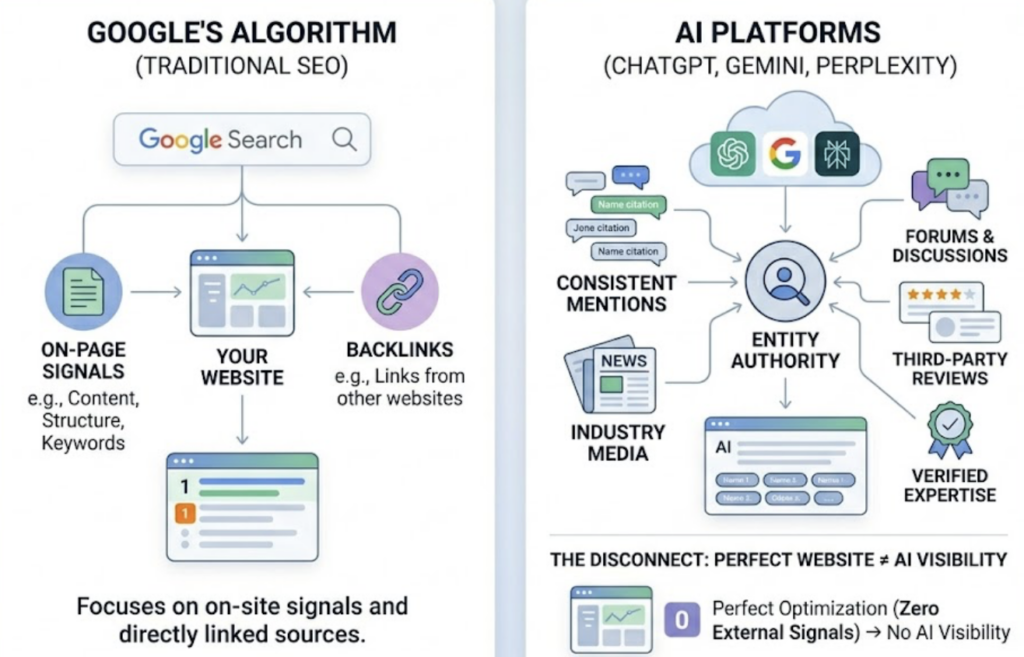
That’s the structural shift. AI SEO isn’t an upgrade to traditional SEO. It’s a parallel discipline with different inputs and different measurement systems.
The 5 Metrics That Define AI Search Visibility
Tracking AI search visibility starts with understanding what “visible” actually means in an AI-generated response. There are five dimensions worth measuring:
Visibility Score captures how frequently your brand appears across a representative set of high-intent prompts compared to competitors. It’s the closest equivalent to an overall “ranking,” but applied to AI responses rather than SERPs.
Mention Rate tracks how often your brand name shows up in AI answers, even without a direct citation link. Some platforms reference brands extensively in text without crediting a source.
Citation Share measures the percentage of AI-generated answers that explicitly credit your domain as a source. This is particularly relevant for Google AI Overviews and Perplexity, both of which surface source links alongside responses.
Sentiment Score reveals the narrative framing an AI uses when describing your brand. An AI might mention you first but describe you as “a budget option” when your positioning is enterprise-grade. That disconnect matters.
Position refers to where in the answer your brand appears. Being the first recommended solution in a list has different commercial value than appearing fifth.
These five metrics together form what AI search analytics practitioners call a visibility matrix. No single number tells the full story.
Why Most Brands Score Zero Without Knowing It
Here’s the problem: absence is invisible. A brand with poor Google rankings can see its position. A brand with zero AI visibility typically has no idea.
Research into AI search behavior in 2026 shows that 37% of consumers now initiate searches via AI tools, often completing their research without ever clicking through to a website. That’s a significant share of discovery happening in a channel most brands aren’t tracking at all.
Several structural issues cause brands to fall out of AI answers entirely. Poor content extraction is one: AI engines prioritize content with clear headers and direct answers. Material buried under long introductions rarely gets cited. The owned-site trap is another. Brands that rely exclusively on their own website for authority signals tend to underperform. Approximately 85% of AI brand mentions originate from third-party sources like Reddit, G2, industry publications, and YouTube, not the brand’s own domain.
There’s also a technical failure most teams don’t catch: robots.txt misconfiguration. Some brands accidentally block crawlers like GPTBot and ClaudeBot, effectively making themselves unreachable to the retrieval processes that feed AI knowledge bases. And content that hasn’t been refreshed in 90 days or more is significantly more likely to lose citation status as models favor fresher evidence.
None of these failures show up in a standard SEO report. That’s the core challenge with AI brand visibility: you can’t fix what you can’t see.
How to Measure AI Search Visibility (Step by Step)
Measuring AI search visibility requires a different toolkit than traditional SEO. Here’s a practical approach:
Step 1: Define your prompt universe. Identify 20 to 50 high-intent prompts your target audience is likely to enter into AI platforms. These should reflect real buying queries, comparison questions, and category exploration prompts, not just branded searches.
Step 2: Run systematic queries across platforms. Citation behavior varies by over 600x between ChatGPT and Perplexity for the same brand. Manually running queries on a single platform gives you a partial, misleading picture. Multi-platform probing is non-negotiable.
Step 3: Track all five metrics. Log whether your brand appeared, where it appeared, what language was used to describe it, and which sources the AI cited.
Step 4: Monitor for drift. AI citation patterns shift. A brand that appeared in 80% of relevant responses last month might be at 40% this month due to model updates or competitor content gains.
For teams that need this at scale, Topify automates this entire workflow. Its Visibility Tracking module runs continuous probes across ChatGPT, Gemini, Perplexity, and other major AI platforms, consolidating Visibility, Sentiment, and Position data into a single view. Source Analysis shows which domains the AI is citing to build authority in your category, so you can identify exactly where your content footprint is thin.
6 Proven Ways to Improve Your AI Search Visibility
Improving AI search visibility isn’t about gaming algorithms. It’s about building the signals that AI systems trust. These six approaches have clear logic behind them:
1. Answer-first content architecture. Lead every section with a direct, one-sentence answer to a potential user query. Use H2 and H3 headers as question prompts. AI systems extract content that’s easy to synthesize. Dense, essay-style writing gets skipped.
2. Build third-party authority. Your own site is not enough. Pursue coverage on industry publications, forums, G2, and YouTube. The majority of AI brand mentions trace back to third-party domains. A mention in a credible industry roundup often does more for AI visibility than a fully optimized blog post on your own site.
3. Implement structured data and entity markup. Schema markup that clearly defines your brand entity, its services, and its relationships to key topics helps AI systems place you correctly in their internal knowledge representation. This is especially important for brands with ambiguous category positioning.
4. Keep content fresh. Content older than 90 days loses citation priority as models preference more recent evidence. A content refresh strategy specifically targeting your highest-priority AI search prompts is worth building into your editorial calendar.
5. Monitor competitor positioning. AI visibility is relative. Knowing your Visibility Score matters less than knowing whether you’re gaining or losing ground against specific competitors. Topify’s Competitor Monitoring module tracks competitor position, sentiment, and citation share automatically, so you don’t have to run manual comparisons.
6. Use Sentiment Score to catch narrative drift. AI systems sometimes develop inconsistent or inaccurate framings of brands, especially when third-party sources are contradictory. Regular Sentiment monitoring lets you identify when the AI narrative diverges from your actual positioning, so you can address the content gaps causing it.
This is what AI search optimization looks like in practice: systematic, data-driven, and iterative.
Choosing the Right AI Visibility Platform
The selection criteria for an AI visibility platform matter more than most buyers initially realize. Here’s a comparison of what differentiates purpose-built tools from legacy SEO platforms that have added AI features:
| Capability | Legacy SEO Tools (AI Add-ons) | Purpose-Built AI Visibility Platforms |
|---|---|---|
| Platform coverage | Typically 1-2 AI engines | 4+ platforms including ChatGPT, Gemini, Perplexity |
| Metrics tracked | Mention frequency only | Visibility, Sentiment, Position, Citation Share, CVR |
| Source analysis | Limited or absent | Full domain-level citation breakdown |
| Competitor monitoring | Basic | Real-time comparative tracking |
| Execution support | Reporting only | Actionable optimization with one-click deployment |
| Prompt discovery | Manual | Automated high-intent prompt surfacing |
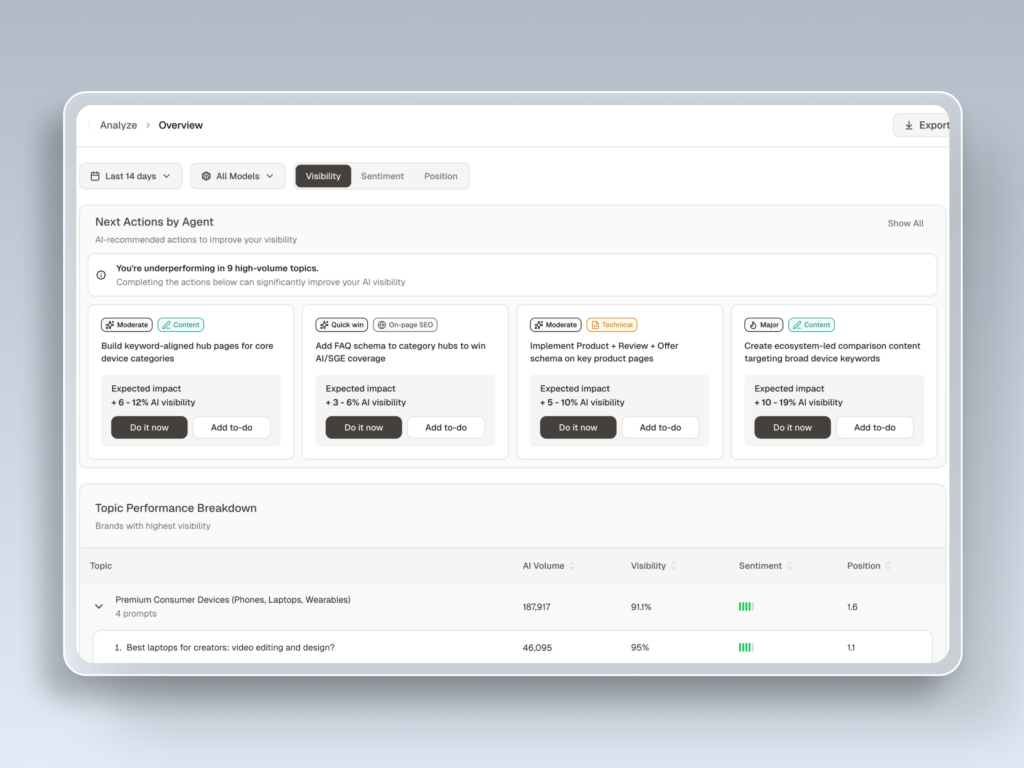
For teams serious about AI search intelligence, the core question is whether the platform bridges the gap between data and action. Reporting that shows your visibility dropped doesn’t help unless it also tells you why, and gives you a clear path to fix it.
Topify’s One-Click Execution feature addresses this directly. You define your optimization goals in plain language. The platform proposes a strategy and deploys it. No manual workflow required.
Pricing starts at $99/month for the Basic plan (100 prompts, 4 AI platforms, 9,000 AI answer analyses per month), with Pro at $199/month for growing teams that need 250 prompts and broader seat access. Enterprise plans start at $499/month with dedicated support. You can review full plan details here.
AI Search Visibility Checklist Before You Start
Before running your first visibility audit, confirm these fundamentals are in place:
| Area | Checklist Item | Status |
|---|---|---|
| Technical | GPTBot and ClaudeBot are not blocked in robots.txt | |
| Technical | Core pages load without JavaScript rendering issues | |
| Content | H2/H3 headers are structured as question prompts | |
| Content | Each section leads with a direct one-sentence answer | |
| Content | Key content pages were refreshed within the last 90 days | |
| Authority | Brand is mentioned on 3+ third-party domains (G2, Reddit, media) | |
| Authority | Structured data / schema markup is implemented for brand entity | |
| Measurement | Prompt universe of 20+ queries is defined | |
| Measurement | Baseline visibility data has been captured across 2+ AI platforms | |
| Optimization | Competitor visibility data is available for benchmarking |
Running through this list before your first AI search visibility audit will save you from chasing metric improvements while a technical issue is quietly canceling your gains.
Conclusion
AI search visibility isn’t coming. It’s already shaping how buyers discover, compare, and shortlist brands. The gap between brands that appear in AI answers and those that don’t will only get harder to close as AI systems accumulate citation history and authority signals.
The starting point is measurement. You can’t improve a number you’re not tracking, and absence doesn’t announce itself in your existing analytics. Once you know where you stand across platforms and against competitors, the optimization path becomes concrete. Get started with Topify to run your first AI visibility audit and see exactly where your brand stands.
FAQ
Q: What is AI search visibility?
A: AI search visibility refers to how frequently and favorably your brand appears in responses generated by AI platforms like ChatGPT, Gemini, and Perplexity. Unlike traditional search rankings, it measures whether your brand is cited, recommended, or described in AI-synthesized answers, not just whether you have a high URL position on a results page.
Q: How do I measure AI search visibility?
A: Measurement requires defining a set of high-intent prompts relevant to your category, running those prompts across multiple AI platforms, and tracking five key metrics: Visibility Score, Mention Rate, Citation Share, Sentiment Score, and Position. Tools like Topify automate this process at scale, providing cross-platform data without manual querying.
Q: How does AI search visibility work differently from traditional SEO?
A: Traditional SEO optimizes for URL ranking on Google’s SERP. AI search visibility optimizes for inclusion in an LLM’s synthesized response. The inputs are different too: AI systems weight entity authority built through third-party mentions, not just backlinks and on-page signals. A brand can rank well on Google and score zero in AI search, and vice versa.
Q: What’s a realistic timeline for improving AI search visibility?
A: Content and technical fixes like robots.txt corrections and answer-first restructuring can show results in 4 to 8 weeks. Building third-party authority takes longer, typically 3 to 6 months for meaningful citation share gains. AI visibility is closer to a brand-building effort than an overnight ranking change.

