

You’ve spent two years positioning your product as the premium option in your category. Then you discover ChatGPT describes it as “a budget-friendly alternative.” Gemini calls it “great for small teams.” Neither reflects your messaging, and nobody on your team knew it was happening.
That’s not a content problem or a PR problem. It’s an AI brand intelligence gap — and for brand managers operating in 2026, it’s becoming one of the most consequential blind spots in the entire marketing stack.
Your Brand May Be Invisible Where Buyers Now Search
Search behavior has split into two parallel tracks. Consumers use Google for browsing; they use AI for deciding.
When someone asks ChatGPT “What’s the best CRM for a 50-person sales team?” or Perplexity “Which skincare brand is actually worth the price?”, the AI doesn’t pull up a ranked list of links. It synthesizes a narrative from its training data and real-time retrieval — and it picks winners.
The problem is structural. Traditional SEO is built on Retrieval: crawling, indexing, ranking. AI search runs on Synthesis: LLMs interpret, validate, and recommend brands within conversational interfaces. A brand can dominate Google and be completely absent from a ChatGPT shopping recommendation in the same afternoon.
That gap is where AI brand intelligence starts.
What AI Brand Intelligence Actually Measures
AI brand intelligence is the discipline of auditing and optimizing how AI models represent, recommend, and describe your brand. It replaces the gut-check (“let me Google ourselves on ChatGPT”) with structured, continuous measurement across five dimensions:
Visibility Rate: Your Share of AI Voice
Visibility Rate measures how often your brand appears in relevant AI responses, expressed as a percentage across a defined prompt set. If you’re tracking 200 purchase-intent prompts in your category and your brand appears in 40 of them, your AI search visibility rate is 20%.
This is the foundational metric — your brand’s “Share of AI Voice” — and it’s typically the first number that surprises brand managers who assumed their SEO footprint would carry over.
Sentiment Score: Advocate or Detractor
The AI mentioning your brand isn’t enough. The framing matters. Does the model describe you as “the industry standard” or “a budget alternative”? Does it lead with your strengths or immediately add caveats?
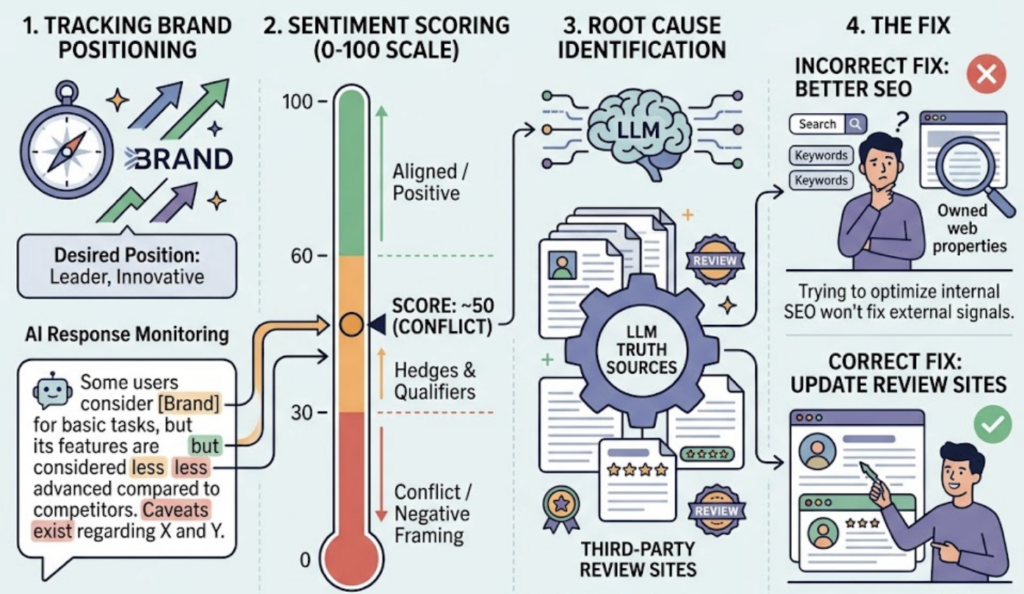
Sentiment scoring tracks the qualitative framing of AI responses on a 0-100 scale, flagging when a model consistently positions your brand with hedges or qualifiers that conflict with your positioning. According to the research framework used in AI brand intelligence: if the AI consistently frames your brand with caveats, the fix isn’t better SEO — it’s updating the content on the third-party review sites that LLMs treat as truth sources.
Position Ranking: The Order That Drives Clicks
When the AI returns a list of five recommendations, position matters. Being mentioned fifth in a “best project management tools” response is functionally different from being mentioned first. Position Ranking tracks where your brand appears in AI-generated recommendation lists relative to competitors — the closest equivalent to SERP rankings in traditional AI SEO.
Source Attribution: The Citation Ecosystem
LLMs don’t fabricate recommendations in a vacuum. They draw from authoritative third-party sources — G2, Capterra, industry publications, Wikipedia, high-trust review sites — that function as “truth anchors.”
Source Attribution identifies which external domains are currently driving AI recommendations for your brand. This is where the AI citation tracking layer of brand intelligence gets operationally important: if G2 reviews from two years ago are driving your current AI sentiment, you need to know that.
Competitor Share: Who’s Winning the Recommendation Slot
No brand operates in isolation. Competitor Share maps how often rival brands appear in the same prompts as yours, and what reasons the AI cites for recommending them over you. It’s competitive AI search analytics — not just “are we showing up,” but “who’s beating us and why.”
5 Strategies Brand Managers Use to Improve AI Shopping Visibility
These aren’t theoretical. They map directly to where AI recommendation algorithms are pulling their signals from.
Strategy 1: Map purchase-intent prompts, not just keywords.
The buyer’s journey in AI search doesn’t look like keyword clusters. It looks like questions: “Best [product category] for [use case],” “[Brand] vs. [Competitor],” “Is [Brand] worth it for [specific need]?” Your content architecture needs to directly and explicitly answer these prompts — not optimize around them. AI models reward direct, confident answers over keyword-dense pages.
Strategy 2: Rebuild your citation ecosystem.
AI models rely on consensus across authoritative sources. If your brand isn’t verified and well-represented on the platforms LLMs treat as trust sources — industry publications, G2/Capterra, Wikipedia, high-DA review sites — you’re invisible to the citation layer. Audit which sources currently drive AI mentions for your competitors, then systematically close the gaps.
Strategy 3: Correct the AI’s narrative at the source.
If a model consistently describes your brand with inaccurate framing, the fix is upstream. Identify which third-party content is feeding that narrative, then update or augment that content to shift the AI’s source material. This is sentiment management for the AI search optimization era — less about press releases, more about citation-worthy content placed on the right platforms.
Strategy 4: Track competitors at the prompt level.
Don’t just monitor whether competitors appear in AI responses — track the reasons the AI cites for recommending them. “Competitors consistently win on price positioning” is an actionable insight. “Competitor X shows up more” is not. AI search intelligence at the prompt level gives you the “why” behind the recommendation gap.
Strategy 5: Integrate AI visibility into your monthly reporting cadence.
AI brand data can’t sit in a separate tab that gets checked quarterly. It needs to sit alongside organic, paid, and social data in the same monthly review. The brands building durable AI search presence aren’t doing one-time audits — they’re tracking weekly, because AI citation patterns shift with model updates and competitive content moves.
How to Track This at Scale
Manual prompt-checking is unscalable. Running 50 queries across ChatGPT, Perplexity, and Gemini by hand every week produces inconsistent data, misses shifts, and gives you no benchmarking against competitors.
Topify was built specifically for this problem. The platform tracks brand visibility across major AI engines — ChatGPT, Gemini, Perplexity, DeepSeek, and others — monitoring thousands of prompts simultaneously and returning structured data across all five intelligence dimensions.
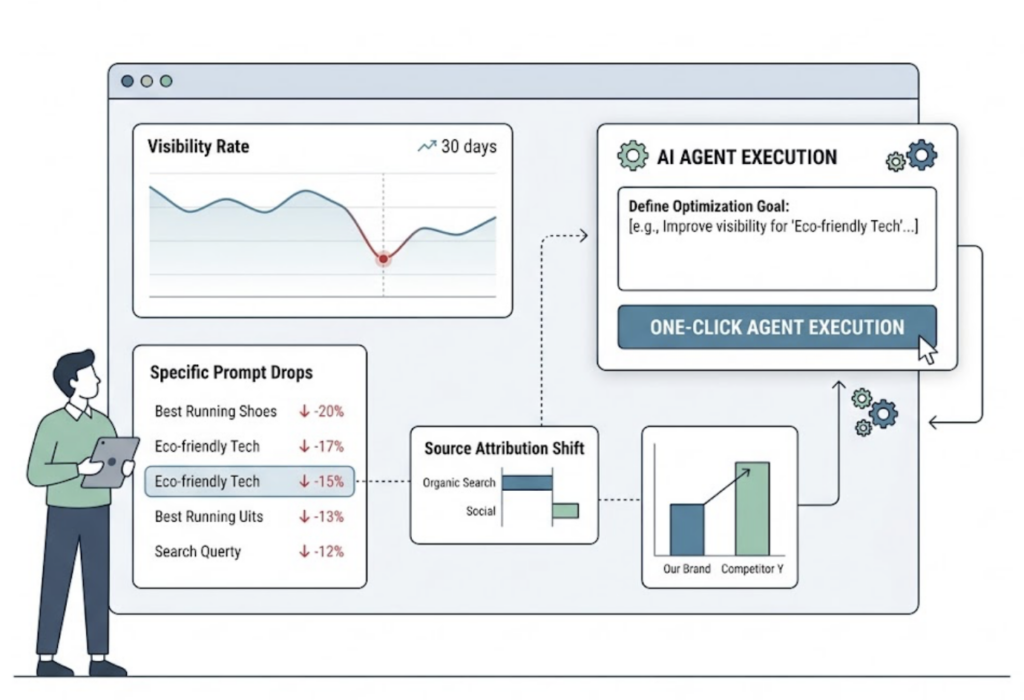
In practice, this means a brand manager can see their Visibility Rate trend over 30 days, identify which specific prompts the brand dropped from, trace those drops to source attribution shifts, and surface which competitor gained ground — all from a single dashboard. The AI visibility platform also includes one-click agent execution: you define the optimization goal in plain English, and the system handles the execution without manual workflows.
For teams managing multiple brands or product lines, Topify’s competitor monitoring layer continuously detects which brands AI engines are favoring in your category and logs the reasons cited — giving you the raw material for counter-strategy without hours of manual research.
Pricing starts at $99/month for the Basic plan, which includes 100 prompts and 9,000 AI answer analyses across 4 projects. That’s enough for most mid-size brand teams to start getting real signal on where they stand.
The AI Brand Intelligence Scorecard for Monthly Reporting
Brand managers who’ve integrated AI intelligence into their reporting use a dashboard structure built around four questions — not raw traffic numbers:
| Metric | Question to Answer |
|---|---|
| AI Visibility Trend | Are we appearing in more relevant prompts month-over-month? |
| Citation Health | Which external sources are currently driving our AI recommendations, and are they authoritative? |
| Sentiment Shift | Has the AI’s framing of our brand moved in the direction of our positioning? |
| Category Share of Voice | Are we the default recommendation for our core product category, or is a competitor holding that slot? |
These four metrics are what a monthly AI brand intelligence report should answer. Everything else — prompt volume, platform breakdown, competitor detail — is supporting data.
The shift is from “how much traffic did we get” to “how often does AI recommend us, and what does it say when it does.”
Conclusion
The brands that built early SEO authority in the 2010s had a compounding advantage for years. The same dynamic is playing out in AI search now — but the underlying logic is different. It’s not about link equity or keyword density. It’s about entity authority: how consistently, authoritatively, and positively your brand is represented across the sources AI models trust.
Brand managers who start tracking AI brand intelligence now will have data — trend lines, competitive benchmarks, source maps — while competitors are still running manual spot checks. That data advantage compounds.
Get started with Topify to run your first AI brand visibility audit and see where your brand actually stands across ChatGPT, Perplexity, and Gemini.
FAQ
Q: What’s the difference between AI brand intelligence and social listening?
A: Social listening tracks what humans are saying about your brand in forums, reviews, and social media. AI brand intelligence tracks how AI models — ChatGPT, Perplexity, Gemini — interpret, validate, and recommend your brand based on the sum total of your digital footprint. The audience is different (humans vs. AI systems), and so is the data source. Social listening captures public sentiment; AI brand intelligence captures what the model has synthesized as “the truth” about your brand.
Q: How often should brand managers check AI search visibility?
A: Weekly tracking is the practical standard. Unlike brand surveys or quarterly audits, AI recommendation behavior is dynamic — models update their training, citation sources shift in authority, and competitor content moves. A brand that’s well-represented in ChatGPT responses in January may have dropped significantly by March due to changes in which sources the model is citing. Monthly reviews can catch major shifts; weekly data is needed to diagnose why they happened.
Q: Does AI brand intelligence apply to e-commerce brands specifically?
A: Yes — and the stakes are arguably higher for e-commerce. AI is increasingly functioning as a shopping assistant: consumers ask Perplexity “what’s the best running shoe under $150” and buy from whatever the model recommends. Being surfaced in shopping-intent prompts often correlates directly with purchase consideration. For e-commerce brand managers, AI brand intelligence strategies to improve AI shopping visibility aren’t optional — they’re where the next wave of product discovery is being decided.
Q: What’s the first thing a brand manager should do to improve AI brand intelligence?
A: Run a baseline audit across 20-30 purchase-intent prompts in your category. Track which ones mention your brand, which mention competitors, and what the AI says when it does reference you. That baseline — your current Visibility Rate and a rough Sentiment read — is the starting point for every strategy decision that follows. Without it, you’re optimizing blind.

