

Your brand ranks on page one of Google. Reviews look solid. PR coverage is decent.
Then someone asks ChatGPT: “What’s the best tool for [your category]?” And your brand either gets described inaccurately, lumped in with mid-tier competitors, or doesn’t show up at all.
That’s not an SEO problem. That’s an AI reputation problem. And it needs a different strategy entirely.
AI Is Now a Reputation Channel, Not Just a Search Engine
When someone uses ChatGPT, Perplexity, or Gemini to research a purchase, they’re not clicking ten blue links and forming their own opinion. They’re receiving a synthesized judgment: this brand is recommended, this one is described as “budget,” this one isn’t mentioned.
That judgment sticks.
AI models are shaping buyer perception at the consideration stage, before a person ever visits a website. According to 2026 industry analysis, brands that fail to monitor their AI reputation risk having their market position defined by inaccurate, outdated, or absent data pulled from sources they don’t control.
Traditional brand monitoring tracks what people are saying. AI reputation monitoring tracks what AI is synthesizing, and that’s a fundamentally different signal.
What “AI Reputation” Actually Means
Here’s the thing most teams get wrong: AI reputation is not the same as social media sentiment.
Social listening captures public opinion. AI reputation tracking focuses on knowledge integrity and retrieval logic. Specifically, it tracks how large language models form and express opinions about your brand when users ask category-level questions.
LLMs operate on Retrieval-Augmented Generation (RAG). They pull content from authoritative sources across the web, synthesize it, and produce a response. If your brand is not “retrievable” in the context of a buyer’s query, you don’t exist in the AI’s output.
The dimensions that actually define your AI reputation are:
- Visibility: How often your brand appears in relevant AI responses
- Sentiment: Whether the framing is positive, neutral, or negative
- Position: Where you appear relative to competitors in a recommendation list
- Source Attribution: Which third-party domains the AI is citing to “validate” what it says about you
Brand exposure across AI models isn’t just about being mentioned. It’s about being mentioned accurately, positively, and in the right context.
The 4-Layer AI Reputation Monitoring Framework
A structured approach starts with four monitoring layers, each tracking a distinct dimension of how AI models perceive your brand.
Layer 1: Prompt Coverage Which buyer-journey queries does your brand appear in? Map the natural language prompts your audience actually uses: “best [category] for [use case],” “alternatives to [competitor],” “[brand] vs [competitor].” Your Query Recall Rate, meaning the percentage of relevant prompts where your brand surfaces, is the starting point for everything else.
Layer 2: Visibility and Mention Rate Frequency matters. A brand that shows up in 60% of category prompts has a fundamentally different AI presence than one that appears in 10%. Share of AI Voice, your mentions as a percentage of total brand mentions in a category, is the AI-era equivalent of share of voice in traditional media.
Layer 3: Sentiment Direction Presence isn’t enough. A brand can appear in every AI answer and still be described as “an older option” or “less suited for enterprise.” Sentiment scoring using LLM-as-a-Judge evaluation frameworks assigns a 0-100 score to how AI models frame your brand. Neutral is not safe. Neutral means forgettable.
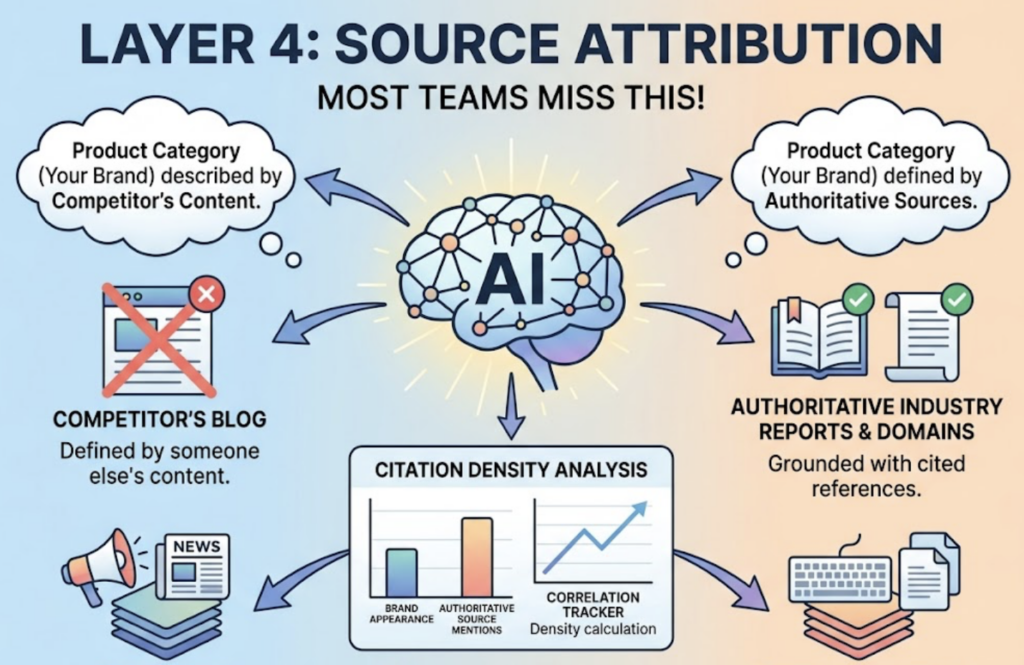
Layer 4: Source Attribution This is the layer most teams miss entirely. AI models cite sources to ground their answers. If the AI is describing your product category using a competitor’s blog post as its primary reference, your brand is being defined by someone else’s content. Citation density, the correlation between authoritative source mentions and brand appearance, tells you exactly which third-party domains to prioritize in your PR and content strategy.
5 Mistakes Brands Make Before Building a Strategy
Most teams don’t start with a gap. They start with an assumption.
Mistake 1: Assuming SEO rankings translate to AI visibility. They don’t. AI models frequently synthesize answers from zero-click sources that prioritize definitional authority over traffic volume. A brand with 50,000 monthly visitors can be outranked in AI responses by a competitor with a well-placed mention in an industry wiki.
Mistake 2: Treating AI reputation as a PR problem, not a data problem. Sentiment issues in AI responses often stem from outdated content being retrieved, not from a recent crisis. You can’t fix a retrieval problem with a press release.
Mistake 3: Ignoring third-party validation ecosystems. AI models don’t trust brand websites alone. They aggregate from G2, TrustRadius, industry journals, and structured review aggregators. Brands that over-optimize their own site while ignoring this ecosystem see fragmented AI presence.
Mistake 4: Skipping structured data. LLMs use Schema markup (Organization, Product, Person) to build their internal knowledge graph. Inconsistent or missing metadata leads to what researchers call “entity hallucination,” where the AI either conflates your brand with a competitor or generates factually incorrect descriptions.
Mistake 5: No prompt-loop testing. If you’re not regularly querying the actual prompts your customers use across ChatGPT, Perplexity, and Gemini, you have no idea what narrative your brand is carrying in the AI layer.
How to Measure AI Reputation: The Metrics That Matter
Traditional metrics like traffic and CTR are lagging indicators. They tell you what happened. AI reputation metrics are leading indicators. They tell you what narrative is being built before the click ever happens.
| Metric | What It Measures | Why It Matters |
|---|---|---|
| Visibility Rate | % of category prompts where brand appears | Baseline presence |
| Share of AI Voice | Brand mentions vs. competitors in AI responses | Competitive standing |
| Sentiment Score (0-100) | Tone and framing of AI brand description | Perception quality |
| Position Rank | Placement in AI recommendation lists | Conversion likelihood |
| Source Coverage | Which domains AI cites for your category | Content strategy signals |
| CVR (Conversion Visibility Rate) | Estimated likelihood AI answers drive user action | Business impact |
Topify tracks all six of these metrics across ChatGPT, Gemini, Perplexity, and other major AI platforms, updated continuously rather than at static snapshot intervals.
Brand Exposure AI Models Tools: What to Actually Look For
The tool landscape for AI reputation monitoring varies widely in depth. Most social listening tools have tacked on “AI monitoring” as a feature. They track brand mentions in AI-generated content after the fact. That’s not the same as monitoring how AI models represent your brand in response to buyer prompts.
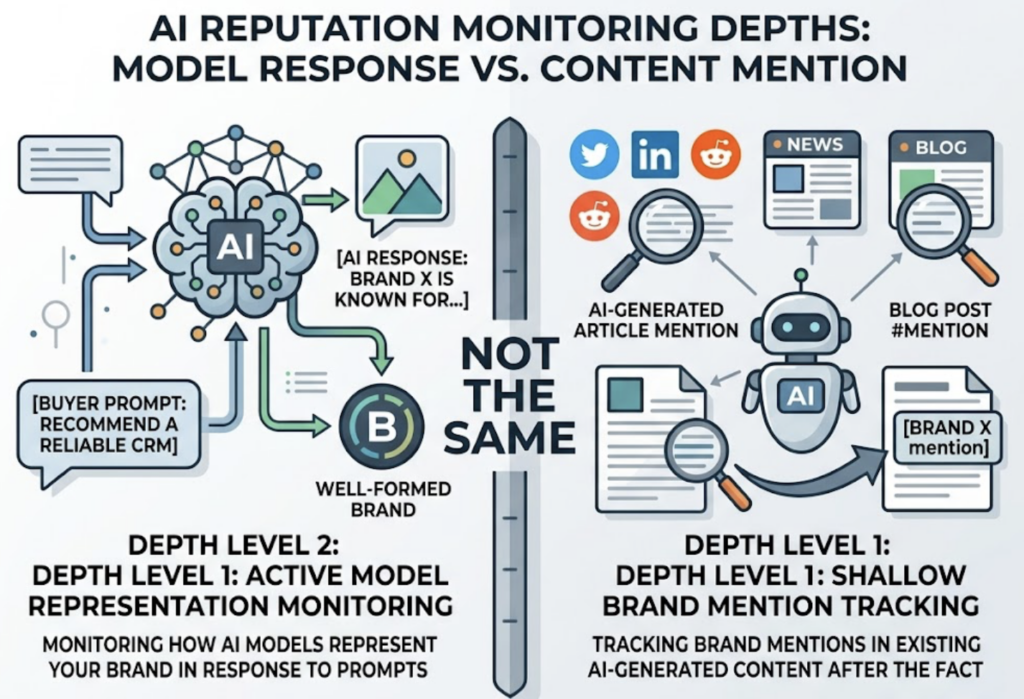
When evaluating brand exposure AI models tools, look for four capabilities:
Multi-platform prompt execution. The tool should fire actual prompts across ChatGPT, Perplexity, Gemini, and ideally DeepSeek or regional AI platforms. Scraping AI-generated content elsewhere is a different, weaker signal.
Sentiment analysis at the response level. Not keyword sentiment. Full-response sentiment, scored against the specific context of how your brand is described relative to competitors.
Source-level attribution. Which URLs and domains is the AI citing? This is the data that drives actionable content strategy.
Competitor benchmarking. AI reputation is inherently relative. A sentiment score of 72 means nothing unless you know the category average and where your closest competitors sit.
Topify covers all of these through its core analytics matrix: Visibility Tracking, Sentiment Analysis, Source Analysis, Competitor Monitoring, and Position Tracking, built specifically for AI search behavior rather than retrofitted from traditional SEO infrastructure.
Building Your Strategy: A Step-by-Step Checklist
Step 1: Baseline audit across AI platforms. Manually query your 10-15 most important category prompts across ChatGPT, Perplexity, and Gemini. Note where you appear, how you’re described, and what sources are cited. This establishes your presence gaps.
Step 2: Schema hygiene. Audit your website’s structured data. Ensure your brand is defined as a distinct entity with clear relationships to your product category, key features, and use cases. Fragmented metadata is one of the most common causes of inaccurate AI representation.
Step 3: Expand your third-party ecosystem. Identify the top authoritative domains that appear as citations in your category’s AI responses. These are your highest-leverage content placement targets. A single mention in a well-cited industry publication can shift citation density meaningfully.
Step 4: Audit your sentiment sources. If AI sentiment is neutral or negative, trace the citations. Often the AI is pulling from a 2-3 year old review or a press piece that no longer reflects the product. Create fresh, high-authority content that overwrites the outdated narrative at the source level.
Step 5: Set up persistent monitoring. Manual audits are a starting point. Operationalizing the strategy means moving to a platform that tracks Share of AI Voice changes over time, flags sentiment shifts, and alerts you when a competitor gains position in your category prompts.
Step 6: Define your review cycle. AI retrieval logic updates frequently. Monthly reviews of your visibility, sentiment, and source data are a minimum. Fast-moving categories may need bi-weekly tracking.
Conclusion
AI reputation isn’t a future concern. It’s a present-tense competitive variable.
The brands that show up accurately and positively in AI-generated answers are already shaping buyer perception before a single website visit. The brands that aren’t monitoring this layer are operating blind.
A structured AI reputation monitoring strategy starts with understanding how LLMs form opinions about your brand, measures what actually matters (visibility, sentiment, position, sources), and operationalizes tracking so you’re not catching problems months after they started affecting pipeline.
The tools exist. The framework is clear. The question is whether you build the strategy before or after a competitor does.
FAQ
What is AI reputation monitoring strategy?
It’s a systematic approach to tracking, measuring, and improving how AI models like ChatGPT, Gemini, and Perplexity describe and recommend your brand. Unlike traditional reputation monitoring, which focuses on public sentiment, AI reputation monitoring focuses on knowledge integrity and retrieval logic: what the AI knows about you, how it frames you, and which sources it uses to validate that framing.
How does AI reputation monitoring strategy work?
The process involves firing category-relevant prompts across multiple AI platforms and analyzing the outputs across four dimensions: visibility (are you mentioned?), sentiment (how are you described?), position (where do you appear relative to competitors?), and source attribution (what domains is the AI citing?). Platforms like Topify automate this at scale, tracking hundreds of prompts across major AI engines continuously.
How do I improve my AI reputation in AI models?
Start with a source audit: identify which third-party domains the AI is using to describe your brand, then build a content and PR strategy to gain mentions on those specific high-authority sources. Fix structured data inconsistencies on your own site, and create fresh authoritative content to replace outdated material the AI may be retrieving. Sentiment improvement is typically a 60-90 day process tied directly to content ecosystem changes.
How do I measure AI reputation monitoring strategy effectiveness?
Track six metrics over time: Visibility Rate, Share of AI Voice, Sentiment Score (0-100), Position Rank, Source Coverage, and CVR. The leading indicators are Share of AI Voice and Sentiment Score. If both are moving up, your strategy is working. If visibility rises but sentiment stays flat, you have a framing problem, not a presence problem.
What does AI reputation monitoring strategy cost?
Costs vary significantly by tool and scope. Topify‘s Basic plan starts at $99/month, covering 100 prompts across ChatGPT, Perplexity, and AI Overviews with 9,000 AI answer analyses. Pro is $199/month for 250 prompts and expanded project capacity. Enterprise plans start at $499/month for custom configurations. For managed GEO services (strategy + execution), plans start at $3,999/month.

