

Your domain authority is solid. Your Google rankings are holding. But someone just asked ChatGPT for a recommendation in your category, and your brand wasn’t mentioned once. Traditional monitoring tools can’t catch that gap, because they weren’t built to measure what AI chooses to say. That’s exactly the problem AI brand intelligence software was designed to solve.
Your Brand Might Be Invisible to AI. Here’s What That Costs
Most brand monitoring stacks today cover social mentions, news coverage, and search rankings. None of those channels tell you whether Perplexity is recommending your competitor or whether Gemini describes your product in a way that contradicts your positioning.
The shift is structural. AI models like ChatGPT, Gemini, and Perplexity operate through what researchers call Retrieval-Augmented Generation (RAG): they synthesize answers from authoritative external sources rather than ranking blue links. If your brand isn’t woven into those sources, you don’t just rank lower. You don’t exist in the answer at all.
That’s the AI Visibility Gap. And it’s growing faster than most marketing teams realize.
What AI Brand Intelligence Software Actually Does
AI brand intelligence software is a category of tools built specifically to track, measure, and analyze how AI systems represent your brand in generated responses. It’s distinct from social listening or traditional brand monitoring in one fundamental way: it focuses on what AI says, not what humans post.
A capable AI brand intelligence platform tracks five core dimensions:
| Metric | What It Measures | Why It Matters |
|---|---|---|
| Visibility Rate | % of relevant prompts where your brand is mentioned | Measures your “Share of AI Voice” in your category |
| Sentiment Score | AI’s descriptive tone toward your brand (0–100) | Reveals whether AI frames you as a leader or a “budget alternative” |
| Position Ranking | Your brand’s order in AI recommendation lists | Placement in the first three results drives most downstream intent |
| Source Attribution | Domains and URLs the AI cites to validate your brand | Identifies which external “trust anchors” are fueling AI confidence in you |
| Conversion Visibility Rate (CVR) | Correlation between AI visibility and traffic or lead generation | Connects AI presence to actual business outcomes |
These aren’t vanity metrics. They’re the operational layer that tells you whether your brand is being recommended, how it’s being described, and what’s driving those outcomes.
Why Traditional Tools Can’t Fill This Role
It’s tempting to assume that a well-configured social listening tool or a standard SEO platform covers enough ground. In practice, the gap is significant.
Social listening tools crawl human-generated content: posts, reviews, news articles. They’re designed to catch what people say about your brand. AI brand intelligence systems track what AI engines say, which is a fundamentally different input set based on entity authority, third-party citations, and cross-platform synthesis patterns.
The cross-platform fragmentation problem makes this worse. A brand might appear consistently in ChatGPT responses but be almost entirely absent from Perplexity or Gemini, because each model relies on different training data and RAG retrieval sources. Without a system that monitors all three simultaneously, that fragmentation is invisible.
One fact worth internalizing: if an AI model synthesizes a recommendation and your brand isn’t cited in the synthesis, you’re effectively invisible to that user at that moment. No impression. No option to click through. The “zero-click” reality of AI search means absence isn’t a ranking problem. It’s a presence problem.
What Separates a Solid AI Brand Intelligence Tool from a Shallow Dashboard
Not all AI brand intelligence solutions are built the same. The difference between a useful platform and a shallow dashboard usually comes down to four criteria.
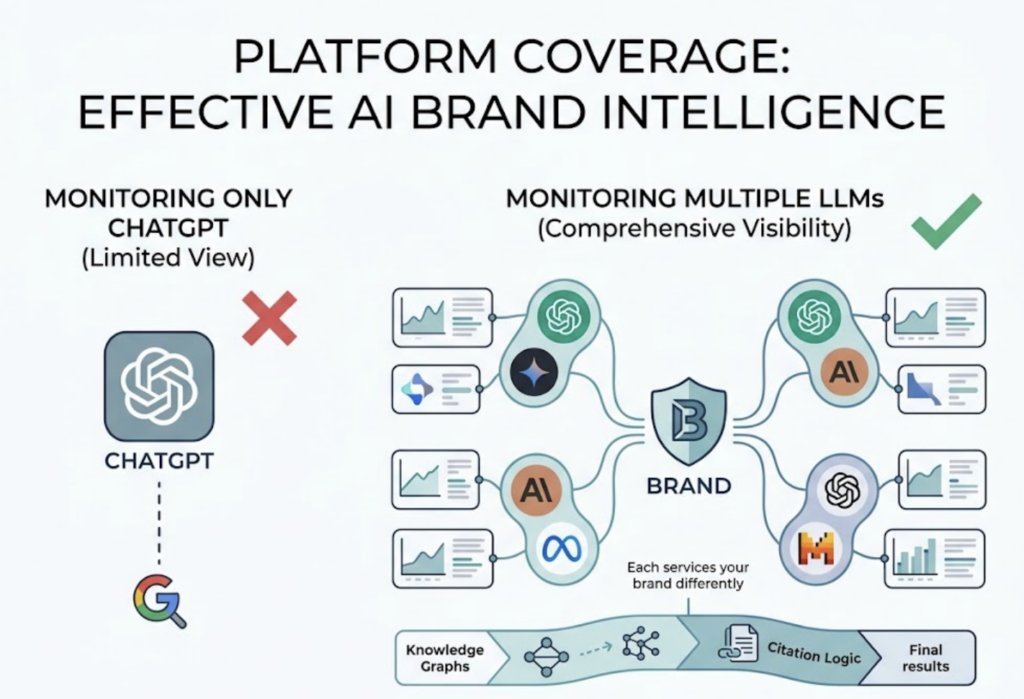
Platform coverage. Monitoring only ChatGPT is like tracking your SEO on one search engine and ignoring the rest. An effective AI brand intelligence system covers multiple LLM architectures simultaneously, because each surfaces your brand differently based on its own knowledge graph and citation logic.
Prompt-level granularity. Broad category tracking isn’t enough. The AI brand intelligence analytics that actually drive decisions are built at the prompt level: specific buyer-intent queries like “best [product] for [industry] in 2026.” That’s where conversion intent lives, and that’s where you need to know your position.
An actionable execution loop. This is where most tools fall short. A dashboard that surfaces an invisibility gap without telling you what to do about it is just a more expensive report. The difference between a monitoring tool and an intelligence platform is whether it closes the loop from insight to action.
Historical drift tracking. Brand sentiment in AI models isn’t static. Model updates, changes in your digital footprint, and shifts in third-party coverage all affect how AI represents your brand over time. Longitudinal tracking is what separates a snapshot from a strategy.
Common Mistakes in AI Brand Intelligence Software Adoption
Industry analysis points to four patterns that consistently undermine AI brand intelligence programs.
The SEO-Only fallacy. Assuming that a #1 Google ranking protects you in AI outputs is one of the most expensive assumptions a marketing team can make. AI models prioritize entity authority and third-party expert consensus, not keyword density. Your Google performance and your AI visibility are increasingly decoupled.
Fragmented entity data. If your brand’s product descriptions, leadership details, or positioning language differ across platforms, AI models develop what researchers call “entity confusion.” The model may exclude your brand from recommendations to avoid surfacing inaccurate information. Consistency across your digital footprint isn’t just good hygiene. It’s a visibility prerequisite.
Ignoring the citation ecosystem. Many brands over-optimize their own website while neglecting the sources AI actually pulls from: industry publications, review platforms, knowledge bases, and structured databases. Those “middle-man” sources are often where AI forms its opinion of your brand.
Treating sentiment data as a vanity metric. If Perplexity consistently describes your brand with negative qualifiers or wrong positioning language, that’s a content strategy signal, not a reporting footnote. The brands that gain from AI brand intelligence analytics are the ones that feed sentiment data back into their content programs and update the external sources AI is pulling from.
How Topify Approaches AI Brand Intelligence
Topify is built around what it calls a GEO Matrix: seven dimensions of brand performance tracked across AI engines simultaneously. Those dimensions are Visibility, Sentiment, Position, Volume, Mentions, Intent, and CVR.
The platform covers ChatGPT, Gemini, Perplexity, DeepSeek, Doubao, Qwen, and other major AI engines, which matters because fragmentation across models is one of the most common and least-tracked problems in AI brand intelligence today. You don’t get a complete picture from any single platform.
What distinguishes the Topify approach from standard AI brand intelligence dashboards is the execution layer. The platform’s One-Click Agent Execution feature lets teams define a visibility goal in plain English, review the proposed strategy, and deploy with a single click. That closes the loop between identifying a gap and actually doing something about it, which is where most AI brand intelligence tools stall.
On pricing, Topify’s Basic plan starts at $99/month, covering 100 prompts, 9,000 AI answer analyses, and tracking across ChatGPT, Perplexity, and AI Overviews. The Pro plan at $199/month expands to 250 prompts and 22,500 AI answer analyses. Enterprise plans start from $499/month with custom configurations. You can review current tiers on the Topify pricing page.
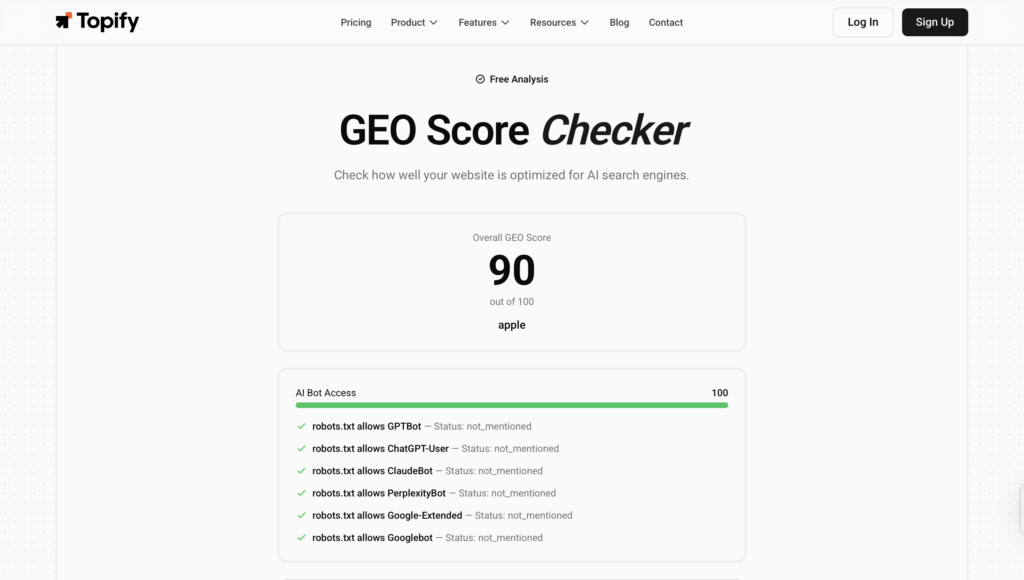
For teams that want to see what the platform measures before committing, Topify’s free GEO score checker is a useful starting point.
Conclusion
AI brand intelligence software isn’t an add-on to your existing monitoring stack. It’s a separate layer of infrastructure for a channel that traditional tools were never built to measure.
The brands that move early on this have a straightforward advantage: they know how AI describes them, where they’re invisible, and which external sources are driving their AI reputation. That’s information their competitors don’t have yet. The gap closes as adoption grows, but for now, it’s one of the more actionable edges available in a crowded marketing stack.
Get started with Topify to see where your brand stands in AI search today.
FAQ
Q: What is AI brand intelligence software?
A: AI brand intelligence software is a category of analytics tools that tracks how AI systems like ChatGPT, Gemini, and Perplexity represent your brand in generated responses. Unlike traditional brand monitoring, which covers social mentions and news coverage, AI brand intelligence platforms measure visibility rate, sentiment score, position ranking, source attribution, and conversion visibility across AI engines.
Q: How does AI brand intelligence software work?
A: These platforms run structured prompts across major AI engines at regular intervals, capture how the AI responds to brand-relevant queries, and analyze patterns in visibility, sentiment, and position. More advanced AI brand intelligence systems also identify which external domains the AI is citing to validate brand claims, enabling teams to optimize the sources that drive AI recommendations.
Q: How do I measure the effectiveness of an AI brand intelligence solution?
A: The core metrics are visibility rate (share of relevant prompts where your brand appears), sentiment score trends over time, position ranking versus key competitors, and correlation between AI visibility and downstream traffic or leads (CVR). A credible AI brand intelligence analytics platform should show movement across all five dimensions, not just mention counts.
Q: What should I expect from AI brand intelligence software pricing?
A: Pricing in this category varies by prompt volume and platform coverage. Entry-level AI brand intelligence tools typically start around $49–$99/month for basic tracking across one or two AI engines. Mid-market platforms with multi-engine coverage and prompt-level analytics generally run $99–$299/month. Enterprise plans with custom configurations and dedicated support typically start from $499/month and scale with usage.

