

Your domain authority is solid. Your content ranks on page one. But when someone asks ChatGPT, “What’s the best tool for [your category]?” your brand doesn’t appear. Not because you did anything wrong, but because ChatGPT SEO follows completely different rules than Google SEO, and most teams haven’t caught up yet.
The good news: AI citation is not random. It’s measurable, and it’s improvable.
What ChatGPT SEO Actually Means
ChatGPT SEO is not about buying ad placements or optimizing your prompts. It refers to the practice of influencing how AI language models, particularly ChatGPT, decide which brands to cite, recommend, and describe in their responses.
This is fundamentally different from traditional SEO. Google ranks pages. ChatGPT synthesizes answers. When a user asks for a product recommendation, it doesn’t return a list of URLs sorted by authority. It generates a response based on what it “knows,” weighted by data clarity, third-party consensus, and entity recognition.
That distinction matters more than most marketers realize.
Why Your Google Rankings Don’t Translate to ChatGPT Visibility
High Google rankings signal that your page has earned clicks and backlinks. ChatGPT citations signal something different: that your brand is consistently described, verified, and mentioned across enough authoritative sources that the model treats it as a reliable entity.
The underlying mechanism is Retrieval-Augmented Generation (RAG). When ChatGPT responds to a query, it converts the question into a vector and retrieves content chunks that are mathematically similar in meaning. It then cross-references those chunks against its knowledge graph, looking for consistency. If your brand appears on your own website but nowhere else, it’s a weak signal. If your brand is consistently described across industry publications, review platforms, and third-party databases, the model treats it as verified.
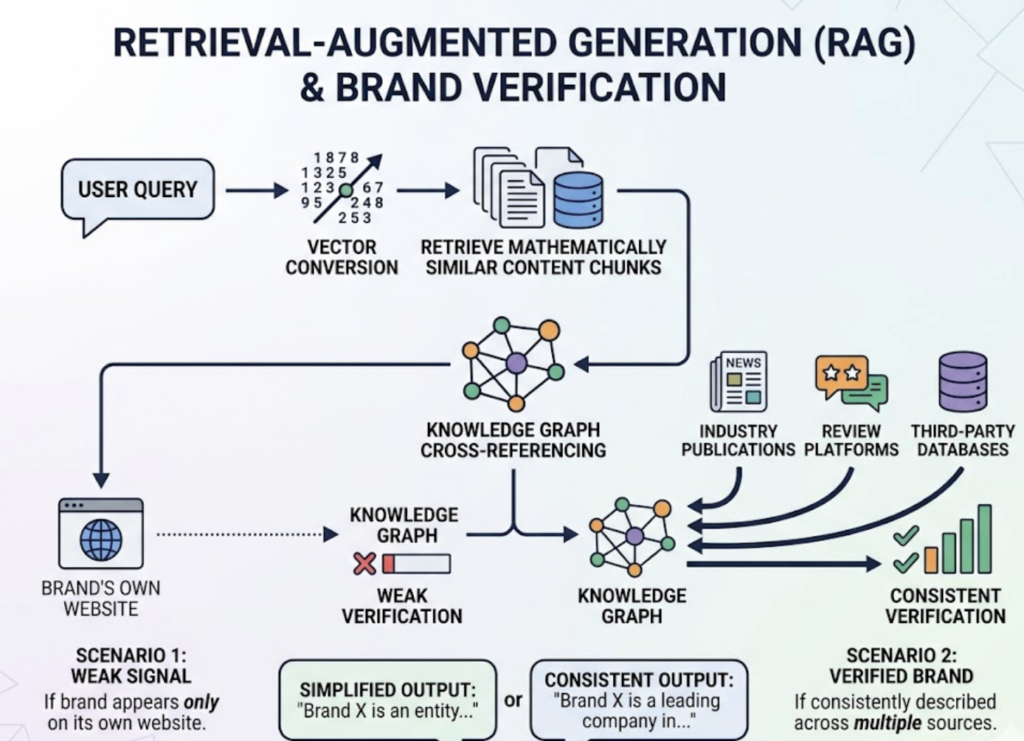
That’s why a startup with a DA of 30 but solid press coverage can outrank a DA-80 site that’s never been mentioned outside its own domain.
How ChatGPT Decides What to Recommend
Understanding the ChatGPT SEO ranking logic comes down to three factors.
Semantic retrieval. The model looks for content that answers the query with precision, not just keywords. “Best project management tool for remote teams” pulls different results than “project management software,” even if both land on the same product. Content that directly answers AI-style questions, in plain language, in the first 100 words, tends to get retrieved more often.
Entity validation. ChatGPT cross-references retrieved content against known entities in structured databases. If your brand doesn’t have consistent schema markup, a verified Crunchbase or LinkedIn presence, or mentions on G2 and Capterra, the model defaults to brands it can more confidently identify. Entity-level SEO, implementing Organization and Product schema markup, gives the model machine-readable facts rather than just creative text.
Consensus check. This is the one most teams overlook. The model prioritizes information reinforced by multiple authoritative sources. If your website claims you’re the leading solution in a category but no third-party source confirms it, the likelihood of a citation drops significantly. AI essentially runs a consensus vote across the web, and self-promotional content loses.
5 Ways to Improve Your ChatGPT SEO
Build Content That Directly Answers AI-Style Questions
ChatGPT doesn’t reward content that buries the answer in a 2,000-word article. It rewards content that delivers a clean, factual answer in the opening paragraph, then supports it with structured detail. If someone asks “what is the best CRM for small businesses,” your content should answer that question directly, not hedge it into oblivion.
Target question-based long-tail formats: “how does X work,” “what is the difference between X and Y,” “best X for [specific use case].” These map directly to how users query AI search.
Get Cited by Publications ChatGPT Already Trusts
Not all backlinks are equal in ChatGPT SEO. The model weights citations from sources it has high confidence in. Getting mentioned in industry journals, featured in comparison roundups on established review platforms, or covered by tech publications that already appear in AI responses is far more valuable than a hundred links from low-authority blogs.
Think of it as third-party validation. Because AI distrusts self-promotional content, it relies on off-site verification as a trust signal. Each credible mention acts as a vote.
Optimize Your Brand’s Presence Across Third-Party Platforms
Your Crunchbase profile, G2 listing, LinkedIn company page, and Wikipedia mention (if applicable) are not just directories. They’re entity signals that AI models actively reference. Make sure your brand description, category, and key differentiators are consistent across all of them.
Inconsistency is a red flag. If your G2 profile says you’re a “project management tool” and your website calls you an “AI-powered workflow platform,” the model gets conflicting signals and defaults to the more established competitor.
Track Your ChatGPT Citations to Close the Feedback Loop
This is where most ChatGPT SEO strategies break down. Teams optimize content, build backlinks, and update schema, but never verify whether any of it changed how ChatGPT responds.
Without a feedback loop, you’re optimizing blind. Tracking which AI prompts trigger your brand, how often you’re mentioned versus competitors, and which sources ChatGPT cites alongside you is the only way to iterate with confidence. Tools that monitor AI citation patterns in real time make this feedback loop systematic rather than manual.
Use Structured Data and Entity-Level SEO
Implement Organization, Product, and FAQ schema markup across your site. These give AI crawlers machine-readable facts: your brand name, category, founding date, key features, pricing range. The clearer the structured data, the easier it is for the model to form a confident entity representation.
Also consider publishing structured content on authoritative external platforms: detailed product descriptions on G2, executive profiles on LinkedIn, and press releases distributed through recognized news wires. Each structured data point outside your own domain reinforces the entity signal.
How to Measure ChatGPT SEO Performance
Standard SEO metrics don’t capture ChatGPT visibility. Organic traffic doesn’t tell you whether ChatGPT mentioned your brand 40 times last month or zero times. You need a different measurement framework.
The metrics that matter for ChatGPT SEO:
| Metric | What It Measures |
|---|---|
| Visibility Rate | % of category-level prompts where your brand appears in the AI response |
| Sentiment Score | How ChatGPT frames your brand: leader, secondary option, niche player, or not recommended |
| Citation Source Quality | Which domains are cited alongside your brand in AI responses |
| Position vs. Competitors | Where your brand ranks relative to direct competitors in AI-generated lists |
| CVR (Conversion Visibility Rate) | Likelihood that an AI mention leads to a user clicking through to your site |
Topify tracks all seven of these core metrics, including volume and intent, across ChatGPT, Perplexity, Gemini, and other major AI platforms simultaneously. The practical advantage is that instead of manually querying AI engines every week, you get a consolidated view of your ChatGPT ranking trends and competitor movements in a single dashboard.
Topify’s Basic plan starts at $99/month with 100 prompts monitored and 9,000 AI answer analyses, which covers most mid-size brand tracking needs. For teams managing multiple clients or brands, the Pro plan ($199/month) expands to 250 prompts and 22,500 AI answer analyses.
Best Tools for ChatGPT SEO in 2026
The tool landscape for ChatGPT SEO has matured significantly. There are now platforms that go beyond manual prompt testing and provide structured visibility data across multiple AI engines.
What separates useful tools from noise: coverage (which AI platforms are tracked), metric depth (are you getting Visibility Rate and Sentiment, or just presence/absence), and execution capability (can the platform help you act on the data, not just report it).
Topify is built specifically for this use case. Its core value is not just tracking whether your brand appears in ChatGPT, but why: which sources are being cited, what sentiment the model attaches to your brand, and where you stand relative to competitors on high-intent prompts. The platform also includes a One-Click Agent Execution feature, where you define your optimization goals in plain English and the AI agent handles the execution, including content adjustments and source-building strategy, without requiring manual workflows.
For teams that want to get started immediately, Topify offers a 30-day trial on the Basic plan with no commitment required.
Common Mistakes That Hurt Your ChatGPT Visibility
Treating Google SEO and ChatGPT SEO as the same thing. They share some foundations (quality content, authoritative backlinks) but diverge significantly at the execution level. ChatGPT doesn’t care about your meta title. It cares about entity consistency and third-party consensus.
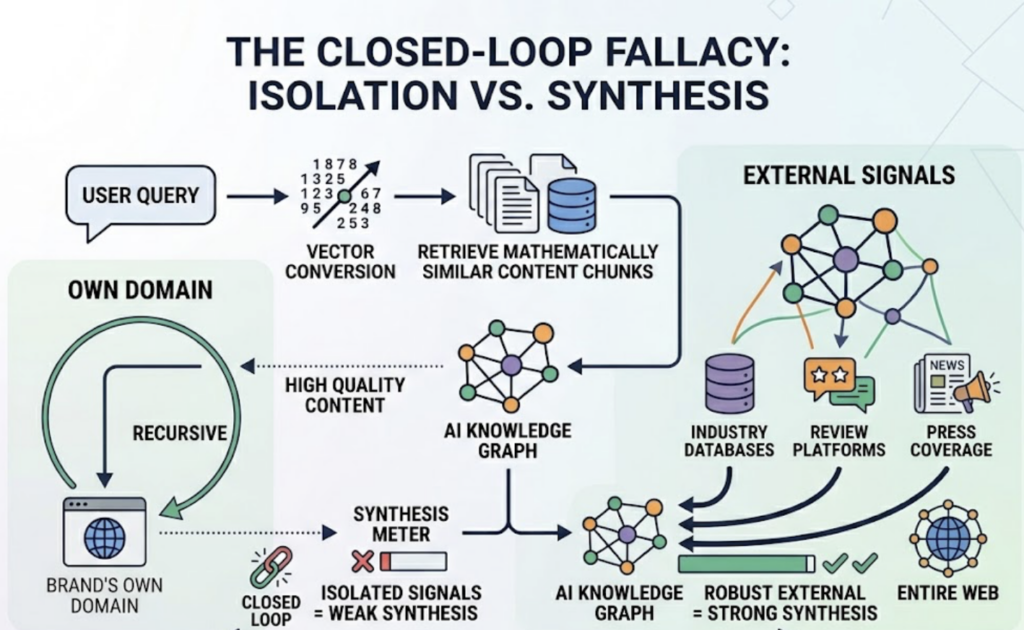
The closed-loop fallacy. Creating strong content on your own domain while ignoring off-site entity signals. AI models synthesize information from the entire web, not just your site. A brand that’s well-documented on its own pages but absent from industry databases, review platforms, and press coverage will consistently lose to competitors with stronger third-party footprints.
Keyword stuffing for AI. Modern language models flag content that over-optimizes for keywords at the expense of natural, authoritative language. Over-engineered content can actually reduce your citation probability because the model interprets it as low-quality or manipulative.
No measurement, no iteration. Assuming that because your Google rankings are strong, your ChatGPT visibility is fine. Ranking is not equivalent to AI citation. Without tracking your ChatGPT brand mentions and visibility rate over time, you can’t know whether your optimization efforts are working or not.
Conclusion
ChatGPT SEO is not a replacement for traditional SEO. It’s an additional layer that operates on different logic: entity authority, semantic precision, and off-site consensus rather than keyword density and backlink volume. Brands that treat it as an extension of their existing content strategy, without measuring AI-specific metrics, will keep showing up on Google page one while staying invisible in AI-generated answers.
The starting point is measurement. Know where your brand stands in ChatGPT today, track which prompts trigger your competitors instead of you, and build a feedback loop that turns that data into content and entity decisions. That’s what a real ChatGPT SEO strategy looks like.
FAQ
Q: What is ChatGPT SEO?
A: ChatGPT SEO refers to the practice of optimizing a brand’s content, entity data, and off-site presence to increase the likelihood that ChatGPT and other AI language models cite, recommend, or positively describe the brand in their responses. It differs from traditional SEO in that it targets AI citation logic rather than search engine ranking algorithms.
Q: How does ChatGPT SEO work?
A: ChatGPT uses a process called Retrieval-Augmented Generation (RAG) to retrieve relevant content chunks and synthesize answers. It prioritizes content that provides clear, factual answers, brands that are consistently described across multiple authoritative third-party sources, and entities with clean structured data (schema markup, verified profiles). Improving your performance across these three factors is the core of ChatGPT SEO.
Q: How do you measure ChatGPT SEO performance?
A: Traditional SEO metrics like organic traffic and keyword rankings don’t capture AI visibility. The right metrics are Visibility Rate (how often your brand appears in category-level AI responses), Sentiment Score (how AI describes your brand), Citation Source Quality (which domains AI cites alongside you), and Position relative to competitors. Platforms like Topify track these across ChatGPT, Perplexity, and Gemini in a unified dashboard.
Q: What is the pricing for ChatGPT SEO tools?
A: Pricing varies by platform and feature depth. Topify’s Basic plan starts at $99/month, covering 100 prompts and 9,000 AI answer analyses. The Pro plan is $199/month with expanded capacity. Enterprise plans start at $499/month with dedicated account management and custom configurations.

