
Your brand might have solid Google rankings, active social channels, and a polished PR presence. None of that tells you whether ChatGPT recommends you when a buyer asks for a solution in your category.
That’s the gap most brands still haven’t closed.
AI brand intelligence strategy is the framework that closes it. Not a monitoring tweak. Not another dashboard. A systematic approach to understanding, measuring, and influencing how large language models perceive and represent your brand across every major AI platform.
What AI Brand Intelligence Actually Means
Traditional brand intelligence tracks what people say about you on social media, in reviews, and in news coverage. That’s a web of existing human-generated content.
AI brand intelligence is different in one critical way: it focuses on synthetic narrative. What does ChatGPT say about your brand when no one has explicitly asked “What do people think of Brand X?” What does Perplexity recommend when a buyer types “best alternatives to [your competitor]”?
As one practitioner framework puts it, this requires moving from reactive listening to proactive simulation. You’re not waiting to see what gets posted about you. You’re actively querying AI systems to audit how they position your brand right now.
There are four dimensions worth tracking:
- Visibility: How often your brand appears across category-relevant, intent-based prompts
- Sentiment: The qualitative framing AI gives your brand (“market leader” vs. “lacks enterprise compliance”)
- Position: Your ranking within AI recommendation lists relative to competitors
- Source attribution: Which third-party domains AI cites as evidence when it recommends or describes your brand
Understanding these four isn’t optional. It’s the foundation of any AI brand intelligence strategy worth running.
Why Your Current Monitoring Tools Can’t See This
Standard tools like Brand24, Mention, or Google Alerts are built to index existing content on the web. They’re crawlers. They find content after it’s been published.
AI platforms don’t work that way. Their answers are generated dynamically, based on context, model state, and query phrasing. A brand might appear in a ChatGPT response at 9 AM and get omitted from a nearly identical query at 10 AM. There’s no URL to crawl. There’s no post to index.
The BOL Agency’s analysis of B2B brand reputation in generative search calls this the “black box” problem: traditional tools have no mechanism to query an AI engine and ask whether it recommends your brand for a specific buyer need.
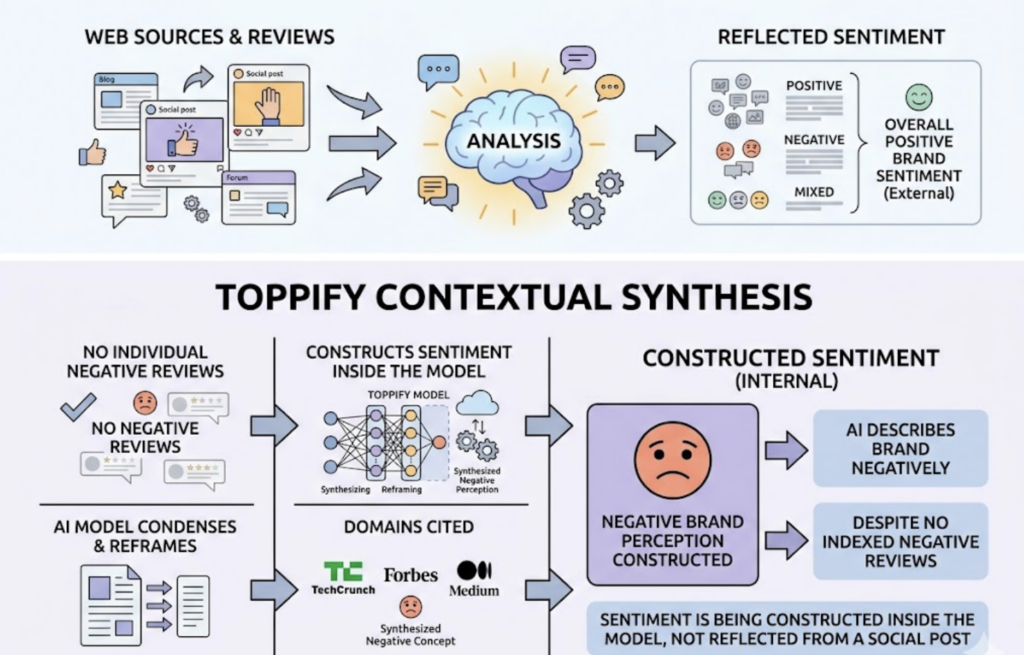
There’s also the contextual synthesis issue. AI models condense and reframe information. A brand can be described negatively without a single negative review existing on any indexed page. Sentiment is being constructed inside the model, not reflected from a social post.
This is why Search Influence’s research on AI search KPIs found that traffic metrics increasingly fail as a leading indicator. Citation authority in AI systems is becoming the metric that matters first.
The 4 Pillars of an Effective AI Brand Intelligence Strategy
A working strategy isn’t complicated, but it does require structure. Here’s how most teams that do this well actually organize their work.
1. Track: Build a prompt library, not a keyword list
The entry point isn’t monitoring your brand name. It’s curating a set of prompts that reflect real buyer behavior. Think: “What are the best alternatives to [competitor] for mid-market B2B?” or “Which [category] tools are recommended for enterprise compliance?”
If your brand doesn’t appear in those prompts, you’ve already lost that buyer. That’s what industry frameworks call the “category discovery” phase, and it’s where most AI brand intelligence efforts start too late.
2. Analyze: Go deeper than visibility counts
Appearing in AI answers is not the same as being recommended well. The Visiblie breakdown of AI brand sentiment tracking outlines a five-category sentiment spectrum. “Cautious” framing, where AI describes your brand as “affordable but lacking enterprise compliance,” can be more damaging to conversion than not being mentioned at all.
You need to know your visibility rate, your share of model (how often you appear relative to your top five competitors in a given category), and your CVR, which tracks whether AI visibility correlates with a lift in branded search traffic or direct conversions.
3. Act: Turn data into content and PR decisions
Intelligence without action is reporting. The “act” pillar is where AI brand intelligence strategy connects to real work: identifying which third-party domains AI is using to justify its recommendations, finding the gaps in your content that explain why AI describes your brand a certain way, and addressing those gaps with targeted content or earned media.
4. Measure: Track change over time, not just snapshots
AI models update continuously. A quarterly audit is obsolete by the time it’s delivered. Persistent, automated tracking is the only way to know whether your actions are moving your visibility score, sentiment framing, or share of model over time.
Common Mistakes That Break AI Brand Intelligence Efforts
Most teams that struggle with this aren’t doing it wrong in obvious ways. The failures tend to be subtle.
Tracking brand names instead of buying prompts. If you only monitor mentions of your brand name, you’re measuring awareness, not discovery. The prompts that matter are the ones buyers use before they’ve heard of you.
Treating any AI mention as a win. A mention with cautious or negative framing is often worse than no mention. Sentiment blindness is one of the most common and most costly gaps in AI brand monitoring.
Running static audits. AI model behavior shifts constantly. A one-time report captures a moment in time, not a trend. Without ongoing tracking, you can’t tell whether your optimization efforts are working.
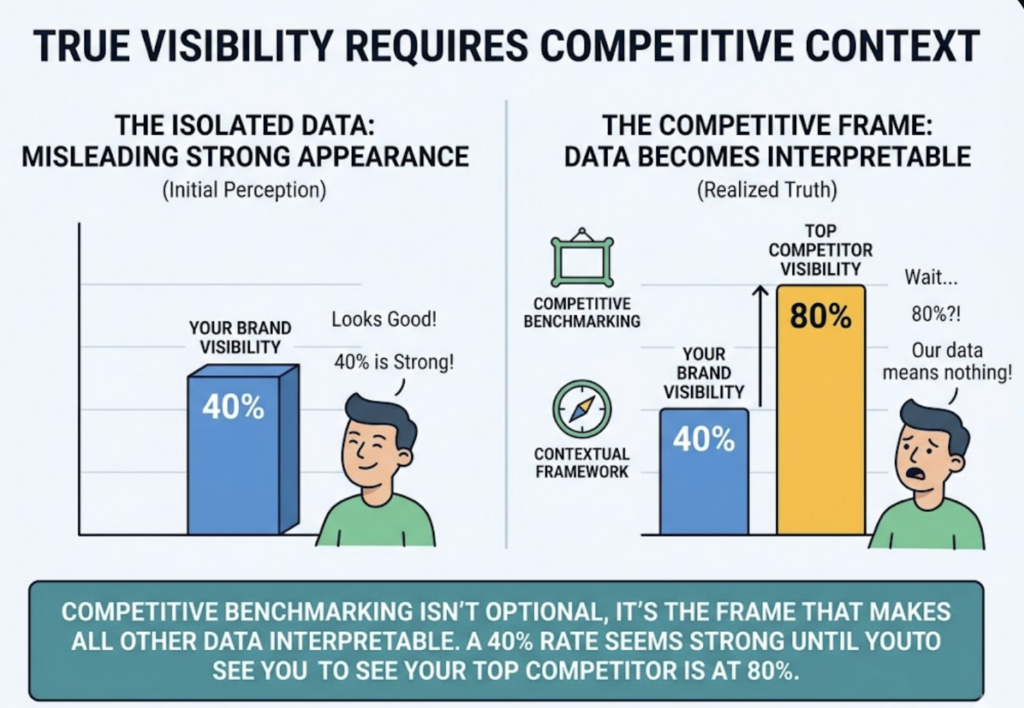
No competitive baseline. Visibility data means nothing without context. A 40% visibility rate looks strong until you see that your top competitor appears in 80% of the same prompts. Competitive benchmarking isn’t optional, it’s the frame that makes all other data interpretable.
Disconnecting data from execution. The teams that get real results from AI brand intelligence strategy are the ones with a clear line from insight to action. Data collection without an execution layer is expensive reporting.
How to Choose the Right AI Brand Intelligence Software
The category is young and crowded, and the product descriptions often sound identical. Here’s what to actually evaluate.
Platform coverage. Which AI engines does the tool query? ChatGPT and Perplexity are table stakes. Gemini, Google AI Overviews, DeepSeek, and regional platforms matter depending on your market. A tool that only covers two platforms will miss a significant portion of your AI search exposure.
Prompt customization. Can you define your own prompt library, or are you limited to the tool’s default queries? Custom prompts are non-negotiable for accurate intelligence.
Sentiment precision. Does the tool give you a binary positive/negative read, or does it capture nuanced framing? The difference between “market leader” and “strong for SMBs, less suitable for enterprise” is commercially significant.
Competitor depth. Knowing your own visibility rate without knowing how it compares to competitors leaves you without the context to interpret the number.
Execution layer. This is where most AI brand intelligence tools stop. They deliver data and leave the action to you. A platform that connects intelligence to optimization workflows cuts the time from insight to impact significantly.
Topify is one of the few platforms in this space that covers all five. It tracks brand visibility, sentiment, and position across ChatGPT, Gemini, Perplexity, DeepSeek, and other major AI platforms, with a prompt library you control. Its competitor benchmarking runs automatically, so you always see your share of model relative to your top rivals. And it includes a one-click execution layer that turns visibility gaps into content and optimization actions without manual workflows.
Topify’s pricing starts at $99/month for the Basic plan (100 prompts, 9,000 AI answer analyses across four projects) and scales to $199/month for the Pro plan (250 prompts, 22,500 analyses). For teams that want managed GEO execution alongside the platform, full-service plans start at $3,999/month. You can review all options at Topify Pricing.
For teams evaluating an AI brand intelligence tool, software, or dashboard, Topify’s combination of cross-platform tracking, sentiment depth, and execution layer is what separates it from lighter monitoring solutions.
AI Brand Intelligence Strategy: Implementation Checklist
A practical starting point, organized by phase.
Setup
- Define your prompt library: 20-50 queries reflecting real buyer behavior in your category
- Identify your top five competitors for benchmarking
- Select the AI platforms most relevant to your audience
- Establish baseline metrics: visibility rate, sentiment score, share of model
Tracking
- Run automated queries across all target platforms weekly or more frequently
- Track both branded prompts and category-discovery prompts
- Log competitor visibility alongside your own
Analysis
- Review sentiment framing, not just visibility counts
- Map which sources AI is citing when it recommends brands in your category
- Identify prompts where competitors appear and you don’t
Optimization
- Create or update content targeting identified citation source gaps
- Pursue earned media placements on high-authority domains AI references
- Adjust product messaging where AI framing is consistently cautious or negative
Reporting
- Track week-over-week and month-over-month changes in visibility rate and share of model
- Correlate AI visibility shifts with changes in branded search traffic or CVR
- Report at the prompt level, not just the aggregate
Conclusion
AI brand intelligence strategy isn’t a future-proofing exercise. It’s a response to a shift in how buyers discover brands that’s already happening.
The brands showing up consistently in AI recommendations aren’t getting there by accident. They’ve built a structured system: a curated prompt library, cross-platform tracking, sentiment analysis, competitive benchmarking, and an execution layer that turns data into action.
The tools exist. The framework is clear. The question is whether your organization has a system in place, or whether you’re still relying on a social listening tool to tell you what AI is saying about your brand.
It won’t.
FAQ
What is AI brand intelligence strategy?
AI brand intelligence strategy is a systematic framework for tracking, analyzing, and optimizing how AI platforms, including ChatGPT, Gemini, and Perplexity, represent and recommend a brand. It covers four core dimensions: visibility (how often a brand appears), sentiment (how it’s framed), position (how it ranks relative to competitors), and source attribution (which domains AI cites as evidence).
How does AI brand intelligence strategy work?
The process involves curating a prompt library that reflects real buyer behavior, running those prompts against major AI platforms at regular intervals, analyzing the results for visibility rate, sentiment, and share of model, and then using those insights to guide content, PR, and optimization decisions. Automated platforms like Topify handle the querying and analysis layer, freeing teams to focus on execution.
How do you measure AI brand intelligence strategy?
The three most meaningful metrics are: visibility rate (percentage of target prompts where your brand appears), share of model (your frequency relative to top competitors in the same prompt set), and CVR, which tracks whether improved AI visibility correlates with a lift in branded search traffic or direct conversions.
What are the best tools for AI brand intelligence strategy?
The most capable AI brand intelligence platforms cover multiple AI engines, support custom prompt libraries, provide sentiment analysis beyond binary positive/negative readings, and include competitive benchmarking. Topify covers all of these and adds a one-click execution layer. Get started here.
How much does AI brand intelligence software cost?
Platform pricing in this category typically starts around $99/month for basic tracking (Topify Basic: 100 prompts, 9,000 AI answer analyses). Professional plans with higher prompt volume and more projects run around $199/month. Full-service GEO programs that include managed execution start higher, often $3,999/month and up.