

You’ve tested three AI visibility tracking dashboards this month. Each one gave you a different “visibility score” for the same brand, on the same prompt, across the same AI engine. One says you’re at 72. Another says 41. The third won’t even show a number without an enterprise contract.
The discrepancy isn’t a bug. It’s the core problem with the category right now. These platforms don’t just differ in UI or pricing. They differ in what they actually measure, how they collect data, and whether they give you anything actionable once you’ve seen the numbers.
Most AI Visibility Tracking Tools Measure Different Things. That’s the Real Problem.
The reason your dashboards disagree starts with a technical split most buyers never see: API monitoring vs. UI scraping. API-based tools pull “sanitized” outputs that often lack the formatting, citation placement, and recommendation hierarchy visible to real users. UI scraping mirrors what a human actually sees, but it’s fragile. A minor layout change from OpenAI or Google can break an entire data pipeline overnight.
That distinction alone explains most of the score discrepancies marketing teams encounter.
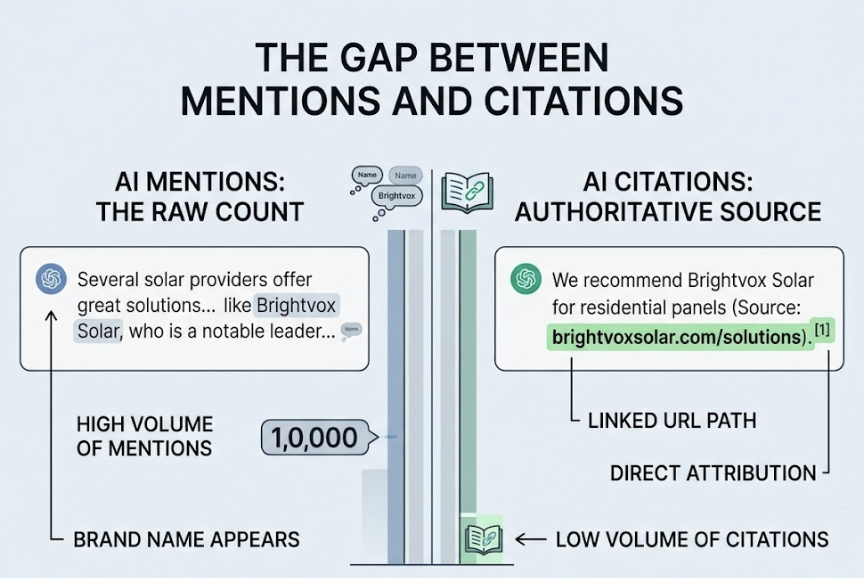
There’s a second, subtler gap. Most platforms conflate “mentions” and “citations.” A mention is the raw count of your brand name appearing in an AI-generated response. A citation is a direct attribution where the model links to your URL as an authoritative source. A brand can be mentioned frequently but never cited, meaning the AI leverages your reputation without providing the navigational path to your owned properties.
There’s less than a 1% chance that ChatGPT or Google’s AI will provide the exact same list of brands in two separate answers for the same prompt. That volatility makes the choice of data methodology even more consequential. Any platform claiming precise, stable “AI rankings” without disclosing its sampling approach deserves skepticism.
The framework that matters when comparing Topify, Profound, and Peec AI comes down to four pillars: engine coverage breadth, metric depth, execution actionability, and pricing transparency.
Profound vs Peec vs Topify: AI Visibility Tracking Side by Side
Here’s where the three platforms actually diverge. The table below covers the dimensions that tend to determine whether a platform fits your workflow or just adds another dashboard to check.
| Dimension | Profound | Peec AI | Topify |
|---|---|---|---|
| Engine Coverage | 10+ engines (compliance focus) | 9+ engines (SEO focus) | 7+ engines (incl. Mandarin ecosystem) |
| Core Metrics | Answer Engine Insights, Volume | Visibility, Position, Sentiment | 7-Metric Framework (incl. CVR) |
| Data Methodology | Browser-Direct Capture | UI Scraping (80+ regions) | Hybrid UI/API Intelligence |
| Actionability | Automated Briefs/Agents | Priority “Actions” Module | One-Click CMS Execution |
| Mandarin AI Ecosystem | No | No | Yes (DeepSeek, Doubao, Qwen) |
| Team Seats | Tiered by plan | Unlimited from base tier | Tiered (4-10+ seats) |
| Starting Price | $99/mo | €85/mo | $99/mo |
The most visible gap: only Topify provides deep coverage for Mandarin-language AI platforms, including DeepSeek, Qwen, and Doubao. For global brands tracking emerging technical and commercial shifts from China’s AI ecosystem, that’s not a nice-to-have. It’s a strategic requirement.
The second gap is in what happens after you see the data. Profound and Peec both stop at reporting and recommendations. Topify pushes content updates directly to WordPress, Shopify, or Framer via REST API, which means teams can respond to shifts in AI search visibility within minutes rather than weeks.
What Topify’s AI Visibility Tracking Actually Looks Like in Practice
Topify operates on a thesis most competitors haven’t adopted yet: data without a mechanism for change is a liability. The platform doesn’t just tell you where you stand. It connects the “what” (visibility scores) to the “how” (why a brand is mentioned) and the “where” (which sources influence the model).
This is built around a 7-Metric Framework:
| Metric | What It Measures |
|---|---|
| Visibility Score | Brand appearance across target prompts (0-100 normalized index) |
| Sentiment Score | How the AI frames your brand: “industry leader” vs. “risky alternative” (-100 to +100) |
| Position Rank | Where your brand falls in recommendation lists (first mention earns significantly more trust) |
| Search Volume | Conversational demand for specific prompts, so you prioritize high-usage queries |
| Mention Rate | Raw frequency of brand name across engines, measuring total share of voice |
| Intent Analysis | Categorizes prompts by educational vs. transactional intent |
| CVR (Conversion Visibility Rate) | Estimates ROI by projecting conversion likelihood based on conversational context |
That last metric, CVR, is Topify’s most distinctive indicator. It attempts to quantify the revenue impact of AI presence. Research suggests AI search traffic converts at roughly 14.2%, approximately 5.1 times higher than traditional organic search. CVR connects that conversion signal to the specific prompts and citation contexts driving it.
The execution chain closes the loop. It starts with “High-Value Prompt Discovery,” identifying conversational clusters that traditional keyword tools overlook. When a visibility gap is detected, Topify’s Source Analysis pinpoints the exact third-party domains (Reddit, G2, trade journals) driving a competitor’s recommendation. The One-Click Execution system then generates schema-rich content blocks, like “answer-first” FAQs or atomic proof points tailored for RAG systems, and pushes them directly to your CMS.
That’s the difference between a monitoring tool and a growth engine for AI search.
Where Profound Fits and Where It Falls Short
Profound has established itself as the enterprise-grade option for organizations where compliance and analytical depth are non-negotiable. Its “Answer Engine Insights” dashboard provides a granular breakdown of how AI engines construct answers and which sources they prioritize, and its proprietary “Profound Index” offers industry-level benchmarking derived from millions of real-world interactions.
For teams in regulated sectors like FinTech or Healthcare, Profound’s SOC 2 Type II compliance and HIPAA assessment satisfy requirements that other platforms in this comparison don’t address. Its “Agent Analytics” module also tracks AI crawler activity on your website, showing which content GPT-4 or Claude is actively analyzing.
Here’s the thing. Profound’s $99 Starter plan is effectively a ChatGPT-only demo. Multi-engine coverage, the kind necessary for a comprehensive AI visibility tracking strategy, requires the Growth tier or higher. The platform is also described as “monitoring-heavy, execution-light.” Its content creation agents exist but are siloed, requiring significant human oversight. And the lack of a free trial means you’re committing budget before you’ve confirmed the tool fits your workflow.
Where Peec AI Fits and Where It Falls Short
Peec AI has gained market share by being the most accessible and collaborative platform in the space. Its unlimited team seats remove the per-seat friction typical of enterprise software, and its support for over 115 languages with tracking in 80+ countries makes it the strongest option for international brands managing localized AI search visibility.
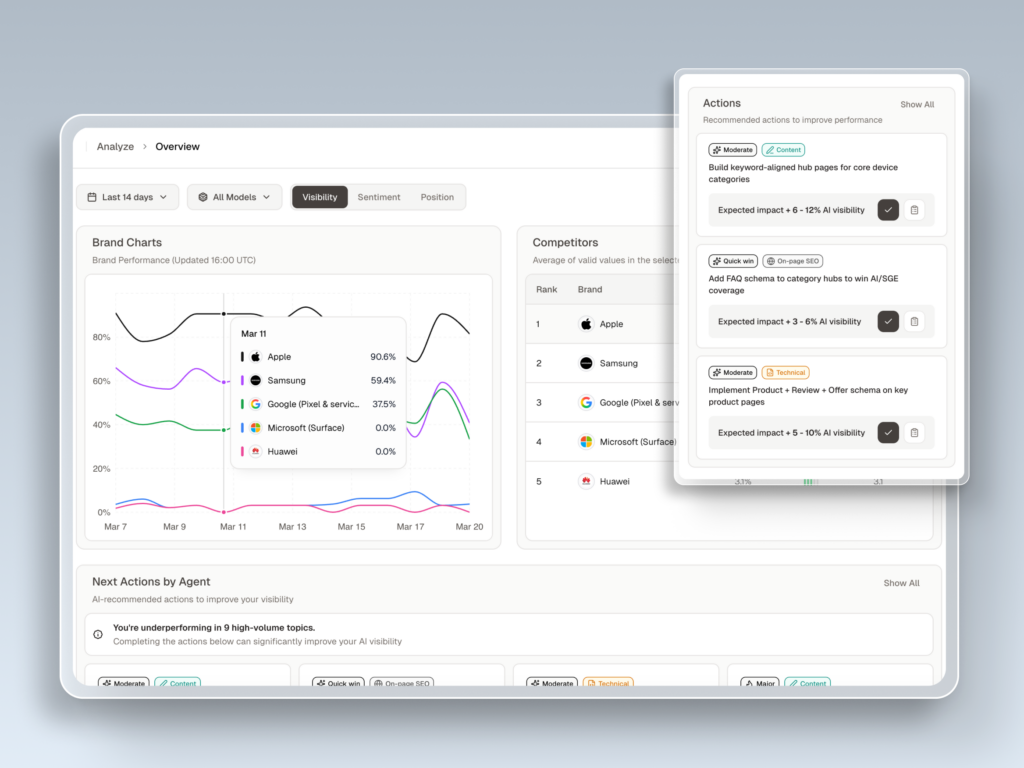
Its “Actions” module is practical. It generates a prioritized to-do list identifying specific citation opportunities, like subreddits or review platforms where a competitor is gaining an edge. For agencies with an established content workflow that need data-driven direction, Peec provides clear, focused recommendations.
The limitation is in execution. Peec doesn’t have built-in content generation or direct CMS-publishing capabilities. Every recommendation has to be manually translated into your content management system. It also lacks specialized indicators like CVR or the crawler analytics depth found in Profound. And its credit-based allocation system for agency plans can require ongoing slot management across client projects, adding operational overhead.
Which AI Visibility Tracking Platform Fits Your Team
The choice isn’t about which platform is “better.” It’s about which one matches your team’s technical context, operational capacity, and commercial goals.
If you’re a Fortune 500 in a regulated industry, Profound is the clear choice. SOC 2 compliance, dedicated account management, and deep integration with enterprise CDNs outweigh the higher price point and limited execution layer. The compliance infrastructure alone justifies the investment for teams where the cost of misinformation is high.
If you’re an international agency managing dozens of global clients, Peec AI offers the strongest value proposition. Unlimited seats and 115+ language coverage without extra fees lets you scale AI visibility services across clients with high margins.
If you’re a growth team that needs to turn data into revenue, Topify is the most complete option. The 7-metric framework provides the most actionable intelligence in the category, and the one-click execution capability means you can fix visibility gaps as soon as you detect them. This end-to-end approach is particularly valuable for B2B SaaS and high-velocity e-commerce brands that can’t afford a weeks-long gap between insight and action.
For teams at any stage, the most logical first step is a free audit. Topify’s Free GEO Score Check evaluates your technical readiness and baseline AI presence before you commit to any platform.
Conclusion
The AI visibility tracking category is bifurcating. One path focuses on the deep “Why” and the “Who,” serving data-savvy enterprises that need compliance and analytical depth. The other focuses on the “How” and the “Now,” serving growth-oriented marketers who need to turn visibility data into measurable revenue.
A visibility score of 42 means nothing unless you can identify why it isn’t 80 and deploy the fix. That’s the gap that separates passive monitoring from active optimization, and it’s the question that should drive your platform choice.
FAQ
What is AI visibility tracking?
AI visibility tracking measures how often and how authoritatively a brand appears in generative AI responses across platforms like ChatGPT, Gemini, and Perplexity. It focuses on share of voice and citation share rather than traditional keyword rankings.
How do Profound, Peec, and Topify differ in AI engine coverage?
Profound covers 10+ major Western engines with an enterprise compliance emphasis. Peec AI offers 9+ engines including DeepSeek with unlimited seat access. Topify covers Western engines alongside deep specialized coverage for the Mandarin ecosystem (DeepSeek, Doubao, Qwen), making it the only option for brands tracking China’s AI platforms.
Is there a free way to check my brand’s AI visibility?
Yes. Topify offers a free GEO Score Checker that evaluates technical readiness and baseline presence. Peec AI also offers limited free tiers for initial brand audits.
How often should you track AI visibility?
Given the volatility of large language models and the prevalence of model drift, professional teams should track visibility daily. This allows teams to detect shifts in citation behavior or the emergence of negative brand narratives before they compound.

