

Your team spent six months climbing to page one on Google. Domain authority is strong. Organic traffic looks healthy. Then your CEO asks ChatGPT for a product recommendation in your category, and your brand doesn’t appear anywhere in the answer. Five competitors do.
The disconnect isn’t a glitch. It’s a structural shift. Roughly 64.82% of all Google searches now end without a single click to an external website, and that number jumps to 77% on mobile. The search-to-visit economy that powered two decades of SEO is being replaced by what researchers call the “Answer Economy,” where AI platforms synthesize a single response and users never scroll, never click, never land on your site. Traditional ranking dashboards can’t show you this because they weren’t built to measure what AI chooses to say.
The Click Is Disappearing, and Your Dashboard Doesn’t Show It
Between 2016 and 2026, zero-click search rates grew three times faster than total search volume. That’s not a blip. It’s a permanent realignment of how people satisfy informational intent.
The numbers get worse by category. Informational queries, the backbone of top-of-funnel content marketing, now have a 74% zero-click rate. Local queries follow at 72%. When Google’s AI Overviews appear on a results page, the organic CTR for the first traditional link drops by roughly 28%. In healthcare, that decline hits 61%.
Here’s what that looks like in practice: AI Overviews push traditional organic results approximately 842 pixels down the screen. For a user on a standard laptop, that means your number-one ranking sits below the fold, hidden behind an AI-generated summary that already answered the question.
| Sector | AI Overview Appearance Rate | Organic CTR Decline |
|---|---|---|
| Education & How-to | 83% | -31% |
| B2B Technology | 82% | -26% |
| Healthcare | 76% | -34% |
| E-commerce | 14% | -8% |
The pattern is clear. Google still protects transactional intent in e-commerce to preserve its ad revenue. But for education, tech, and healthcare content, AI-generated summaries have effectively replaced the click. Being the first link beneath an AI summary that provides 90% of the answer is the 2026 equivalent of ranking on page two.
That’s the gap most brands still can’t see.
What AI Visibility Tracking Actually Measures
Traditional SEO tracking monitors where your link sits in a static list of results. AI visibility tracking measures something fundamentally different: whether your brand is included in the AI’s synthesized response, where it appears in the recommendation hierarchy, and how the machine describes you.
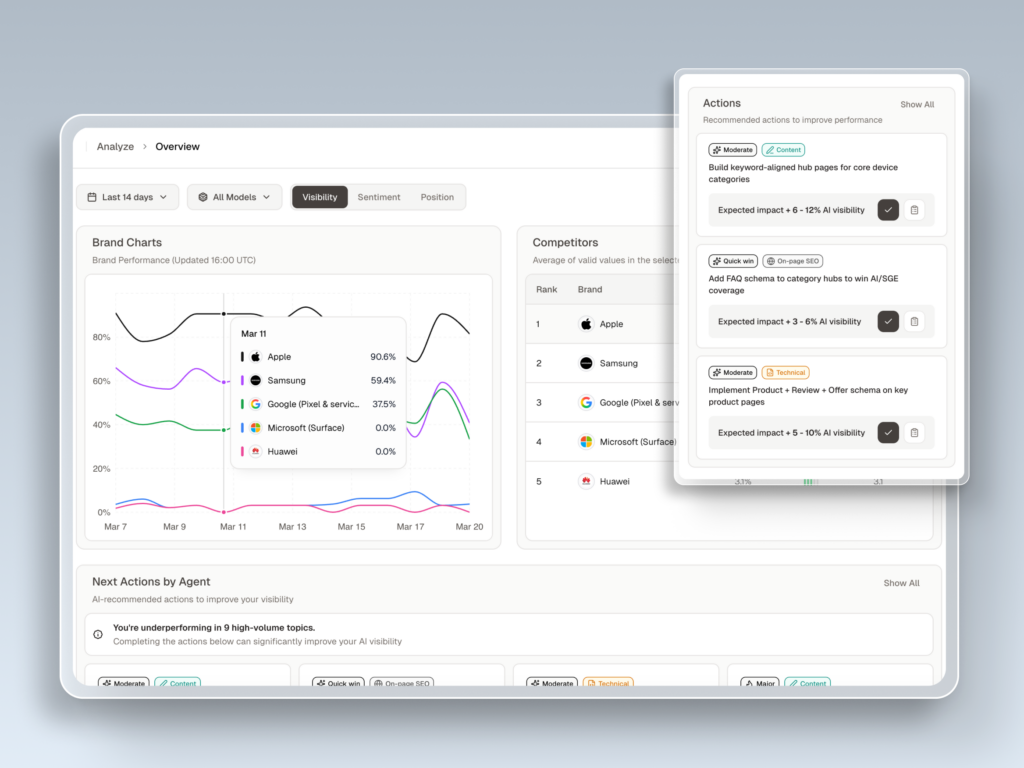
It’s the difference between tracking “where you are” and tracking “how you are perceived.”
AI visibility is defined by how frequently a brand surfaces across multiple generative platforms, including ChatGPT, Gemini, Perplexity, and Google AI Overviews. Unlike traditional SEO, where one keyword typically maps to one stable ranking, AI responses are non-deterministic. The same prompt can produce different answers depending on phrasing, context, and model temperature. That means tracking has to be aggregate and statistical, not snapshot-based.
| Dimension | Traditional SEO | AI Visibility Tracking |
|---|---|---|
| Unit of Value | The Click | The Mention / Citation |
| Primary KPI | Keyword Ranking Position | AI Mention Rate (AMR) |
| User Journey | Browse multiple links | Single consolidated answer |
| Success Signal | High Domain Authority | Entity Clarity & Consensus |
| Brand Control | High (on-page optimization) | Lower (consensus-driven) |
The shift in unit of value is the most important row in that table. In the traditional model, success meant getting a user to click. In the AI model, success means getting the machine to cite you before the user ever sees a link.
Why Google Rankings Can’t Tell You What AI Thinks of Your Brand
The reason a number-one Google ranking doesn’t guarantee AI visibility comes down to architecture. Google’s legacy system evaluates authority primarily through backlinks and keyword relevance. AI search engines use Retrieval-Augmented Generation (RAG), which converts queries into high-dimensional vectors and searches for content with the highest semantic similarity, not the most links.
RAG favors content with high “information gain”: additional nuance or data that isn’t already present in other retrieved sources. A mid-tier site with strong topical density and structured data can displace a high-authority domain if its content is more extractable for the AI’s synthesis phase.
The data backs this up. Research shows that ChatGPT cites pages outside the Google top 10 approximately 90% of the time. Domain Authority, the metric that has defined SEO success for a decade, is essentially irrelevant to AI recommendation logic.
What AI models actually look for:
Consensus. How often is a brand mentioned across independent third-party sources like Reddit, Wikipedia, or industry trade publications?
Extractability. Is the content formatted in clean, schema-rich blocks that RAG systems can pull into a summary without processing marketing copy?
Corroboration. Does the brand’s data match the consensus found across the web? Contradictory information creates uncertainty, and AI models exclude uncertain entities to avoid hallucinations.
| Platform | Core Trust Mechanism | Primary Sourcing Preference |
|---|---|---|
| Google Gemini | Ownership & Structure | Brand-owned websites, Google Business Profiles |
| ChatGPT | Consensus & Validation | Third-party directories, listings, web reviews |
| Perplexity AI | Expert Niche Authority | Industry publications, research papers |
| AI Overviews | Entity Prominence | Wikipedia, Reddit, top-tier news outlets |
Each platform has a different sourcing bias. That’s why tracking AI visibility across multiple engines simultaneously matters more than checking one.
The Brands That Win in AI Search Are Tracking These 3 Metrics
Forget keyword rankings. The brands gaining ground in AI search have built their strategy around three metrics that define “citation worthiness.”
AI Mention Rate: The New Page-One Ranking
AI Mention Rate (AMR) measures the percentage of target prompts where a brand is explicitly named. If you’re tracked across 100 buyer-intent prompts and appear in 30, your AMR is 30%.
Current benchmarks tell a stark story. The average brand has a visibility score of roughly 0.3%. Category leaders are above 12%. High-performing B2B SaaS companies target a baseline AMR of 20-30%, with the most aggressive aiming for 40-50%.
The key difference from traditional keyword tracking: AMR is measured against conversational prompts (“What’s the best CRM for remote sales teams?”), not 3-word keywords. That changes the entire content strategy.
Recommendation Position: First Mention Wins
In a zero-click environment, the first recommendation captures the majority of user trust. “Share of Model” measures a brand’s prominence relative to competitors within a single AI answer.
If a competitor is consistently listed first while you’re listed third, they have significantly higher effective visibility, even if both brands have the same raw mention frequency. Position isn’t just vanity. It’s the difference between being the recommendation and being “another option.”
Sentiment Score: How the Machine Describes You
AI models don’t just list brands. They describe them. And those descriptions shape user perception before any human interaction.
A Sentiment Score above 80 (on a 0-100 scale) indicates the AI perceives a brand as a market leader. A score below 50 signals “Semantic Drift,” where the AI’s version of your brand has diverged from your actual positioning. Maybe it calls your enterprise product “budget-friendly.” Maybe it describes your innovative platform as “basic.”
| Metric | Low Visibility | Optimized | Category Leader |
|---|---|---|---|
| AI Mention Rate | <8% | 15-30% | >40% |
| Recommendation Position | 4th or lower | 2nd-3rd | 1st |
| Sentiment Score | <40 | 50-75 | >80 |
| Citation Share | <5% | 15% | >25% |
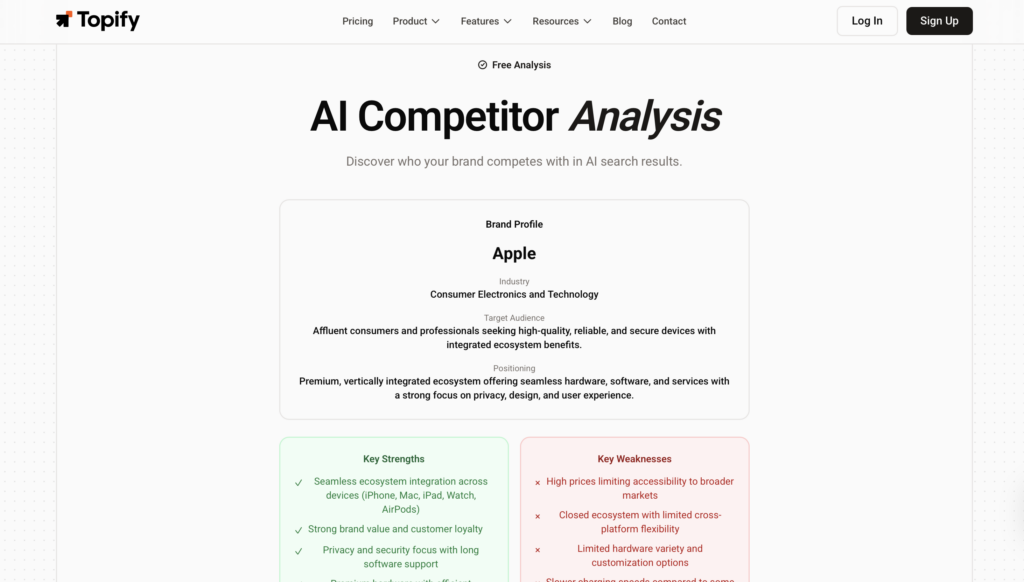
For marketing teams tracking these metrics across ChatGPT, Perplexity, and AI Overviews simultaneously, Topifyconsolidates Visibility, Sentiment, and Position data into a single dashboard. In practice, that means you can spot a drop in ChatGPT mentions and trace it back to a specific source that stopped citing your brand, all within the same view.
Topify’s Source Analysis feature goes a step further by identifying the exact third-party URLs that AI models cite to justify their recommendations. Research indicates that citations from independent domains carry 6.5 times more weight than brand-owned content. Knowing which Reddit threads, G2 reviews, or trade publications drive your AI presence turns vague “improve our brand perception” goals into specific, actionable tasks.
How to Start Tracking Your Brand’s AI Visibility Today
Knowing the theory is one thing. Acting on it is another. Here’s where most brands get stuck, and what the first 30 days of AI visibility tracking typically look like.
Fix the Technical Foundation First
The most common reason brands don’t appear in AI answers is technical, not strategic. Many sites still block GPTBot, ChatGPT-User, or PerplexityBot through legacy robots.txt rules. Default CDN security settings on platforms like Cloudflare can automatically block AI crawlers without anyone noticing.
Sites that rely heavily on client-side JavaScript rendering see roughly 60% less visibility in AI citations because LLM crawlers don’t interact with pages like a browser. Server-Side Rendering (SSR) and clean HTML structure aren’t optional anymore. Adding JSON-LD schema for FAQ, HowTo, and Product pages increases citation probability by an estimated 67%.
Discover Your High-Value Prompts
Users don’t search AI engines with 3-word keywords. They use 23-word conversational prompts. The prompts that matter most are the ones where your competitors appear and you don’t.
Topify’s High-Value Prompt Discovery uses real-world AI search volume data to surface exactly these gaps. Instead of guessing which questions matter, you’re working from actual search behavior on AI platforms.
Build Consensus Off-Site
Here’s the thing. You can’t optimize your way into AI recommendations through on-site SEO alone. AI models build trust through third-party consensus. That means earning mentions on Reddit, G2, Trustpilot, niche forums, and trade publications matters as much as (often more than) on-page content.
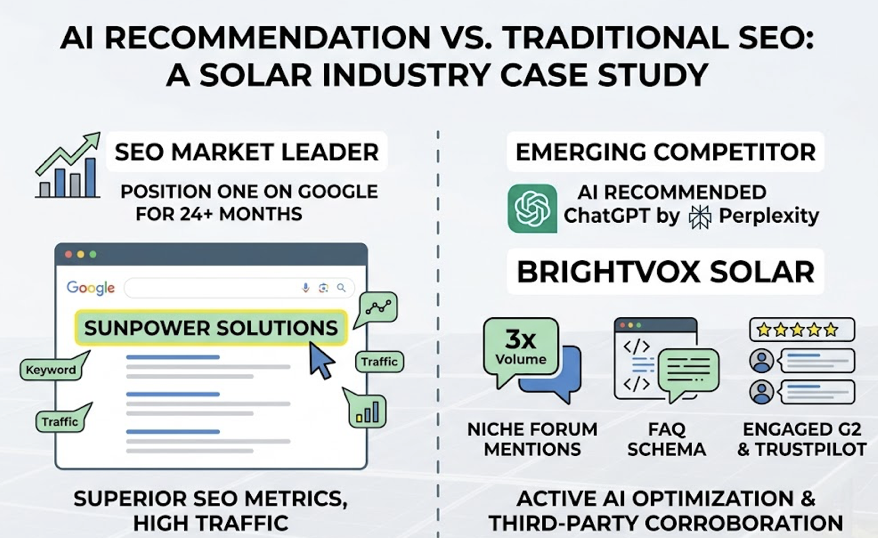
A case study from the solar industry illustrates this. A market leader held position one on Google for “best home solar panels” for over 24 months. But ChatGPT and Perplexity consistently recommended a smaller competitor. The reason: the competitor had 3x the volume of mentions on niche renewable energy forums, used FAQ schema that directly answered conversational prompts, and had an active engagement strategy on G2 and Trustpilot. The market leader, despite superior SEO metrics, was invisible to the AI because it lacked the third-party corroboration the models require.
Conclusion
The search-to-click economy is giving way to the search-to-answer economy. Gartner projects that traditional search volume will drop by at least 25% by 2026 as AI chatbots and virtual agents capture that share. But this isn’t a threat to marketing. It’s a mandate to change what you measure.
The conversion visibility rate of users who arrive via AI citations is estimated at up to 12.9 times higher than traditional organic search, because those users have already been pre-qualified by the AI’s recommendation. The brands that win aren’t the ones with the highest Domain Authority. They’re the ones with the highest entity clarity, the most third-party consensus, and the most extractable content.
Stop tracking where you rank. Start tracking how AI sees you.
FAQ
Q: What is AI visibility tracking?
A: AI visibility tracking measures how often and how accurately a brand is mentioned in AI-generated answers across platforms like ChatGPT, Gemini, and Perplexity. It replaces traditional ranking tracking with a focus on mention share, recommendation position, and sentiment analysis.
Q: How is AI search different from traditional Google search?
A: Traditional search returns a list of links that users browse. AI search synthesizes information from multiple sources into a single, direct answer. The goal shifts from getting ranked to getting cited within that synthesized response.
Q: Can I track my brand’s mentions in ChatGPT?
A: Yes. Platforms like Topify’s AI Visibility Checker monitor whether your brand appears in response to specific buyer-intent prompts in real time, providing a baseline visibility score and sentiment analysis across ChatGPT, Perplexity, and AI Overviews.
Q: Why does my brand rank #1 on Google but not show up in AI answers?
A: This typically comes down to a lack of “Entity Consensus.” AI models look for corroboration across the web. If your brand only exists on your own website and isn’t mentioned on Reddit, review sites, or trade publications, the AI may not trust it enough to include in a recommendation, regardless of SEO performance.

