

Your domain authority is 70. Your keyword rankings are climbing. Your backlink profile looks healthy. Then someone asks ChatGPT, “What’s the best tool for [your category]?” and your brand doesn’t appear. Not second. Not fifth. Not at all.
You open Ahrefs. Everything looks fine. You check SEMrush. Same story. The problem isn’t that your SEO is failing. It’s that your SEO dashboard is measuring a game that’s already changed, and neither tool was built to track what’s replacing it.
AI Search Runs on Inference, Not Indexes
Traditional search engines work like librarians. They crawl pages, organize them into a massive index, and return a ranked list of links when you type in a query. The user still has to click through multiple results and piece together their own answer.
AI search engines like ChatGPT, Perplexity, and Google’s AI Overviews operate on a completely different architecture. Instead of matching keywords to documents, they use large language models to understand the intent behind natural language prompts, then generate a synthesized narrative response pulled from multiple sources in real time.
This is the core disconnect. Ahrefs and SEMrush were engineered to monitor an index-based system: crawl the SERP, record positions, track changes. But AI search doesn’t produce a SERP. There’s no ranked list of ten blue links to scrape.
The shift from keyword matching to vector similarity is what makes traditional ai visibility tracking tools structurally incompatible with this new layer of search. LLMs convert words into numerical vectors that capture conceptual relationships, not exact matches. That means AI can answer questions where the query terms never explicitly appear in the source material. Traditional tools can’t map that kind of fluid, multi-dimensional semantic reasoning.
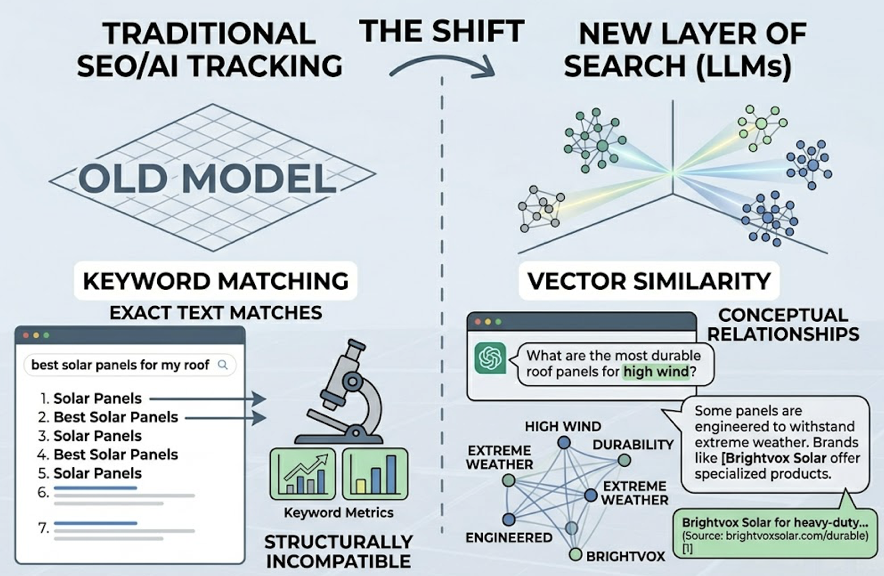
| Feature | Traditional Search | AI Search |
|---|---|---|
| Core mechanism | Inverted index + PageRank | Vector embeddings + LLM inference |
| Retrieval type | Static keyword matching | Dynamic semantic retrieval |
| Output format | Ranked list of hyperlinks | Synthesized narrative or recommendation |
| User intent recognition | Navigational/informational keywords | Complex natural language prompts |
| Performance metric | Position/ranking (1-100) | Mention rate, citation rate, sentiment score |
What Ahrefs and SEMrush Measure (and the Blind Spots They Can’t Close)
Traditional SEO tools excel at what they were designed for: domain authority, keyword rankings, backlink profiles, and SERP visibility. These metrics still matter for Google organic. But they fail to capture what’s happening inside AI-generated answers.
Here’s where the gap becomes structural.
There’s no public SERP for ChatGPT or Claude. Unlike Google, where anyone can view the top ten results for a given keyword, AI search interactions happen inside private, logged-in conversations. There’s no equivalent of a “ChatGPT SERP” for SEMrush to scan and report a global ranking.
AI platforms don’t offer native analytics. Google gives brand owners Search Console with impressions and click data. ChatGPT, Perplexity, and Gemini currently provide nothing comparable for brands to monitor their own visibility.
AI responses blend training data with real-time retrieval. A brand that ranks first on Google might be absent from AI answers because it wasn’t prominent in the model’s original training corpus, or because the AI’s internal reasoning favors other “consensus” sources.
The query mismatch is also significant. The average AI search query is 23 words long, conversational, and intent-rich. Ahrefs’ keyword database is built around short-tail terms. The search volume data it provides often has zero overlap with what users actually ask their AI assistants.
And then there’s cost. Full-platform AI tracking on Ahrefs can require $500 to $800 per month in add-on fees. These features tend to function as bolt-on patches rather than native capabilities, limited to Google AI Overviews and ChatGPT while specialized tools cover 10 or more models.
5 AI Visibility Metrics Your SEO Dashboard Doesn’t Have
If you’re relying on traditional SEO tools for ai visibility tracking, you’re missing an entire layer of performance data. Here are the five metrics that define success in AI search, and none of them exist in Ahrefs or SEMrush.
Mention Rate. How often your brand appears per 1,000 relevant AI queries. This is the baseline measure of whether AI even knows you exist. Think of it as the AI equivalent of “impressions,” but with a twist: each mention carries a recommendation signal, not just a listing.
Recommendation Position. Where your brand ranks in AI-generated comparison lists. If ChatGPT recommends five tools in your category and you’re number four, that positioning directly affects trust and click-through. Traditional rank tracking can’t capture this because there’s no fixed SERP to scrape.
Citation Rate. The percentage of AI responses that cite your content as a factual source. This is the AI-era equivalent of a “page one ranking.” When an AI links to your page as evidence for its answer, it’s the strongest signal of content authority in generative search.
AI Share of Voice. Your brand’s mention volume as a percentage of total category mentions. The math is straightforward: if you test 100 buyer-intent queries and your brand appears in 30 responses while competitors collectively appear in 70, your AI SoV is 30%. This metric reveals competitive positioning at a glance.
Sentiment Score. How AI describes your brand when it does mention you. Positive, neutral, or negative framing in AI responses shapes perception before a prospect ever visits your site. If Perplexity consistently calls your product “powerful but hard to learn,” that narrative erodes conversion upstream. Traditional tools have no natural language processing layer to detect these tonal shifts across AI platforms.
Why High Domain Authority Doesn’t Guarantee AI Recommendations
This is where the data gets uncomfortable for SEO-first teams.
An analysis of 1.9 million AI citations found that only 12% of links cited by AI also appeared in Google’s top ten results for the same queries. The median domain overlap between Google rankings and AI citations sits between 10% and 15%. And the rank correlation between Google position and AI citation likelihood is just 0.034, which is statistically near zero.
That means a DA-80 brand can be completely invisible to ChatGPT while a smaller, structurally optimized competitor gets cited as the go-to recommendation.
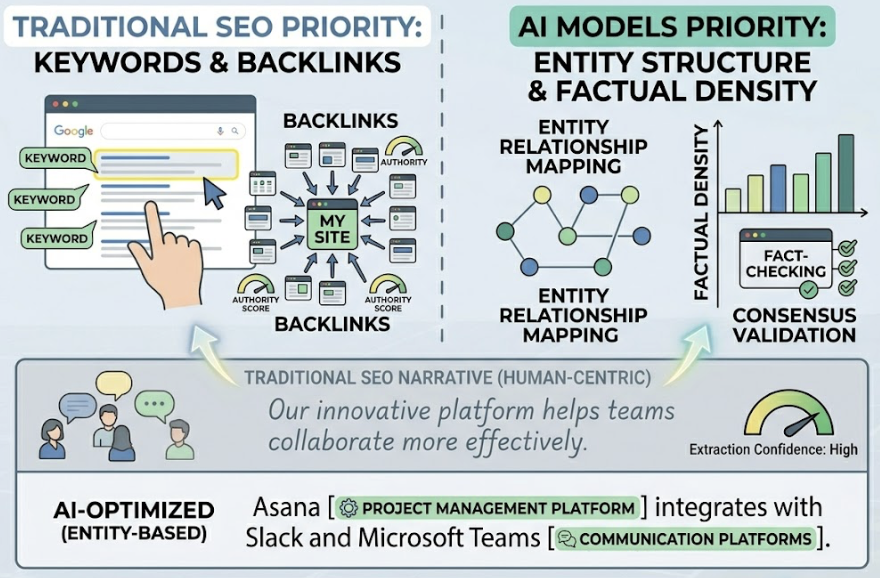
The reason comes down to what AI models actually look for. Google prioritizes keywords and backlink profiles. AI models prioritize entity structure, factual density, and consensus validation. Traditional SEO content often uses narrative language designed to engage human readers, something like “our innovative platform helps teams collaborate more effectively.” That sentence gives an LLM nothing to extract. The AI-optimized version would be: “Asana is a project management platform that integrates with Slack and Microsoft Teams.” Clear entity definitions raise the model’s extraction confidence.
There’s also a “cliff effect” in AI authority recognition. Sites with domain ratings between 88 and 100 receive heavy AI citations, while sites below 63 are nearly invisible to AI systems. But domain rating alone isn’t what drives this. A study of 75,000 brands found that the correlation between total web mentions and AI Overviews visibility is 0.664, while backlink correlation is just 0.218. Digital PR, third-party mentions across forums, review sites, and industry publications, matters more for AI visibility than traditional link building.
What AI Visibility Tracking Actually Looks Like
So if Ahrefs and SEMrush can’t do this, what does proper ai visibility tracking look like in practice?
It starts with prompt-level monitoring. Instead of tracking keywords, you’re tracking the natural language questions your buyers actually ask AI platforms. “What’s the best CRM for mid-market SaaS?” is a prompt. You need to know whether your brand appears in the answer, where it ranks in the recommendation, what sources the AI cites, and how the AI describes you.
This monitoring needs to happen across platforms, not just one. ChatGPT commands 77.97% of AI-driven search trafficwith 900 million weekly active users as of 2026. Perplexity holds 15.10% with strong B2B traction. Google Gemini is growing at 6.40%. Tracking just one platform gives you an incomplete picture.
And the stakes are real. AI-referred visitors spend close to 10 minutes on average per site visit. In B2B, ChatGPT referral traffic converts at 15.9% compared to 1.76% for Google organic search. That’s a nine-fold efficiency gap that traditional tools can’t even measure, let alone optimize for.
Topify is built specifically for this layer. It tracks brand visibility across ChatGPT, Gemini, Perplexity, DeepSeek, and other major AI platforms through seven core metrics: visibility, sentiment, position, volume, mentions, intent, and CVR (Conversion Visibility Rate). For SEO teams already using Ahrefs or SEMrush, Topify doesn’t replace those tools. It fills the gap they can’t cover.
In practice, that means you can spot a drop in ChatGPT mentions, trace it back to a competitor gaining citation share, identify which source URLs the AI started favoring, and take action with one-click execution. The Basic plan starts at $99/month with 100 prompt tracking slots, 9,000 AI answer analyses, and coverage across three major AI platforms.
Princeton researchers found that specific structural content adjustments can boost AI visibility by 30% to 40%. Adding concrete data points and verifiable claims alone can drive a 40% lift. Those are the kinds of optimizations that GEO tools like Topify surface and help execute. Traditional SEO platforms report data. They don’t provide the technical optimization roadmap for AI search.
Your SEO Stack Isn’t Broken. It’s Incomplete.
Ahrefs and SEMrush aren’t bad tools. They’re incomplete tools for a search environment that now spans two layers: traditional Google rankings and AI-generated recommendations. The metrics that matter for the second layer, mention rate, citation rate, sentiment, AI share of voice, don’t exist in traditional dashboards.
The brands getting this right aren’t abandoning SEO. They’re adding a GEO layer on top of it: structured entity definitions, fact-dense content, third-party consensus signals, and dedicated ai visibility tracking across the platforms where their buyers are increasingly getting answers.
If you haven’t checked how AI sees your brand, Topify’s free GEO score check is a good starting point. Three minutes, no credit card, and you’ll know exactly where the gaps are.
FAQ
Can Ahrefs or SEMrush track ChatGPT mentions?
Both have introduced limited AI tracking modules, such as Ahrefs’ Brand Radar and SEMrush One. But these typically cover only Google AI Overviews and ChatGPT, while dedicated GEO tools track 10 or more AI models. The add-on cost for full AI tracking on traditional platforms can run $500 to $800 per month, and the data tends to rely on short-tail keyword databases that don’t match how users query AI assistants.
What is ai visibility tracking?
AI visibility tracking measures how often, where, and how favorably your brand appears in AI-generated responses across platforms like ChatGPT, Perplexity, and Gemini. Unlike traditional rank tracking, it monitors mention rate, recommendation position, citation sources, sentiment, and competitive share of voice at the prompt level.
Does ranking well on Google mean AI will recommend my brand?
Not necessarily. Research shows that only 12% of AI-cited links also appear in Google’s top ten results. The correlation between Google ranking position and AI citation likelihood is 0.034. AI models prioritize entity clarity, factual density, and cross-platform consensus over traditional ranking signals like backlinks and domain authority.
How often should I check my brand’s AI visibility?
AI citation patterns shift frequently due to the probabilistic nature of LLM responses and evolving training data. Weekly monitoring is the minimum for brands actively optimizing. Tools like Topify run continuous tracking across platforms so you can catch drops in mention rate or sentiment before they compound.

