

Your team spent six months building domain authority, earning backlinks, and climbing Google rankings. Then a potential customer asked ChatGPT, “What’s the best CRM for a 50-person sales team?” and got five recommendations. Your brand wasn’t one of them.
The gap isn’t in your SEO strategy. It’s in what AI search engines actually look for. And for SaaS brands, the data is clear: category authority now drives more AI search visibility than brand recognition ever could.
Most SaaS Brands Are Optimizing for the Wrong Signal in AI Search
Here’s the disconnect. Most SaaS marketing teams still treat branded search volume as their north star. More people searching your company name should mean more visibility, right?
Not in AI search. 50% of software buyers now start their journey inside an AI chatbot, a figure that jumped 71% in just four months in late 2025. And when they do, they’re not typing your brand name. They’re asking questions like “best project management tool for remote engineering teams” or “which CRM integrates with Slack.”
These are category queries. And if your brand hasn’t built authority around the category, AI simply won’t mention you.
The numbers make this harder to ignore. Traditional organic search already had a zero-click problem, with rates between 34% and 58.5%. In AI search, that number hits 83% for AI Overviews and 93% in AI Mode. Organic click-through rates have dropped 61%. The window where a user might discover you through a blue link is shrinking fast.
That’s the shift most SaaS teams haven’t internalized yet.
How AI Engines Decide Which SaaS Products to Recommend
Understanding why category beats brand starts with how AI search actually works under the hood. Unlike Google’s traditional algorithm, which scores URLs based on backlinks and keyword relevance, AI engines score concepts and entities.
When someone asks Perplexity “What’s the best analytics platform for e-commerce?”, the system doesn’t look up which brand has the highest domain authority. It runs a retrieval process called RAG, or Retrieval-Augmented Generation. The query gets converted into a semantic vector. The system then scans billions of text fragments across the web, Reddit, G2, and other sources to find the most relevant chunks. Those chunks are re-scored based on how directly they answer the specific constraints of the query. Finally, the LLM synthesizes a response and cites the sources that contributed the most useful information.
For SaaS brands, this means one thing: your content needs to be machine-readable and fact-dense. Marketing copy that buries product capabilities inside vague narratives gets filtered out during retrieval. The AI can’t extract what it can’t parse.
There’s a technical layer here too. Research shows that 42% of JavaScript-rendered content is never indexed by AI crawlers, and client-side sites rank 67% lower than server-rendered alternatives. If your product pages rely on heavy JavaScript without server-side rendering, AI engines may not even see your content. Brands implementing structured data like SoftwareApplication and FAQPage schema see 2-3x higher citation rates.
Why Niche SaaS Players Often Outrank Market Leaders in AI Search
You’d expect AI models to favor Salesforce, HubSpot, and other household names. The data tells a different story.
AI search engines show an overwhelming preference for third-party, authoritative sources over brand-owned content. In software verticals, earned media (reviews, press, community mentions) accounts for 69% to 82% of AI citations, compared to just 36-45% in traditional Google results. Brand-owned content, on the other hand, often contributes less than 9.1% of citations on platforms like Claude. Reddit and community sources make up 46.7% of Perplexity’s top-cited domains.
This is the earned media advantage. And it structurally favors niche players.
A focused SaaS brand that dominates G2 reviews, gets mentioned in three independent trade publications, and has active Reddit threads about its use case will often outrank a market leader whose AI footprint is mostly its own blog. The AI builds its recommendation from consensus across sources, not from a single brand’s self-description.
The case studies back this up. SoWork, an AI-powered Digital HQ, started with a 16.6% AI visibility score. By shifting to structured, fact-dense content and fixing technical grounding issues, they reached 100% visibility across seven AI engines in 90 days. A $25M ARR project management SaaS moved from an 8% citation rate to 24% by rewriting pages to open with concise factual answers instead of keyword-stuffed copy.
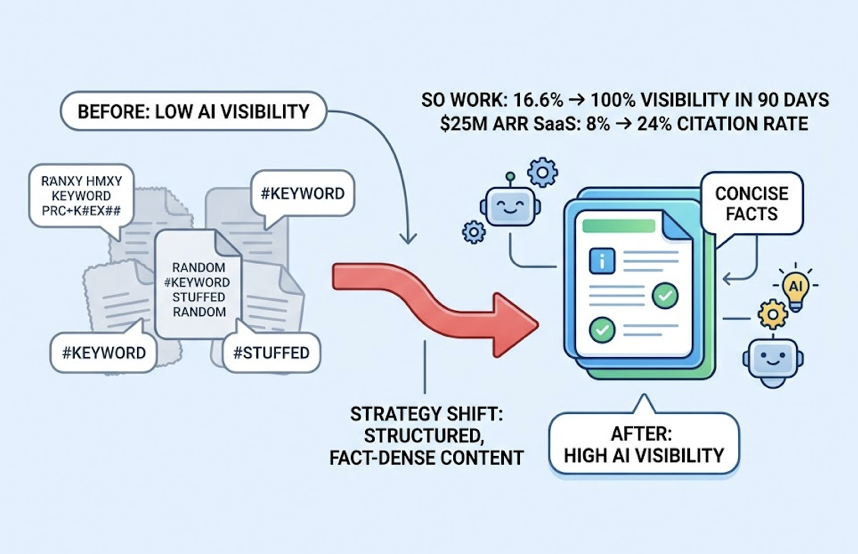
Category focus beats brand size when the evidence ecosystem supports you.
3 Category Signals That Actually Drive AI Search Visibility
Research from Princeton University, Georgia Tech, and the Allen Institute for AI identified nine specific optimization methods for Generative Engine Optimization. Three of them have the most direct impact on category visibility for SaaS brands.
Signal 1: Citations to Authoritative Sources
When your content references third-party data, research papers, or industry reports, AI engines treat your claims as more credible. The research found that integrating authoritative citations into content increases the probability of being cited by AI platforms by up to 40%.
This is the “credibility chain” at work. If you cite a Gartner report or a peer-reviewed study, the AI perceives your page as a higher-quality source, not just for the data point, but for the surrounding claims as well.
Signal 2: Statistics and Original Research
Numbers are highly cite-worthy for LLMs. The Princeton study found that adding relevant statistics improved AI visibility by 37%. Models are 22.6% less likely to cite sentences without numbers where a human reader would expect proof.
SaaS companies that publish proprietary benchmarks, original surveys, or product usage data create what researchers call “information gain.” It’s new data the AI can’t find anywhere else, which makes your content the primary source for that category insight.
Signal 3: Expert Quotations and Attribution
Including direct quotes from recognized industry figures boosted visibility by 30% to 41%, the highest improvement factor among all tested GEO methods. AI models recognize named individuals and organizations as high-value entities during synthesis. Attributed expertise signals that your content isn’t just opinion. It’s validated.
For SaaS brands, this means guest contributions from analysts, customer quotes with real names, and co-authored research all carry measurable weight in AI recommendations.
How to Audit Your Brand’s Category Visibility in AI Search
Tracking Google rankings won’t tell you where you stand in AI search. SaaS teams need a different framework: one built around citation rate, share of voice, and prompt-level visibility.
A category audit typically follows four steps.
Step 1: Money Prompt Discovery. Identify 20 to 50 conversational questions your buyers actually ask. Not keyword phrases, but full natural-language prompts like “Which CRM has the best Slack integration for a team of 50?” These are the queries where AI search visibility matters most.
Step 2: Baseline Measurement. Run those prompts across multiple AI engines (ChatGPT, Gemini, Perplexity, Claude) with multiple regenerations to capture variance. A single test isn’t enough. AI responses shift between sessions.
Step 3: Gap Diagnosis. Determine whether the problem is structural (AI can’t parse your site), authority-based (no third parties cite you), or sentiment-driven (AI mentions you, but negatively).
Step 4: Targeted Execution. Deploy optimizations directly to the gaps you’ve identified, whether that’s adding FAQ schema, generating community content, or rewriting product pages for information density.
Platforms like Topify compress this process into a single dashboard. Topify tracks seven distinct metrics across AI platforms: Visibility (cross-platform mention rate), Sentiment (0-100 brand perception score), Position (where you rank in AI responses), Source Coverage (which domains cite you), AI Volume (monthly demand within AI platforms), Intent Alignment (whether AI recommends you for the right use cases), and Conversion Visibility Rate (predictive interaction likelihood).
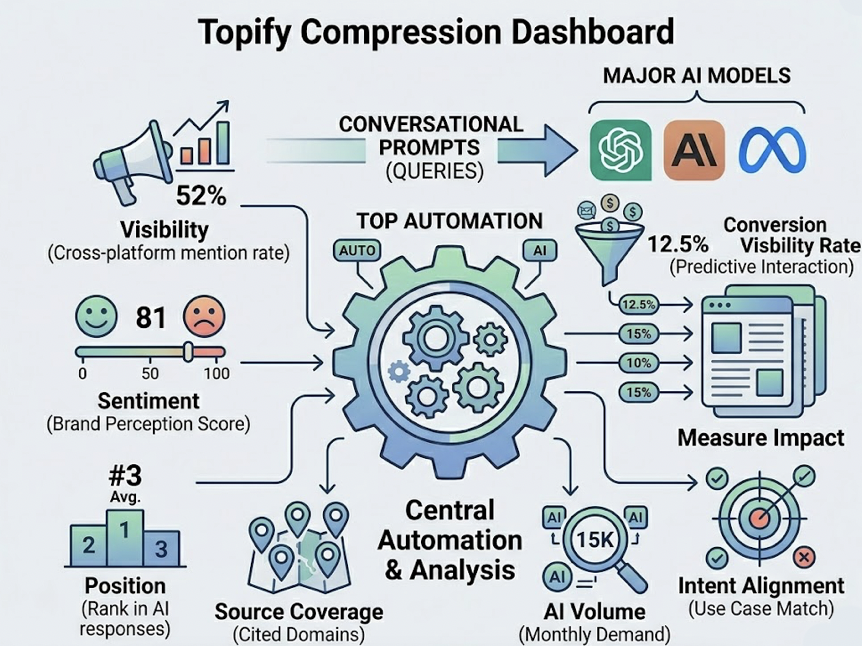
For SaaS teams running this audit manually, the process can take weeks. With Topify’s Prompt Discovery and Competitor Monitoring, you can identify category-level gaps, benchmark against rivals, and track changes across AI engines from one place.
Only 20% of brands stay visible across multiple consecutive AI sessions without active optimization. That stat alone makes continuous auditing non-optional.
Conclusion
The brands winning in AI search aren’t the ones with the biggest ad budgets or the most backlinks. They’re the ones that own their category.
AI engines don’t search for your brand. They search for answers to category problems. And the data is consistent: earned media outweighs owned content in citations, niche players routinely outrank incumbents, and fact-dense, structured content gets retrieved while marketing copy gets filtered out. With AI referral traffic converting at rates between 12.4% and 16.8% (compared to 2.8% for traditional organic), the ROI of category visibility is already measurable.
The shift from brand-first to category-first isn’t optional. It’s structural. SaaS teams that audit their category visibility now and invest in the signals AI engines actually prioritize will define the next generation of market leaders.
FAQ
Q: What is AI search visibility for SaaS brands?
A: AI search visibility measures how often and how favorably your SaaS product appears in AI-generated responses when users ask category-level questions on platforms like ChatGPT, Perplexity, and Gemini. Unlike traditional SEO rankings, it’s driven by citation frequency, source authority, and semantic relevance to the user’s prompt.
Q: Does brand awareness help with AI search visibility?
A: Brand awareness alone doesn’t guarantee AI visibility. AI engines prioritize third-party citations, structured content, and category relevance over brand recognition. A well-known brand with weak category signals can be outranked by a niche competitor that dominates reviews, community mentions, and fact-dense content.
Q: How do I find which category keywords matter most for AI search?
A: Start by identifying the natural-language questions your buyers ask when evaluating solutions in your category. Tools like Topify’s Prompt Discovery surface high-volume AI prompts specific to your market. Focus on conversational queries (“best X for Y”) rather than traditional short-tail keywords.
Q: Can small SaaS brands compete with market leaders in AI search?
A: Yes, and the data suggests they often win. AI engines rely on distributed evidence across third-party sources. A focused SaaS brand with strong G2 reviews, active Reddit presence, and fact-dense content can achieve higher citation rates than a market leader whose AI footprint is mostly its own blog.

