

You held the number one spot on Google for your most important keyword. Then a prospect typed that same query into ChatGPT and got five brand recommendations. Yours wasn’t one of them. The dashboard still shows stable rankings. Traffic still looks acceptable. But somewhere between a traditional SERP and an AI-generated answer, your brand disappeared from the conversation — and a competitor quietly took your place.
The gap between what your SEO metrics report and what AI engines actually recommend is growing wider every quarter. The brands closing that gap aren’t guessing. They’re following a specific playbook.
The AI Search Visibility Gap Most Brands Don’t See
Traditional SEO and AI search visibility used to overlap. They no longer do. The correlation between top-ranking Google pages and sources cited in AI-generated answers has dropped from roughly 70% in early 2024 to under 20% by 2026. That means four out of five brands ranking on page one for a given query are completely absent from AI responses for the same topic.
The root cause is structural. Google’s algorithm rewards link equity and keyword optimization. AI engines prioritize factual density, semantic clarity, and cross-platform corroboration. A page can rank first on Google and still be invisible to ChatGPT, Perplexity, or Gemini — because the criteria for selection are fundamentally different.
This blind spot is costly. When a Google AI Overview appears, the organic click-through rate for traditional results drops by an average of 61%, falling from 1.76% to just 0.61%. In Google’s AI Mode, the zero-click rate reaches 93%. For most users, the AI’s synthesized answer is the final destination. If a brand isn’t part of that answer, it’s effectively excluded from the decision.
Why AI Search Visibility Matters More Than Ever
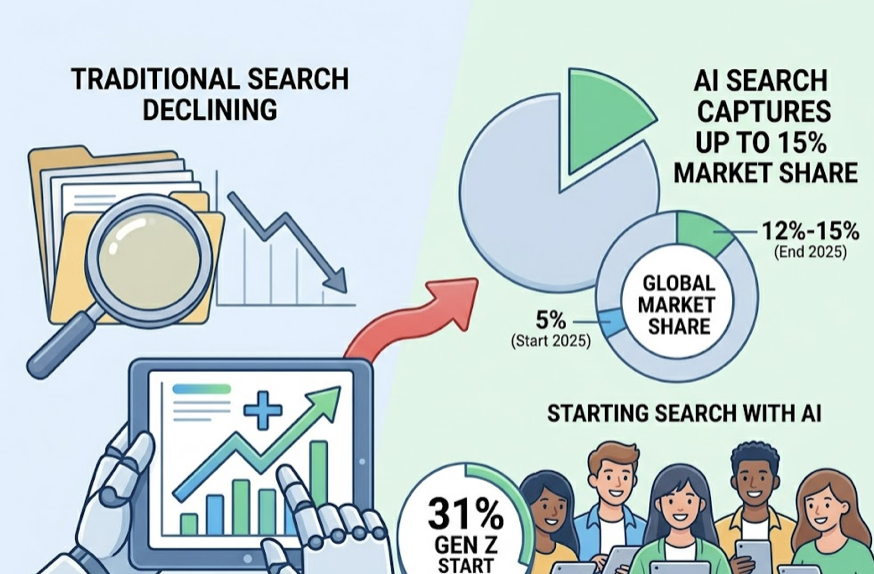
The shift isn’t hypothetical. ChatGPT alone expanded from 400 million to 800 million weekly active users between early 2024 and late 2025, now processing over one billion queries daily. Collectively, AI-powered search tools captured between 12% and 15% of global search market share by the end of 2025, up from around 5% at the start of the year. Among Gen Z users, 31% now start their searches with AI platforms rather than traditional engines.
These aren’t keyword searches. They’re conversational prompts — six or more words — that represent what analysts call “Dark Queries”: high-intent research prompts with near-zero traditional search volume but significant influence on purchasing decisions. Your analytics tools don’t track them. But AI models respond to them every day.
The buyers who use AI for research arrive at your website “pre-decided.” They convert at rates 31% higher and spend 45% more time on-site. But if your brand is missing from the AI conversation, you’re excluded from the shortlist before your sales team even knows the buyer exists.
What Winning Brands Do Differently for AI Search Visibility
Competitors who consistently appear in AI recommendations aren’t just lucky. They’ve rebuilt their content strategy around three pillars that align with how retrieval-augmented generation actually works.
They Build Content for Extraction, Not Just Reading
AI engines don’t browse pages the way humans do. They retrieve specific passages — typically between 134 and 167 words — that provide self-contained, verifiable answers. Winning brands maintain their conversion-focused pages for traditional search but build a secondary layer of informational content designed specifically for AI extraction.
The data confirms this split approach. Informational landing pages earn 37.86% of all AI citations, while conversion-focused pages account for just 7.63%. Content that scores highly on semantic completeness — the ability to provide a full, self-contained answer — is 4.2 times more likely to be cited by AI Overviews than standard SEO content.
In practice, this means opening each section with a direct answer in the first two to three sentences, using dense H2/H3 structures with tables and lists, and replacing hedged language (“many find our solution potentially useful”) with declarative specifics (“Feature X reduces cost by 20%”).
They Dominate Third-Party Sources
AI systems verify brand claims through cross-platform corroboration. A brand that appears consistently across Reddit threads, review platforms, industry forums, and niche publications earns what researchers call “Entity Confidence.” The scale of this preference is striking: 95% of AI citations come from third-party sources rather than a brand’s own website.
The five review platforms that account for 88% of all commercial citations in Google’s AI Overviews are Gartner Peer Insights at 26%, G2 at 23.1%, Capterra at 17.8%, Software Advice at 12.8%, and TrustRadius at 8.3%. Winning competitors don’t just have profiles on these platforms — they actively manage their presence, solicit reviews, and ensure their messaging is consistent across every listing.
They Control Their Entity Narrative
AI platforms recognize brands as entities, not URLs. When a brand uses identical “About” boilerplate text across LinkedIn, Crunchbase, G2, and its own website, it signals to the AI that these profiles refer to the same entity. That consistency strengthens the brand’s position within the AI’s internal knowledge graph.
Leading competitors also use structured schema markup — specifically the sameAs property — to connect their website to authoritative entity sources like Wikipedia and Wikidata. This gives the AI a deterministic reference point for grounding its generative responses.
5 Signals That a Competitor Has an AI Search Strategy
You can determine whether a competitor is actively engineering AI search visibility by watching for five quantifiable signals.
Cross-platform consistency. When a brand is recommended for the same query across ChatGPT, Gemini, and Perplexity — each of which uses a different retrieval layer — it suggests the brand has optimized its entity authority across the entire web ecosystem, not just one platform.
Broad citation architecture. Active competitors don’t rely on their own blog alone. They appear in AI citation lists through Reddit threads, industry white papers, and second-tier news sites. A wide source footprint indicates a deliberate PR and content partnership strategy designed to feed AI retrieval models.
Narrative alignment. When an AI engine’s description of a brand mirrors the brand’s own marketing language and value propositions, it’s a sign of successful entity seeding. If ChatGPT characterizes a competitor as “the leading provider of X for Y users” and that phrase matches their mission statement, the strategy is working.
Rapid presence in new prompts. AI platforms have a strong recency bias. Content updated within the last 30 days receives 3.2 times more citations than older content. A competitor that surfaces for a new industry trend within days of its emergence is likely pushing content directly to AI knowledge graphs through automated indexing.
Sustained positive sentiment. AI models don’t just cite brands — they characterize them through tone. Leaders receive confident phrasing (“the industry standard”), while laggards get cautious mentions (“growing alternative”). A competitor maintaining a consistently positive characterization is actively managing its digital reputation to influence the AI’s confidence score.
How to Track and Close the AI Search Visibility Gap
Identifying the gap is the first step. Closing it requires a systematic workflow — one that moves beyond manual ChatGPT spot-checks and into structured competitive intelligence.
Step 1: Establish a baseline. Run your core commercial prompts through all major AI platforms simultaneously to establish a “Share of Model” metric — the percentage of responses where your brand is mentioned versus competitors. Topify‘s AI Visibility Checker automates this across ChatGPT, Perplexity, Gemini, and other platforms, showing exactly where your brand is “part of the answer” and where it’s absent.
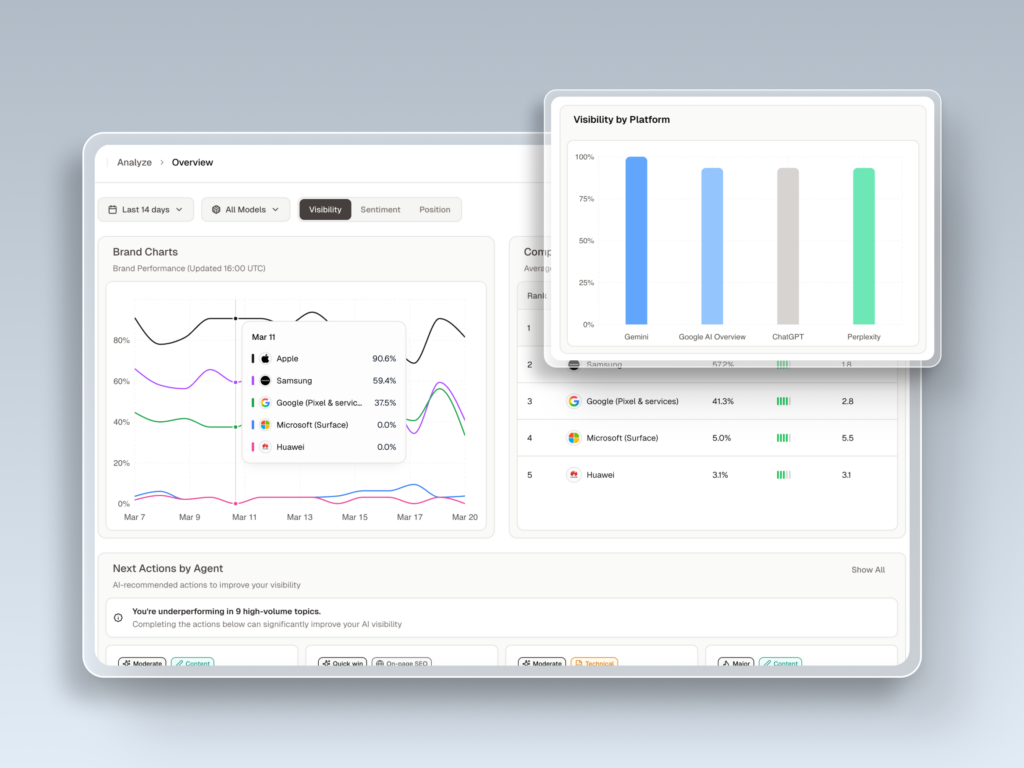
Step 2: Identify the citation gap. Once you know where you’re missing, the next question is why. Topify’s Competitor Monitoring and Source Analysis reveal which specific domains and URLs the AI engines cite instead of yours. This tells you whether the gap is a content structure problem (your pages aren’t extraction-friendly) or an authority problem (you lack third-party corroboration on platforms like Reddit or G2).
Step 3: Engineer your content for AI retrieval. After identifying high-value prompts where visibility is missing, restructure your content to match what AI models prefer. This means adding direct-answer blocks, increasing factual density, and implementing schema markup. Topify’s One-Click Execution feature provides page-level recommendations and allows teams to deploy GEO improvements without manual workflows.
Step 4: Monitor continuously. AI models are probabilistic. Visibility fluctuates daily. Topify’s Proprietary Sentiment Engine scores brand presence from -100 to +100, so you see not just whether you were mentioned, but how favorably. Weekly Share of Voice reports give stakeholders a quantified view of brand influence within the AI discovery layer.
A B2B SaaS company that implemented this type of systematic approach achieved a 600% citation uplift across major AI platforms in four weeks — increasing AI-referred trials from 550 to 2,300 per month by restructuring 66 articles for machine readability.
The Cost of Waiting While Competitors Build AI Search Visibility
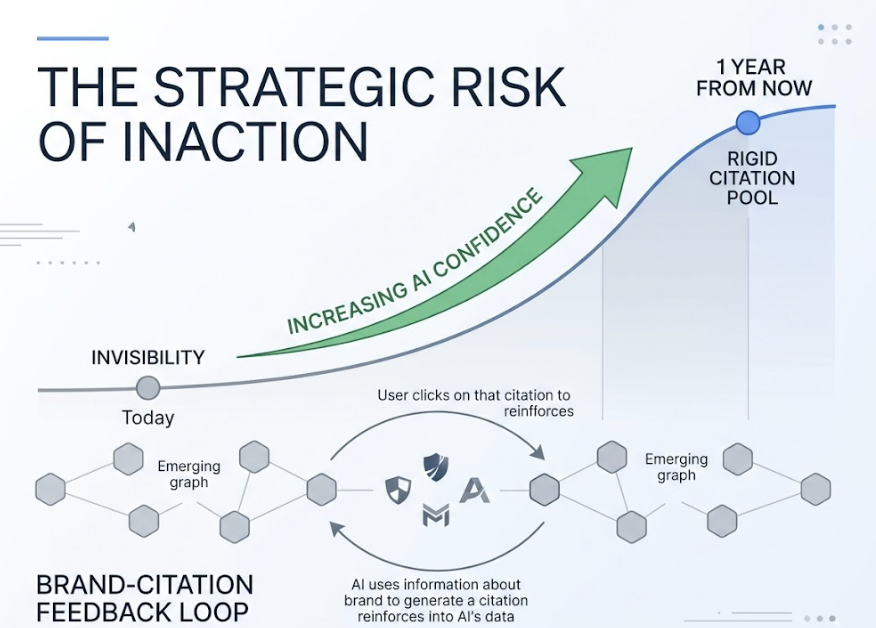
The strategic risk of inaction compounds over time. AI platforms are recursive — each time they cite a brand and that citation is corroborated by a user’s subsequent action, the AI’s confidence score for that brand increases. A brand that remains invisible today will find it exponentially harder to break into the citation pool a year from now, as the AI’s knowledge graph becomes more rigid.
The numbers are already stark. Approximately 73% of B2B websites experienced significant traffic losses between 2024 and 2025, with an average year-over-year decline of 34%. In local discovery, 98.8% of business locations are completely invisible in AI-generated recommendations.
The competitive moat is real. Brands that earn early citations build “Citation Velocity” — a compounding advantage that makes reclaiming lost ground three to five times more expensive later. And because AI-influenced buyers arrive pre-decided, the cost isn’t just lost traffic. It’s lost deals your team never knew existed.
Conclusion
The brands winning AI search visibility didn’t get there by accident. They recognized that the rules of discovery have changed — from links to entities, from rankings to citations, from pages to passages. Their advantage isn’t a bigger budget. It’s an earlier start.
The first step is measurement. Establish an AI visibility baseline, benchmark against competitors, and begin tracking Share of Model as a primary KPI. Platforms like Topify make this workflow operational — from gap analysis to content optimization to continuous monitoring. The window for early-adopter advantage is narrowing. The brands that move now will be the ones AI recommends tomorrow.
FAQ
What is AI search visibility and why does it matter?
AI search visibility refers to how often and how favorably your brand appears in synthesized responses from platforms like ChatGPT, Perplexity, and Google AI Overviews. It matters because these generative answers satisfy user intent directly on the page, reducing traditional click-through rates by up to 61% and making inclusion in AI responses the primary driver of brand influence.
How do I check if my competitors are optimizing for AI search?
Monitor five signals: consistent recommendations across multiple AI platforms, a broad citation footprint on third-party sites like Reddit and G2, AI characterizations that align with their brand messaging, rapid appearance in new topic prompts, and sustained positive sentiment in AI responses. Tools like Topify’s Competitor Monitoring can automate this tracking across platforms.
Which AI platforms should I monitor for brand visibility?
Start with ChatGPT (the market leader for general discovery), Perplexity (strong for research-intensive and B2B queries), and Google AI Overviews (the primary driver of mass-market informational visibility). For enterprise audiences, Microsoft Copilot and Google Gemini are also worth tracking.
How long does it take to improve AI search visibility?
AI visibility can shift faster than traditional SEO. Some brands see improved citation frequency within six to eight weeks of implementing GEO strategies. Building durable entity authority that withstands model updates typically takes three to six months of consistent optimization and source seeding.

