

Your SEO dashboard says everything’s fine. Rankings are holding. Domain authority ticked up a point last quarter. But here’s the number your dashboard doesn’t show: 64.82% of Google searches now end without a single click to any website. On mobile, it’s 77.2%. The traffic your team worked months to earn is being answered, summarized, and resolved before users ever reach your site.
That’s not an SEO problem. It’s a budget allocation problem. And in 2026, the teams that figure out how to split spend between traditional SEO and AI search visibility will own the next wave of organic growth.
Two-Thirds of Searches Never Reach Your Site. Here’s Where the Traffic Goes.
The “zero-click” trend isn’t new, but its acceleration is. In 2019, roughly half of Google searches ended without a click. By 2024, that number crossed 60%. In early 2026, it sits at 64.82%, with informational queries hitting a 74% zero-click rate.
Where are those users going? Straight to AI-generated answers. Google’s AI Overviews, ChatGPT Search, Perplexity, and Gemini now synthesize responses in real time, satisfying user intent inside the search interface itself. Gartner projects that traditional search engine volume will drop 25% by late 2026, driven almost entirely by this migration to AI-powered answers.
The impact isn’t evenly distributed. Transactional keywords (“buy,” “order,” “pricing”) still preserve a 31% organic click rate. But the informational queries that once fueled top-of-funnel blog traffic? Those are being consumed by AI at scale. If your content budget is still weighted toward high-volume informational posts designed to drive clicks, you’re investing in a channel with shrinking returns.
That’s the shift most marketing teams haven’t priced into their 2026 budgets yet.
What AI Search Visibility Actually Costs vs Traditional SEO
Traditional SEO and AI search visibility (often called GEO, or Generative Engine Optimization) don’t compete for the same line items. They have fundamentally different cost structures, and understanding the difference is the first step toward smarter allocation.
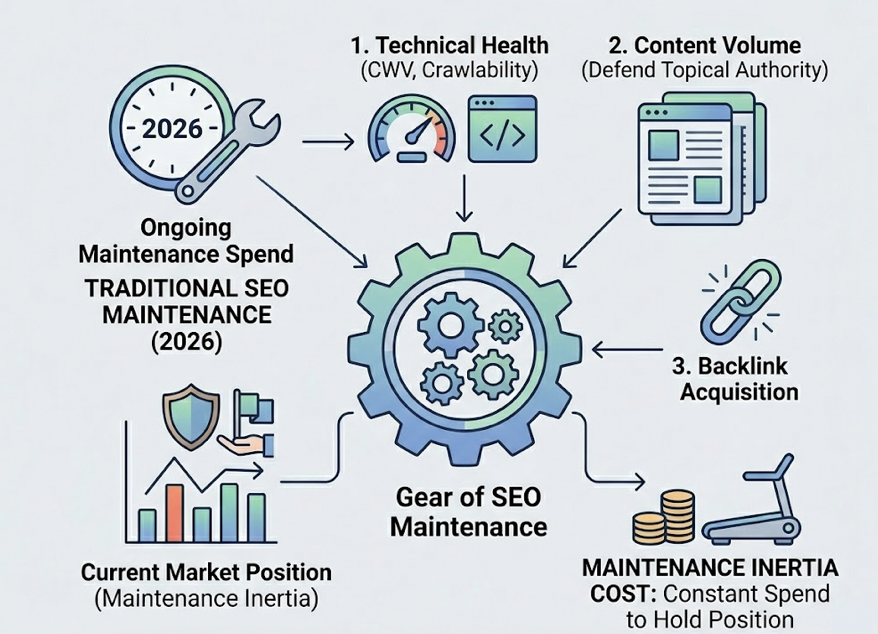
Traditional SEO in 2026 is a maintenance-heavy discipline. It demands ongoing spend on technical health (Core Web Vitals, crawlability), content volume to defend topical authority, and backlink acquisition. The cost is characterized by what one industry analysis calls “maintenance inertia”: you keep spending just to hold your current position against competitors who are also spending.
GEO flips the investment model. Instead of hundreds of keyword-targeted articles, it prioritizes fewer, higher-authority content assets that AI models can parse and cite. The focus is on “citatability”: structured, data-backed, entity-rich content designed for extraction rather than ranking.
| Cost Category | Traditional SEO | GEO / AI Visibility |
|---|---|---|
| Technology | Rank trackers, technical auditors | AI visibility platforms like Topify, prompt researchers |
| Content | Keyword-optimized long-form (2,000+ words) | Entity-rich, answer-first structured fragments |
| Authority | High-DA backlink acquisition | Citation-worthy research, digital PR, forum presence |
| Measurement | Clicks, sessions, keyword positions | AI mention frequency, citation share, sentiment score |
A typical monthly GEO budget for a mid-market B2B company ranges from $2,000 to $8,000, covering platform subscriptions and the human resources for content restructuring. The upfront learning cost is higher because the discipline is newer. But the marginal cost of maintaining AI visibility tends to be lower than traditional SEO, because AI models favor authoritative, structured data over brute-force backlink profiles.
The Tracking Gap That Inflates Your “Direct” Traffic
Here’s a cost most teams don’t see: AI search platforms like ChatGPT and Perplexity typically don’t send referral data to Google Analytics. Traffic from AI recommendations gets misclassified as “direct” or “branded search.” That means your brand could be losing share in AI conversations and your analytics wouldn’t flag it.
This isn’t a minor reporting quirk. It’s a blind spot that makes budget decisions based on traditional analytics fundamentally incomplete. Platforms like Topify exist specifically to close this gap, tracking brand mentions, citation frequency, and sentiment across AI engines so you can quantify what traditional tools miss.
AI-Referred Clicks Convert at Nearly 2x the Rate. Here’s Why.
The ROI case for AI search visibility isn’t theoretical anymore. Early data from 2025 and 2026 shows a clear pattern: users who click through from an AI-generated answer convert at significantly higher rates than standard organic traffic.
The reason is what researchers call the “pre-vetting” effect. By the time someone clicks a citation inside an AI response, they’ve already consumed a summary of your value proposition. They’re not browsing. They’re validating a decision they’ve half-made.
| Metric | Traditional Organic | AI-Referred | Difference |
|---|---|---|---|
| Conversion Rate | 5.3% – 5.8% | 7.05% – 11.4% | ~2x higher |
| Session Duration | Baseline | +34% | Deeper engagement |
| Pages per Session | Baseline | 2.7x | More exploration |
| Average Order Value | Baseline | +18% | Higher-value conversions |
For B2B SaaS specifically, the numbers are even sharper. Brands optimized for AI visibility have reported conversion rates up to 6x higher than traditional organic, because AI assistants handle the early-stage comparison work that used to require an SDR or multiple content touchpoints.
There’s a compounding effect, too. When users see a brand recommended by an AI, they’re 3.2x more likely to perform a direct search for that brand afterward. So even when AI visibility doesn’t produce an immediate click, it fuels branded search volume downstream.
The bottom line: AI search visibility isn’t just a new traffic source. It’s a higher-quality traffic source.
The 70/30 Trap: Why a Fixed Budget Split Doesn’t Work
In early 2025, the common recommendation was simple: allocate 70% of your organic budget to SEO and 30% to AI visibility. By 2026, that rule has fallen apart.
The problem is that a fixed split ignores how differently AI disrupts each industry. Some categories are “AI-native” in search behavior. Others are still anchored in visual or local discovery. Applying the same ratio to a SaaS company and a local restaurant is like using the same media plan for both.
High information density categories (SaaS, Finance, Healthcare): These are the primary targets of AI search because they involve complex comparisons and high-stakes decisions. Decision-makers are already using Perplexity and ChatGPT to shortlist vendors. In these sectors, a 60% SEO / 40% GEO split is often the baseline just to stay in the conversation.
Low complexity, high visual categories (Fashion, Retail, Local Services): Traditional SEO and visual search (Google Maps, Instagram) still dominate here. AI shopping assistants are generating less than 10% of revenue in these verticals. An 80/20 or 75/25 split favoring traditional SEO makes more sense.
Content publishers and education: These sectors sit in the eye of the storm. Informational queries are the most disrupted category. A 50/50 split is often necessary to survive the transition, earning both the traditional rank and the AI citation.
Your Competitor’s AI Visibility Score Matters More Than Their DA
Budget allocation shouldn’t happen in a vacuum. If a competitor has already secured what the industry calls a “citation moat,” meaning they’re consistently the primary source AI recommends for your category, your SEO traffic will erode regardless of your Google rankings.
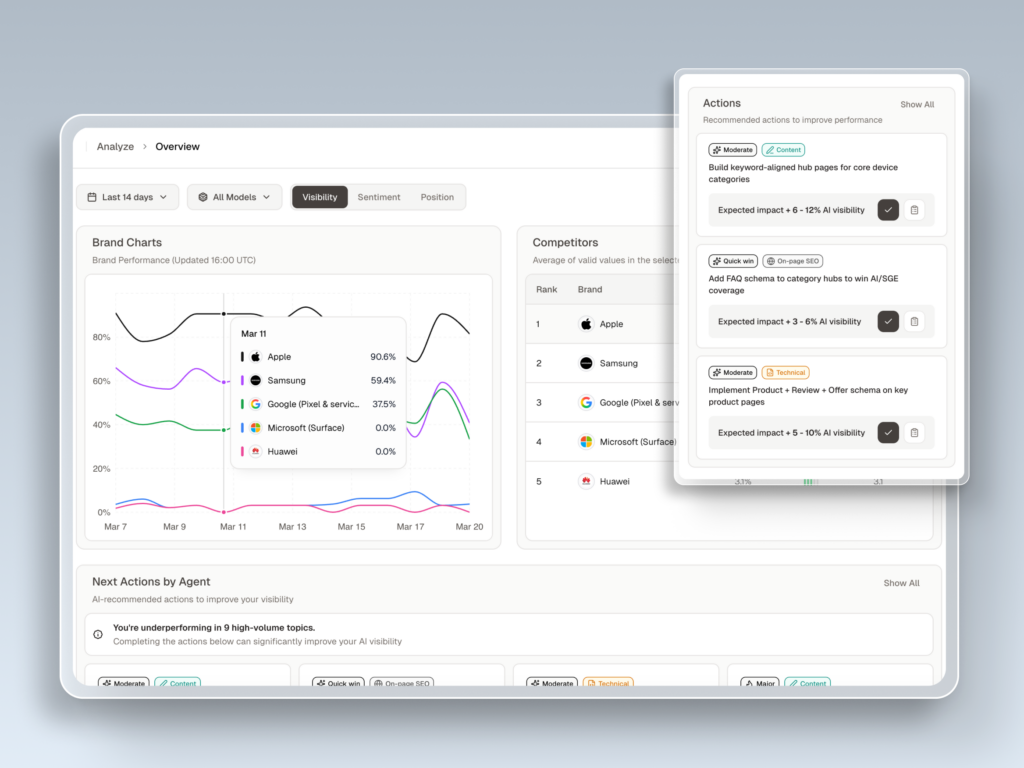
Topify’s Competitor Monitoring surfaces exactly this signal. It identifies when a rival dominates AI citations for your core prompts, so you can decide whether to stay on defense with SEO or shift to offense with GEO. Without this data, you’re guessing.
Allocate by Channel Signal, Not by Gut
To avoid the 70/30 trap, marketing leaders need a framework that responds to data, not convention. Here’s a three-step approach built around what we call “Channel Signal.”
Step 1: Audit your current AI footprint. Before reallocating anything, you need a baseline. Topify’s AI Visibility Checker generates a composite score based on mention frequency, recommendation position, and sentiment across major AI platforms. If your score is low despite strong SEO rankings, you’ve found the gap that needs funding.
Step 2: Evaluate the AI search demand in your category. Traditional keyword tools don’t capture how users talk to AI. Topify’s AI Volume Analytics identifies the specific natural-language prompts users are asking ChatGPT and Gemini within your vertical. If AI search demand for your category is growing by double digits, you need to allocate budget before a first-mover competitor captures that intent.
Step 3: Benchmark competitor infiltration. The final input is your “Share of AI Voice.” If a single rival holds more than 50% of category citations, they’ve built topical authority in the eyes of the model. At that point, reallocating budget isn’t strategic. It’s survival.
| Situation | Data Signal | Recommended Action |
|---|---|---|
| Invisible in AI | SEO top 3, but AI Visibility Score < 10% | Shift 20% of SEO budget to GEO content restructuring |
| Sentiment problem | Frequent AI mentions, but neutral/negative tone | Redirect content budget toward digital PR and expert reviews |
| Competitor dominance | Rival cited in > 50% of category prompts | Accelerate GEO spend to 40% of organic total |
| Local/visual category | High Google Maps and social engagement | Maintain 80/20 SEO split; add AEO for voice search |
The Technical Layer Most Teams Skip
Winning AI search visibility isn’t only about better content. It’s about technical “extractability.” AI engines use fragment-based retrieval, indexing granular snippets of meaning rather than full pages.
Research shows that 44.2% of all AI citations come from the first 30% of an article. Content that buries the answer under a long narrative intro gets systematically skipped. The fix: follow the “BLUF” rule (Bottom Line Up Front) and place a direct, definitive answer within the first 100 words of each section.
Three technical signals also increase your citation odds significantly. Implementing FAQ, HowTo, and ItemList schema raises the probability of a rich citation by 1.8x. Content updated within the last 90 days is 2.3x more likely to be cited by ChatGPT. And using specific entities (product names, technical terms, named features) rather than generic keywords helps transformer architectures map your brand to user intent more accurately.
These aren’t optional enhancements. In 2026, they’re the baseline for AI search visibility.
Conclusion
The question for 2026 isn’t “SEO or AI search visibility.” It’s how much of each, and when to shift. Traditional SEO still provides the technical foundation and authority signals that AI models use to discover content. GEO ensures that content actually gets cited in the final answer.
The teams that win this cycle will be the ones that stop allocating budget based on a search environment that no longer represents how 65% of users find information. Start with data: audit your AI visibility, benchmark your competitors, and let channel signal guide the split. If AI-referred traffic converts at nearly 2x the rate and your brand isn’t showing up in those answers, the cost of inaction is already compounding.
The smartest move right now? Get a baseline. Know where you stand in AI search before you finalize a single budget line.
FAQ
Q: What is AI search visibility and how is it different from SEO?
A: Traditional SEO focuses on ranking in a list of links on search engine results pages. AI search visibility, or GEO, focuses on getting your brand mentioned and cited as a source within the synthesized answer generated by AI platforms like ChatGPT, Perplexity, or Google AI Overviews. SEO drives clicks. GEO drives citations.
Q: How much should I budget for AI search optimization in 2026?
A: It depends on your industry. For B2B SaaS and high-information categories, a 40% GEO / 60% SEO split is becoming standard. For local businesses, 20% GEO / 80% SEO is typically sufficient. Monthly platform costs for visibility tracking range from $2,000 to $8,000 for mid-market companies.
Q: Can traditional SEO content also improve AI search visibility?
A: Yes, but only if it’s structured for extraction. AI models use search indices like Google and Bing to find sources, but they only cite content that’s “extractable,” meaning it has clear heading hierarchies, answer-first paragraph structures, and schema markup.
Q: What metrics should I track for AI search visibility?
A: The core four are AI Visibility Score (how often your brand is mentioned), Citation Share (how often your URL is referenced in answers), Net Sentiment Score (the tone of AI mentions), and Share of Voice (your presence relative to competitors across AI platforms).

