

Your dashboard has 12 AI visibility metrics. Your CMO only cares about one question: “What’s driving revenue?” You pull up mention counts, platform coverage, and prompt frequency, but none of them connect cleanly to pipeline or closed deals. Meanwhile, zero-click searches jumped from 56% to 69% between 2024 and 2025, which means more of your brand’s influence is happening inside AI interfaces where traditional analytics can’t reach.
The disconnect isn’t a data problem. It’s a measurement problem. Most teams are tracking the wrong signals.
The Gap Between AI Brand Visibility Data and Revenue
Traditional SEO metrics were built for a click-based economy. Higher SERP ranking led to higher CTR, which led to more traffic and conversions. That pipeline made sense for a decade.
It doesn’t work in AI search.
When an AI Overview appears, the organic CTR for the top-ranking result drops by 61%, falling from 1.76% to just 0.61%. Paid CTR takes a similar hit, declining nearly 68%. Brands are watching their referral traffic shrink while their AI visibility climbs. Documented cases show companies losing 20% of referral traffic while simultaneously gaining 113% in AI mentions.
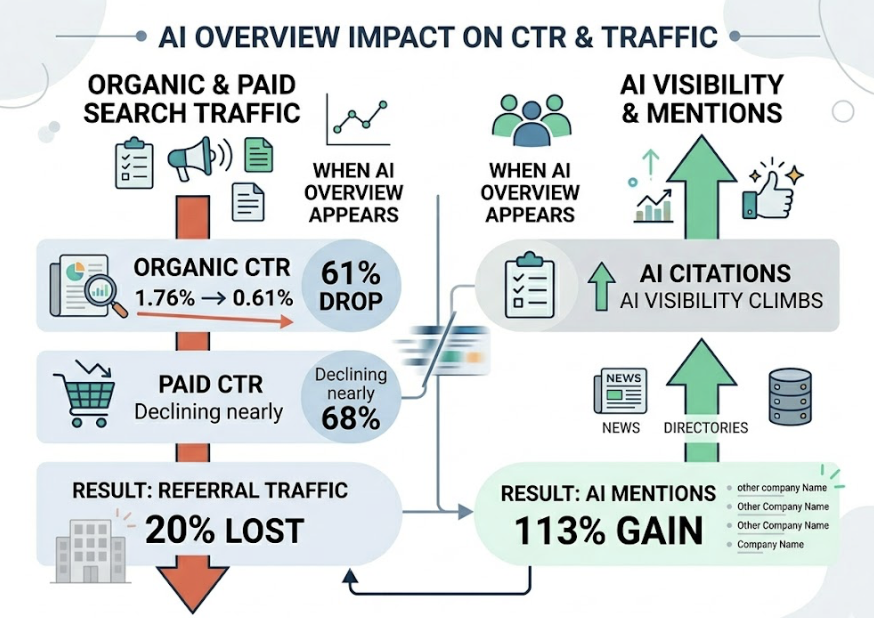
That’s the paradox: more visibility, fewer clicks, unclear revenue impact.
Only 16% of brands today systematically track their AI search performance. The rest are either ignoring the channel or measuring it with the wrong instruments. The result is misallocated budgets, skeptical leadership, and marketing teams that can’t defend their AI investments.
Bridging this gap starts with knowing which metrics actually predict commercial outcomes, and which ones just look good in a slide deck.
Five AI Brand Visibility Metrics That Correlate with Revenue
Not every data point in your AI visibility stack carries the same weight. These five metrics have the strongest connection to downstream revenue.
1. Conversion Visibility Rate: Where AI Mentions Meet Buyer Action
Conversion Visibility Rate, or CVR, measures the probability that an AI mention drives a user toward a conversion action, even when no immediate click is recorded. It accounts for the “decision density” that happens inside conversational interfaces, where users research, compare, and filter options before they ever reach your site.
The numbers are striking. Visitors arriving from AI search platforms convert at 23x the rate of traditional organic search visitors. That’s because they arrive pre-qualified: the AI has already done the browsing for them. Roughly 80% of AI-referred traffic lands on high-intent pages like product pages or free tool signups, not blog posts.
Topify‘s CVR metric estimates conversion probability based on prompt intent and response sentiment. For marketing teams trying to connect AI impressions to pipeline, this is the closest thing to a revenue predictor in the current toolkit.
2. Sentiment Score: How AI Characterizes Your Brand Changes Buying Behavior
AI engines don’t just mention brands. They describe them. And the language they use, whether it’s “the leading solution” or “an alternative worth considering,” directly shapes purchase decisions.
A brand mentioned in 60% of category prompts might seem healthy. But if the dominant tone across those mentions is cautious or negative, that visibility is actually a liability. Sentiment analysis catches what mention counts miss.
| Sentiment Category | What It Sounds Like | Revenue Impact |
|---|---|---|
| Endorsement | “Top choice,” “Widely recommended” | High: activates purchase triggers |
| Neutral | “Offers features,” “Is available” | Moderate: visible but not persuasive |
| Cautious | “Worth considering but,” “Some users report” | Negative: increases friction |
| Negative | “Not recommended for,” “Lacks compared to” | Critical: drives users to competitors |
Topify’s Sentiment Analysis tracks these patterns across individual platforms. ChatGPT might describe a brand favorably while Perplexity ignores it entirely. Catching those platform-specific gaps early prevents them from becoming pipeline problems.
3. Position in AI Recommendations: First Mention Wins
In traditional search, position #1 earns the most clicks. In AI search, the first-named brand in a synthesized response captures an even larger share of user trust.
Research shows that SERP position #1 earns a 33.07% chance of being cited in an AI Overview, while position #10 drops to just 13.04%. Brands cited in AI responses earn 35% more organic clicks and 91% more paid clicks compared to those that aren’t cited.
Being the “first mention” in an AI summary functions as a new Position 0. It captures the high-intent traffic that still converts, even as overall CTR declines.
Topify’s Position Tracking monitors brand ranking across multiple regenerations to account for the randomness built into LLM outputs. The result is a Response Position Index reflecting your average placement across thousands of simulations, not a single snapshot.
4. AI Search Volume on High-Intent Prompts
Not all AI prompts carry commercial value. A startup doesn’t need 10,000 users asking “what is CRM.” It needs 500 asking “Salesforce alternatives for Series B startups,” because the latter converts at roughly 10x the rate.
High-intent prompts are the “dark query” pool that traditional keyword tools miss entirely. They’re conversational, specific, and often start with “who,” “what,” or “why” paired with a concrete use-case constraint.
Focusing AI brand visibility tracking on these prompts changes everything. Generic, top-of-funnel queries like “What is search?” get resolved by the AI summary itself, generating zero clicks and zero revenue. Revenue lives in the long tail of specific, pain-point-driven conversational intent.
Topify’s High-Value Prompt Discovery uses large-scale prompt matrixing to generate thousands of intent variations. This lets brands measure their Share of Voice across the exact queries that drive deals, not just impressions.
5. Source Citation Frequency: The Backlink of AI Search
Source citation frequency measures how often AI engines credit your domain as a primary source for their answers. Think of it as the AI-era equivalent of backlink authority: the more AI cites your content, the more likely it is to recommend you.
Brand search volume carries a 0.334 correlation with model confidence, making it the strongest predictor of AI recommendation identified so far. But here’s the catch: 82% to 85% of AI citations come from third-party sources like media outlets, Reddit, and review platforms, not from a brand’s own website.
That means off-site presence is a direct input for AI visibility. Distributing content through third-party channels can produce a 325% lift in AI citation rates compared to hosting the same material exclusively on an owned domain.
Topify’s Source Analysis reverse-engineers the citation trails of each AI engine, showing which URLs are being retrieved and where your brand has coverage gaps.
Three AI Brand Visibility Metrics That Don’t Predict Revenue
These metrics show up on every AI visibility dashboard. They feel important. But they consistently fail to correlate with commercial outcomes.
1. Raw Mention Count Without Context
A brand appearing in 80% of AI searches looks impressive. But if 60% of those mentions carry cautious or neutral sentiment, or are tied to low-intent queries, the volume is noise. Raw counts don’t distinguish between a glowing endorsement and a factual footnote.
Mention count tells you that AI knows your brand exists. It doesn’t tell you whether that knowledge is helping or hurting.
2. Visibility Across Low-Intent Prompts
High visibility on informational queries like “What is SEO?” inflates dashboards without moving revenue. These queries get fully resolved inside the AI interface. Users asking basic definitions are casual seekers who were never going to convert.
The metric looks great in quarterly reports. It contributes nothing to pipeline.
3. Platform Coverage Without Depth
“We appear on 10 AI platforms” sounds like a win. But only 11% of cited domains show up across multiple AI engines, because each platform has a different indexing and retrieval strategy. Wide coverage with shallow authority means you’re present everywhere and influential nowhere.
A brand with deep authority on Perplexity (which cites 3x more sources than ChatGPT) will typically outperform one that appears superficially across a dozen platforms.
| Category | Metric That Predicts Revenue | Metric That Doesn’t |
|---|---|---|
| Revenue Link | Conversion Visibility Rate | Raw AI-driven sessions |
| Brand Impact | Sentiment Score | Number of platforms covered |
| Market Share | Share of LLM (weighted) | Raw mention count |
| User Intent | High-Intent Prompt SOV | Low-intent “What is” visibility |
| Authority | Source Citation Frequency | Platform coverage count |
How to Build an AI Brand Visibility Dashboard Tied to Revenue
Knowing which metrics matter is step one. Building a system that tracks them consistently is where most teams stall.
Start by defining your “money prompt set”: 20 to 50 conversational questions that high-intent buyers in your category actually ask. Balance them across awareness, comparison, and branded queries.
Next, establish a Share of LLM baseline. Score each appearance on a scale: 0 for no mention, 1 for passive mention, 2 for active citation, 3 for linked citation. Run this across ChatGPT, Gemini, Perplexity, and DeepSeek to build a weighted composite.
Then diagnose the gaps. Where are competitors dominating prompts you should own? Is the cause a sentiment problem, a citation coverage problem, or a content structure problem? Each diagnosis points to a different fix.
Topify’s platform combines all seven AI visibility dimensions, including Visibility, Volume, Position, Sentiment, Mentions, Intent, and CVR, into a single dashboard. Its one-click execution model translates detected gaps into specific optimization actions: updating content structure, adding schema, or expanding third-party distribution.
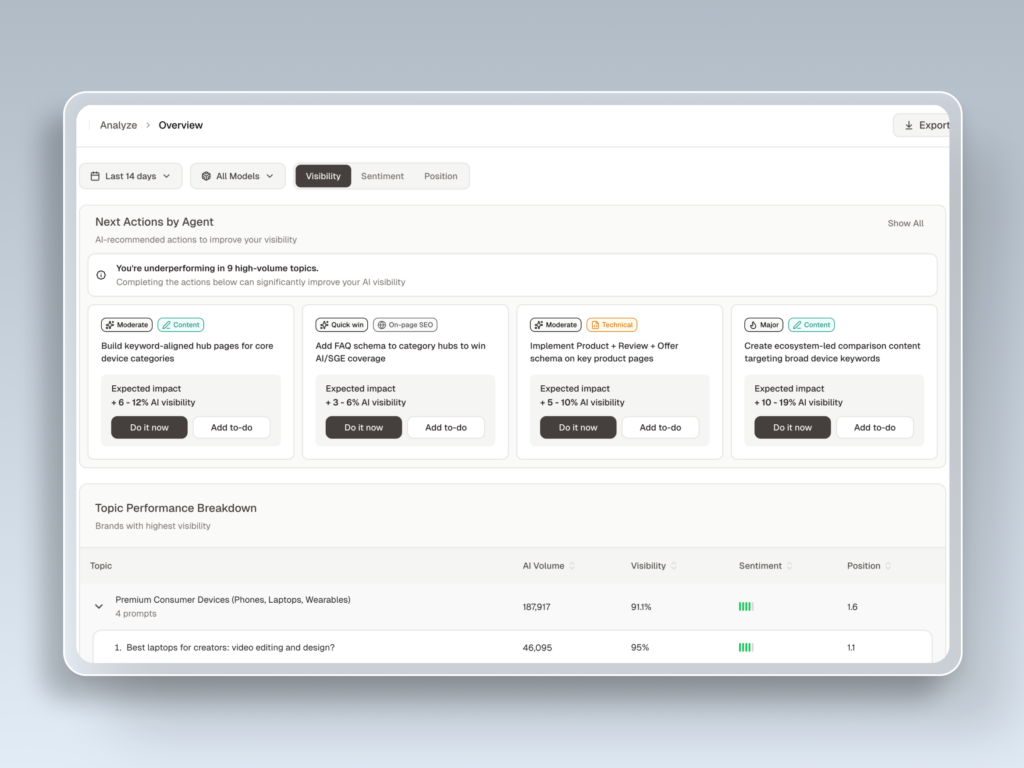
For teams tired of presenting AI data that doesn’t connect to business results, this is the missing layer.
Conclusion
Not all AI brand visibility metrics deserve a spot on your dashboard. Raw mention counts, low-intent prompt coverage, and platform breadth without depth look good in presentations but consistently fail to predict revenue.
The five metrics that do, CVR, Sentiment Score, Position, High-Intent Prompt Volume, and Source Citation Frequency, share a common trait: they measure influence, not just presence. Marketing teams that restructure their AI visibility tracking around these indicators will spend less time defending their dashboards and more time connecting AI performance to pipeline.
The brands that win in AI search won’t be the most visible. They’ll be the most trusted, the most cited, and the most precisely positioned on the prompts that drive buying decisions.
FAQ
What is AI brand visibility and why does it matter for revenue?
AI brand visibility measures how often your brand is surfaced, cited, and recommended in answers from AI engines like ChatGPT and Perplexity. It matters because AI-referred visitors convert at 23x the rate of traditional organic visitors, arriving pre-qualified by the AI’s research and filtering process.
How do you measure AI brand visibility across different platforms?
Measurement involves running thousands of prompt variations across platforms and geographic nodes to calculate a statistical Share of Voice, sometimes called Share of LLM. Professional platforms like Topify automate this by tracking seven key metrics including position, sentiment, and intent alignment.
What’s the difference between AI visibility and traditional SEO visibility?
Traditional SEO focuses on keyword rankings and backlinks to drive clicks to a URL. AI visibility focuses on synthesis and retrieval, where the goal is to have your brand facts integrated into the AI’s narrative and cited as an authoritative source, especially in the zero-click environment where users get their answers without leaving the AI platform.
Can you improve AI brand visibility without increasing content volume?
Yes. Distributing existing content through third-party channels like media outlets, review sites, and community platforms can produce a 325% lift in AI citation rates. The key is expanding off-site authority, not just publishing more on your own domain.

