

Your marketing report says “AI visibility is up.” Your SEO lead says “AI search visibility is flat.” Your PR team says “AI mentions are growing.” All three are looking at the same AI platforms, and all three think they’re measuring the same thing.
They’re not. These three metrics answer fundamentally different questions about your brand’s presence in AI-generated answers. Confusing them doesn’t just muddle your reporting. It sends your team chasing the wrong signals while the metric that actually matters stays untracked.
The Terminology Problem That’s Costing Brands Real Data
Most marketing teams treat “AI brand visibility,” “AI search visibility,” and “AI mentions” as interchangeable labels for one concept: whether AI knows your brand exists. That conflation made sense when the only visibility that mattered was a position on a list of blue links. It doesn’t hold up in the generative era.
Here’s why the distinction matters now. 37% of consumers start their research directly in AI tools rather than Google. And 93% of those AI sessions end without a single website click. The AI’s answer is the final stop. So whether your brand gets mentioned, cited, or framed correctly inside that answer isn’t a branding nuance. It’s a revenue question.
Each of these three metrics captures a different layer of that answer. Mix them up, and you’ll optimize for the wrong one.
What AI Brand Visibility Actually Measures
AI brand visibility is the broadest of the three. It’s a composite measure of how frequently and accurately your brand appears across AI-generated answers, summaries, and recommendations on platforms like ChatGPT, Gemini, and Perplexity.
Think of it as the answer to: “Does AI know who we are, and does it describe us correctly?”
That second part is what separates brand visibility from a simple mention count. AI brand visibility tracks the full framing of your brand: how the model describes your features, where it positions you relative to competitors, and whether it associates you with the right use cases. A brand can be mentioned ten times across AI answers and still have poor visibility if the model consistently mischaracterizes its positioning.
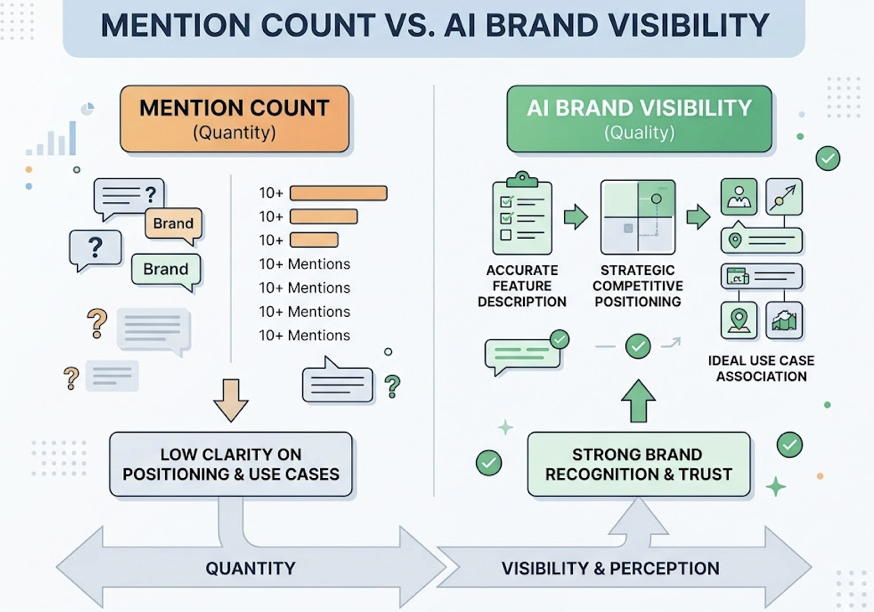
This is where the concept of “Semantic Authority” comes into play. AI models calculate a synthesized score based on the frequency, diversity, and sentiment of brand references across their training data. A brand referenced across 500 high-authority domains carries more weight than one mentioned 100,000 times on low-quality sites. Quality of third-party validation matters exponentially more than volume of self-published content.
The N-E-E-A-T-T framework (Notability, Experience, Expertise, Authoritativeness, Trustworthiness, and Transparency) determines how confidently an AI presents your brand. Low scores here don’t just reduce your visibility. They cause the AI to hedge, using cautious language like “Brand X may be suitable for small teams” instead of a direct recommendation.
That hedging is measurable. And it’s one of the signals AI brand visibility is designed to catch.
What AI Search Visibility Actually Measures
AI search visibility is narrower. It zooms in on a specific question: “When someone asks AI about our category, do we show up in the answer?”
Where brand visibility looks at the overall AI ecosystem, search visibility is prompt-specific. It tracks whether your brand appears in response to particular queries, what position you hold relative to competitors in those responses, and how consistently you show up across different prompt variations.
This distinction matters because AI answers aren’t static. Ask ChatGPT “What’s the best CRM for nonprofits?” five times, and you might get three different brand recommendations. The prompt’s phrasing, the user’s location, and even the time of day can shift results. AI search visibility tools address this by running thousands of prompt variations across geographic nodes to calculate what’s sometimes called “Share of Model Voice.”
Here’s a data point that underscores why search visibility needs its own metric: nearly 90% of ChatGPT citations come from pages that don’t rank on the first or second page of traditional Google results. AI platforms aren’t scraping the top of Google. They’re pulling from wherever the most semantically relevant and clearly structured content lives. Your Google rank tells you almost nothing about your AI search visibility.
The shift from keyword tracking to prompt tracking is the operational difference. A keyword like “CRM” is a static string. A prompt like “What CRM works best for a 50-person nonprofit in Germany?” reflects real conversational intent. Measuring the second requires a fundamentally different methodology.
What AI Mentions Actually Measure
AI mentions are the most granular of the three, and the most commonly misread.
A mention is a plain-text reference to your brand name within the body of an AI-generated response. No link, no citation, just the name appearing in the answer. It’s the count of how often AI says your brand name.
That sounds straightforward. The trap is assuming that more mentions equals more visibility. It doesn’t.
Here’s the core problem: there’s a significant gap between brands that get mentioned and brands that get cited. Research shows that fewer than 30% of brands most frequently mentioned by AI are also among the most cited. AI models often pull their factual information from one set of sources (news sites, directories, databases) while recommending a completely different set of brands in the answer itself.
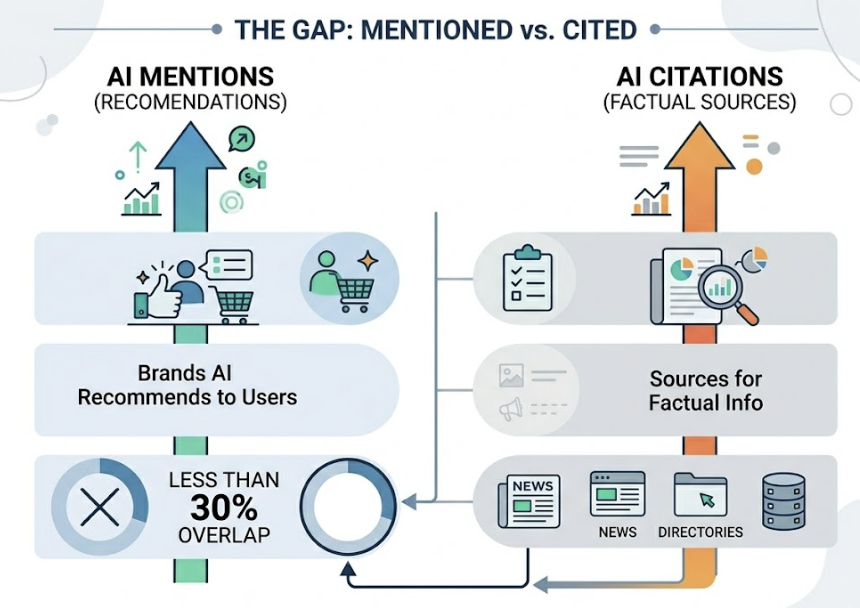
A mention also carries no sentiment signal on its own. Your brand could be mentioned 50 times this month, but if 40 of those mentions include phrasing like “lacks enterprise features” or “better suited for beginners,” the raw count is actively misleading. Negative mentions in AI responses tend to be concentrated in high-visibility query types, and the damage compounds: negative framing gets absorbed into future model training, making it harder to correct over time.
Different AI platforms handle negative information differently, too. Google AI Overviews tends to surface news-driven negativity (controversies, lawsuits, recalls), while ChatGPT focuses more on product-level criticism (limitations, compatibility issues, value assessments). A mention on one platform doesn’t mean the same thing as a mention on another.
The real value of tracking mentions is as a leading indicator. Rising mention frequency, combined with positive sentiment, typically feeds a flywheel: more mentions lead to higher brand recall, which drives branded search volume, which strengthens the brand’s authority for future AI retrieval cycles. But mention count alone, without sentiment and context, is noise.
Side-by-Side: What Each Metric Tells You and What It Misses
| Dimension | AI Brand Visibility | AI Search Visibility | AI Mentions |
|---|---|---|---|
| Core question | “Does AI know us and describe us correctly?” | “Do we show up when someone asks about our category?” | “How often does AI say our name?” |
| Scope | Broadest: covers framing, sentiment, positioning, accuracy | Mid-range: prompt-specific presence and ranking | Narrowest: raw count of name references |
| What it catches | Mischaracterization, hedged language, competitor framing | Missing from key queries, position shifts, prompt sensitivity | Frequency trends, emerging or declining presence |
| What it misses | Prompt-level granularity | Overall brand narrative and sentiment | Sentiment, context, whether mention is positive or negative |
| Actionable for | Brand strategy, narrative control, AI reputation management | Content optimization, competitive positioning, GEO tactics | Early signal detection, trend monitoring |
| Risk if used alone | Too broad to guide specific content changes | Misses brand narrative issues outside tracked prompts | Misleads if negative mentions are counted as wins |
No single metric gives you the full picture. Brand visibility without search visibility is like knowing your reputation without knowing whether people find you. Search visibility without brand visibility means you’re showing up, but potentially with the wrong story. And mentions without either context layer is just a number that could mean anything.
How to Track All Three Without Juggling Five Dashboards
The practical challenge is that most teams end up cobbling together separate tools for each metric: one for mention tracking, one for search position monitoring, another for sentiment analysis. That creates data silos, inconsistent definitions, and reports that don’t reconcile.
Topify consolidates these three layers into a single platform. It tracks AI brand visibility across ChatGPT, Gemini, Perplexity, DeepSeek, and other major AI engines through seven integrated metrics: visibility, sentiment, position, volume, mentions, intent, and CVR (Conversion Visibility Rate).
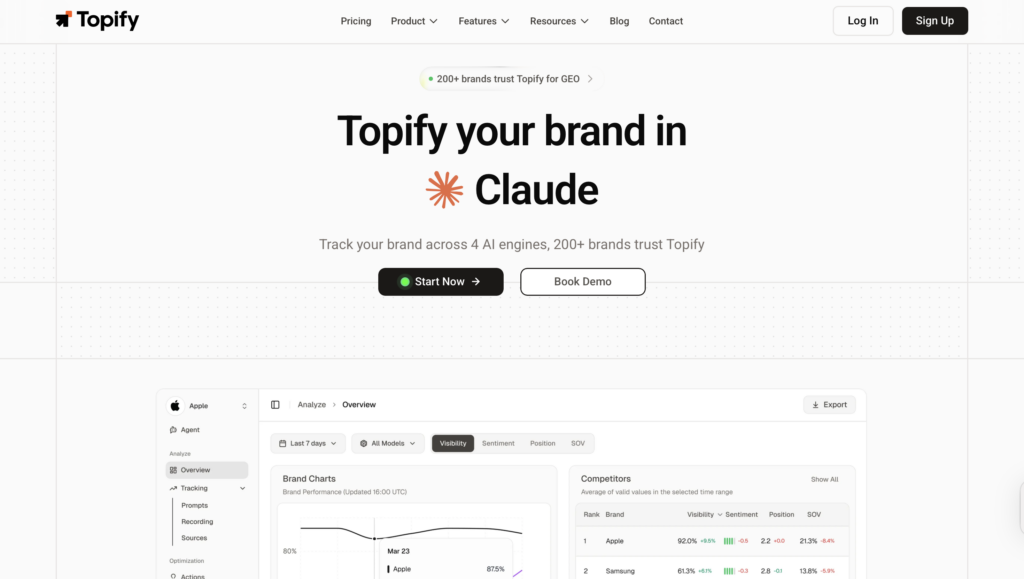
In practice, that means you can spot a drop in mentions on Perplexity, check whether the sentiment behind those mentions shifted, trace the change back to a specific source the AI stopped citing, and see how your competitor’s position moved in the same prompt set. All within one dashboard.
The platform uses prompt matrixing to test thousands of query variations, giving you a statistical view of whether your brand holds “Robust Visibility” (recommended in 85%+ of prompt simulations) or falls into an “Invisibility Gap” (below 5%). That’s the difference between knowing you showed up once and knowing whether you show up reliably.
For teams that are still relying on manual spot checks (typing your brand into ChatGPT and hoping for the best), that’s a significant operational upgrade. Plans start at $99/month, which covers 100 prompts across multiple AI platforms.
Conclusion
AI brand visibility, AI search visibility, and AI mentions aren’t three names for the same thing. They measure different layers of your brand’s presence in AI-generated answers: the overall narrative, the prompt-level performance, and the raw frequency.
Getting these definitions right isn’t academic. It determines which metric your team optimizes for, which tools you invest in, and whether your AI strategy actually moves the needle. Start by aligning your team on what each term measures. Then build a tracking system that covers all three, because the brands winning in AI search are the ones that don’t confuse showing up with being recommended.
Ready to see where your brand actually stands across all three metrics? Get started with Topify and find out in minutes.
FAQ
Q: What’s the difference between AI brand visibility and traditional brand visibility?
A: Traditional brand visibility measures how often your brand appears in search engine results, social media, and advertising channels. AI brand visibility specifically measures how AI models describe, position, and recommend your brand in generated answers. A brand can have strong traditional visibility (high Google rankings, large social following) and still be invisible or misrepresented in AI responses, because AI platforms use different signals to decide which brands to include.
Q: Can I track AI mentions without a paid tool?
A: You can do manual spot checks by typing relevant prompts into ChatGPT, Perplexity, or Gemini and noting whether your brand appears. But this approach is unreliable because AI answers vary by prompt phrasing, location, and time. You’d need to test hundreds of prompt variations consistently to get a statistically meaningful picture. Free GEO scoring tools can give you a quick baseline, but systematic tracking requires a dedicated platform.
Q: Which AI visibility metric should I prioritize first?
A: Start with AI brand visibility to establish whether AI models know your brand and describe it accurately. If the narrative is wrong, optimizing for search visibility or chasing higher mention counts won’t help, because you’d be amplifying a flawed story. Once your brand visibility baseline is solid, shift focus to AI search visibility for prompt-level optimization.
Q: Does AI search visibility affect my Google SEO rankings?
A: Not directly. Google’s traditional ranking algorithm and AI Overviews use different selection criteria. However, there’s an indirect feedback loop: brands that appear frequently in AI answers tend to generate more branded search queries on Google, which signals authority to Google’s algorithm. Over time, strong AI search visibility can reinforce traditional SEO performance, but they’re measured and optimized through separate strategies.

