

Your team spent months building domain authority, earning backlinks, and climbing Google rankings. Then your CMO asked a simple question: “What does ChatGPT say when someone asks for the best tool in our category?” You typed the prompt, hit enter, and your brand wasn’t mentioned once. Three competitors were. You had no data to explain why, no framework to diagnose the gap, and no way to tell if this was a one-time miss or a systemic problem.
That gap between traditional SEO performance and AI search presence is where most brands are flying blind right now. And fixing it doesn’t require a six-week research project. It takes 30 minutes and a structured approach.
Most Brands Check AI Visibility the Wrong Way. Here’s What Actually Works.
The typical “audit” looks like this: someone on the marketing team opens ChatGPT, types a few prompts, screenshots the results, and calls it a day. The problem? AI responses shift based on phrasing, timing, and platform. A single manual check tells you almost nothing.
Microsoft research shows a 22% increase in unique chat turns per session, meaning users aren’t asking one question. They’re having conversations. Your brand needs to show up across a range of prompts, not just the one you happened to test.
That’s why professional audits use a structured framework called Share of LLM, which scores brand appearances on a weighted scale: zero points for no mention, one for a passive mention, two for an active citation, and three for a linked citation. This turns a subjective “did we show up?” into a quantifiable metric you can track over time.
Here’s how to run that audit in five steps.
Step 1: Define Your AI Search Visibility Baseline (5 Min)
Start with your prompt dataset. Pick 5-10 prompts that mirror how real customers search for your category. These should cover three types:
- Branded queries: “What is [your brand] known for?”
- Category queries: “What’s the best [your category] tool for [use case]?”
- Comparison queries: “[Your brand] vs [Competitor] reviews”
Run each prompt across ChatGPT, Gemini, and Perplexity. For each response, record three things: whether your brand appears, where it ranks relative to competitors, and whether the description is accurate.
One thing to note: AI citation behavior isn’t uniform across regions. Research shows the citation rate in the United States sits at 10.31%, nearly three times higher than non-US markets. If your audience is global, you’ll need to account for geographic variation in your baseline.
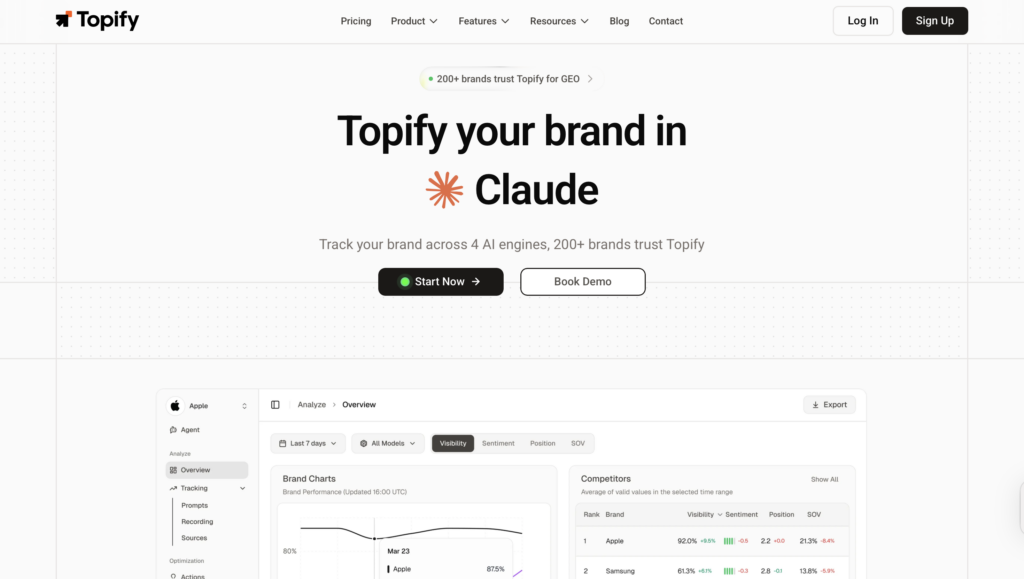
Topify automates this entire step. Its Visibility Tracking feature monitors brand mentions across ChatGPT, Gemini, Perplexity, DeepSeek, and other major AI platforms, scoring each appearance across seven key metrics: visibility, sentiment, position, volume, mentions, intent, and CVR. What takes 20 minutes manually takes seconds with the right tooling.
Step 2: Map Your Competitors’ AI Presence (10 Min)
Your baseline only tells half the story. The other half is who’s showing up instead of you.
In mature categories, the gap can be severe. Analysis of the HR software sector shows that top brands dominate nearly 86% of the consideration set in AI responses. In manufacturing, the picture looks different: brands are tightly clustered, with the leader holding just 27.2% Share of LLM. The competitive dynamics of your specific industry determine whether you’re fighting for a dominant position or competing for marginal visibility gains.
Run your same prompt set and document every competitor the AI mentions. Pay attention to patterns. Is one competitor consistently appearing first? Is another being recommended for a use case that should be yours?
Doing this manually across three platforms and 10 prompts means reviewing 30 responses and cataloging every brand mention. Topify’s Competitor Monitoring feature handles this automatically. It detects competitors across your tracked prompts, compares visibility, sentiment, and position side by side, and flags when a new competitor enters the AI’s recommendation set.
Step 3: Check What AI Says About Your Brand (5 Min)
Showing up is only half the battle. What the AI says about you matters just as much.
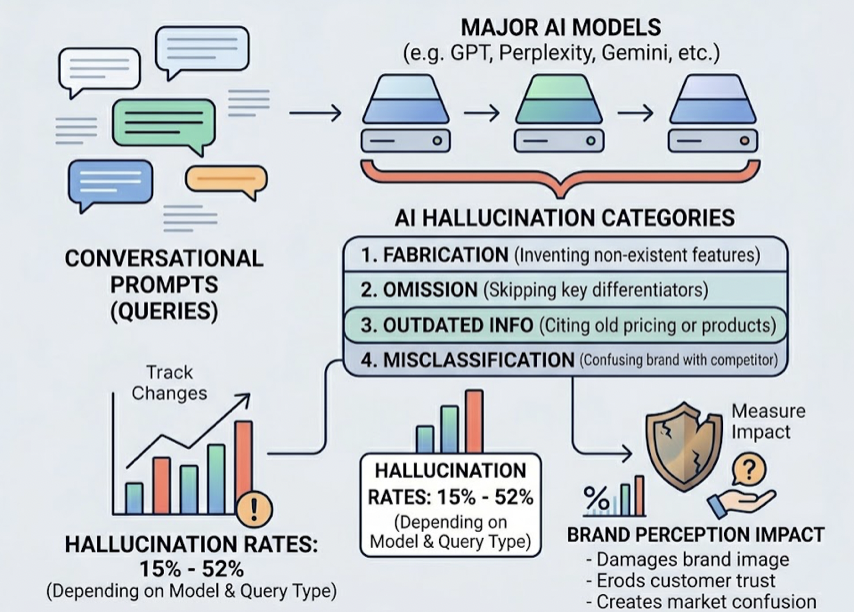
Hallucination rates across major models remain stubbornly high, ranging from 15% to 52% depending on the model and query type. These aren’t just minor errors. They fall into four categories that directly impact brand perception: fabrication (inventing features you don’t have), omission (skipping key differentiators), outdated information (citing old pricing or discontinued products), and misclassification (confusing your brand with a competitor).
For this step, review each AI response about your brand and check for two things. First, sentiment: is the AI’s tone positive, neutral, or negative? Second, accuracy: does the description match your actual positioning?
Researchers use an embedding similarity score to measure this precisely. A score close to 1.0 means the AI’s representation aligns with your brand identity. A drop below 0.95 signals what’s called “Semantic Drift,” where the AI’s version of your brand has diverged from reality.
Topify’s Sentiment Analysis tracks this on a 0-100 scale across every monitored prompt, so you can spot reputation risks before they compound.
Step 4: Trace Where AI Gets Its Information (5 Min)
If the AI is getting your brand story wrong, the next question is: where is it getting its information?
The answer is often surprising. Late-2025 citation data shows that YouTube accounts for 23.3% of average AI citations, Wikipedia for 18.4%, and Google.com for 16.4%. Reddit’s share varies by prompt but is dominant in categories like gaming and consumer tech. Roughly 34% of all AI citations come from news sites and industry publications.
This means your AI visibility isn’t just determined by your website. It’s shaped by your presence across the entire citation ecosystem.
For this step, identify the specific domains the AI is citing when it talks about your category. Then check: is your brand represented on those domains? If a competitor has coverage on Gartner, Forbes, or a top industry blog and you don’t, the AI will naturally treat them as more authoritative.
Topify’s Source Analysis feature reverse-engineers exactly which domains and URLs each AI platform cites. You can see at a glance whether your brand’s owned content is in the citation mix or whether third-party sources are shaping the narrative without your input.
Step 5: Score Your Gaps and Set Priorities (5 Min)
You’ve now collected four layers of data: your visibility baseline, competitor positioning, brand accuracy, and citation sources. The final step is turning that into a prioritized action plan.
Not all gaps are equally urgent. A hallucination about your pricing is a higher priority than a missing mention in a low-volume prompt. Content that includes data and statistics can see up to a 40% increase in selection likelihood by AI models, so adding structured, data-rich content to your key pages often delivers the fastest ROI.
Score each finding on two axes: business impact (how much does this affect conversion?) and fix difficulty (how hard is it to address?). High-impact, low-difficulty items go first.
Here’s a practical prioritization framework:
| Priority | Action | Timeline |
|---|---|---|
| Immediate | Fix hallucinations, update incorrect listings | Week 1-2 |
| Short-term | Create content for prompts where competitors appear but you don’t | Month 1 |
| Medium-term | Build citation presence on high-authority third-party domains | Month 2-3 |
Topify’s CVR (Conversion Visibility Rate) metric helps quantify the business impact side of this equation. It estimates how likely an AI response is to drive a user toward your brand, so you can prioritize the prompts and platforms that actually move revenue.
What to Do After Your First AI Search Visibility Audit
A 30-minute audit gives you a snapshot. But AI recommendations shift constantly as models retrain, new content enters their index, and competitor activity changes the picture.
The AI search market is projected to grow from $43.6 billion in 2024 to $379 billion by 2030, capturing over 62% of total search volume. The shift toward agentic AI, where models don’t just answer questions but make purchasing decisions on behalf of users, means the stakes will only increase. Your brand’s AI visibility today shapes whether an AI agent recommends you tomorrow.
That’s why a one-time audit isn’t enough. The brands that win in AI search are the ones that monitor continuously, not quarterly.
Topify turns this manual audit into an automated, always-on system. Its platform covers every step outlined above: visibility tracking, competitor benchmarking, sentiment monitoring, source analysis, and conversion impact scoring. You can define your goals in plain English, review the proposed strategy, and deploy with a single click. No manual workflows required.
The gap between brands that track AI visibility and those that don’t is widening every month. Thirty minutes is all it takes to see which side you’re on.
Conclusion
AI search visibility isn’t a future concern. It’s a present-day competitive advantage that most brands still aren’t measuring. The 30-minute audit framework covered here gives you a structured, repeatable process: establish your baseline, map competitor presence, verify brand accuracy, trace citation sources, and prioritize your gaps.
The brands that treat AI visibility as a data problem, not a guessing game, will be the ones AI systems recommend with confidence.
FAQ
What is an AI search visibility audit?
An AI search visibility audit is a structured review of how your brand appears across generative AI platforms like ChatGPT, Gemini, and Perplexity. It evaluates whether your brand is mentioned, how accurately it’s described, where the AI sources its information, and how you compare to competitors.
How often should I audit my brand’s AI search visibility?
A manual audit is a good starting point, but AI responses change frequently as models update and new content enters their training data. Ideally, brands should monitor AI visibility weekly or use automated tools like Topify for continuous tracking.
Which AI platforms should I include in my audit?
At minimum, cover ChatGPT, Google Gemini, and Perplexity. These three represent the largest share of AI search traffic. For global brands, consider adding DeepSeek, Doubao, and Qwen to cover non-English markets.
Can I audit AI search visibility without paid tools?
Yes. You can manually run prompts across AI platforms and record the results in a spreadsheet. The trade-off is time: a manual audit covers a limited number of prompts and platforms, while tools like Topify can monitor hundreds of prompts across multiple AI engines continuously.
What’s the difference between traditional SEO and AI search visibility?
Traditional SEO focuses on ranking in search engine result pages through backlinks and keyword optimization. AI search visibility focuses on being cited and recommended within AI-generated answers, which depends on semantic clarity, structured data, and third-party authority rather than just domain ranking.

