

You published the article. You got the rankings. Then a colleague searched your category on Perplexity and got a synthesized answer that cited three competitors and not you. Your domain authority didn’t matter. Neither did your keyword rankings. The AI looked at your content and decided it wasn’t citable.
That gap between “ranking” and “being cited” is what Answer Engine Optimization (AEO) is built to close. Here’s a checklist of the 10 signals that determine whether your content makes it into an AI answer or gets filtered out during retrieval.
Most Content Fails the AI Citation Test Before the AI Reads a Word
Traditional search evaluates your content after finding it. Generative AI evaluates your content before deciding to use it.
The filtering mechanism is the RAG (Retrieval-Augmented Generation) pipeline. When a user submits a query to ChatGPT Search, Perplexity, or Gemini, the system doesn’t crawl the web in real time. It retrieves pre-indexed chunks of content and scores them for relevance, authority, and extractability. If your content scores low on any of these, it gets bypassed, not because it’s wrong, but because it’s hard to parse.
The practical consequence: approximately 52% of search queries now result in no AI Overview, but for those that do, the synthesized answer typically cites a small pool of high-scoring sources. A winner-takes-most pattern emerges where Wikipedia, major media outlets, and a handful of domain-specific authorities capture most citations. The 10 signals below are what separates those sources from everyone else.
Signal #1–3: Structure Signals (Be Easy to Extract)
AI systems process content in chunks, not pages. Each chunk needs to stand alone and score well against the user’s query vector. That requires structural decisions at the paragraph level.
Signal #1: Answer-First Format
State the conclusion in the first sentence. Not after three paragraphs of context. Not as the closing summary.
Pages using FAQPage schema and clear Q&A structures are 2.7x more likely to be cited than those structured as narrative prose. The RAG retriever needs to lift a chunk and immediately recognize that it answers the user’s query. If the answer is buried, the chunk gets a lower relevance score and another source wins.
Signal #2: Headers That Mirror Real Queries
“Benefits of Our Approach” tells a human reader something general. It tells an AI retriever almost nothing useful. “How does X reduce operational costs by 20%?” creates a high-confidence vector match for users asking that exact question.
Hierarchical headings that use natural-language questions improve citation likelihood by 40%. The hierarchy itself matters too. H2 to H3 relationships help AI bots map which sub-topics belong to which parent concept, improving the semantic coherence of each retrieved chunk.
Signal #3: Modular Paragraphs
One paragraph, one idea. Sentences under 25 words. Paragraphs between 60 and 120 words.
This isn’t a stylistic preference. Sentences under 25 words improve the extractability score by 70% because they reduce syntactic complexity, which makes the content easier for AI to parse without misrepresentation. When a retriever pulls a chunk from a dense, multi-clause paragraph, the meaning often degrades. Modular writing prevents that.
Signal #4–6: Authority Signals (Be Worth Trusting)
Structure gets your content into the retrieval pool. Authority determines whether AI engines consider it trustworthy enough to cite. E-E-A-T (Experience, Expertise, Authoritativeness, Trustworthiness) acts as a binary filter at this stage. Low E-E-A-T content often gets excluded from AI answers entirely, regardless of where it ranks in traditional search.
Signal #4: Original Data and First-Hand Research
AI models prioritize “information gain,” data that expands what the model already knows. Generic content that restates common knowledge scores poorly. Proprietary research, case studies with quantified outcomes, and statistical benchmarks score well.
Content with original statistics or expert quotes sees a 30–40% increase in citation probability. That’s a significant edge for brands willing to publish genuine research instead of synthesized summaries of what other people have already published.
Signal #5: Author Credentials and Entity Signals
AI bots don’t just read your content. They cross-reference your authors across the web to validate expertise.
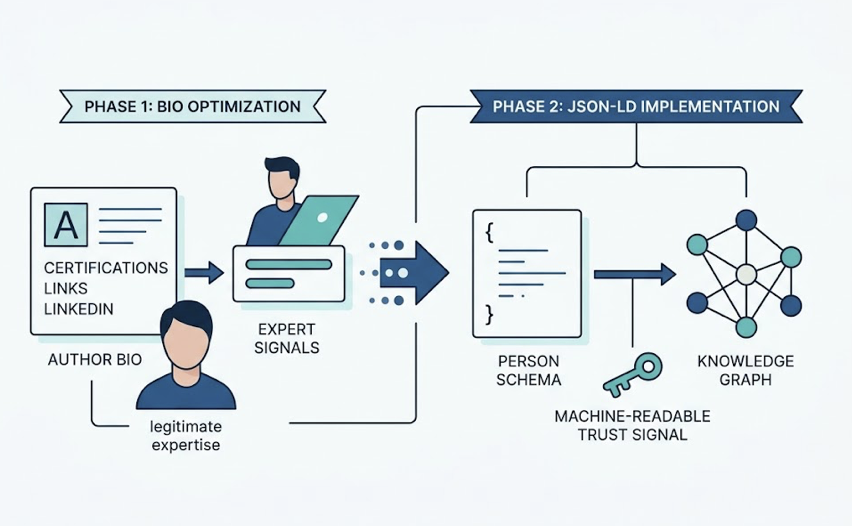
Detailed author bios (200–300 words) with professional certifications, links to published work, and LinkedIn profiles give the AI the signals it needs to confirm that the person behind the content has legitimate expertise. Implementing Person schema in JSON-LD to link authors to their entity in the knowledge graph is the technical step that turns bio information into a machine-readable trust signal.
Signal #6: Third-Party Consensus and Earned Media
Backlinks still matter in AEO, but their function has shifted. In traditional SEO, a backlink was a ranking vote. In AEO, it’s a consensus signal.
Approximately 34% of AI citations come from PR and earned media coverage. When authoritative news outlets, industry journals, and review platforms like G2 mention your brand independently, AI engines interpret that as external validation of your entity. Brands that treat PR as separate from SEO are leaving a significant portion of their citation authority unbuilt.
Signal #7–8: Relevance Signals (Match Intent, Not Keywords)
Keyword density is irrelevant to AEO. What matters is whether your content fully satisfies the intent behind the query, covering the complete semantic space a user would expect an expert to address.
Signal #7: Direct Answer Within the First 100 Words
The retrieval score of any document is heavily influenced by how quickly the opening text aligns with the user’s query. The first 100 words function as the document’s “executive summary” for AI systems.
This is structurally opposite to traditional SEO, which often delayed the core answer to maximize dwell time. In AEO, speed of answer is a feature. Adding a “TL;DR” or “Quick Answer” box at the top of key pages is one of the fastest AEO improvements a content team can make to legacy content.
Signal #8: Semantic Coverage of the Full Topic
A single article on “email automation” that never mentions deliverability, segmentation, or SMTP looks shallow to an AI model. Topical authority is measured by whether related entities and concepts appear naturally throughout the content.
Brands that publish clusters of 10+ interconnected articles on a specific theme rank higher in AI citation pools than those with isolated posts. The cluster signals that the domain understands the full topic, not just one angle of it.
Signal #9–10: Freshness and Format Signals (Be Machine-Ready)
The final two signals are technical. They don’t require new content creation. They require updating how existing content is structured and marked up for machine consumption.
Signal #9: Visible Last Updated Date
Perplexity and SearchGPT have a documented temporal bias. Content published within the last 12 months accounts for roughly 65% of AI bot hits. Content that appears outdated, even if factually accurate, gets deprioritized.
A visible “Last Updated” date on the page, combined with a dateModified timestamp in the schema, signals to AI crawlers that the content reflects current information. This matters especially for fast-moving topics where accuracy is time-sensitive.
Signal #10: Schema Markup and llms.txt
Schema markup is a translator between human prose and machine logic. FAQPage schema alone delivers a 2.7x improvement in citation rates, and general schema implementation makes content 3x more likely to earn AI citations.
The technical implementation that matters most: nested JSON-LD that connects products to organizations, organizations to authors, and authors to their published work. This removes ambiguity for AI crawlers. Additionally, the emerging llms.txt standard provides a curated, Markdown-formatted index of a site’s most important pages specifically for AI bots, bypassing JavaScript-heavy layouts that AI crawlers struggle to parse cleanly.
Checking Boxes Isn’t Enough If You Can’t See the Results
Here’s the thing: you can implement all 10 signals and still not know whether any of it is working. Most analytics platforms categorize AI referral traffic as “Direct,” which means the citation impact is invisible in standard dashboards.
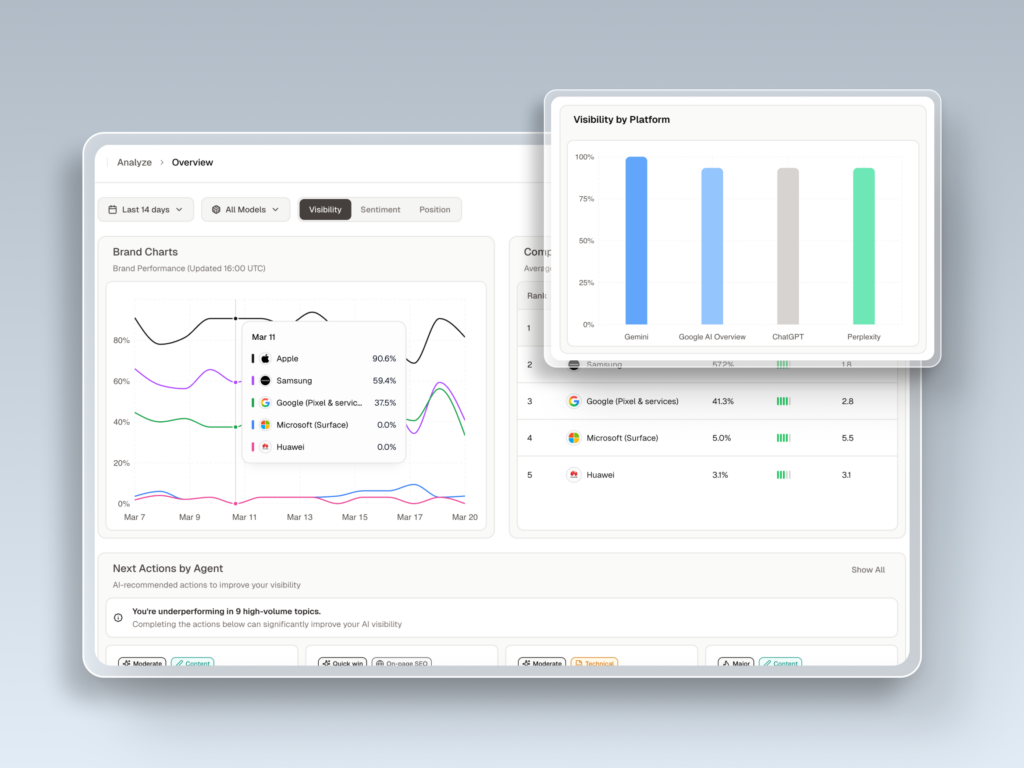
That’s where source forensics becomes necessary. Topify’s Source Analysis feature reverse-engineers the footnotes of AI answers across ChatGPT, Gemini, Perplexity, and AI Overviews to identify which third-party domains are actually driving citations in your category. If a competitor is consistently cited while you aren’t, Topify surfaces which sources they’re earning coverage from and which content signals are driving the AI’s preference.
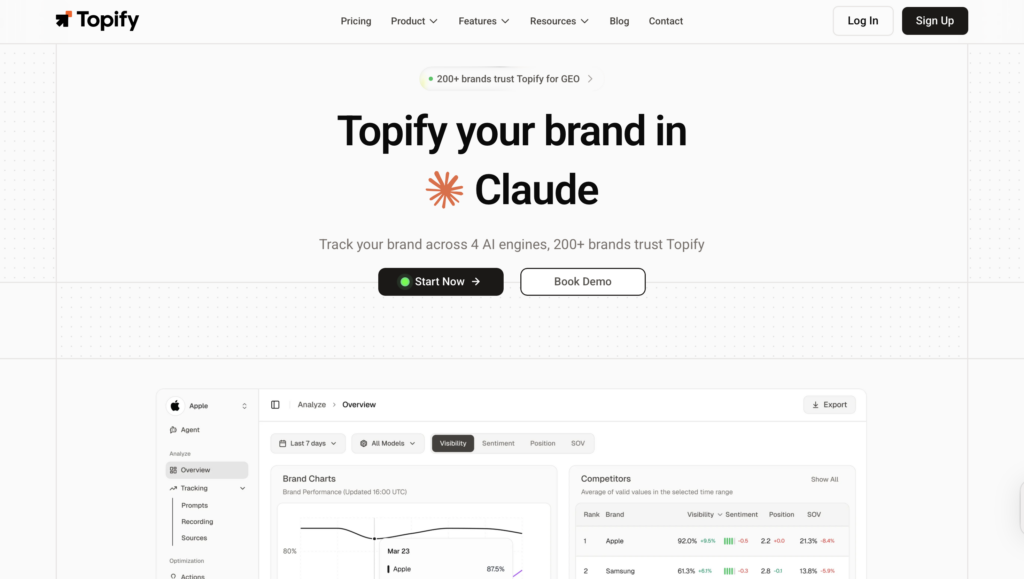
The Visibility Tracking layer then turns that diagnostic data into a measurable growth channel: tracking how often your brand appears per 1,000 relevant queries, monitoring recommendation position, and connecting AI citation patterns to downstream conversion signals through CVR (Conversion Visibility Rate) data.
Running the checklist without tracking is optimization without feedback. The two need to work together.
Conclusion
Implementing the AEO checklist is a content audit, not a one-time fix. Start with your highest-traffic pages. Update the structure to answer-first format, convert headers to natural-language questions, add FAQPage schema, and make “Last Updated” visible. Then measure.
The brands that will dominate AI citations in the next 12 months aren’t necessarily the ones with the largest content libraries. They’re the ones that understood the citation filter early and get started optimizing for it before competitors did.
FAQ
Q: What is the difference between SEO and AEO?
A: SEO focuses on ranking in a list of results by optimizing for keywords and backlinks. AEO focuses on being selected as a cited source inside a synthesized AI answer by optimizing for structural clarity, semantic alignment, and entity-based authority.
Q: How long does it take to get cited by AI after optimizing content?
A: Established brands with existing authority may see citations within 2–4 weeks on Claude or 3–6 weeks on Perplexity. Newer brands with limited entity signals typically need 12–18 months to build the authority threshold required for consistent citation.
Q: Does content length affect AEO citation rates?
A: Structure matters more than length. ChatGPT tends to favor in-depth content (2,000+ words), while Perplexity and AI Overviews prioritize concise, modular segments that can be extracted independently. The practical answer: write complete coverage, then make sure each section reads as a standalone unit.
Q: Can older content be updated for AEO without rewriting it entirely?
A: Yes. Adding a “Quick Answer” box to the top, restructuring headers into questions, implementing FAQPage schema, and updating the dateModified timestamp are high-impact changes that don’t require rebuilding the article from scratch.

