

You built a keyword matrix. Mapped 3,000 terms by volume, grouped into content pillars, distributed across a six-month editorial calendar. Then someone on your team typed your category into ChatGPT, and your brand wasn’t mentioned once. Not because the content was wrong. Because it was built for the wrong engine.
That’s the gap most SEO teams are hitting in 2026. Keyword research didn’t become obsolete. It became more complicated.
Keyword Research Didn’t Die. It Multiplied.
The prevailing narrative is that GEO and AEO have replaced keyword research. That’s not what’s happening.
These disciplines are built on the same foundation — understanding the language people use to describe their problems — applied to a new set of platforms. The battlefield expanded. Traditional SEO still governs high-volume, reflexive lookups. But ChatGPT now handles 17.1% of all digital queries and reaches over 900 million weekly active users. Perplexity processes 780 million monthly queries. These aren’t experimental channels anymore.
The structural shift is not one search bar, but many. And each one requires its own keyword strategy.
The Skills You Already Have Transfer Directly
Intent analysis. Volume estimation. Competitive mapping. These three competencies are the pillars of keyword research, and they’re equally relevant in AI search.
The only thing that changed is the unit of study. In traditional SEO, you researched “keyword fragments.” In AI search, you research “conversational prompts.” A professional who already knows how to ask “what language do people use when they describe this problem?” is already doing 80% of the work that GEO and AEO require.
Here’s the practical translation: “how to reduce SaaS churn” becomes “Compare the top 5 churn reduction strategies for mid-market enterprise SaaS.” Same intent cluster. Different linguistic register.
The tooling must upgrade. The analytical thinking doesn’t need to change.
Why Ignoring AI Search Keywords Leaves 30%+ of Discovery Behind
More than 30% of global search traffic now flows through conversational AI ecosystems, never touching a traditional search engine. Among users aged 18 to 24, 66% already use ChatGPT as a primary research tool. This isn’t a trend. It’s a structural redistribution of discovery.
The core problem with existing keyword tools is that they’re blind to this traffic. Google’s Keyword Planner, Ahrefs, SEMrush — all are designed to surface queries with consistent monthly volume on search engines. A long-tail prompt with 200 Google searches per month might be the core of a question asked thousands of times daily on AI platforms. Traditional research will systematically miss it.
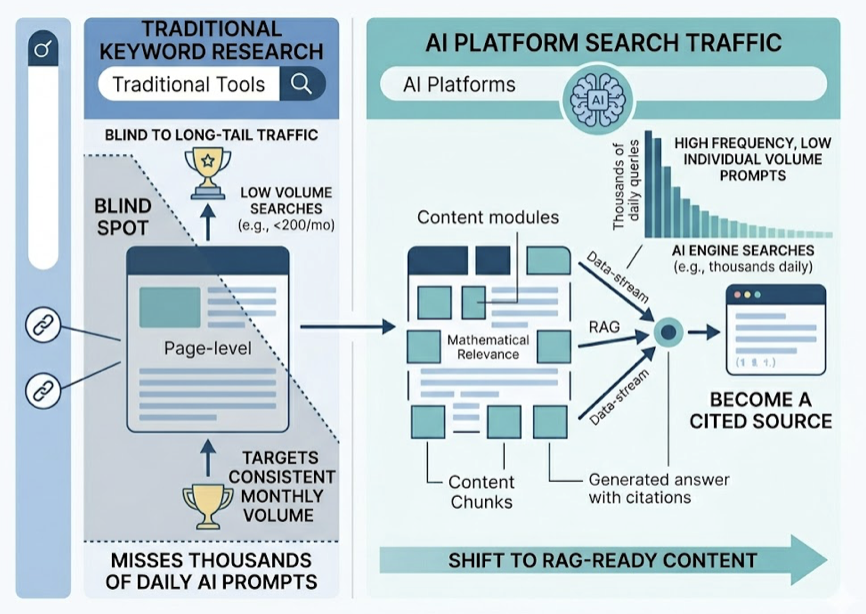
The 58-60% zero-click rate makes this worse. When AI Overviews appear, organic CTR for the top Google position drops from 1.76% to 0.61%. Not appearing in the AI answer is no longer just a missed opportunity.
It’s a visibility gap with a measurable cost.
Beyond traffic volume, AI-referred visitors convert differently. AI-referred traffic converts at 10.5% to 15.9% — compared to 1.76% for traditional organic search. In SaaS specifically, that gap widens to 57.84% versus 37.17%. One lead from an AI citation is worth approximately five to ten leads from traditional SEO. The economics of ignoring AI search keywords aren’t just about impressions.
They’re about pipeline.
What AEO Actually Is (And Why It Starts With Keyword Research)
Answer Engine Optimization (AEO) is the practice of structuring content so that AI-powered platforms — Google’s AI Overviews, Perplexity, Bing Copilot — select it as a cited source when generating direct answers. In 2026, AEO is the discovery layer of SEO. It focuses on becoming the answer, not just ranking near it.
The first step of AEO is not about content format.
It’s about identifying the right prompts. A brand can’t optimize for everything. The process begins by finding the top 10 to 20 “Golden Prompts” — the specific questions where being cited would have the greatest impact on trust and conversion. That identification process is keyword research, applied to AI platforms instead of a search bar.
Once those prompts are identified, the content requirements become structural. Research shows that 68.7% of all ChatGPT citations follow a strict heading hierarchy (H1 → H2 → H3). For smaller domains, articles over 2,900 words have a 65% greater impact on AI citation probability than shorter content. Answer-first structure — leading with a direct 40-60 word response — dramatically increases the “liftability” of content for AI synthesis.
How to do AEO if you already have an SEO workflow
Start with the intent clusters from your existing keyword research. Translate each cluster into the conversational prompt format users bring to AI assistants. Then restructure your top-performing content into an answer-first format: direct definition at the top, strict heading hierarchy throughout, and FAQ schema covering the top questions in each cluster.
The most impactful single change most content teams can make: front-load the answer. AI models extract the first well-formed response to a question and treat it as the citation candidate. Burying the answer in paragraph three means the content won’t be “lifted,” regardless of how good the rest of the page is.
The GEO Tools That Replace Your Keyword Planner for AI Search
Traditional keyword tools can’t tell you what people are asking on ChatGPT. That’s the functional gap a new category of GEO tools was built to fill.
Topify is one of the specialist platforms built specifically for this use case. Its High-Value Prompt Discovery feature analyzes AI responses at scale to surface the specific prompts where a brand should be visible but isn’t — the AI-era equivalent of keyword gap analysis. Unlike a traditional keyword tool that surfaces search volume, Topify surfaces opportunity gaps in AI citation coverage.
The platform’s AI Volume Analytics quantifies monthly prompt volume across AI tools, so teams can prioritize content investment based on actual AI search demand rather than Google estimates. Source Analysis goes further, reverse-engineering which external domains the AI currently trusts for a given topic — giving content teams a roadmap for where to build authority off-site.
For teams tracking across multiple platforms, Topify’s Visibility Tracking monitors brand mentions across ChatGPT, Gemini, Perplexity, DeepSeek, and others simultaneously. Pricing starts at $99/month for the Basic plan, covering 100 prompts and 9,000 AI answer analyses per month.
Here’s how that compares to traditional tooling:
| Feature | Traditional SEO Tool | Topify (GEO-native) |
|---|---|---|
| Keyword / Prompt Discovery | Search engine queries | AI platform prompts |
| Volume Metric | Monthly Google searches | Monthly AI prompt volume |
| Competitive Benchmarking | Ranking positions | AI citation frequency vs competitors |
| Source Intelligence | Backlink profiles | Domains AI trusts and cites |
| Platform Coverage | Google, Bing | ChatGPT, Gemini, Perplexity, DeepSeek + |
The contrast matters for budgeting decisions too. Enterprise tools with AI add-ons (Ahrefs’ Brand Radar, SEMrush’s AI Toolkit) can exceed $699/month. GEO-native platforms provide core AI visibility research for a fraction of that, making the entry barrier lower than most teams assume.
A 2026 Keyword Research Workflow That Covers Both Channels
The most effective teams in 2026 aren’t running separate SEO and GEO programs. They’re running one intent research process that feeds two execution layers.
Step 1: Identify Intent Clusters (SEO layer)
Start with traditional keyword research. Use Ahrefs or SEMrush to group high-value topics into intent clusters — categories defined by the problem they solve, not the exact phrases. “Cloud migration security” or “remote team productivity” are intent clusters. Individual keywords are just entry points into them.
Step 2: Translate Clusters into Prompts (AI layer)
Take each intent cluster and convert it into natural language questions. “Cloud migration security” becomes “What are the hidden risks of migrating a legacy database to AWS?” Same intent. Different register. This translation step is where most SEO teams stop — and where AI visibility gaps begin.
Step 3: Validate with GEO Analytics (validation layer)
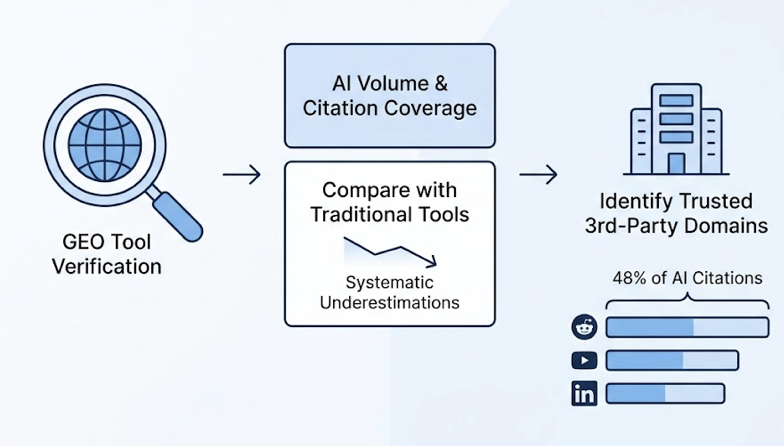
Run those prompts through a GEO tool to verify AI volume and competitive citation coverage. This step surfaces the systematic underestimations that traditional tools produce. It also identifies which third-party domains the AI trusts for your topic. Reddit, YouTube, and LinkedIn collectively account for 48% of all AI citations — meaning your SEO strategy needs to account for these platforms, not just your own domain.
Step 4: Prioritize by Dual Potential (execution layer)
Rank content opportunities by a combined score: Google ranking potential and AI citation probability. The highest-priority content wins on both channels. Adding original statistics increases AI visibility by up to 40%. Citing primary sources and using direct answer introductions are the highest-ROI structural changes most content teams can make today.
That’s not two workflows. It’s one workflow, run smarter.
The Part Most Keyword Strategies Miss Entirely
Here’s a data point that shifts how keyword research should be scoped: 85% of brand mentions in AI search originate from third-party pages — listicles, review roundups, comparison articles, community threads.
Being visible in AI responses isn’t just about what’s on your domain. It’s about what the internet says about you.
This creates a new category of research: off-site keyword discovery. The process involves identifying which Reddit threads, YouTube tutorials, G2 reviews, or industry roundups the AI is using as its source of truth for your category — then optimizing for presence there, not just on owned content.
Only 11% of cited domains overlap between ChatGPT and Perplexity. A brand with a single-platform SEO strategy has a structural visibility blind spot across the rest of the LLM landscape. Keyword research must now inform a distribution strategy, not just an on-site content calendar.
Conclusion
The argument that keyword research is dead is usually made by people who were only doing one kind of keyword research. The professionals who built strong intent analysis skills aren’t starting over. They’re extending what they already know into a new layer of the search landscape.
The discovery channel is fragmenting. But the intent behind it isn’t. Keyword research — expanded to cover prompts, AI platforms, and off-site citation networks — is the infrastructure that connects both. The brands that treat GEO and AEO as separate programs from their keyword strategy will build two incomplete maps. The ones that unify the research layer will own visibility across both.
Get started with Topify to map your brand’s AI prompt visibility and identify the specific discovery gaps your current keyword strategy is missing.
FAQ
Q: Is traditional keyword research still useful in 2026?
A: Yes. It remains the foundation for understanding intent and driving site traffic. It needs to be extended, not replaced, with prompt-based research to capture the 30%+ of discovery now happening on AI platforms like ChatGPT and Perplexity.
Q: What’s the difference between SEO keyword research and GEO or AEO research?
A: SEO research focuses on search volume and competition for reflexive lookups on search engines. GEO and AEO research focuses on conversational prompts — the specific questions that trigger citations and brand recommendations inside AI chat interfaces.
Q: How do I start doing AEO if I already have an SEO workflow?
A: Begin by identifying your top 10 informational “Golden Prompts” — the questions where being cited would most impact trust and conversion. Restructure your best-performing content with a direct 40-60 word answer at the top of each section, implement FAQ and HowTo schema, and enforce a strict H1 → H2 → H3 heading hierarchy throughout.
Q: What are the best AEO tools and GEO tools for AI search visibility in 2026?
A: For prompt discovery and AI citation tracking, Topify is a specialist platform built specifically for this use case. For broader coverage with SEO integration, Ahrefs’ Brand Radar and SEMrush’s AI Toolkit provide enterprise-grade options. Budget-conscious teams can also evaluate LLMrefs as an entry point into AI visibility monitoring.

