

As AI engines replace traditional search for millions of queries, brands that optimize only for Google are becoming invisible where it matters most.
You’ve built a solid SEO strategy. Your brand ranks on page one. Traffic holds steady in Google Search Console. And then someone asks ChatGPT for the best tool in your category. Your name doesn’t come up once.
That’s not a fluke. It’s a structural problem.
The rules of digital visibility have split into two separate games. Search Engine Optimization was built to win one of them. Answer Engine Optimization (AEO) is what you need to win the other. Right now, most brands are only playing one.
Google Ranks Pages. AI Engines Pick Winners.
Traditional SEO was built around one idea: get indexed, get ranked, get clicked. The logic made sense for two decades. Google’s algorithm rewarded keyword relevance, backlink authority, and technical compliance. Check the right boxes, move up the list.
AI search engines work differently. When someone asks ChatGPT or Perplexity a question, the engine doesn’t return a list of links. It synthesizes an answer and cites the sources it trusts most. The question shifts from “who ranks highest?” to “who does the AI choose to quote?”
That’s a fundamentally different optimization problem.
| Logic Component | Traditional SEO | AEO |
|---|---|---|
| Primary Goal | Rank at the top of a results list | Be the cited source in a synthesized answer |
| Core Metric | Clicks, impressions, SERP position | Citation share, brand mentions, sentiment |
| Optimization Focus | Keyword density, backlink volume | Semantic clarity, entity structure, consensus |
| Authority Signal | Domain Authority, PageRank | Factual accuracy, E-E-A-T, cross-platform proof |
| User Interaction | Search → Click → Website visit | Question → Direct AI response → Brand trust |
The algorithm didn’t just change. The object you’re optimizing for changed.
The Overlap Number That Should Worry Every Marketing Team
Here’s a concrete data point to anchor this shift.
In 2024, roughly 70% of URLs appearing in AI citations also showed up in Google’s top 10 results. By 2026, that overlap has collapsed to under 20%. For ChatGPT specifically, the URL overlap with Google’s top 10 is down to 8%. For Gemini, it’s 6%.
A brand with strong Google rankings has, at best, a single-digit probability of appearing in AI-generated answers on those platforms.
Only Google’s own AI Overviews maintain a high correlation at 76%, because they’re designed to summarize the existing search index. Every other major AI engine has effectively built its own citation logic, independent of where you rank on Google.
Zero-click searches now exceed 65% in many categories. Users get their answer directly from the AI and never visit a page. If you’re not the cited source, you don’t exist in that interaction.
What AEO Actually Optimizes For (It’s Not Keywords)
AEO isn’t about feeding keywords to a crawler. It’s about making your brand the most extractable, trustworthy source available when an AI builds its answer.
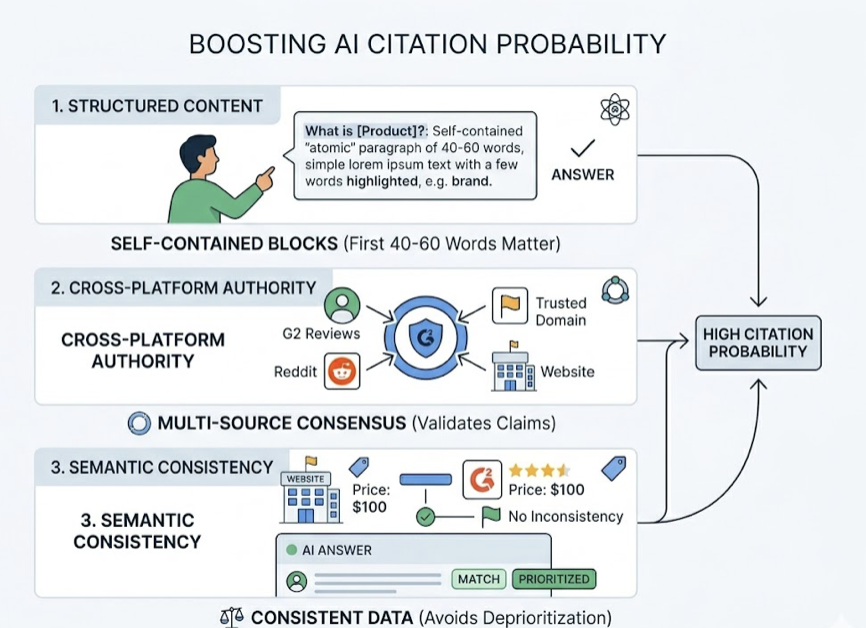
Three things drive citation probability. First, structured content: AI models prefer “atomic” paragraphs broken into self-contained blocks that answer one question without requiring surrounding context. The first 40-60 words of any section are often decisive. Second, cross-platform authority: AI engines use multi-source consensus to validate claims. If multiple trusted domains, G2 profiles, Reddit threads, and industry publications all point to the same factual claim about your brand, citation probability rises. Third, semantic consistency: if your pricing on your website contradicts what’s on a review platform, an AI model will flag the inconsistency and deprioritize your brand.
AEO doesn’t replace SEO. It sits on top of it. Without a solid technical foundation, AI engines won’t trust your site enough to cite it in the first place.
Why Your Google Rank Doesn’t Transfer to ChatGPT
This is where a lot of marketing teams hit a wall. The SEO investment they’ve built over years feels like it should count for something in AI search. Often, it doesn’t, and here’s the mechanism behind that.
Traditional search uses vector-based keyword matching and link-based authority scores. AI search uses Retrieval-Augmented Generation (RAG): the model retrieves chunks of text from multiple sources, performs consensus validation, and synthesizes a response. If your content lacks clear entity signals and third-party corroboration, the AI retriever skips it, regardless of your Google ranking.
AI models also carry biases that SEO was never designed to address. Perplexity prioritizes content updated within the last 30 days, regardless of organic ranking. Narrative-heavy content, the standard in traditional SEO, is often passed over in favor of reference-style content with a higher ratio of facts to words.
There’s also a blind spot many brands discover too late: some inadvertently block AI crawlers like GPTBot and PerplexityBot in their robots.txt file while allowing Googlebot. Their site is technically invisible to the very models they most need to influence.
What the Princeton Data Says About AEO Techniques That Actually Work
The first peer-reviewed evidence came from a landmark Princeton University study titled “Generative Engine Optimization,” which introduced a benchmark called GEO-bench to measure how specific content changes affect citation rates.
The results were unambiguous.
| AEO Technique | Visibility Increase | Why It Works |
|---|---|---|
| Cite Sources | +115.1% | Shows the AI where the claim came from |
| Expert Quotations | +41.0% | Signals authority through named provenance |
| Add Statistics | +37.0% | Converts vague claims into extractable facts |
| Keyword Stuffing | Negative | Penalized as low information-gain content |
Citing credible external sources more than doubled citation probability for brands originally sitting in the 5th position on search results. The AI effectively rewards a scholarly approach to content over a traditional marketing approach.
Keyword stuffing, the defining tactic of early-2000s SEO, was the single least effective method and in some cases actively reduced visibility below non-optimized baseline content.
That’s not a subtle difference. That’s a complete reversal of what used to work.
The Brand That Cracked AEO First
In the project management software category, Asana scores 12/12 across multi-platform AI visibility tests. Monday.com follows at 11/12. ClickUp at 10/12.
These aren’t just well-known brands. They’ve built content architecture that AI engines specifically prefer.
Asana maintains what analysts call a “Comparison Hub”: dedicated, structured pages for every major competitor. These pages aren’t marketing copy. They’re organized around the exact entities and relationships AI systems look for, including features, integrations, pricing, and category definitions. The AI retriever finds a clean, extractable chunk and cites it.
ClickUp earns citations by positioning itself as the source of truth for the entire category, not just its own product. A Perplexity recommendation for ClickUp often points directly to a ClickUp blog post titled “Top 10 AI Tools for Startups.” The brand trained AI engines to see it as a category authority, not just a vendor.
82-85% of citations in AI responses come from third-party sources. Your own website, no matter how well-optimized, is only part of the equation. Perplexity alone pulls 46.7% of its citations from Reddit and community forums. Winning at AEO means winning on platforms you don’t own.
How to Know If You Have an AEO Visibility Problem Right Now
Three questions cover most of the diagnostic work.
When you ask ChatGPT or Perplexity for a recommendation in your category, does your brand appear? If not, you have a visibility gap. When your brand is mentioned, is your own domain cited as the source, or is the AI pulling from a competitor’s blog or a third-party review? If it’s the latter, you have a citation authority problem. Are your competitors appearing in AI responses for your highest-intent queries while you’re absent?
The challenge is that traditional SEO tools can’t answer these questions. Google Search Console doesn’t track whether ChatGPT recommended your brand today.
Topify was built for exactly this layer. It tracks brand visibility across ChatGPT, Perplexity, Gemini, and other major AI platforms, using a methodology called Synthetic Probing to run thousands of query variations and calculate a statistically significant Share of Voice. Instead of guessing, you get a number.
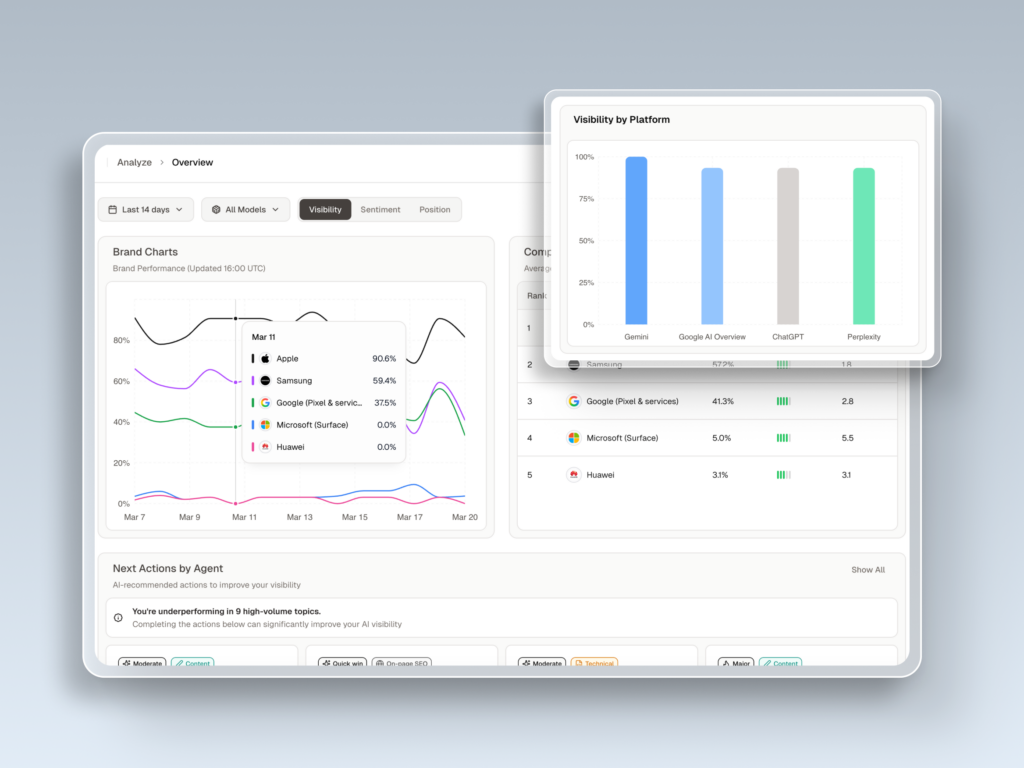
Topify’s Source Analysis goes further. It reverse-engineers which URLs AI engines are actually citing when they mention your category. If a competitor keeps appearing because of a specific Reddit thread or a niche industry listicle, Topify surfaces that source directly. Passive monitoring becomes active competitive intelligence.
For teams that need to act quickly, Topify’s One-Click Execution lets you define AEO goals in plain English and deploy a strategy without manual workflows. New or refreshed content can enter AI citation pools in as little as 3-5 days, compared to 3-6 months for Google ranking movement.
That’s the gap, spelled out in time: weeks vs. months.
Conclusion
SEO isn’t dead. It’s still the foundation. But it’s no longer sufficient.
The brands that will lead the next five years aren’t just optimizing for keywords. They’re optimizing for answers. They’re structuring content for extraction, building authority across platforms they don’t own, and measuring visibility where their customers are actually asking questions.
AEO is not a future trend. It’s the current playing field.
Start by measuring. Check whether your brand appears when an AI gets asked about your category. If it doesn’t, you now know why, and you know what to fix.
FAQ
Is AEO the same thing as GEO?
They’re closely related but not identical. AEO (Answer Engine Optimization) is the broader practice of structuring content for direct answers across search assistants, featured snippets, and AI chatbots. GEO (Generative Engine Optimization) is a more specific subset, popularized by the Princeton study, focused on earning brand citations within narrative summaries generated by LLMs like ChatGPT and Perplexity.
Do I still need SEO if I’m doing AEO?
Yes. AEO doesn’t replace SEO; it extends it. Without a strong technical SEO foundation, AI engines won’t trust your site enough to cite it. Think of SEO as the prerequisite and AEO as what you build on top.
How long does AEO take to show results?
Faster than most teams expect. New or refreshed content can enter AI citation pools in 3-5 days. Brands tracking their AI visibility with platforms like Topify have reported measurable lifts in AI mentions within weeks, not months.
Which AI platforms should I prioritize first?
It depends on your audience. For B2B SaaS, Perplexity and ChatGPT are the highest-leverage platforms: they’re used heavily for vendor research and shortlist building. For local businesses, Google AI Overviews and Gemini matter most because of their integration with local search and maps.
What’s the single highest-ROI AEO change a brand can make today?
Based on the Princeton research, adding credible citations to your existing content delivers the highest lift (+115.1% citation rate increase). It doesn’t require a full content overhaul. Pick your five most important category pages and add external references to every major factual claim.

