

Your keyword rankings look stable. Your share of voice in Google is holding. But when a prospect asks ChatGPT for a tool recommendation in your category, your brand isn’t in the answer.
That’s not a ranking problem. It’s a monitoring gap that traditional search tools weren’t built to close.
The Search Monitor is a solid platform for what it was designed to do: PPC compliance, affiliate monitoring, and organic SERP tracking. But as AI search becomes a primary discovery channel for buyers, the tools built for the blue-link era are running into a hard structural limit. They track retrieval. They can’t track synthesis.
If you’re evaluating The Search Monitor alternatives because you want to extend visibility into ChatGPT, Perplexity, or Gemini, here’s what you actually need to understand before switching.
The Search Monitor Was Built for a Different Search Model
The Search Monitor’s core strength is monitoring search engine results pages: who’s running ads against your brand terms, which affiliates are out of compliance, where your competitors rank organically. It’s deterministic, SERP-focused, and effective within that scope.
The architecture assumes a ranked list of links. Position 1 through 10. Crawl the page, log the position, repeat.
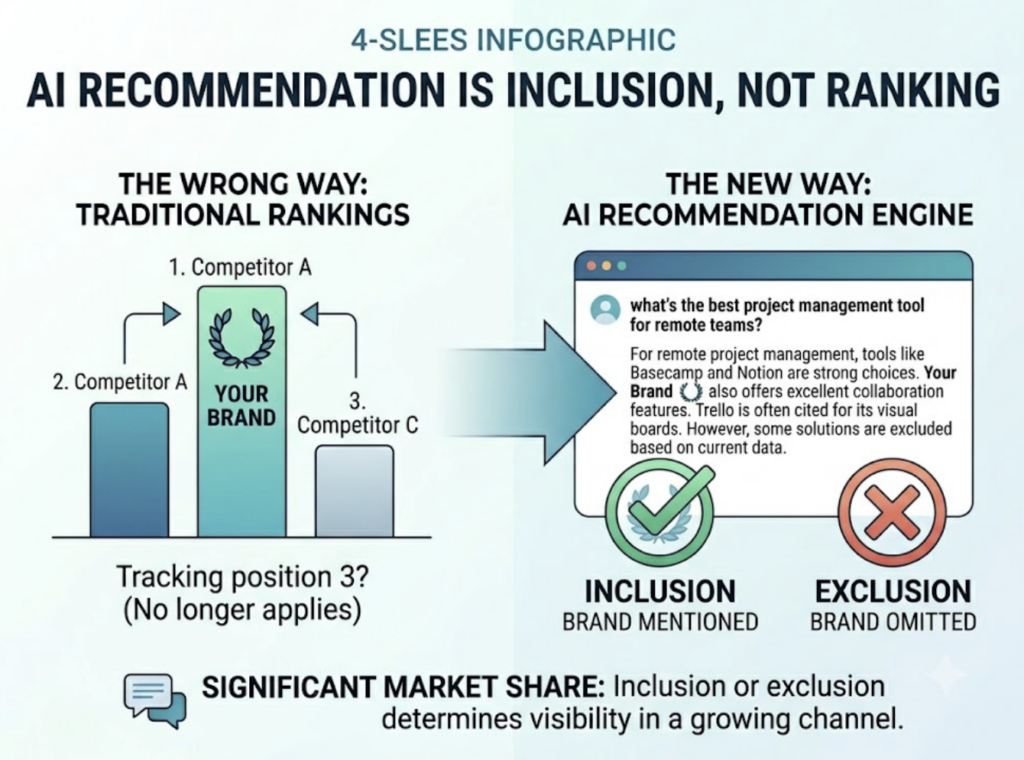
AI search doesn’t work that way. When a user asks Perplexity “what’s the best project management tool for remote teams,” the engine doesn’t return a ranked list. It generates a paragraph, cites a few sources, and either includes your brand in the narrative or doesn’t. There’s no position 3 to track. There’s inclusion or exclusion, and the difference between the two can represent significant market share in an acquisition channel that’s growing fast.
That structural gap isn’t a bug in The Search Monitor. It’s a category boundary.
Why Traditional Rank Tracking Misses the AI Visibility Signal
The shift from search rankings to AI recommendations isn’t just a new feature request. It’s a different data model entirely.
In traditional search, visibility is a function of ranking algorithms you can reverse-engineer through keyword research and backlink analysis. In AI search, visibility is a function of synthesis: which sources the model trusts, how it interprets brand authority across multiple citations, and what narrative it builds when combining those inputs.
AI engines determine what to say about your brand by aggregating “cross-source agreement” from high-authority references like G2, Reddit, Wikipedia, and industry publications. Monitoring this requires tracking the sources the AI trusts, not just your own domain’s technical SEO signals. Traditional tools have no mechanism for that.
There’s also the zero-click reality. AI engines increasingly satisfy user intent within the conversation interface. A user who gets a complete recommendation from ChatGPT doesn’t click through to a comparison page. That’s a conversion event that never registers in Google Analytics, and a brand mention that never shows up in your rank tracker.
5 Capabilities The Search Monitor Doesn’t Cover
If you’re building out an AI search monitoring stack, these are the specific gaps you’ll need to fill.
Prompt-level tracking. AI visibility is measured at the prompt level, not the keyword level. The relevant question isn’t “do I rank for ‘CRM software'”—it’s “when someone asks ChatGPT for a CRM recommendation for a 50-person startup, does my brand appear?” Running simulated buyer queries and capturing the AI’s generated response is the core monitoring unit.
Sentiment in AI answers. Being mentioned isn’t enough. AI engines sometimes describe brands in ways that contradict their positioning. A platform positioned as enterprise-grade might be described as “a good option for small teams.” Sentiment tracking within generated responses catches narrative drift before it affects pipeline.
Competitive positioning within AI responses. Share of voice in AI answers means something different than it does in traditional SEO. It’s not just about whether you’re mentioned—it’s about whether you’re mentioned first, how many competitors appear in the same response, and whether the AI frames you as a category leader or a secondary option.
Citation source analysis. AI models don’t generate information from nothing. They synthesize it from sources they consider authoritative. Knowing which third-party domains (review sites, forums, publications) are being cited when AI talks about your category tells you exactly where to focus your content and PR efforts.
Multi-platform AI coverage. AI search behavior varies significantly across engines. A brand cited frequently in Perplexity may be underrepresented in Gemini, or actively described differently in ChatGPT. Single-platform monitoring gives you a partial picture. Brands operating in competitive categories need coverage across all major AI platforms to get an accurate read on visibility.
The Search Monitor Alternatives Worth Considering
When evaluating alternatives, the key distinction is whether you’re looking for a replacement or a complement. If you still need PPC compliance and affiliate monitoring, The Search Monitor stays in your stack. The question is what sits alongside it for AI visibility.
| The Search Monitor | Topify | Other AI-Native Tools | |
|---|---|---|---|
| Primary focus | PPC/SEM compliance | AI brand synthesis | Prompt/citation analysis |
| AI platform coverage | None | ChatGPT, Gemini, Perplexity, DeepSeek, Qwen, and more | Varies; often 1-2 platforms |
| Prompt-level tracking | No | Yes (up to 250 prompts on Pro) | Partial |
| Sentiment analysis | No | Yes, scored 0-100 | Limited |
| Competitive positioning | SERP-based | AI response positioning | Partial |
| Citation source analysis | No | Yes | Varies |
| Best for | Ad/affiliate audits | Marketing and brand teams | Technical SEO/content ops |
For teams that need AI search visibility tracking as a primary dashboard, not just an add-on, the platform needs to go beyond simple mention detection. The combination of Visibility, Sentiment, Position, and Source data in a single view is what separates a monitoring tool from an intelligence layer.
Topify covers ChatGPT, Gemini, Perplexity, DeepSeek, Doubao, Qwen, and other major AI platforms, which matters if your audience isn’t limited to English-language markets. Its Basic plan starts at $99/month and includes 100 prompts and 9,000 AI answer analyses across 4 projects, with a 30-day trial.
AI-Native Tools Are a Different Category, Not Just Better Versions
Here’s the framing that helps when building the internal case for adding a new tool:
An AI visibility platform isn’t an upgraded rank tracker. It’s a different category of product solving a different measurement problem.
Think about how Google Analytics and Brandwatch sit in different parts of the marketing stack. Analytics answers “what happened on my site.” Brandwatch answers “what are people saying about us.” Neither replaces the other; they measure different things. AI visibility tools occupy a similar position relative to traditional search monitors: they’re not competing for the same measurement job.
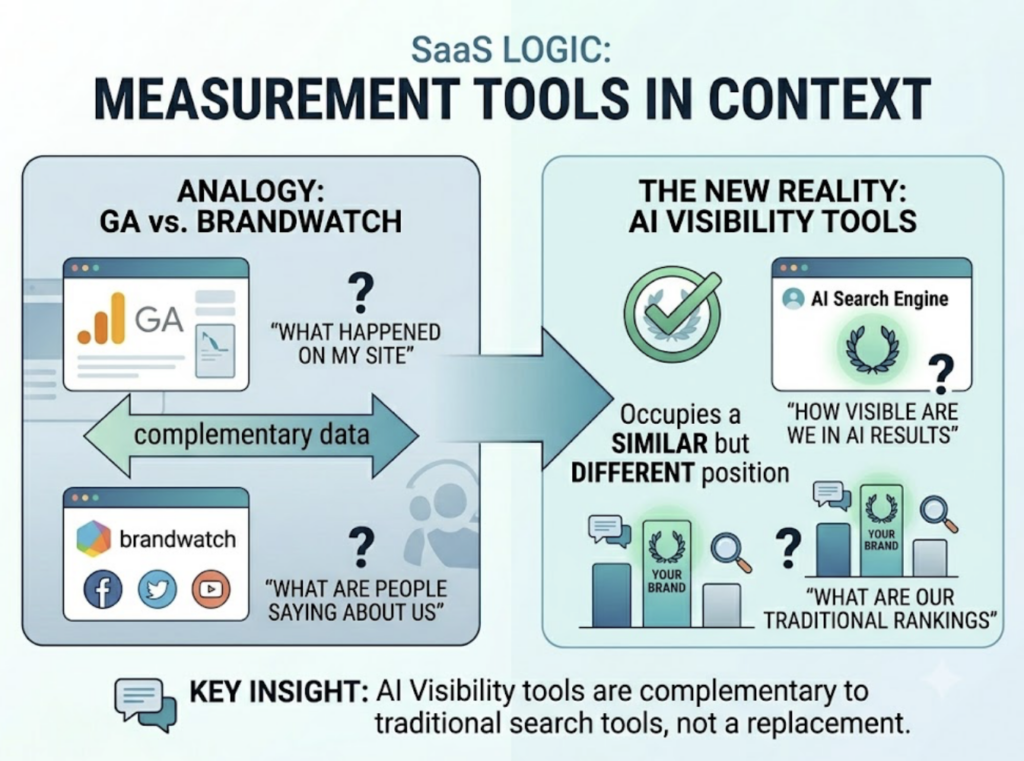
The decision isn’t “should I switch from The Search Monitor to Topify.” It’s “what does my current stack miss, and what category of tool fills that gap.”
If the gap is AI search synthesis data—brand mentions, sentiment, citation sources, competitive positioning across LLMs—then you’re looking for an AI-native intelligence layer, not a better version of what you already have.
How to Add AI Visibility Monitoring Without Replacing Your Stack
Implementing a dual-track approach is typically how teams make this transition without disruption.
Start by selecting 20-30 high-intent buyer queries relevant to your category. These are the prompts real buyers use when they’re actively evaluating solutions: “best [category] for [use case],” “alternatives to [competitor],” “[category] comparison.” Use an AI-native tool to run these queries across platforms and establish a baseline for how often your brand appears, how it’s framed, and which sources the AI is citing.
Keep The Search Monitor running for PPC compliance and SERP tracking. That data is still useful for paid acquisition and affiliate management. What changes is that the AI-native tool becomes your primary dashboard for brand health and competitive intelligence in organic AI search.
The practical trigger for this shift: if your sales team is hearing from prospects who researched your category through AI assistants, or if your organic traffic is holding while inbound lead volume is declining, those are signals that AI search is already affecting your funnel without showing up in your current reporting.
Once you’ve established the baseline, the citation source analysis is usually where the most actionable insights surface. It tells you exactly which third-party publications, review platforms, and community sites are shaping AI’s perception of your brand, which means you know precisely where to focus earned media and content efforts.
Conclusion
The Search Monitor does its job well. The issue isn’t the platform; it’s that the job has expanded. Buyers now discover and evaluate products through AI conversations that leave no trace in traditional analytics and show up in no rank tracker.
If your brand isn’t showing up in those conversations, you won’t know from your current dashboard. The monitoring gap between what legacy tools track and what AI search engines actually do with your brand has become a competitive variable.
The teams closing that gap now are building dual-track monitoring stacks: keeping their existing tools for traditional search channels and layering in AI-native platforms for the generative layer. Get started with Topify to see where your brand stands across ChatGPT, Perplexity, and other major AI platforms.
FAQ
Q: Is The Search Monitor good for SEO?
A: Yes, for legacy SEM/PPC monitoring, affiliate compliance, and organic keyword rank tracking. It’s effective within that scope. It doesn’t cover AI search results or brand mentions in LLM-generated responses, which is a separate monitoring category.
Q: Does The Search Monitor track AI search results?
A: No. Its architecture is built for traditional SERP crawling and paid ad monitoring. It doesn’t capture brand mentions, sentiment, or positioning within AI-generated answers from ChatGPT, Perplexity, Gemini, or other AI engines.
Q: What’s the best alternative to The Search Monitor for AI visibility?
A: For brands that need multi-platform AI search coverage combined with sentiment and citation analysis, Topify is currently the most complete option. It covers ChatGPT, Gemini, Perplexity, DeepSeek, Qwen, and other major AI platforms, with prompt-level tracking and accessible pricing starting at $99/month.
Q: Do I need to replace The Search Monitor to use an AI visibility tool?
A: No. The two tools serve different monitoring jobs. A practical approach is to keep The Search Monitor for PPC compliance and SERP tracking while adding an AI-native tool like Topify as your primary dashboard for brand health in generative search. Most teams run them in parallel rather than switching entirely.

