

Your The Search Monitor dashboard is showing stable rankings. Traffic looks fine. But a prospect just asked ChatGPT “what’s the best [your category] tool?” and got five recommendations. Your brand wasn’t on the list. Your competitor was.
That’s not a ranking problem. It’s a visibility gap that traditional search monitoring was never designed to catch.
What The Search Monitor Doesn’t Show You Anymore
The Search Monitor was built for a specific era of search: Google, Bing, keyword rankings, and SERP positions. That model worked well when “being found” meant earning a blue link in a traditional results page.
AI search engines work differently. When a user asks ChatGPT or Perplexity for a recommendation, the platform doesn’t return a list of links. It synthesizes an answer. Your brand either gets included in that answer or it doesn’t. According to research on AI search behavior, organic click-through rates drop by 60-70% in categories where AI summaries appear, because the AI satisfies user intent before any website gets visited.
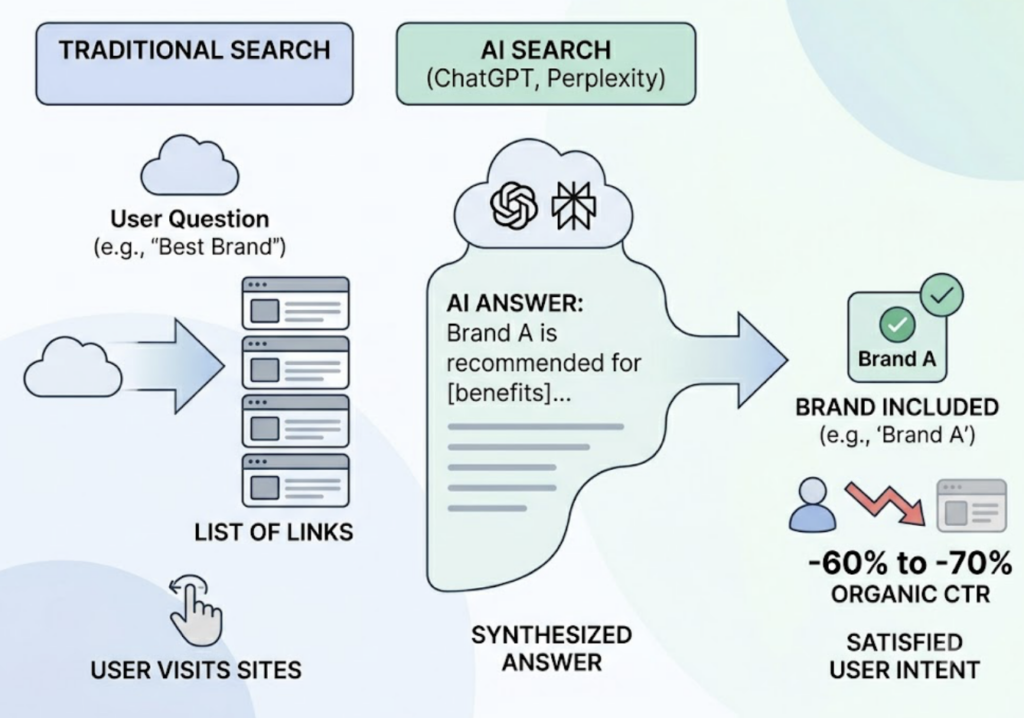
The Search Monitor can’t tell you any of that. It has no visibility into what ChatGPT recommends, how Perplexity describes your brand, or whether Gemini is citing your competitors instead of you.
What AI Search Monitoring Actually Requires
Switching from traditional search monitoring to AI search monitoring isn’t just a tool change. It’s a measurement paradigm shift. Here’s what a capable AI search monitoring stack needs to cover:
| Capability | Traditional Search Monitoring | AI Search Monitoring |
|---|---|---|
| Primary goal | Keyword ranking / CTR | Answer inclusion / citation |
| Data source | SERP positions | Prompt-level LLM responses |
| Competitive view | Keyword overlap | Share-of-voice in AI recommendations |
| Sentiment | Link-based signals | Narrative accuracy within AI answers |
| Platform coverage | Google, Bing | ChatGPT, Perplexity, Gemini, DeepSeek |
The hardest part isn’t choosing a tool. It’s understanding that the underlying metrics are different. Position in AI search doesn’t mean “ranking #2 for a keyword.” It means “appearing in the top two brands mentioned when someone asks AI which tools to use.”
That requires prompt-level auditing, citation tracking, sentiment analysis, and multi-platform coverage. Most traditional monitoring tools offer none of these.
The Best The Search Monitor Alternative: Topify
For teams making the switch from legacy search monitoring to AI search intelligence, Topify is the most complete option available right now.
Topify is built specifically around how AI engines work. Rather than tracking keyword positions, it tracks how AI platforms respond to buyer-intent prompts, which brands they mention, in what order, with what sentiment, and from which cited sources.
Platform coverage. Topify monitors brand performance across ChatGPT, Gemini, Perplexity, DeepSeek, Doubao, and Qwen. That’s meaningful for teams operating in global markets where different AI engines dominate different regions.
Seven core metrics. Topify tracks visibility, sentiment, position, volume, mentions, intent, and CVR (Conversion Visibility Rate). CVR is particularly useful for teams that want to connect AI visibility to business outcomes, not just raw brand mentions.
Competitor monitoring. You can set up automated tracking of how competitors appear in AI recommendations alongside your brand. If a rival starts appearing in “best of” answers where you previously dominated, you’ll catch it before it costs you pipeline.
Source analysis. Topify reverse-engineers the citations behind AI answers, showing you which third-party domains and URLs the AI platforms are using to build their narrative about your brand. If your brand is being misrepresented, this is how you find out why.
Pricing. Topify’s Basic plan starts at $99/mo, which covers 100 prompts, tracking across ChatGPT, Perplexity, and AI Overviews, and 9,000 AI answer analyses per month. That’s a practical entry point for teams coming off a legacy tool. See Topify’s full pricing for plan details.
For teams that previously relied on The Search Monitor for competitor tracking, Topify’s competitor benchmarking fills that gap while adding the AI-native layer that legacy tools lack.
3 Other The Search Monitor Alternatives Worth Considering
If Topify isn’t the right fit, here are three other tools that address specific parts of the AI search monitoring problem. Note that none of these match Topify’s coverage breadth, but each has a clear use case.
| Tool | Primary Focus | Best For |
|---|---|---|
| Sanbi.ai | Entity accuracy audits | Teams that need to fix how AI describes their brand before they start tracking at scale |
| Friction AI | Persona-based prompt mapping | Brands that want to map their AI footprint across specific buyer personas and journey stages |
| MindStudio Analytics | Narrative accuracy | Teams dealing with AI hallucinations around product features, pricing, or positioning |
These tools address narrower use cases. Sanbi.ai is useful for an initial audit but doesn’t offer continuous monitoring. Friction AI’s persona-based approach is excellent for research but not built for ongoing competitive tracking. MindStudio focuses on content accuracy rather than visibility metrics.
For teams that need a single platform that covers monitoring, competitor tracking, and citation analysis, these are supplements rather than replacements.
3 Signals It’s Time to Switch
You don’t need to abandon The Search Monitor to start tracking AI search. But these three patterns suggest you’re accumulating blind spots that will compound over time.
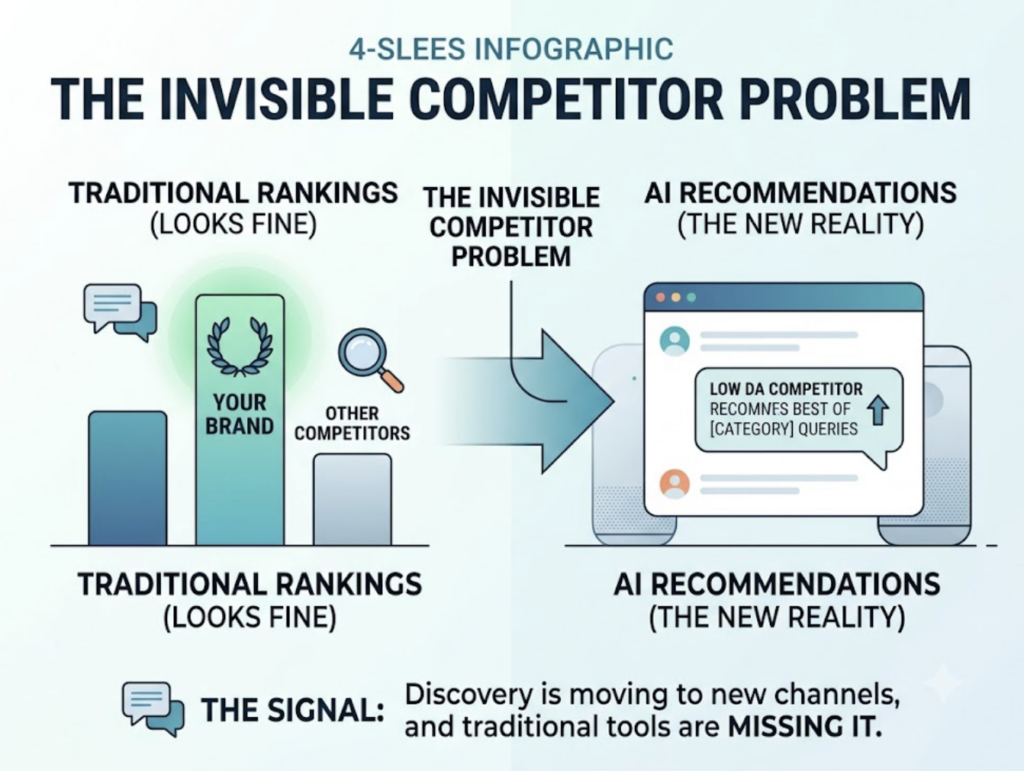
The invisible competitor problem. A competitor with lower domain authority than yours is consistently appearing in AI recommendations for “best of” queries in your category. Your traditional rankings look fine. But in AI answers, you’re not there. This is the clearest signal that your monitoring tool isn’t covering the channel where discovery is actually happening.
The narrative mismatch. Your sales team starts hearing prospects reference features you discontinued, pricing you changed six months ago, or use cases you don’t serve. Chances are, an AI platform is pulling from an outdated source and presenting stale information as current. Traditional monitoring doesn’t catch this. Citation tracking does.
The fragmented footprint. Your brand is mentioned inconsistently across AI platforms. ChatGPT describes you one way, Perplexity another, Gemini not at all. That kind of fragmentation suggests your brand lacks a consistent entity footprint in the sources AI models trust. No traditional search monitoring tool surfaces this.
Any one of these is reason enough to audit your current monitoring coverage.
Making the Switch: What to Expect
Transitioning from The Search Monitor to an AI-native tool doesn’t require a full stack replacement. Most teams run both in parallel for a quarter before deciding what to keep.
Here’s a practical three-phase approach based on how teams typically migrate:
Phase 1: Baseline. Start by running your top 20 buyer-intent prompts through an AI monitoring tool like Topify. Measure your inclusion rate across platforms and document your current sentiment score. This gives you a starting point for comparison.
Phase 2: Source calibration. Use citation analysis to identify which high-authority sources the AI is using to describe your brand. Cross-reference those against your current content strategy. Gaps here are usually content gaps: the AI can’t cite you if you’re not present in the sources it trusts.
Phase 3: Ongoing monitoring. Replace your daily keyword reports with weekly AI narrative reports. The question shifts from “where did we rank?” to “how did AI describe us this week, and what changed?”
Topify’s Basic plan supports this workflow from day one, with prompt tracking, platform coverage, and competitor benchmarking included in the entry tier.
Conclusion
The Search Monitor is a solid tool for what it was built to do. But AI search has introduced a visibility layer that didn’t exist when most traditional monitoring tools were designed.
If your brand is actively tracked in Google and Bing but invisible in ChatGPT, Perplexity, and Gemini, the monitoring gap is costing you consideration. The good news is that closing it doesn’t require overhauling your entire stack. It requires adding an AI-native monitoring layer to what you already have.
Topify is the most complete option for teams making that transition, whether you’re migrating from The Search Monitor or simply adding AI search coverage for the first time.
FAQ
Q: Is The Search Monitor good for tracking AI search visibility?
A: No. The Search Monitor is designed for traditional web search monitoring across Google and Bing. It doesn’t track how brands appear in AI-generated answers from ChatGPT, Perplexity, Gemini, or other AI search engines. If AI search is part of your monitoring requirements, you’ll need a separate tool built for that purpose.
Q: What’s the main difference between traditional search monitoring and AI search monitoring?
A: Traditional search monitoring tracks keyword rankings and click-through rates on SERP pages. AI search monitoring tracks whether and how your brand appears in AI-synthesized answers, at the prompt level, across multiple AI platforms. The metrics are fundamentally different: position in AI search means appearance in an AI recommendation, not a keyword ranking.
Q: Can I use The Search Monitor and an AI search tool at the same time?
A: Yes, and many teams do during the transition period. Traditional search monitoring still has value for Google and Bing performance. AI search monitoring fills the gap for ChatGPT, Perplexity, and Gemini. Running both in parallel for a quarter is a practical way to evaluate which channel deserves more investment.
Q: How much does it cost to add AI search monitoring alongside The Search Monitor?
A: Topify’s Basic plan starts at $99/mo and covers ChatGPT, Perplexity, and AI Overviews tracking across 100 prompts per month. For most teams making the switch, that’s enough to establish a baseline and validate whether AI search is driving meaningful discovery in their category.

