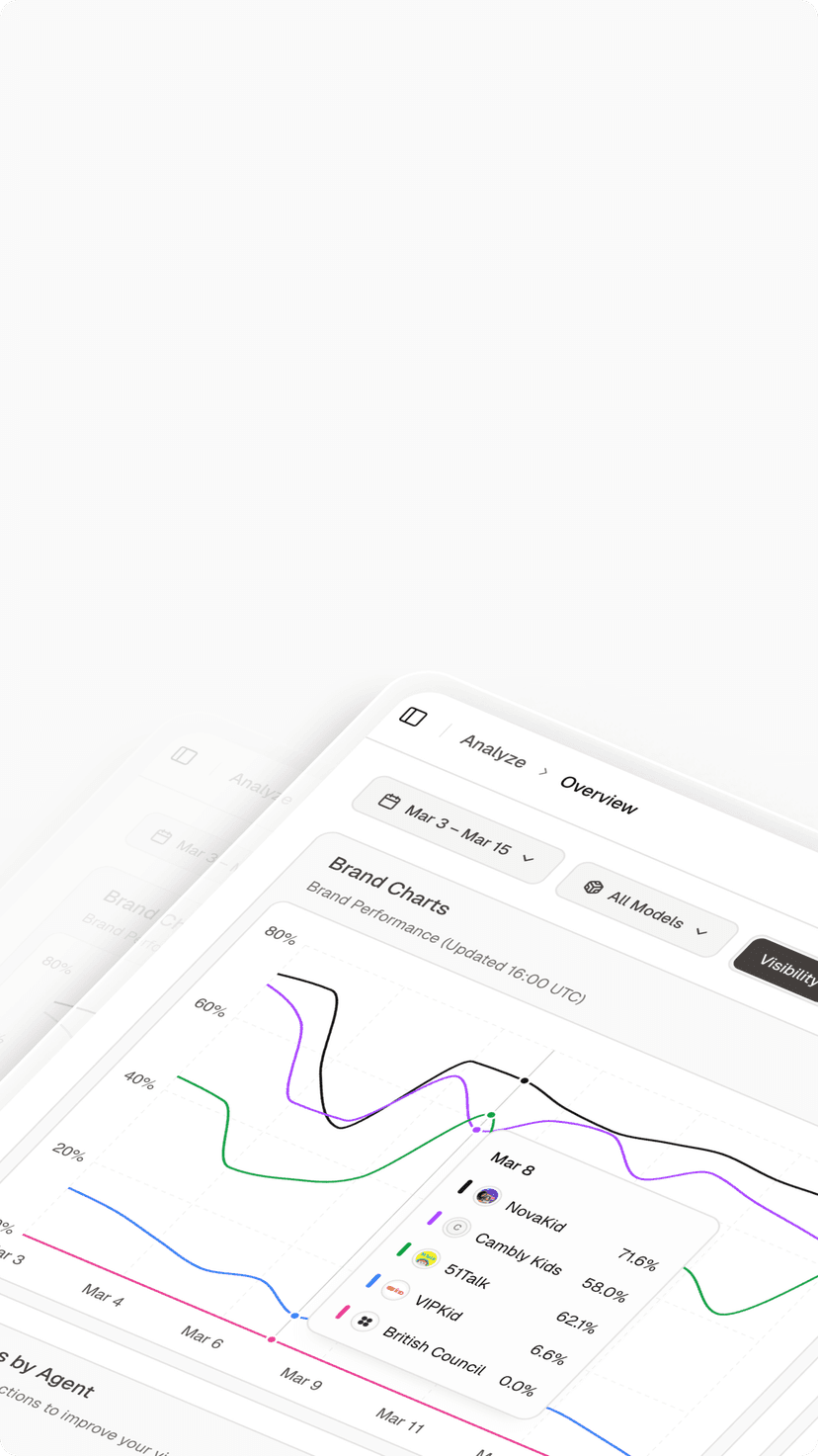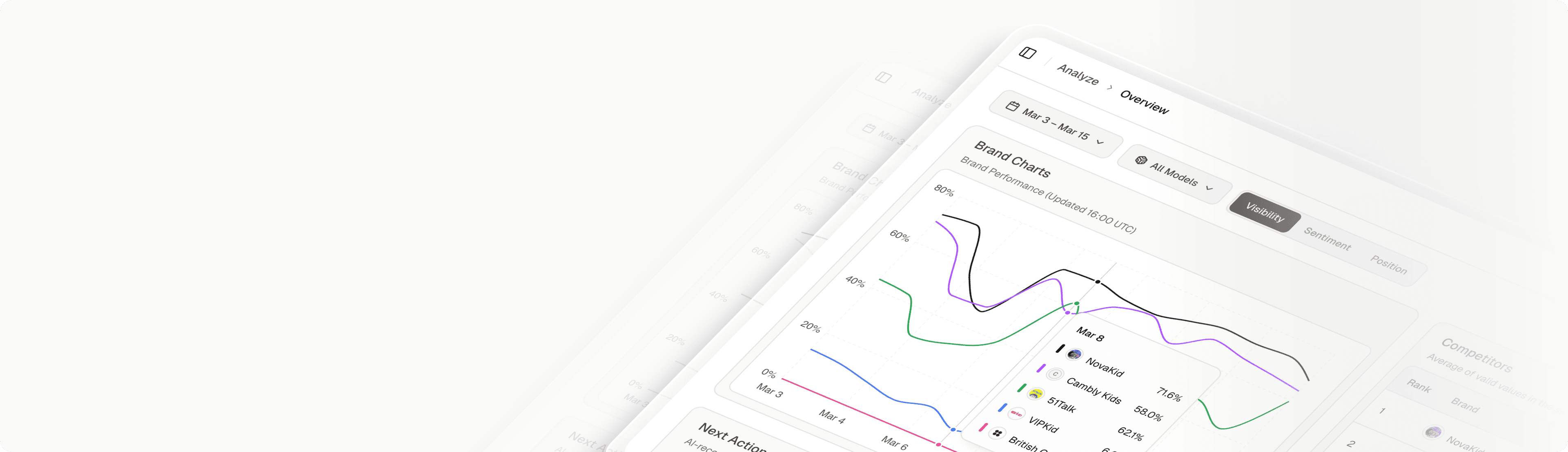

Your domain authority is solid. Your PPC campaigns are clean. Your brand monitoring tool flags every unauthorized ad copy in minutes. But when a potential customer opens Perplexity and types “best [your category] tool,” you have no idea what comes back. That’s the blind spot The Search Monitor was never built to close.
The gap isn’t a bug. It’s structural. And for teams whose buyers are shifting to AI-powered search, it’s becoming a real problem.
The Search Monitor Was Built for a Search World That No Longer Exists Alone
The Search Monitor excels at what it was designed for: auditing PPC compliance, flagging affiliate infringements, and tracking keyword positions in traditional search engines like Google and Bing. Its architecture is built around deterministic crawlers that scan static pages and capture ad placements.
AI search engines work differently. They don’t serve static pages. They synthesize real-time responses using large language models and live RAG (Retrieval-Augmented Generation) pipelines. A crawler can’t audit what an LLM decides to say.
By mid-2026, AI-integrated search engines including Perplexity, ChatGPT, and Google AI Overviews account for an estimated 30-40% of high-intent B2B search traffic. That’s a significant share of buyer discovery happening in a channel The Search Monitor simply can’t see.
What “AI Search Coverage” Actually Means Before You Pick a Tool
Not all “AI monitoring” features are equal. A tool that tells you a competitor got mentioned in an AI response is doing something fundamentally different from one that simulates buyer-intent prompts and maps your brand’s position within the AI’s reasoning.
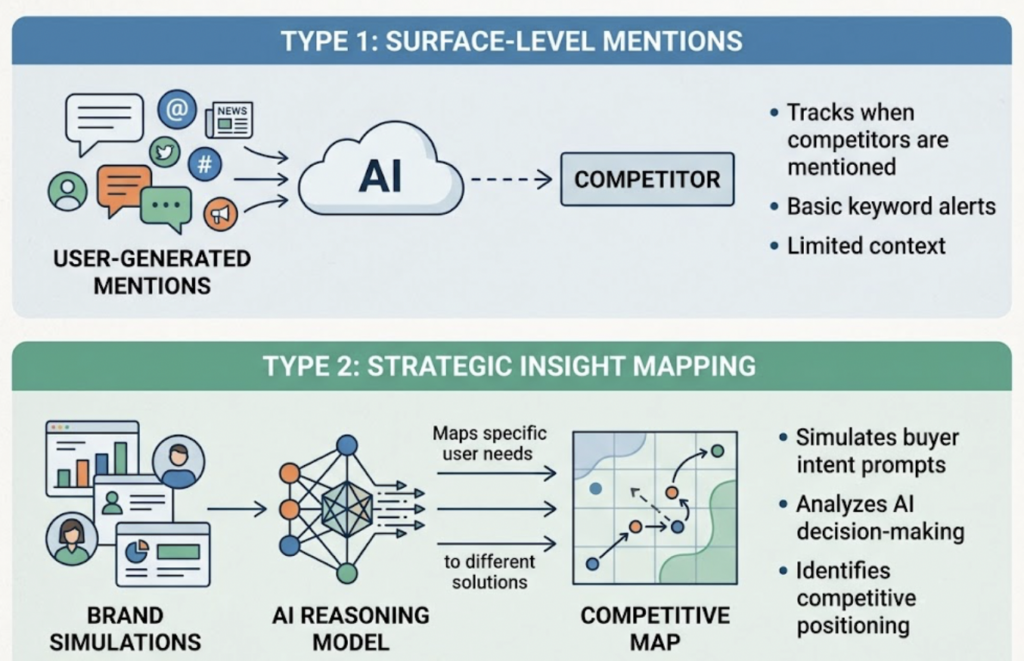
Three dimensions actually matter when evaluating search monitor alternatives for AI:
AI platform breadth. Does the tool cover the full range: ChatGPT, Perplexity, Gemini, DeepSeek, and regional leaders like Doubao and Qwen? A tool covering only Google AI Overviews is still leaving most of the picture dark.
Prompt-level granularity. Can it simulate how a real buyer asks questions and track where your brand appears within that answer? Domain-level mentions and prompt-level position tracking are not the same thing.
Actionable intelligence. Can it trace which external sources (G2, Reddit, specific blogs) the AI used to build its recommendation? Without source analysis, you know you’re missing but not why.
These three criteria will sort the alternatives quickly.
5 the Search Monitor Alternatives, Ranked by AI Search Coverage
Here’s how the leading options compare:
| Tool | AI Platform Coverage | Prompt-Level Tracking | Source/Citation Analysis | Best For |
|---|---|---|---|---|
| Topify | High (6+ platforms) | Yes | Yes | Full-funnel AI brand strategy |
| Semrush | Low (AI Overviews only) | No | No | Technical SEO + content ops |
| Brandwatch | Low (social-first) | No | No | Brand sentiment + PR |
| Mention | Low (broad web) | No | No | Crisis + media monitoring |
| SE Ranking | Moderate (SERP-centric) | Partial | No | Traditional SEO focus |
#1 Topify: The AI-Native Option
Topify is the only tool in this list built specifically around the non-linear nature of AI-generated answers. It doesn’t bolt AI visibility onto a traditional SEO suite. The entire product is structured around how AI engines decide what to recommend.
Platform coverage includes ChatGPT, Perplexity, Gemini, DeepSeek, Doubao, Qwen, and other major AI platforms. That matters for brands with global audiences, where regional AI engines like Doubao drive significant discovery in Chinese-speaking markets.
Topify tracks seven core metrics: Visibility, Sentiment, Position, Volume, Mentions, Intent, and CVR (Conversion Visibility Rate). The CVR metric is worth understanding specifically. It estimates the likelihood that an AI response will drive a user toward your brand, based on narrative framing and recommendation position. It’s the closest thing to “conversion tracking” that exists in AI search today.
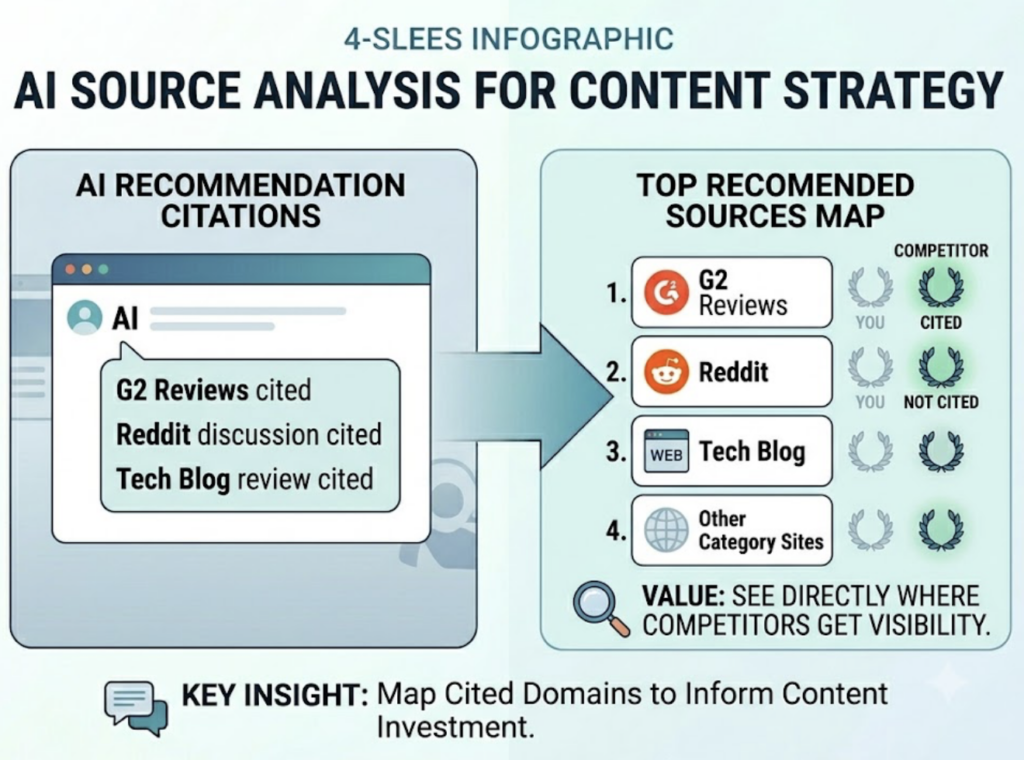
The source analysis capability is where teams doing content strategy get real value. Topify maps the exact domains and URLs that AI platforms are citing when they recommend brands in your category. If G2, a specific tech blog, or a Reddit thread is driving AI citations for your competitors but not for you, you can see that directly.
Competitive benchmarking runs automatically. You don’t set up separate tracking for each rival. Topify detects competitors in the AI responses it monitors and shows you how your position shifts relative to them over time.
Pricing starts at $99/mo for the Basic plan, which includes a 30-day trial and covers ChatGPT, Perplexity, and Google AI Overviews tracking with 100 prompts and 9,000 AI answer analyses. For teams migrating from a traditional monitoring workflow, the onboarding is designed to be straightforward. Get started with Topify here.
#2 Semrush
Semrush is the dominant platform for traditional SEO and content operations. It has introduced AI Overview tracking as a feature, but it’s a secondary capability within a suite built for keyword research, backlink analysis, and technical audits.
For teams that primarily need traditional search performance and want basic AI search visibility as a supplement, Semrush is a reasonable choice. It won’t give you cross-LLM coverage or prompt-level tracking, but the breadth of its non-AI features is unmatched. The trade-off is clear: if AI search is your primary monitoring need, Semrush isn’t the right center of gravity.
#3 Brandwatch
Brandwatch is a strong platform for broad brand sentiment analysis across social media and the open web. It surfaces unstructured mentions from forums, news outlets, and social platforms at scale.
What it can’t do is audit the generative output of an LLM. Brandwatch doesn’t simulate search prompts or track where your brand ranks within an AI-synthesized recommendation. It’s built for social listening, not search intent monitoring. Teams dealing with PR crises or needing to track brand perception across social channels will find it useful. Teams trying to understand their AI search presence won’t.
#4 Mention
Mention is designed for real-time brand mention alerts across news, blogs, and forums. It’s fast and accessible for smaller teams that need to know when they’re being talked about online.
Like Brandwatch, it lacks the infrastructure to query AI models or interpret the narrative framing in an AI-generated paragraph. You’ll know if a tech blog wrote about you. You won’t know whether ChatGPT is recommending that blog post as a source when users ask about your category. Different capabilities, different use cases.
#5 SE Ranking
SE Ranking is a solid, affordable option for SMBs focused on traditional rank tracking with some early-stage AI overview monitoring. It covers Google AI Overviews and provides basic SERP features at a price point that works for smaller teams.
The AI monitoring remains SERP-centric rather than cross-platform. It’s a transitional tool for teams starting to think about AI search rather than one built around it. If your budget is limited and traditional SEO is still your core focus, SE Ranking bridges the gap reasonably well.
Where The Search Monitor Still Has an Edge
Being direct here: The Search Monitor is not a weak tool. It’s a specialized one.
If your primary business risk involves unauthorized trademark usage in PPC ads, affiliate fraud, or competitive bid monitoring in traditional search engines, The Search Monitor does that work better than any AI-visibility platform. It was engineered for compliance and paid search protection, and it handles both well.
The issue is scope. None of these AI search monitoring capabilities overlap with what The Search Monitor does. They’re different categories of intelligence serving different use cases. Brands conflating the two will underinvest in one or both.
Choosing Based on What You Actually Need to Monitor
The decision isn’t complicated once you’re clear on your primary risk:
Your main exposure is PPC compliance and affiliate fraud in traditional search. The Search Monitor remains the right tool. No AI-native platform replaces that capability.
Your buyers are discovering products through ChatGPT, Perplexity, or Gemini, and you don’t know how your brand appears in those answers. That’s where Topify fills the gap. The seven-metric framework and cross-platform coverage give you the visibility that traditional tools can’t provide.
You need both. Enterprise brands increasingly run The Search Monitor for legal and compliance monitoring alongside Topify for AI search positioning. These aren’t competing tools. They address genuinely distinct risks.
Start by auditing where your buyers are actually searching. If that answer increasingly includes AI platforms, the monitoring infrastructure needs to follow.
Conclusion
The Search Monitor alternatives aren’t a better version of the same thing. They’re a response to a different set of questions: not “is our ad copy compliant?” but “what is AI saying about us, and to whom?”
For teams where AI search is becoming a meaningful discovery channel, Topify’s cross-platform coverage and prompt-level tracking make it the most direct fit. The Basic plan’s 30-day trial gives you enough data to see whether your brand’s AI search presence matches what you’re investing to build. That gap, when you find it, tends to be clarifying.
FAQ
Q: What is The Search Monitor used for?
A: The Search Monitor is a specialized tool for monitoring paid search (PPC) compliance and affiliate activity in traditional search engines like Google and Bing. It audits ad copy, keyword bidding, and trademark usage but does not track AI-generated search platforms like ChatGPT or Perplexity.
Q: Which tools track brand mentions in ChatGPT and Perplexity?
A: AI-native platforms like Topify are specifically built to monitor these platforms through simulated prompt queries and citation tracking. Traditional SEO and social listening tools generally don’t have the infrastructure to query LLMs or analyze narrative-level brand positioning.
Q: Is there a free alternative to The Search Monitor for AI search monitoring?
A: Robust free alternatives for prompt-level AI search tracking don’t currently exist. AI monitoring requires significant API and compute overhead to simulate buyer-intent queries across multiple platforms and analyze citation patterns at scale. Topify’s Basic plan at $99/mo with a 30-day trial is the most accessible entry point with full cross-platform coverage.
Q: How does AI search monitoring differ from traditional brand monitoring?
A: Traditional monitoring tracks static rankings and mentions across indexed web pages. AI search monitoring tracks the generative output of a language model, which includes how your brand is framed narratively, where it ranks relative to competitors within an AI recommendation, and which external sources the AI used to form that recommendation. The data types and the questions they answer are fundamentally different.