

You’d finally gotten your brand’s AI citation rate to a predictable number. Structured data was in place, entity signals were clean, and your mention rate across ChatGPT held steady through Q2. Then on July 9, OpenAI swapped out the engine underneath. GPT-5.6 rolled out across ChatGPT, the API, and a new agent layer called ChatGPT Work, replacing the model your entire GEO strategy was calibrated against. The source preferences, retrieval logic, and entity weighting that drove your Q2 baseline no longer exist in their previous form. Cross-platform tracking data shows that model transitions routinely produce citation shifts of up to 34% between rivals in competitive categories, and the correlation between organic rank and AI citation sits at just 0.034. Betting your GPT-5.6 visibility on your Google rankings is betting on a relationship that barely exists.
Three Models, Three GPT 5.6 Citation Patterns
GPT-5.6 isn’t one model. It’s a family of three, each with different reasoning depth and cost: Sol (flagship, $5/$30 per million tokens), Terra (balanced everyday workhorse, $2.50/$15), and Luna (fast and cheap, $1/$6). For brand visibility, the split matters because deeper reasoning correlates directly with more citations.
A Search Engine Land study across 100 prompts found that high-reasoning mode lifted citation rates from 50% to 68%, nearly doubled average sources per response from 2.6 to 4.5, and increased fan-out queries by 4.6x. Sol with max or ultra reasoning sits at the top of that curve. Luna, optimized for throughput, leans more heavily on probabilistic memory and top-ranked search results.
That’s the gap most brands can’t see yet.
Two workflow additions compound the shift. GPT-5.6 introduces an ultra mode that spins up parallel sub-agents to divide work, cross-check each other, and merge conclusions. ChatGPT Work, released alongside GPT-5.6, operates across desktop apps, connected files, and third-party tools to produce research deliverables autonomously. When an AI agent is doing the buying research for your prospects, your brand needs to be the one it retrieves and recommends.
Why Your GPT-5.5 GEO Baseline Is Already Obsolete
Model transitions don’t tweak citation behavior. They rewrite it.
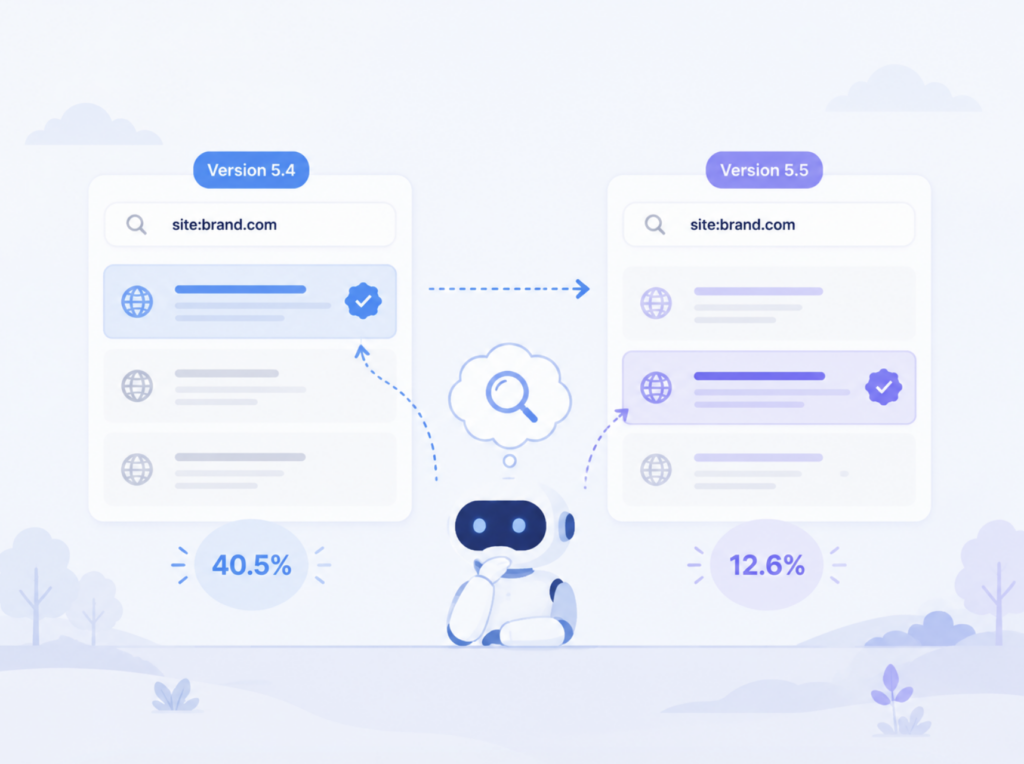
Between GPT-5.4 and GPT-5.5, the share of fan-out queries using the site: operator scoped to a brand’s domain dropped from 40.5% to 12.6%. That’s a 70% reduction in brand-domain-targeted searches between two consecutive versions. The brand citation rate fell with it. GPT-5.5 didn’t decide brand sites were less trustworthy. It simply stopped seeking them out on their own domains as aggressively.
GPT-5.6 adds another variable: a three-tier architecture where each tier may favor different source types. Efficiency-optimized models like Luna lean on top-ranked search results and training-data memory, while Sol with ultra reasoning digs deeper into documentation-grade content and cross-references multiple sources before citing.
The disconnect between traditional SEO and AI citation is already well documented. EMGI Group’s April 2026 SaaS AI Citation Gap Report found that 44% of Google top-10 brands get zero ChatGPT citations for the same keywords. In Marketing Automation, that gap hit 53%. Analytics was close behind at 52%. These gaps don’t shrink when a new model ships. They reshuffle.
Teams that lock their optimization to GPT-5.5’s behavior are already optimizing for a model that’s no longer answering most of their prospects’ questions.
Fan-Out in GPT 5.6: More Sub-Queries, Higher Citation Stakes
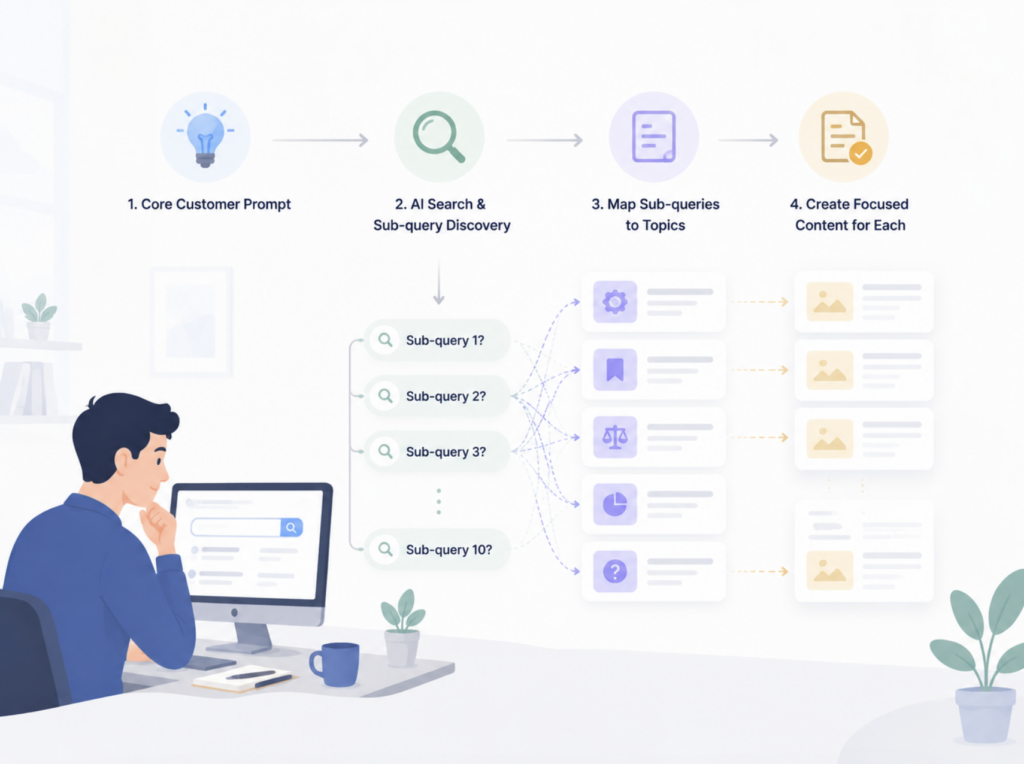
When someone asks ChatGPT a question, the model doesn’t search for that exact phrase. It decomposes the prompt into multiple sub-queries, a process called query fan-out, then assembles an answer from the combined results.
AirOps analyzed 548,534 retrieved pages across 15,000 prompts and 43,233 total queries and found that 88.6% of queries generate exactly 2 fan-out sub-queries. Complex comparative queries produce 4 or more. With GPT-5.6’s ultra mode coordinating parallel sub-agents, that fan-out surface area likely expands further for high-reasoning tasks.
Here’s the number that should change how you plan content: 32.9% of cited pages appeared only in fan-out results, not in the results for the original prompt. Nearly a third of all citation opportunities exist entirely outside the keyword you’re tracking.
And 95% of fan-out queries that triggered citations had zero traditional search volume. They aren’t keywords any brand targets. They’re the sub-questions ChatGPT asks itself while building an answer: things like “NCLEX pass rates by nursing school” when the user asked “what are the best nursing programs?”
The practical takeaway is straightforward. If your content strategy only covers primary keywords and pillar topics, you’re invisible to the retrieval layer that generates a third of all citations. Fan-out-aligned content, pages that answer the specific sub-questions a model asks itself, is no longer optional for GPT 5.6 optimization.
Five Moves to Earn GPT 5.6 Citations Before Your Competitors Do
1. Get Indexed on Bing
ChatGPT’s web retrieval runs on Bing’s index. A site indexed on Google but not Bing is invisible to GPT-5.6’s search layer, period. Submit your sitemap to Bing Webmaster Tools and verify your coverage. This is the lowest-effort, highest-impact fix that most brands still haven’t done.
2. Deploy a Triple Schema Stack
Organization, Article, and FAQPage schema implemented together using JSON-LD @graph format create a structured signal that AI models use to verify authority and extract content cleanly. Google’s March 2026 update shifted schema’s role from a SERP display trigger to an AI trust and entity verification signal. If your schema is a boilerplate template-fill, you’re getting minimum value. Optional properties like author, dateModified, sameAs, and description are what give AI systems the context to cite confidently rather than skip you.
3. Keep Content Updated Within 30 Days
Content updated within 30 days receives 3.2x more citations than older material. The freshness signal isn’t about publication date alone. It’s about whether the model finds evidence that the content reflects current conditions: updated statistics, current examples, a visible “Last updated” timestamp. A 2023 article with fresh 2026 data performs differently from a 2023 article that’s never been touched.
4. Build Content for Fan-Out Sub-Queries
Stop writing only for primary keywords. Run your core customer prompts through ChatGPT search and document the sub-queries it generates. Then build focused content for each sub-query layer. Not 10 rewrites of the same piece, but 10 new pages, each targeting one sub-question the model asks itself.
The AirOps data backs this up. Pages covering 26-50% of ChatGPT’s fan-out sub-queries outperform pages covering 100%. The “ultimate guide” playbook that dominated traditional SEO actually hurts citation rates when query relevance is held constant. Focused, specific answers beat comprehensive everything-pages.
5. Strengthen Third-Party Presence
GPT-5.6’s agentic architecture cross-references claims against multiple sources. Brands with consistent, corroborated presence across review platforms like G2, Capterra, and TrustRadius, plus industry publications and authoritative third-party sites, get cited more reliably than brands with a single well-optimized homepage.
LinkedIn is now reportedly the second most-cited domain across ChatGPT Search, Google AI Mode, and Perplexity. Employee thought leadership on personal profiles is becoming source material for how AI systems describe your brand.
Tracking GPT 5.6 Citations Without Flying Blind
One audit is a photograph. GEO needs video.
GPT-5.6’s three-tier architecture means your brand might appear in Sol’s deep-reasoning answers but go missing from Luna’s faster, cost-optimized responses. Or the opposite. Without per-model tracking, you can’t tell where the gaps are, and you can’t prioritize fixes.
Topify provides the monitoring layer this workflow requires. Its Comprehensive GEO Analytics tracks brand visibility, sentiment, position, and citation sources across ChatGPT, Gemini, Perplexity, and AI Overviews. In practice, this means you can spot a drop in ChatGPT mention rate after a model update and trace it back to a specific source that shifted, all within the same dashboard.
The Source Analysis feature shows exactly which domains GPT-5.6 is citing in your category. If a competitor’s documentation or a third-party review site is getting the citations your brand used to own, you’ll see it before the traffic impact hits. Dynamic Competitor Benchmarking reveals who AI engines recommend in your space and tracks how those positions change with each model update, so you know where you’re gaining ground and where you’re falling behind.
Here’s a practical sequence for a GPT-5.6 reset audit. Record your citation rate, average position, and cited sources for each tier of ChatGPT answer. That’s your pre-drift baseline. Look for asymmetries: present in high-volume answers but missing from complex ones usually means your content lacks the technical depth Sol wants before it cites you. Then monitor for drift continuously. Track the statistical gain or decline in mentions after each update and feed what you learn back into your schema and content pillars. Teams that get started with ongoing tracking before the next weight update have a structural advantage over those that audit reactively.
Conclusion
GPT-5.6 didn’t tweak ChatGPT’s citation rules. It replaced them. New model weights, a three-tier architecture, and an agentic workflow layer mean the optimization playbook that worked through Q2 is a starting point, not a strategy. The brands that move first have a window: record your per-model citation baseline now, map the fan-out sub-queries your category generates, fill the content gaps, and put continuous monitoring in place so the next model update is a data point, not a surprise. The brands that wait will spend Q4 trying to reverse-engineer why their competitors show up in every ChatGPT answer and they don’t.
FAQ
Q: Does GPT 5.6 use Google or Bing for web search?
A: ChatGPT’s web retrieval still runs on Bing’s index. Brands that haven’t submitted their sitemap to Bing Webmaster Tools are invisible to GPT-5.6’s search component, regardless of their Google ranking.
Q: How often does GPT 5.6 change its citation behavior?
A: Citation behavior can shift with every model weight update, not just major version releases. Between GPT-5.4 and GPT-5.5, site-scoped query usage dropped 70% in a single transition. Continuous monitoring is the only reliable way to catch these shifts early.
Q: Do I need to optimize separately for Sol, Terra, and Luna?
A: You don’t need three separate strategies, but you should track visibility across tiers. Sol’s deeper reasoning pulls from more sources and tends to favor documentation-grade content. Luna leans on top-ranked results and training data. The same brand can be visible in one tier and absent in another.
Q: Can small brands earn GPT 5.6 citations?
A: Yes. Topical depth and clean structure let focused brands win citations for niche prompts even without high domain authority. AirOps’ research found that domain authority shows no positive correlation with AI citation. ChatGPT evaluates content based on relevance and structure, not backlink counts.

