

Your marketing team spent the last quarter building comparison pages, earning media placements, and climbing Google rankings. Then a procurement lead at your biggest prospect opened ChatGPT Work, typed “research and shortlist the top five platforms in [your category],” and walked away. Ten minutes later, the agent delivered a finished slide deck with vendor names, feature breakdowns, and a recommendation. Your brand wasn’t on it.
That slide deck didn’t disappear after one read. It got forwarded to a buying committee of eight people, and none of them ran a second search. The shortlist was set before your sales team knew the deal existed.
What GPT 5.6 and ChatGPT Work Changed About Brand Discovery
On July 9, 2026, OpenAI launched GPT 5.6 alongside ChatGPT Work, an autonomous agent designed for multi-step workplace tasks. GPT 5.6 ships in three variants: Sol, the most powerful model; Luna, optimized for speed; and Terra, built to balance performance and cost for everyday work.
ChatGPT Work isn’t a chatbot. It’s an agent that connects to your apps and files, browses the live web, and produces finished deliverables: reports, spreadsheets, presentations, and even interactive web pages through a new Sites feature. It can run in the background for hours, breaking larger projects into smaller steps without waiting for user input.
The distinction matters. When someone asks ChatGPT a question in a normal chat, the answer is read once and forgotten. When ChatGPT Work builds a vendor shortlist inside a slide deck, that shortlist becomes a document people circulate, present, and act on. The brands named in it carry the weight of a recommendation.
ChatGPT Work is rolling out to paid plans (Pro, Pro Lite, Enterprise, and Edu first, with Plus and Business following). That’s the audience making purchasing decisions, using an agent that names brands inside documents they ship to colleagues.
How ChatGPT Work Decides Which Brands Make the Shortlist
ChatGPT Work compresses an entire product category into three to five names. It does this by browsing the web, pulling data from connected apps, and synthesizing what it finds into a structured deliverable.
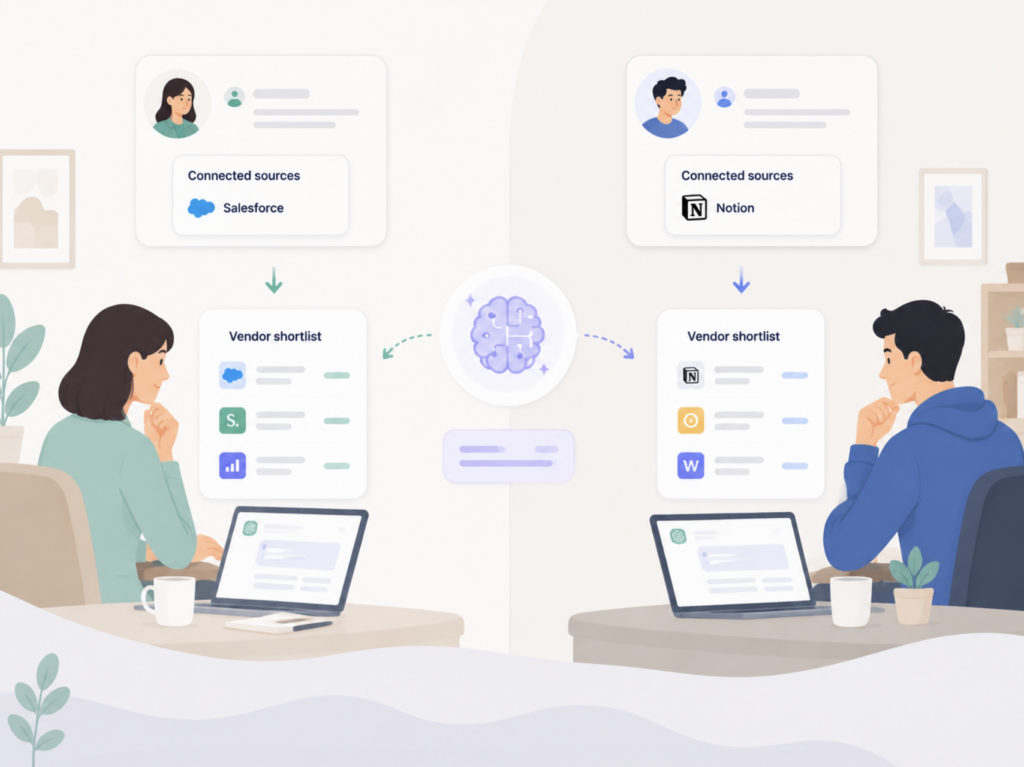
Here’s what makes this different from a regular ChatGPT chat response. Work draws on the user’s connected files and prior context, which means the same research brief can produce different shortlists for different users. A VP of marketing with Salesforce connected will get a different vendor comparison than a startup founder using Notion. Personalization makes it harder to predict, and harder to monitor.
The signals ChatGPT Work relies on to select brands overlap with what drives regular AI search visibility, but the stakes are higher:
| Signal | What It Means for ChatGPT Work |
|---|---|
| Crawlable, structured content | Work’s built-in browser reads live web pages to build deliverables. Thin or outdated pages get skipped. |
| Third-party mentions | Earned media placements in high-authority publications increase the chance Work trusts your brand enough to include it. |
| Review site presence | G2, Capterra, and industry directories feed the evidence Work uses to justify a recommendation. |
| Clear product positioning | Work needs to match your brand to a specific use case. Vague messaging means you don’t fit the prompt. |
One spot check tells you little. What matters is the pattern across many agent runs: how often does your brand make the deliverable at all?
GPT 5.6 Arrives as 51% of B2B Brands Have Zero AI Citations
The timing of GPT 5.6 makes the visibility gap more urgent. Crackle PR’s Q2 2026 AI Citation Benchmark found that 51% of B2B tech brands have zero citations across ChatGPT, Perplexity, and Gemini. More than half the market is invisible to the AI tools buyers already use daily.
Those buyers aren’t experimenting. Forrester’s 2026 B2B Buyer Journey report found 72% of B2B software buyers now use ChatGPT during vendor evaluation. Bain’s 2026 research puts the average at 17 AI search queries per buyer per week. Across buying committees that Gartner’s 2026 data places at a median of 8.2 people, that’s over 100 AI-assisted research touchpoints per deal cycle.
The conversion data is just as stark. According to HubSpot, AI referral traffic is growing 165 times faster than organic search and converts at four to nine times the rate of traditional visitors. ChatGPT’s user base has crossed 900 million weekly active users as of early 2026, more than doubling from 400 million just a year earlier.
Being excluded from an AI-generated shortlist doesn’t show up in your CRM. The buyer never visits your site, never fills out a form, never talks to sales. You lose the deal before anyone on your team knows it existed.
Your SEO Dashboard Can’t Show You This GPT 5.6 Visibility Gap
Most marketing teams track domain authority, keyword rankings, and organic traffic. None of those metrics predict whether ChatGPT Work will include your brand in a procurement report.
Crackle PR’s benchmark data reveals the disconnect: 34% of AI answers cite sources ranked below position 20 in Google search. Traditional SEO rank alone does not predict AI visibility. An Ahrefs study of 75,000 brands found that brand mentions correlate three times more strongly with AI visibility than traditional backlinks (0.664 vs. 0.218).
The citation source split reinforces this. According to Crackle PR, 71% of ChatGPT’s B2B vendor citations come from earned media placements, with only 29% from owned content. Domain authority correlates with citation frequency at r = 0.62, meaning the quality tier of a placement matters more than the volume of coverage.
That’s a fundamentally different optimization problem than traditional SEO. You can rank on page one of Google for every target keyword and still be absent from the ChatGPT Work report your prospect’s team is reading right now.
How to Check If ChatGPT Work Recommends Your Brand
Before you can fix the gap, you need to see it. Here’s a practical audit framework:
Start by running the same research briefs your buyers would. Open ChatGPT Work and ask it to research and shortlist options in your category, the kind of task a procurement lead would set. Save the result with today’s date. Record which brands are included, where they’re positioned, which competitors show up, and which source URLs the agent cited.
Then compare agent output against chat. Run the same question as a plain ChatGPT chat and as a Work task. The differences reveal how the deliverable format re-ranks your space. A brand that shows up in a casual chat response can still be absent from a structured slide deck.
The problem with manual testing is that it doesn’t scale. Personalization means results shift based on connected context. Region, plan tier, and timing all affect the output. One spot check is a snapshot, not a strategy.
For consistent monitoring across prompts, platforms, and competitors, you need dedicated AI visibility tracking. Topifytracks brand performance across ChatGPT, Gemini, Perplexity, DeepSeek, and other major AI platforms through seven key metrics: visibility, sentiment, position, volume, mentions, intent, and CVR. In practice, this means you can detect when ChatGPT stops mentioning your brand for a specific use case, identify which competitor took your position, and trace the shift back to a specific source domain, all from one dashboard.
Topify’s Source Analysis shows exactly which URLs AI platforms cite when answering queries in your category. If ChatGPT Work’s browser is pulling from a competitor’s comparison page instead of yours, you’ll see it. The Dynamic Competitor Benchmarking feature tracks who AI engines recommend in real time, so you’ll know when a new rival enters the shortlist before your sales team hears about it from a lost deal.
For teams that want to move from monitoring to action, Topify’s One-Click Execution lets you define your visibility goals in plain English, review the proposed strategy, and deploy it with a single click, no manual workflows required.
What the GPT 5.6 Shift Means for Your AI Visibility Strategy
ChatGPT Work represents a structural change in how brands get discovered. It’s not just another answer surface. It’s a surface where the answer becomes a deliverable that travels through organizations and drives purchasing decisions.
Three things matter now more than they did before July 9:
First, your content needs to be agent-readable. ChatGPT Work’s built-in browser reads live web pages to build deliverables. If your product pages are thin, outdated, or lack structured data, the agent will build around you. Clear comparison content, detailed feature documentation, and up-to-date pricing pages give Work something it can confidently cite.
Second, earned media quality outweighs volume. With 71% of AI citations coming from earned placements and domain authority correlating with citation frequency at r = 0.62, a single placement in TechCrunch or Forbes may yield more AI visibility than a dozen mid-tier trade articles. Focus on publications ChatGPT actually cites, not just publications that drive traffic.
Third, continuous monitoring is no longer optional. ChatGPT Work’s personalization engine means visibility shifts can happen without any change to your content. A competitor publishes a new case study, a review site updates its rankings, and suddenly your brand drops off the shortlist for a segment you thought you owned. The only way to catch this is persistent, automated tracking across AI platforms. Get started with Topify to see exactly where your brand stands.
Conclusion
GPT 5.6 didn’t just upgrade ChatGPT’s intelligence. It powered an agent that builds the documents your buyers rely on to make purchasing decisions. When ChatGPT Work compresses your category into a three-name shortlist inside a slide deck, the brands left out don’t get a second chance. The buying committee acts on what the agent delivered.
The data says most brands aren’t ready. Over half of B2B tech companies have zero AI citations, while nearly three-quarters of software buyers are already using ChatGPT to evaluate vendors. The gap between buyer behavior and brand visibility is the biggest blind spot in B2B marketing right now. Start by auditing your ChatGPT Work presence. Then build the monitoring system that ensures you see every shift before your competitors do.
FAQ
Q: What is ChatGPT Work and how does it affect brand recommendations?
A: ChatGPT Work is an AI agent launched on July 9, 2026, powered by GPT 5.6. Unlike regular ChatGPT, it autonomously researches, browses the web, connects to user apps, and produces finished deliverables like reports and slide decks. When it builds a vendor shortlist, it typically compresses a category into three to five brand names, and those names carry the weight of a recommendation that gets circulated to buying committees.
Q: Does GPT 5.6 change how my brand appears in AI search results?
A: Yes. GPT 5.6’s Sol model is OpenAI’s most capable model to date, and it powers ChatGPT Work’s agentic capabilities. The key change isn’t just model intelligence. It’s that GPT 5.6 enables a new deliverable format where brand recommendations get embedded in documents, spreadsheets, and presentations that decision-makers rely on. Visibility in a ChatGPT Work report carries more downstream influence than a mention in a single chat response.
Q: How can I track whether ChatGPT Work is recommending my brand?
A: Manual testing gives you a starting point: ask ChatGPT Work to shortlist options in your category and record the results. For consistent monitoring at scale, use an AI visibility platform like Topify that tracks brand mentions, position, sentiment, and citation sources across ChatGPT and other major AI engines. This lets you detect shortlist changes before they affect your pipeline.
Q: What’s the difference between AI visibility and traditional SEO rankings?
A: Traditional SEO measures how well your pages rank in Google search results. AI visibility measures whether AI platforms like ChatGPT mention and recommend your brand when users ask category-level questions. Research shows that 34% of AI-cited sources rank below position 20 in Google, and brand mentions correlate three times more with AI visibility than backlinks. The two channels require different optimization strategies.

