

You spent months building a stable brand presence in ChatGPT’s answers. Structured data, entity building, content restructuring. By late June, your mention rate finally looked predictable.
Then OpenAI swapped out the engine underneath.
On July 9, 2026, GPT-5.6 rolled out across ChatGPT, Codex, and the API, replacing the model that generated most of the AI answers your prospects have been reading. The citation logic, source preferences, and entity weighting your GEO strategy was calibrated against no longer exist in their previous form.
Your GEO baseline from last month may already be obsolete.
Unlike traditional search, which runs on a relatively stable index and link graph, generative engines are probabilistic synthesizers. Every major model generation rewrites attention patterns, training data weighting, and retrieval preferences. This article breaks down what shipped in ChatGPT 5.6, why it reshuffles brand visibility, and how to re-audit your AI search presence during the reset window.
What Actually Shipped in ChatGPT 5.6: Sol, Terra, and Luna
This wasn’t a routine version bump. GPT-5.6 restructures the entire model lineup, the agent workflow, and the naming system.
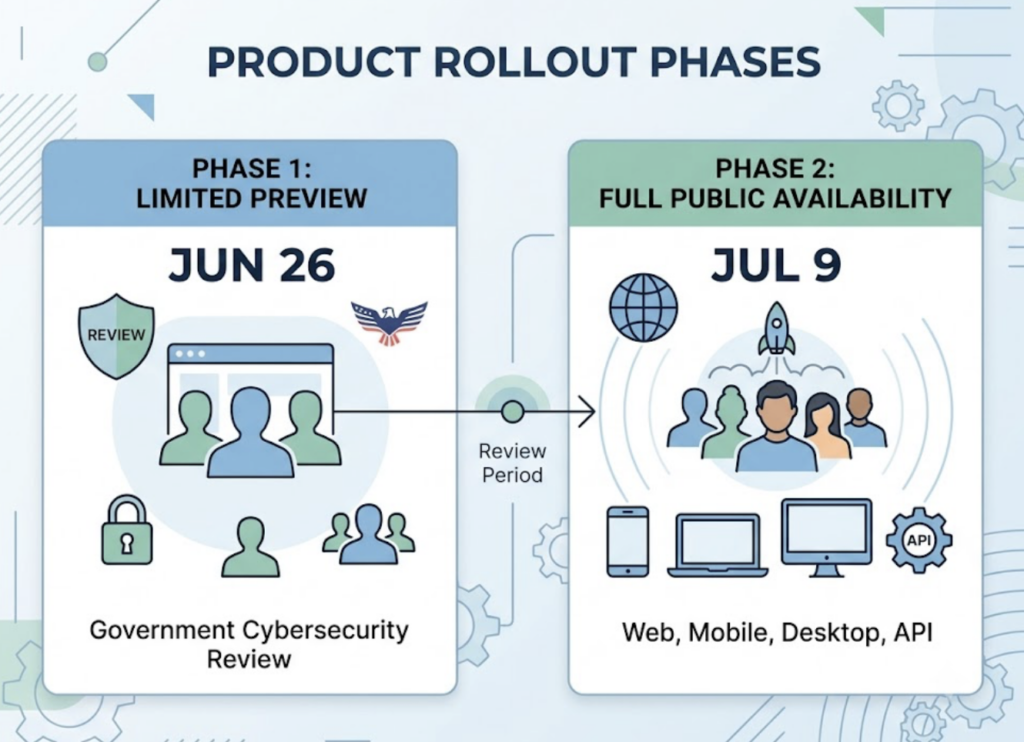
The rollout came in two phases. OpenAI opened a limited preview on June 26 at the request of the U.S. government, which asked for a cybersecurity review period before broad release. Full public availability followed on July 9, covering web, mobile, desktop, and the API. A two-week government-coordinated review is itself a signal: this generation crosses a meaningful capability threshold in autonomous, agentic work.
The naming system also changed. The number now marks the generation, while three durable tiers, Sol, Terra, and Luna, identify capability levels that can evolve on their own cadence.
| Model tier | Positioning | API pricing per 1M tokens, input/output | Default usage |
|---|---|---|---|
| Sol | Flagship. Complex reasoning, agentic coding, long-horizon knowledge work. Exclusive ultra mode. | $5.00 / $30.00 | Default advanced model for Pro and Enterprise plans |
| Terra | Balanced. Everyday professional output at roughly half the cost of the previous flagship. | $2.50 / $15.00 | Default model for Free and Go users |
| Luna | Speed-focused. High-volume classification and extraction at the lowest cost. | $1.00 / $6.00 | API and enterprise routing for bulk tasks |
Pricing shown reflects the OpenAI Help Center listing at launch and may change.
On efficiency, OpenAI reports Sol is 54% more token efficient on agentic coding tasks than its predecessor. All three tiers support a context window of roughly 1.05 million tokens, which changes how much source material the model can hold and compare when synthesizing an answer.
Two workflow additions matter as much as the models themselves. A new ultra mode lets the system spin up parallel sub-agents that divide work, cross-check each other, and merge conclusions. And ChatGPT Work, a new agent released alongside GPT-5.6, moves beyond the chat box entirely: it operates across desktop apps, connected files, and third-party tools to produce documents, spreadsheets, and research deliverables on its own.
Why a Model Update Can Reshuffle Your Brand’s AI Search Visibility
Generative engine optimization rests on one premise: you understand how the model retrieves, weighs, and synthesizes information. A generation change breaks that premise.
In traditional SEO, volatility comes from algorithm tweaks to link weighting or page experience signals. In AI search, volatility comes from something deeper: a full reallocation of the model’s internal feature space. New training data. New RLHF alignment. New retrieval preferences in the RAG pipeline. All of it, replaced at once.
The most immediate shift is at the consumer scale. Hundreds of millions of free-tier users just got hard-switched to Terra as their default answer engine. Terra’s compression logic, its tolerance for long-form content, and its preferred data sources all differ statistically from the model it replaced. The generation logic behind most consumer-facing AI answers changed overnight.
That’s not a theoretical risk.
Cross-platform tracking data shows that model transitions routinely produce swings beyond normal variance. In competitive software and professional service categories, shifts in source preference have moved citation gaps of up to 34% between rivals during a single model transition. And the disconnect between traditional SEO strength and AI visibility is well documented: in large-scale tracking, 88% of URLs cited by AI engines didn’t appear in the top 10 organic results for the same queries, with a correlation coefficient of just 0.034 between organic rank and AI citation.
Betting your GPT-5.6 visibility on your Google rankings is betting on a relationship that barely exists. When millions of buyers ask Terra or Sol for a shortlist this week, a fresh set of judgment criteria decides who makes it.
Three Shifts in GPT-5.6 That Matter for GEO
Beyond the engine swap, three capability changes reshape how brands get cited and recommended.
Design Judgment and Computer Use Change What Gets Cited
Previous generations read your site as text and markup. If your Schema.org tags were clean, a broken layout didn’t matter much.
GPT-5.6 changes that. OpenAI describes a step change in design judgment, paired with stronger computer-use skills that let the model inspect the rendered result, not just the underlying code. In agentic research tasks, the model can browse a page in a virtual environment the way a person would: rendering it, scanning the visual hierarchy, clicking through navigation.
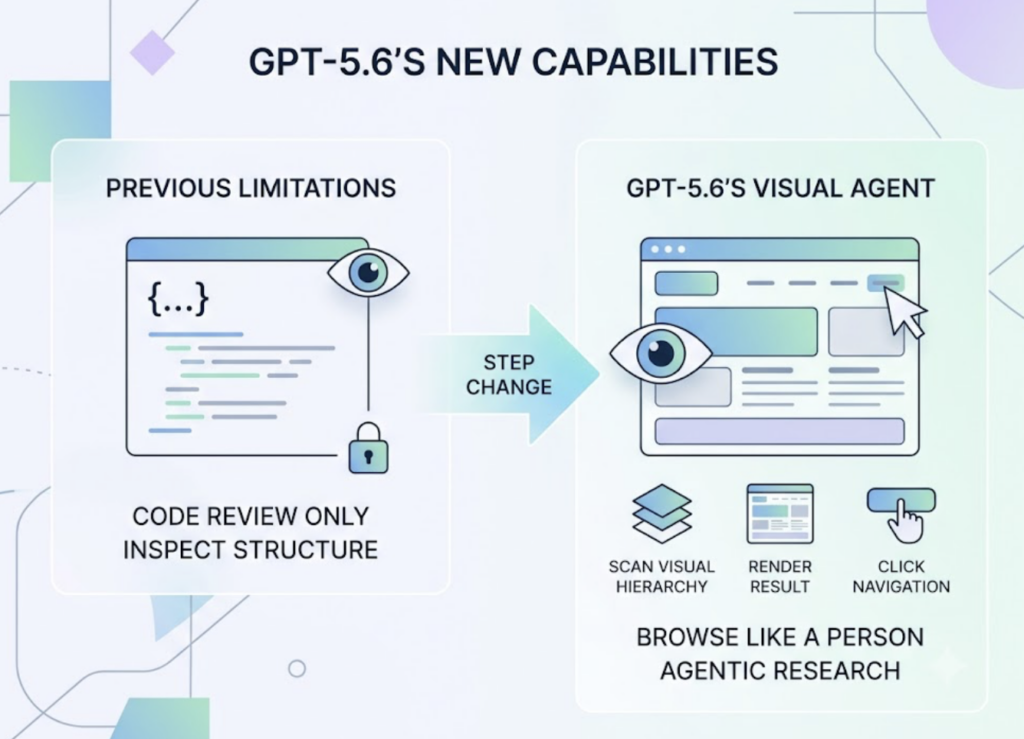
The implication for GEO is direct. A source that renders poorly, breaks on interaction, or buries its key claims in cluttered layouts can now lose trust scoring during evaluation, even with perfect structured data underneath. Visual quality is becoming an authority signal, not just a UX concern.
ChatGPT Work Pulls Answers From Connected Apps, Not Just the Web
Brand visibility used to be a public-web contest. ChatGPT Work breaks that boundary.
Through its connector ecosystem, the agent can retrieve context from Slack, Teams, Google Drive, SharePoint, and CRM platforms alongside web search. When a buyer asks “which vendors should we shortlist for the Q3 security audit,” the agent doesn’t just query the open web. It scans internal chat threads, past evaluation memos, and shared analyst briefs, then cross-references that internal consensus against public sources.
For B2B brands, this restructures the goal. Winning external search mentions is no longer sufficient. The brands that get recommended will be the ones whose whitepapers, templates, and benchmark data have already penetrated the buyer’s internal knowledge base. If your name shows up in their Slack, it shows up in their AI’s answer.
Tiered Models Mean Your Visibility Differs by User Plan
The Sol, Terra, Luna split creates something GEO teams haven’t dealt with before: plan-dependent visibility.
A free user asking for a category comparison gets Terra, which tends to synthesize quickly from high-visibility FAQ pages and mainstream coverage. A Pro or Enterprise user asking the same question may get Sol running a deep retrieval pipeline across technical documentation, long-form reviews, and niche sources, with multi-agent cross-checking before the final answer.
Same question, different model, different shortlist.
If your monitoring samples only one tier, your data carries a structural blind spot. The market picture your enterprise buyers see through Sol can diverge sharply from what free users see through Terra. Visibility now has to be measured, and optimized, per model tier.
How to Audit Your AI Search Visibility After the ChatGPT 5.6 Update
With the baseline reset, waiting is the worst available strategy. Here’s the audit sequence that matters right now.
Re-run your full prompt universe. Don’t spot-check a handful of queries or recycle SEO head terms. Build 50 to 200 high-intent, long-tail questions that mirror real buying conversations: best-solution asks, head-to-head comparisons, scenario-specific alternatives.
Compare mention rates and positions before and after the switch. Absolute mention count is only half the story. Watch whether your position within the answer has slipped, whether you’ve moved from first recommendation to footnote while a competitor took your slot.
Trace the citation shift. Every confident AI recommendation rests on sources the model chose to trust. Map which forums, review platforms, and communities like Reddit gained weight under the new models, and which lost it.
Monitor competitors at high frequency. During transition chaos, a minor rival whose content happens to match the new model’s extraction preferences can see exponential exposure gains in days.
Running this manually, prompt by prompt in a spreadsheet, isn’t realistic at the required scale and frequency. This is the problem Topify is built for. Its Visibility Tracking covers ChatGPT across model tiers, plus Gemini, Perplexity, DeepSeek, Doubao, and Qwen, so your read on the market doesn’t hinge on one platform’s quirks. Competitor Monitoring samples at high frequency to catch position reshuffles as they happen and identify which new citation sources a rival used to take share. Source Analysis reverse-engineers the new models’ citation preferences, showing whether your visibility drop traces to missing AI-crawler-friendly markup, like llms.txt or nested Schema.org, or to a competitor’s entrenched presence on high-weight third-party platforms.
Topify measures all of this through seven metrics: Visibility, Sentiment, Position, Volume, Mentions, Intent, and CVR. Together they separate “mentioned as the top pick” from “named as the cheap alternative,” and connect AI exposure to actual conversion signals rather than vanity counts. Its One-Click Execution agent then turns the diagnosis into deployed fixes without manual workflows.
Bottom line: the reset cuts both ways. Every competitor’s baseline just got wiped too. The team that maps the new algorithm’s preferences first takes the open ground.
The Window Is Short: Why Early Movers Win After Model Updates
AI recommendation systems exhibit strong path dependence. Once a new model’s entity associations settle, dislodging them takes far more contradicting evidence than establishing them did.
Right after a generation launch, the system is in a rare re-learning state, actively seeking stable, well-structured sources to anchor its new output patterns. Brands that act within the first 2 to 4 weeks get outsized returns: fixing firewall rules that block GPTBot, deploying llms.txt, rolling out JSON-LD markup for organization, product, and FAQ content across the site.
There’s also a hard economic mechanism locking in early winners. GPT-5.6 introduces explicit prompt caching with cache writes billed at 1.25x and cache reads discounted 90%. Once an answer pattern for a high-frequency commercial query gets cached, the platform has a direct cost incentive to reuse and lightly adapt it. Brands whose content enters those early cached answers gain a moat backed by compute economics.
Early citations also snowball across ecosystems. Consistent AI recommendations get picked up by aggregators, which lifts traditional search signals, which in turn feeds back into the next round of AI crawling as fresh authority evidence. That’s the circular authority loop, and it compounds in whichever direction it starts.
Conclusion
GPT-5.6 isn’t a patch. It’s a reset of how the world’s most-used AI interface evaluates, weighs, and recommends brands: three isolated model tiers, an agent that reads private workspaces, visual quality as a trust signal, and a caching economy that rewards whoever gets synthesized first.
Static playbooks from the SEO era, or even from early GEO, won’t survive contact with an engine that changes this fast. What works is continuous, tier-aware, cross-platform measurement, a clear read on the new models’ citation preferences, and fast execution inside the 2-to-4-week recalibration window. The brands that treat this launch as a monitoring event, not a news item, will be the ones GPT-5.6 keeps recommending long after the window closes.
FAQ
What’s the difference between GPT-5.6 Sol, Terra, and Luna?
Sol is the flagship tier for complex reasoning, agentic work, and deep research, with exclusive access to ultra mode, and defaults to paid advanced plans. Terra balances cost and quality at roughly half the previous flagship’s price and now powers free and everyday usage. Luna trades reasoning depth for speed and cost efficiency, serving high-volume extraction and classification through the API.
Does GPT-5.6 change how ChatGPT recommends brands?
Yes, in measurable ways. Free users’ default engine switched to Terra, which compresses and sources information differently from the model it replaced, so consumer-facing shortlists shift. The new computer-use capability adds rendered visual quality to source evaluation, and ChatGPT Work adds internal workspace content to the evidence pool. Brands now need clean markup, strong visual UX, and presence inside buyers’ internal documents to earn high-confidence recommendations.
How do I track my brand mentions in ChatGPT 5.6?
Manual spot checks can’t handle probabilistic answers that vary by model tier and plan. The current best practice is continuous sampling with a tracking platform like Topify, running a large set of high-intent prompts across ChatGPT’s tiers and other major engines, then analyzing visibility, sentiment, position, volume, mentions, intent, and CVR to locate your real standing and the highest-leverage fixes.

