

Ask ChatGPT a question about your product category today, and the answer depends on something most marketing teams never check: which model is actually doing the answering. A free user, a Plus subscriber, and a developer calling the API can each get responses generated by different models, with different reasoning depth and different citation habits. Your brand might appear in one answer and vanish from the next, for the exact same prompt. If your visibility reports still treat “ChatGPT” as a single engine, you’re now measuring an average of three.
Your Customers Aren’t All Talking to the Same ChatGPT
With GPT-5.6, OpenAI formalized something that had been true informally for a while: ChatGPT is a family of models, not one model. In the new naming system, the number identifies the generation, while Sol, Terra, and Luna identify durable capability tiers that advance on their own schedules.
Sol is the flagship, built for complex reasoning, research, and long-running work. Terra is the balanced everyday model, positioned as competitive with GPT-5.5 at roughly half the cost. Luna is the fast, low-cost tier for high-volume tasks.
Here’s the part that matters for marketers. According to OpenAI’s Help Center, Sol powers the Medium, High, and Extra High reasoning options on eligible paid ChatGPT plans, while GPT-5.5 Instant remains the default for fast everyday responses. Terra and Luna aren’t selectable in standard ChatGPT conversations at all. They serve ChatGPT Work, Codex, and the API, where free and Go users get Terra and paid users choose among all three.
Your customers are distributed across that entire matrix. And each cell of the matrix can describe your brand differently.
GPT-5.6 Sol, Terra, and Luna at a Glance
The family moved from limited preview to general availability in early July 2026, and it’s already rolling out across third-party surfaces like GitHub Copilot. Here’s how the three tiers compare on the dimensions a GEO team actually cares about.
| Dimension | Sol | Terra | Luna |
|---|---|---|---|
| Positioning | Flagship, frontier reasoning | Balanced everyday work | Fast and cost-efficient |
| API pricing per 1M tokens | $5 input / $30 output | $2.50 input / $15 output | $1 input / $6 output |
| Where users meet it | ChatGPT reasoning modes on paid plans, API, Codex | ChatGPT Work free tiers, Codex, API | High-volume API workloads, latency-sensitive apps |
| Typical query type | Complex research, comparisons, due diligence | Everyday professional questions | Quick lookups, embedded assistants |
| GEO implication | Deep source cross-referencing, harder to earn a citation | The baseline for most professional brand queries | Leans on top-ranked sources and probabilistic memory |
Two details from the launch are worth flagging. Sam Altman told CNBC the new flagship is 54% more token efficient on agentic coding, which signals OpenAI is optimizing for models that read more and generate less filler. And tier labels don’t guarantee behavior on any single task: on Terminal-Bench 2.1, Luna actually outscored Terra despite sitting a tier below it.
That second point is the whole story in miniature. Tier names describe an average trade-off, not a promise about how any specific query gets answered.
Why Model Tiers Reshape Your Brand’s AI Search Visibility
Brand visibility in AI search isn’t a static ranking anymore. It’s a dynamic outcome of the model’s reasoning architecture, and the three GPT-5.6 tiers reason differently.
Research into LLM behavior suggests that higher-reasoning models like Sol show a greater tendency to cross-reference multiple sources before committing to a claim. Efficiency-optimized models like Luna lean more heavily on probabilistic memory and top-ranked search results. The practical consequence: if your brand dominates traditional search but lacks deep, authoritative documentation, you’re more likely to be cited by Luna and ignored by Sol.
The reverse pattern exists too. A niche brand with rigorous technical content but weak conventional SEO can surface in Sol’s carefully reasoned answers while staying invisible in Luna’s fast ones.
That’s the gap a single “ChatGPT visibility” number can’t show you.
There’s also a generational effect. Every model rollout updates the underlying weights, which creates what amounts to a visibility baseline reset. Training preferences shift, sometimes away from high-authority aggregator sites and toward high-relevancy niche expert content. GPT-5.6 also shows improved intent interpretation, which tends to reward brands publishing clear problem-solution content over pages built on generic keyword density.
What Happens to Brand Mentions When the Model Updates
The transition from GPT-5.5 to 5.6 is exactly the kind of moment where brand mentions drift without anyone on your team touching a single page.
A brand that GPT-5.5 reliably recommended can drop out of GPT-5.6 answers because the new weights favor different source categories. The citations behind AI answers shift too: domains that AI models cited last quarter may stop appearing, while new expert sources take their place. None of this registers in Google Search Console, because none of it happens in Google.
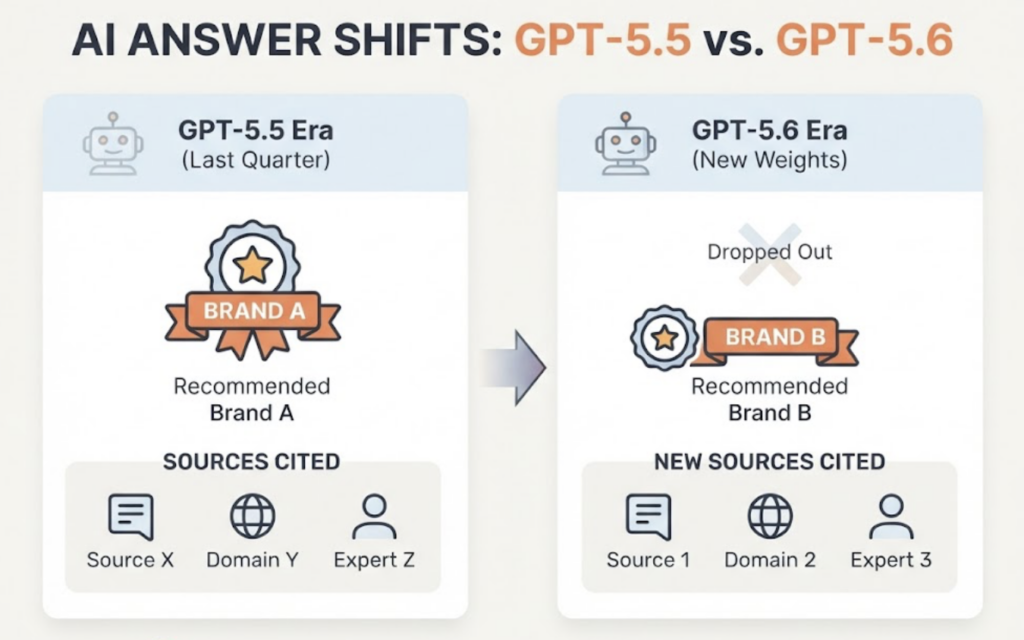
What makes the 5.6 transition different from previous updates is fragmentation. Because Sol, Terra, and Luna can return different sources for the exact same prompt, measuring brand visibility without segmenting by model produces misleading data. An aggregate mention rate might look stable while your presence in Sol, the tier your highest-value enterprise buyers reach through paid plans and the API, quietly erodes.
The black box didn’t just get a new version. It split into three boxes.
How to Track Your Visibility Across GPT-5.6 Sol, Terra, and Luna
The capability you need now is prompt-level, model-aware monitoring: the ability to run the same set of high-intent prompts on a recurring schedule and see how mentions, positions, and cited sources differ across models and change over time.
For teams building that capability, Topify approaches the problem as a matrix rather than a single feed. Its Visibility Tracking measures how often your brand appears in AI answers across ChatGPT, Gemini, Perplexity, DeepSeek, and other major platforms, so a shift inside one engine doesn’t get averaged away by stability in another. Position Tracking shows where you land relative to competitors when you do appear, which matters because a move from first mention to fourth is invisible in a simple mention count.
The layer most relevant to a model transition is Source Analysis. It reverse-engineers the exact domains and URLs that AI platforms cite, so when your mention rate dips after a rollout, you can trace it to the specific sources that stopped carrying your brand and target replacements. In practice, that turns “our AI visibility dropped” from a mystery into a content brief.
If you want to gauge your starting point before committing to continuous tracking, Topify also maintains a set of free GEO tools that cover quick checks like GEO scoring and visibility snapshots.
A 3-Step GEO Playbook for the GPT-5.6 Transition
Model transitions reward teams that move early, because the baseline you capture now becomes the reference point for every drift measurement later.
Step 1: Establish a multi-model benchmark. Run a snapshot audit across the tiers your audience actually uses, built on 50 to 100 high-intent category-level prompts. Record your citation rate, average position, and cited sources for each. This is your pre-drift baseline.
Step 2: Map your content gaps by tier. Look for asymmetries. Present in high-volume answers but missing from complex ones usually means your content lacks the technical depth a flagship reasoning model wants before it cites you. The fix tends to be documentation-grade content: methodology pages, original data, detailed comparisons.
Step 3: Monitor for drift continuously. One audit is a photo; GEO needs video. Track the statistical decline or gain in mentions after each model update, and feed what you learn back into your schema and content pillars. Teams that get started with ongoing tracking before the next generation ships will know exactly what changed. Teams that don’t will be guessing.
Conclusion
GPT-5.6 ends the era of optimizing for “ChatGPT” as a single destination. Sol, Terra, and Luna reason differently, cite differently, and reach different segments of your audience, from free-tier users on Terra to enterprise buyers running Sol through the API. Your brand’s reputation is now being synthesized by three distinct compute classes at once.
The strategic response isn’t complicated, but it is urgent: establish a per-model visibility baseline now, find the tiers where your brand goes missing, and put continuous monitoring in place before the next weight update resets the board again. Don’t optimize for the search engine. Optimize for the reasoner.
FAQ
Q: What’s the difference between GPT-5.6 Sol, Terra, and Luna?
A: They’re capability tiers within one generation. Sol is the flagship for complex reasoning at $5/$30 per million tokens, Terra is the balanced everyday model at $2.50/$15, and Luna is the fast, low-cost tier at $1/$6. The generation number advances together; each tier evolves on its own cadence.
Q: Does GPT-5.6 change how ChatGPT recommends brands?
A: It can. New model weights shift source preferences and citation patterns, and GPT-5.6’s improved intent interpretation tends to favor clear problem-solution content. Brands often see mention rates move after a rollout even when their own content hasn’t changed.
Q: Which GPT-5.6 model do most ChatGPT users actually encounter?
A: In standard ChatGPT conversations, Sol powers the reasoning modes on eligible paid plans while GPT-5.5 Instant remains the fast default. Terra serves free and Go users in ChatGPT Work and Codex, and all three tiers are available through the API.
Q: How do I track my brand’s visibility in ChatGPT 5.6?
A: Run a fixed set of high-intent prompts on a recurring schedule and measure mentions, positions, and cited sources over time, segmented by model where possible. Platforms like Topify automate this across ChatGPT, Perplexity, Gemini, and other engines, with source-level analysis to explain why visibility changed.

