

Your team spent the last year building domain authority and defending page-one rankings. Then on July 9, OpenAI shipped ChatGPT 5.6, and every assumption baked into those rankings quietly reset. A model generation change isn’t a feature update. It’s a reshuffle of which sources get trusted, which brands get named, and which get filtered out of the buyer’s consideration set entirely. Most teams won’t notice until high-intent traffic dips weeks later, with nothing in their SEO dashboard to explain why.
GPT-5.6 Just Dropped. Your Brand’s AI Visibility May Have Already Shifted.
On July 9, 2026, OpenAI moved GPT-5.6 to general availability across ChatGPT, Codex, and the API. Instead of a single model, it’s a three-tier family: Sol, the flagship for complex reasoning and long-horizon agent workflows; Terra, a balanced everyday model that matches GPT-5.5 performance at roughly half the cost; and Luna, a speed-focused variant priced around $1 per million input tokens. All three carry a one-million-token context window and a refreshed knowledge cutoff of February 2026.
For marketers, the headline isn’t the benchmarks. It’s what the architecture implies about sourcing.
Sol introduces a max reasoning effort setting and an Ultra mode that coordinates multiple sub-agents on deep research tasks. A model that spends more compute verifying facts behaves less like a summarizer and more like an analyst. It cross-references technical documentation, structured datasets, and dense third-party evaluations rather than skimming marketing copy. If your brand’s footprint in those machine-readable sources is thin, your visibility in GPT-5.6’s long-form answers has likely already slipped, whether or not anyone on your team has checked.
How ChatGPT 5.6 and Claude Fable Decide Which Brands to Cite
GPT-5.6 and Anthropic’s Claude Fable 5 sit at the top of the same market, but they hold different philosophies about what counts as a trustworthy source. That difference, more than any benchmark score, determines which brands each model names.
What GPT-5.6 Pulls From the Web
When a prompt involves brand comparisons or product recommendations, GPT-5.6 shows a strong appetite for structured, official, high-density information. Its retrieval behavior favors pages with clean JSON-LD markup (FAQPage, Product, Article schemas), clear H2/H3 hierarchies, and content packed with specific statistics, recent research, and precise specifications.
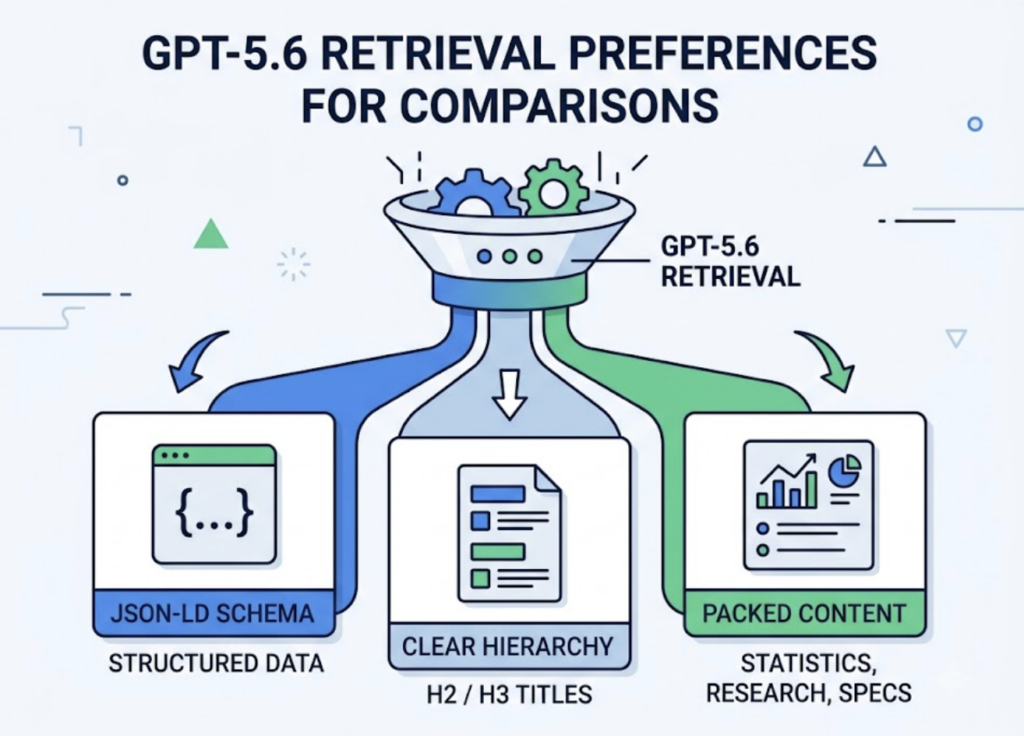
In practice, this rewards brands whose sites read like reference material. A pricing page that answers “how much does it cost” in one extractable sentence beats a persuasion-heavy landing page. Content built on keyword volume alone, without factual anchors an agent can lift and verify, tends to get scored as low-information and dropped from the synthesis.
How Claude Fable Handles Brand Mentions
Claude Fable 5 leans the opposite way. Anthropic’s flagship runs with adaptive thinking enabled by default and some of the strictest safety alignment in the industry, which translates into visible skepticism toward commercially biased content, including a brand’s own marketing pages.
The data backs this up. Yext’s Q4 2025 analysis of 17.2 million AI citations found that Claude relies on user-generated content, reviews and social media the study classifies as “limited control” sources, at rates 2 to 4 times higher than competing models across every sector studied. In food and beverage, limited-control sources reached 24.4% of Claude’s citations. In business services, 15.89%, more than double the peer average.
Ask Claude Fable how an enterprise tool actually performs, and it tends to route around the vendor’s homepage entirely, pulling instead from G2 threads, Reddit discussions, and independent reviewers. Verified crowd consensus reads as safer than a single company’s claims.
There’s a deeper pattern underneath both behaviors, one that recent academic work on generative AI and brand visibility calls the ranking-mention separation. Studies of AI citation behavior suggest a large majority of cited sources come from outside Google’s top ten results, with traditional organic ranking showing near-zero correlation with citation probability. Ranking well is not the same as getting cited. Getting cited is not the same as getting named as the recommendation.
That’s the gap most brands still can’t see.
The Citation Gap: Same Question, Different Brands
Feed both models the same high-intent prompt, something like “compare the top customer success platforms for a fast-scaling startup,” and the outputs split along predictable lines. Neither model hallucinates. They just trust different corners of the internet.
| Dimension | GPT-5.6 Sol | Claude Fable 5 |
|---|---|---|
| Preferred sources | Official docs, analyst reports, schema-rich reviews | G2/TrustRadius aggregates, Reddit threads, independent blogs |
| Brands surfaced | 4-5 brands in a structured grid by size and feature set | 2-3 brands with the strongest community consensus, analyzed in depth |
| What wins position one | High fact density on owned pages, recent coverage in major outlets | Broad validation in communities, with complaints limited to non-fatal flaws |
| Sentiment style | Neutral, capability-focused statements | Direct relay of user praise and pain points, clearly polarized |
Two of these rows deserve extra attention. First, position rank barely transfers between systems: a brand that GPT-5.6 puts first can be absent from Claude’s answer entirely, because the SEO moat that impresses one model is invisible to the other. Second, Claude’s sentiment behavior creates what you might call a negative visibility trap. A brand that gets mentioned often but framed by community complaints can be worse off than a brand that isn’t mentioned at all.
You Can’t Optimize for a Model You’re Not Measuring
The most common response to all this is also the least useful one: a marketer types their brand name into ChatGPT a few times, sees something positive, and closes the tab reassured. Ad-hoc spot checks can’t capture how answers shift with temperature, prompt phrasing, retrieval cache refreshes, or model updates. One sample is not a signal.
Systematic, cross-model measurement is the actual prerequisite. Buyers move between ChatGPT, Claude, Perplexity, and Google AI Overviews within a single research cycle, so a brand’s real AI presence is the composite across all of them. This is where a platform like Topify fits: it tracks visibility, sentiment, and position across major AI engines from one dashboard, then reverse-engineers the source domains each model is actually citing.
Here’s what that looks like in practice. Your team loads 100 high-intent prompts into Topify, things like “best alternatives to [category leader]” or “[your product] security concerns.” The system samples answers across platforms on a schedule. One morning the dashboard flags a divergence: visibility in GPT-5.6 is holding at 85%, but your recommendation position in Claude Fable dropped out of the top three overnight. Source Analysis traces it to a niche industry forum, one of those limited-control sources Claude weights heavily, where a pricing change sparked a wave of negative threads 48 hours earlier. Now you know exactly where to respond, and why it moved one model but not the other.
That level of diagnosis rests on a handful of core metrics: visibility rate (how often you appear across your prompt set), citation share (whether AI links your own domain or talks about you secondhand), sentiment score, competitive share of voice, position rank, source attribution, and drift over time. Topify’s Basic plan covers this kind of continuous multi-engine tracking from $99 per month, which puts systematic measurement within reach of teams that were previously guessing.
Drift is the metric to watch right now. A volatility spike in the days after a release like GPT-5.6 is your signal to run a gap analysis before the new patterns harden.
What to Do in the First 30 Days After a Model Release
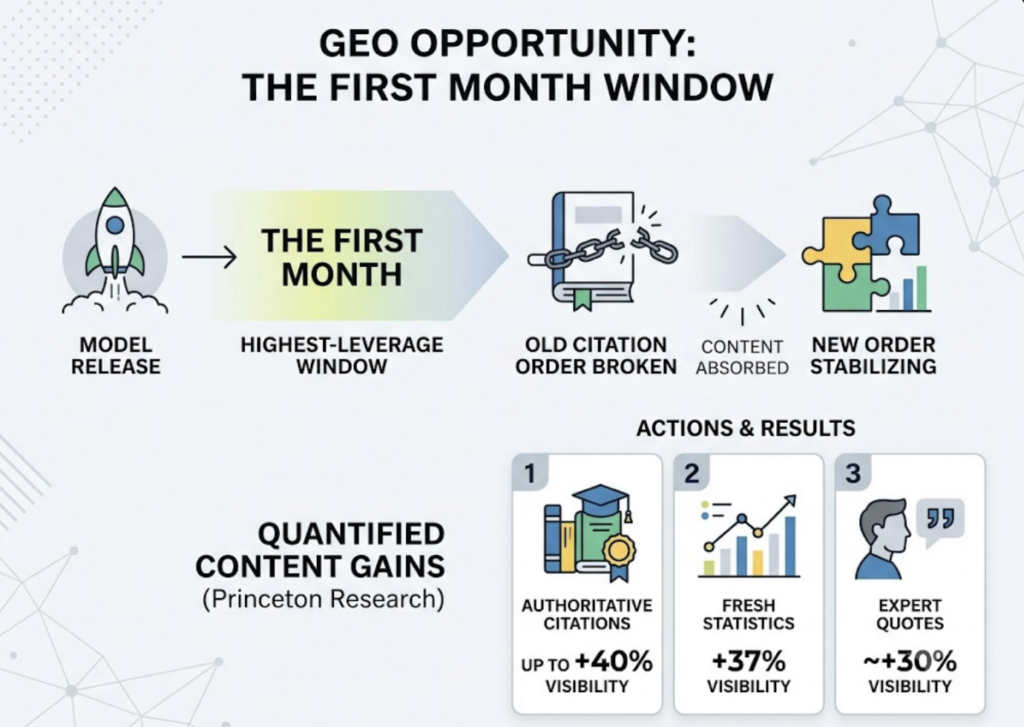
The first month after a major model release is the highest-leverage window in GEO. The old citation order is broken, the new one hasn’t fully set, and content changes made now get absorbed as the model’s retrieval patterns stabilize. Princeton’s research on generative engine optimization quantifies what those changes are worth: adding authoritative citations lifted visibility in AI answers by up to 40%, adding fresh statistics by 37%, and adding expert quotes by around 30%.
Here’s a sprint plan that fits the window:
| Days | Focus | What to do |
|---|---|---|
| 1-7 | Baseline measurement | Run 50-200 core prompts against GPT-5.6, the prior model, and Claude Fable. Record all metrics. Change nothing yet, so the baseline stays clean. |
| 8-14 | Source gap analysis | Compare source attribution across old and new models. Which competitors did GPT-5.6 promote? Which sources that used to cite you got dropped, and is the cause missing schema or stale content? |
| 15-21 | Fact and data injection | Refresh statistics, specs, and pricing on owned pages with 2026 data. Add extractable answer blocks and FAQ modules so facts can be lifted cleanly. This targets GPT-5.6’s structured-data appetite. |
| 22-30 | Cross-model alignment | Address Claude’s social layer. Audit recent Reddit and G2 discussions about your brand, respond officially where warranted, and publish clarifying content that third-party communities can absorb before Claude’s next retrieval pass. |
The logic behind the sequence matters more than the exact dates. Measure before you touch anything, find the gap before you fill it, and feed each model the source types it actually eats.
Conclusion
So which model cites your brand more, GPT-5.6 or Claude Fable? There’s no universal answer, and anyone selling you one is skipping the hard part. The outcome depends on your industry, how your digital footprint is distributed between owned pages and community discussion, and the prompts your buyers actually type. B2B brands with dense technical documentation tend to fare better in GPT-5.6’s structured retrieval. Consumer and reputation-driven categories live or die by the community sources Claude Fable weights most.
What is universal: you can’t answer the question for your own brand without measuring both models, on the same prompts, at the same time. The ranking-mention separation means your Google position won’t tell you. Start with a baseline this week, while the post-release window is still open, and let the data decide where your optimization effort goes. You can set up your first prompt set in Topify in a few minutes.
FAQ
Q: Does GPT-5.6 cite brands differently from GPT-5.5?
A: Yes, and the shift is structural. The Sol/Terra/Luna tiering plus deeper reasoning modes means GPT-5.6 verifies more aggressively than GPT-5.5’s comparatively static extraction. It favors sources with rigorous schema markup, current statistics, and expert commentary, which pushes thin, keyword-driven pages further to the margins.
Q: How do I track my brand’s mentions in Claude Fable?
A: Traditional backlink tools won’t help, because Claude leans on reviews, forums, and social discussion rather than link graphs. You need an AI response monitoring setup: a library of buyer-intent prompts sampled against Claude on a schedule, with sentiment scoring and source attribution to identify which communities are shaping the model’s framing of your brand.
Q: Which AI platform matters more for my industry?
A: It follows your buyers’ behavior. Technical B2B and research-heavy categories tend to see more influence from GPT-5.6 and Perplexity, while consumer services and experience-driven categories are shaped more by Claude Fable and Google AI Overviews, which aggregate community sentiment. Run a cross-platform baseline and let measured visibility, not intuition, allocate your effort.
Q: How often should I re-check AI visibility after a model update?
A: During the first 30 days after a generational release like GPT-5.6, weekly at minimum, and every 48 hours for your highest-value prompts, since retrieval patterns are still settling. After the window closes, biweekly or monthly tracking with drift alerts is generally enough to catch competitor moves and quiet model adjustments.

