

Your brand finally started showing up consistently in ChatGPT’s answers. You tuned your schema, built third-party authority, and watched citation rates stabilize over the spring. Then on July 9, 2026, OpenAI replaced the engine underneath. GPT-5.6 Sol now powers ChatGPT’s advanced reasoning stack, and it processes the same prompts with 54% fewer output tokens than its predecessor. That sounds like an efficiency win for developers. For brands tracking AI visibility, it’s a citation earthquake.
The model generates shorter, more precise answers. But behind those concise responses, it runs deeper retrieval, pulls from more sources, and decomposes queries into more sub-queries than before. Your GEO baseline from June is already stale.
GPT 5.6 Sol Generates Less but Retrieves More
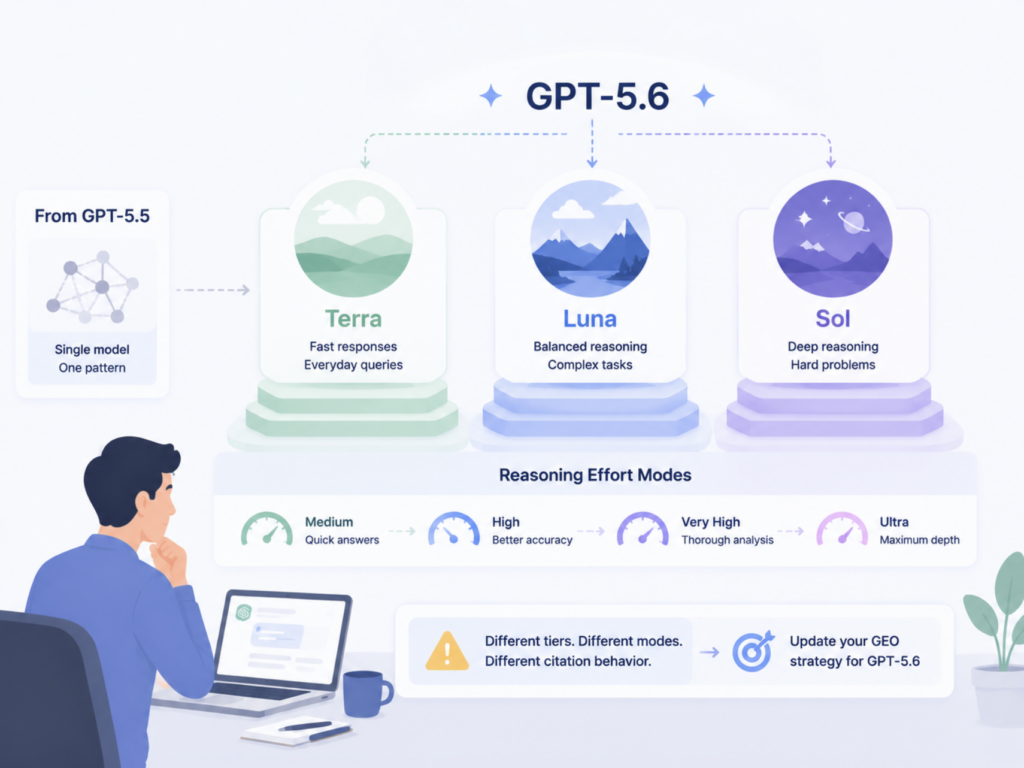
GPT-5.6 Sol is OpenAI’s new flagship model, launched for general availability on July 9, 2026 after a limited preview starting June 26. It ships as part of a three-tier family: Sol (flagship), Terra (balanced), and Luna (cost-efficient). The naming convention is new. OpenAI describes the shift as moving from “one model with a dial” to “three models, choose a tier.”
The efficiency numbers are striking. On OSWorld 2.0, Sol surpasses Claude Opus 4.8 while using 85% fewer output tokens. On the Artificial Analysis Coding Agent Index, it scores 80, which is 2.8 points above Claude Fable 5, while using less than half the output tokens and taking less than half the time. Pricing reflects the efficiency play: Sol runs at $5 input and $30 output per million tokens, Terra at $2.50/$15, and Luna at just $1/$6.
Here’s the thing. “Fewer tokens” doesn’t mean the model is doing less work. Sol generates more concise, precise responses without sacrificing completeness. It just does it with less text. Meanwhile, its reasoning modes fire off more sub-queries, browse more pages, and pull in more external sources before composing that shorter answer. For GEO, this is the paradox that matters: the AI writes less, but reads more.
Every Model Update Rewrites the Citation Playbook
If you’ve tracked ChatGPT citation behavior over the past year, you already know the pattern. Every model version change reshuffles which brands get cited, which domains lose ground, and how the model finds information.
The data trail is clear. When ChatGPT transitioned to GPT-5.3 as the default, average cited domains per response dropped from 19.1 to 15.2, a 20% decline. GPT-5.4 reversed the trend hard: brand website citations jumped to 56%, up from just 8% under GPT-5.3, a 7x increase. Then GPT-5.5 pulled back. Brand site citations dropped to 47%, driven by a 70% reduction in site: operator usage during fan-out queries. The GPT-5.5 Instant tier was even more dramatic: brand website citations fell to just 6%, a 55% drop from GPT-5.3 Instant.
SISTRIX analyzed 3.8 million German-language ChatGPT responses and compared citation patterns before and after the GPT-5.5 rollout. The company compared it to a Google core update.
GPT-5.6 isn’t just another increment. It’s a structural change. Three model tiers with different reasoning depths, a new caching architecture, and reasoning effort modes ranging from medium to ultra. Each tier and mode produces different citation behavior. The brands that built their GEO strategy around GPT-5.5’s patterns are now operating on outdated assumptions.
GPT 5.6 Reasoning Modes Create Two Separate Citation Webs
This is where the data gets uncomfortable for teams treating ChatGPT as a single channel.
A June 2026 Semrush study of 100 prompts found that only 25.6% of cited domains overlapped between ChatGPT’s minimal reasoning mode and high reasoning mode. Same prompts, same platform, wildly different sources.
The numbers break down fast. Citation rate climbs from 50% in Instant mode to 68% in Thinking mode, an 18-percentage-point jump. Average citations per response nearly double, from 2.6 to 4.5. And the mechanism driving it: fan-out sub-queries run 4.6x higher in Thinking mode than in Instant mode. High reasoning pulled from 173 unique domains across the test set, compared to a much narrower pool in Instant.
The industry-level differences matter too. Finance sees the largest citation rate increase at 28 percentage points. Health and lifestyle gain 24 points, B2B SaaS gains 16, and consumer tech sees only a modest 4-point lift.
GPT-5.6 Sol amplifies this split. It powers the medium, high, and extra-high reasoning levels in ChatGPT for paid users. GPT-5.5 Instant still handles fast everyday responses on the free tier. So a ChatGPT Plus subscriber asking “best project management tool for remote teams” may see your brand cited across 4 to 5 sources in a Sol-powered answer. A free-tier user asking the same question gets a GPT-5.5 Instant response that may cite zero brand sites.
Brand visibility in AI answers isn’t a ranking problem anymore. It’s a retrieval-depth problem.
What “Fewer Tokens, More Sources” Actually Means for GEO
The combination of token efficiency and deeper retrieval creates a specific dynamic that changes how GEO should work.
On the output side, GPT-5.6 Sol generates shorter responses. Fewer tokens means fewer mentions per answer, which means each citation slot is more competitive. Your brand either makes the cut in a concise, 3-to-5 source response, or it doesn’t appear at all.
On the retrieval side, the model searches more before responding. Higher reasoning modes decompose a single user prompt into multiple sub-queries, each targeting a different angle of the question. Google AI Mode fires 9 to 11 parallel sub-queries per prompt, while ChatGPT runs 2.3 to 2.8 on average. But in ChatGPT’s Thinking mode, that fan-out multiplies by 4.6x.
Here’s what that means for your content strategy. According to AirOps research from March 2026, 32.9% of cited pages appeared only in fan-out results, not in the original prompt’s search results. They were never discovered through the primary keyword. And 95% of those fan-out queries had zero traditional search volume. You can’t find them in Google Search Console. You can’t target them with conventional keyword tools.
The implication is direct. Brands that only optimize for surface-level queries miss roughly a third of their citation opportunities. The ones that cover the sub-query layer, the specific comparisons, pricing breakdowns, use-case distinctions, and niche technical questions, capture visibility that competitors can’t even see.
That gap is exactly what Topify is built to diagnose. Its Source Analysis feature tracks which domains AI platforms actually cite for your target prompts, across ChatGPT, Gemini, Perplexity, and Google AI Overviews. When GPT-5.6 reshuffles the source pool, you can see which of your pages gained or lost citations within days, not months.
How to Track GPT 5.6 Citation Shifts Before Your Competitors Do
The first 30 days after a major model release are the highest-leverage window in GEO. Citation patterns haven’t hardened yet. The old retrieval order is broken, the new one is still settling, and content changes made now get absorbed as the model’s preferences stabilize.
Here’s what to do right now.
Audit your prompt-level visibility across tiers. GPT-5.6 Sol and GPT-5.5 Instant produce different citation webs. If you’re only tracking one, you’re seeing half the picture. Run your core customer prompts through both reasoning levels and compare which domains get cited. Topify’s Comprehensive GEO Analytics monitors brand performance across seven key metrics (visibility, sentiment, position, volume, mentions, intent, and CVR) and can surface these tier-level differences in a single dashboard.
Map your fan-out coverage gaps. Take your top 10 customer prompts and document the sub-queries ChatGPT decomposes them into. Then check whether you have content that directly answers each sub-query. The pages you’re missing are the citation opportunities GPT-5.6 Sol is handing to your competitors.
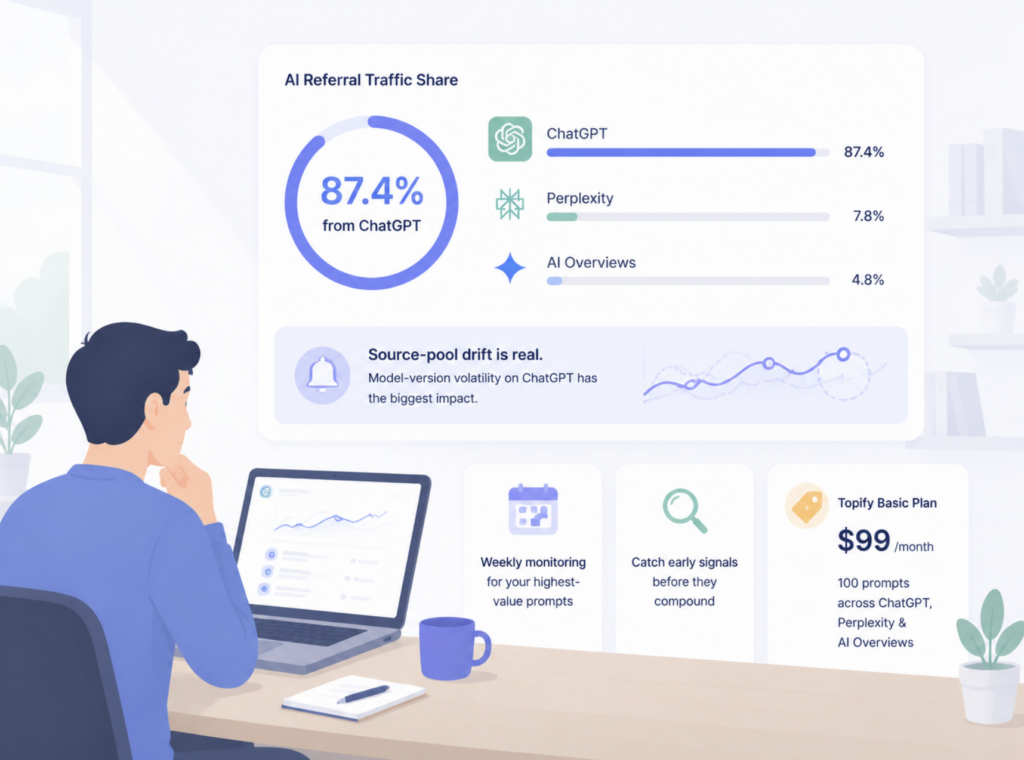
Watch for source-pool drift. ChatGPT drives 87.4% of all AI referral traffic. Model-version volatility on ChatGPT specifically has outsized impact on overall AI search visibility. Set up weekly monitoring for your highest-value prompts during the post-launch window. Topify’s platform starts at $99/month for the Basic plan, which covers 100 prompts across ChatGPT, Perplexity, and AI Overviews, enough to catch the early signals before they compound.
Build for multiple retrieval depths. The reasoning-mode citation split means your content needs to be findable in both quick retrievals and deep research chains. That means structured data, clear entity signals, FAQ coverage for niche sub-queries, and presence on third-party authority platforms like G2, Reddit, and industry publications.
The brands that treat model updates as one-time events keep rebuilding their GEO strategy from scratch every 8 to 12 weeks. The ones that invest in continuous, tier-aware, cross-platform monitoring compound their visibility through each transition instead of losing it.
Conclusion
GPT-5.6 Sol’s token efficiency is a genuine technical advance. But for brands, the real story isn’t that ChatGPT generates shorter answers. It’s that the model now searches deeper, cites from a wider pool, and produces fundamentally different citation patterns depending on which reasoning tier answers the query.
The citation playbook has reset again. It won’t be the last time. The teams that win in this environment aren’t the ones chasing each model’s quirks. They’re the ones running continuous monitoring across platforms and tiers, diagnosing gaps in real time, and executing content changes inside the 2-to-4-week window before new patterns harden. Start tracking your brand’s AI visibility now so the next model update is an opportunity, not a surprise.
FAQ
Q: How does GPT 5.6 Sol’s token efficiency affect brand citations in ChatGPT?
A: Sol generates shorter, more precise answers using fewer output tokens. But its reasoning modes run more sub-queries behind the scenes, pulling from a wider pool of sources. The result is fewer mention slots per response but more total citation opportunities across the retrieval chain. Brands need to be present in both surface-level and sub-query results to maintain visibility.
Q: What’s the difference between GPT 5.6 Sol, Terra, and Luna for AI search visibility?
A: Sol powers ChatGPT’s advanced reasoning (medium, high, extra-high effort levels) for paid users. Terra is the balanced tier for everyday production traffic. Luna is the fastest and cheapest option. Each tier has different retrieval depth and citation behavior. Sol tends to cite more sources per response, while Luna and Instant modes produce leaner, third-party-heavy citations.
Q: How often should I check my brand’s AI citation data after a major model update?
A: During the first 30 days after a release like GPT-5.6, weekly at minimum, and every 48 hours for your highest-value prompts. After the window closes, biweekly or monthly tracking with drift alerts is typically enough to catch competitor moves and quiet model adjustments.
Q: Does GPT 5.6’s reasoning mode change which brands get recommended?
A: Yes. Research shows only 25.6% of cited domains overlap between minimal and high reasoning modes on the same prompts. Higher reasoning also lifts citation rates from 50% to 68% and nearly doubles average sources per response. A brand that’s visible in Instant mode can be absent in Thinking mode, and vice versa.

