

Your product ranks in the top three on Google for “best noise-canceling headphones under $150.” Your Google Ads budget is healthy. Your conversion rate has been steady for months. Then a shopper asks ChatGPT, “What are the best noise-canceling headphones for a $150 budget?” and gets a list of five products. Yours isn’t on it.
That gap between Google performance and AI recommendation is where e-commerce brands are quietly losing their highest-intent buyers. Traditional analytics can’t measure it because they weren’t built for a world where the purchase decision happens inside a conversation, not a search results page.
ChatGPT Is Already Your Customer’s Shopping Assistant
The shift from search to synthesis isn’t coming. It’s already here, and the numbers are hard to ignore. During the 2025 holiday season, traffic to retail sites from generative AI tools grew 693.4% year over year. Total online spending hit a record $257.8 billion, with more than $4 billion spent daily for nearly a month. But the path to those purchases looked nothing like the traditional Google-click-buy funnel.
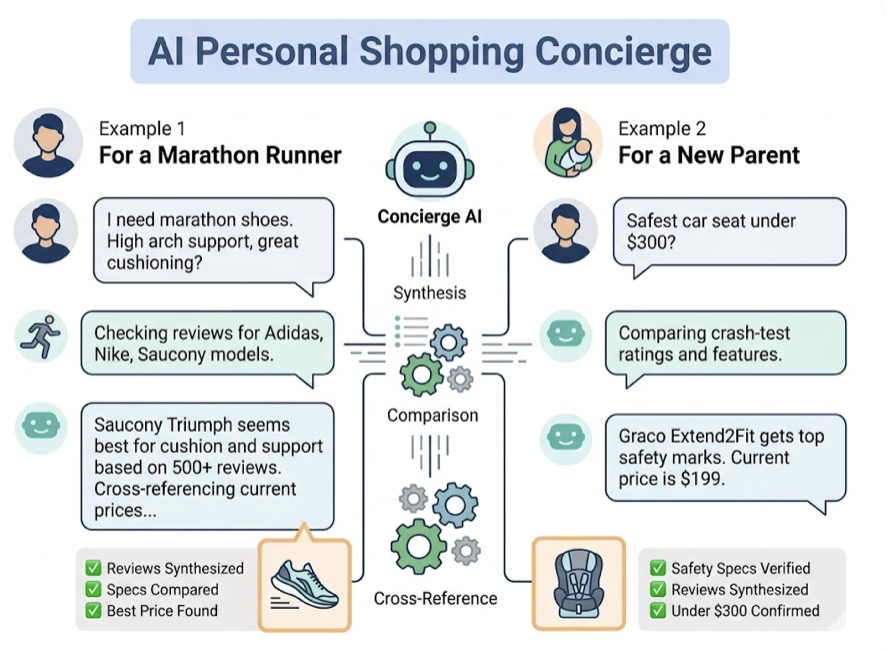
AI assistants are functioning as personal shopping concierges. A marathon runner asks for sneakers based on arch support and cushioning. A new parent asks for the safest car seat under $300. These aren’t keyword searches. They’re multi-turn conversations where the AI synthesizes reviews, compares specs, and cross-references prices before the shopper ever visits a product page.
The adoption curve is steep. ChatGPT reached 900 million weekly active users by early 2026, more than doubling from 400 million just a year earlier. Among households earning $150,000 to $200,000, AI has already overtaken Google as the starting point for product research. If your brand isn’t visible in these AI-generated answers, you’re excluded from the consideration set before a shopper ever reaches your site.
That’s the gap most e-commerce teams still can’t see.
What AI Visibility Tracking Actually Measures for E-commerce
Traditional SEO tracks how pages rank for keywords. AI visibility tracking measures something fundamentally different: how AI models synthesize and recommend your products as entities within a generated answer.
Think of it this way. Google ranks your product page. ChatGPT recommends your product. Those are two different systems with two different criteria, and being good at one doesn’t guarantee the other. Research shows that in 2024, roughly 70% of AI-cited sources ranked in the organic top 10. By 2026, that overlap has dropped to under 20%.
There’s also a critical distinction between mentions and citations. A mention means the AI names your product in its response. A citation is a clickable link back to your site, indicating the AI used your content as a source. Both matter, but citations drive the high-converting traffic. In the U.S. market, AI citation rates sit at approximately 10.31%, nearly three times higher than in non-U.S. markets. For global e-commerce brands, that geographic variation alone changes the optimization playbook.
4 Metrics That Determine Whether AI Recommends Your Product
Tracking AI visibility for e-commerce requires moving from keywords to prompts. Here are the four metrics that form the foundation.
Mention Rate: Are You in the Answer?
Mention Rate is the percentage of relevant shopping prompts where your brand appears. Because AI is probabilistic, it can give different answers to the same question in different sessions. The average brand has an AI visibility of about 0.3%, while top performers reach 12%. A single manual check tells you almost nothing. You need thousands of prompt simulations to get a statistically reliable baseline.
Recommendation Position: Where You Rank in the AI’s List
In a list of five product recommendations, being first carries far more weight than being fifth. AI responses typically mention only three to five brands, and the #1 ranked brand captures an average of 62% of total AI Share of Voice. The gap between first and third is typically 5x. In AI shopping, anything outside the top three risks total exclusion.
There’s a nuance worth noting in Google’s AI Overviews: Position 2 sometimes outperforms Position 1 in click-through rate (5.76% vs. 2.51%) because users skip the AI summary box to find the first organic link beneath it. Context matters.
Sentiment: What the AI Says About You
It’s not enough to be mentioned. What the AI says about your product shapes purchase decisions. If ChatGPT describes your premium headphones as a “budget option,” that’s a positioning problem no amount of Google Ads can fix.
Sentiment tracking goes beyond positive or negative. Smart e-commerce teams track what practitioners call “Sentiment Velocity,” the direction in which the AI’s opinion is trending. A downward shift in how the AI frames your pricing or reliability is a leading indicator of declining sales, often visible weeks before it shows up in your conversion data.
Source Attribution: Where the AI Gets Its Information
This is where things get tactical. Source attribution reveals exactly which URLs the AI is citing to justify its recommendations. And here’s the uncomfortable truth for e-commerce brands: third-party citations are 6.5 times more likely to influence AI models than content from a brand’s own domain. Between 82% and 85% of AI citations come from external sources like Reddit, YouTube, and review platforms.
If a competitor is winning a product recommendation because ChatGPT is pulling from a specific Reddit thread, you need to know that. Not next quarter. Now.
How to Set Up AI Visibility Tracking for Your Product Catalog
Getting started with ai visibility tracking doesn’t require rebuilding your entire marketing stack. But it does require a different approach than traditional SEO monitoring.
Step 1: Map your high-value prompts. Forget keywords. Think in full conversational queries: “best eco-friendly yoga mat for hot yoga under $80” or “wireless earbuds for running that don’t fall out.” The average AI query is 23 words long, packed with specific constraints. Topify‘s High-Value Prompt Discovery identifies these prompts at scale and scores them using an Opportunity Score that weighs AI query volume, visibility gaps where competitors appear but you don’t, commercial intent signals, and your existing content readiness.
AI Prompts Researcher
Step 2: Track across platforms, not just ChatGPT. Brand representation is highly fragmented across AI models. Perplexity pulls roughly 46.7% of its top citations from Reddit. Gemini prioritizes pages that already rank well in traditional Google search. A brand dominating ChatGPT can be completely invisible on Perplexity. That’s not noise. That’s a strategic blind spot that single-platform monitoring will never catch.
Step 3: Establish baselines and monitor continuously. AI responses shift as training data and retrieval indexes update. Research shows that only about 30% of brands maintain consistent visibility across multiple regenerations of the same query. A two-week audit cycle is the minimum cadence to detect meaningful changes. Topify’s Visibility Tracking automates this by simulating thousands of prompt variations across ChatGPT, Perplexity, Gemini, DeepSeek, and other platforms, scoring each appearance across seven metrics: visibility, sentiment, position, volume, mentions, intent, and CVR.
What Gets Your Product Recommended by ChatGPT
AI models don’t rank pages based on backlinks the way Google does. They prioritize content they can confidently extract, summarize, and cite. Research from Princeton and Georgia Tech found that content incorporating authoritative citations, direct quotes, and relevant statistics achieved 30-40% higher visibility in generative responses.
For e-commerce brands, this translates into a few concrete requirements. Answer-first structure means putting your core product value proposition in the first two to three sentences of any content block. Structured data through Product, FAQ, and Organization schemas gives AI models machine-readable signals to work with. And factual density, specific numbers, specs, and comparisons, outperforms marketing fluff every time.
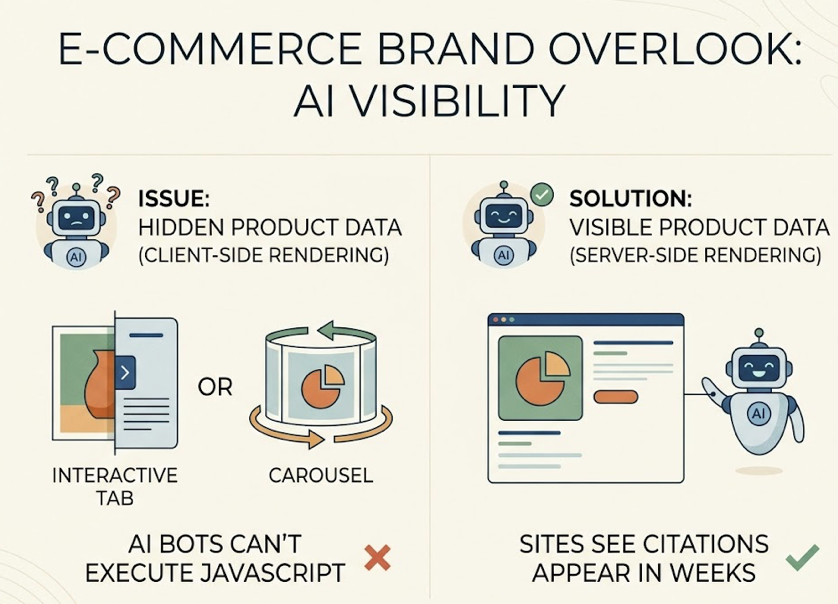
There’s a technical layer most e-commerce brands overlook. AI bots generally don’t execute JavaScript. If your product information lives behind a client-side rendered carousel or interactive tab, it’s invisible to the AI. Sites that switch to server-side rendering often see citations appear within weeks. And many brands are inadvertently blocking AI crawlers through default CDN settings. Cloudflare recently changed its defaults to block AI bots, meaning you need to manually verify your “AI Crawl Metrics.”
The trust layer matters too. AI tools describe the absence of a verified review profile as a “warning sign.” A brand can increase its citation rate from 1% to over 75% simply by actively gathering and responding to customer reviews on platforms like Trustpilot. Review sites are now the #2 citation source for AI systems, accounting for 14% of all citations.
Real Scenario: A DTC Brand Discovers Its AI Blind Spot
Consider a mid-sized DTC brand selling ergonomic office furniture. The brand ranks in the top three for “best standing desk” on Google. Strong domain authority. Solid backlink profile. But when a user asks ChatGPT, “I have chronic back pain, which standing desk should I buy for a home office?” the brand appears third, behind two competitors with lower organic rankings.
Using Topify’s Competitor Monitoring and Source Analysis, the brand identifies the root cause. ChatGPT is citing a specific Reddit community thread and a 2024 review from a niche health blog. The competitors have been mentioned across these third-party roundups. The DTC brand focused exclusively on its own site’s SEO and missed the third-party coverage entirely.
AI Competitor Analysis
The recovery plan was straightforward. First, they cleaned up entity disambiguation using Organization Schema, because the AI was confusing them with a similarly named, defunct furniture company. Second, they partnered with the niche health blog to update the 2024 review and published guest articles on authoritative sites addressing “ergonomic desks for back pain.” Third, they launched a campaign to secure 50+ new Trustpilot reviews that specifically mentioned lumbar benefits, improving their Sentiment Velocity.
Within four weeks, the brand moved to the #1 recommended spot for that high-intent prompt.
Conclusion
AI visibility tracking isn’t a future problem for e-commerce brands. It’s a current one. The data tells a clear story: AI-referred traffic converts at rates up to 5x higher than Google organic, and AI shopping volume is projected to reach $750 billion by 2028. The brands that act now, shifting from keywords to prompts, from page-level SEO to entity-level optimization, from owned-channel focus to third-party authority building, will be the ones AI recommends first.
The ones that don’t will keep wondering why their Google rankings look fine but their revenue growth has stalled.
FAQ
What is AI visibility tracking for e-commerce? It’s the systematic monitoring of how, where, and why an e-commerce brand’s products appear in AI-generated answers across platforms like ChatGPT, Gemini, and Perplexity. It focuses on brand mentions, citation frequency, recommendation position, and sentiment.
How do I check if ChatGPT recommends my product? You can perform manual queries for your brand and category, but for statistically reliable data, you’ll need to use a tracking platform like Topify that simulates thousands of prompts to account for the probabilistic nature of AI responses.
What’s the difference between SEO and AI visibility tracking? SEO ranks pages based on keywords, backlinks, and domain authority. AI visibility tracking measures how AI models synthesize and recommend entities and facts based on structural clarity, content authority, and third-party citations.
How often should e-commerce brands monitor AI recommendations? A two-week audit cycle is the minimum to detect the impact of content updates. For high-volume brands or during product launches, real-time monitoring of sentiment shifts and competitor movements is necessary.
Why is my product ranking #1 on Google but not recommended by AI? Common causes include JavaScript rendering that AI bots can’t parse, a lack of third-party coverage on platforms the AI trusts like Reddit and review sites, or entity confusion where the AI associates your brand name with a different company.

